The Case for Investing in America
Chapter 1
America Has Always Been the Bet
Why Pessimism About America Is the Most Expensive Mistake in Financial History
A merchant in Philadelphia in the spring of 1814 had every reason to sell everything.
The British had burned the Capitol. The Treasury was empty. The currency was a rumor backed by hope. Banks were failing in clusters, and the men who ran them spoke openly about whether the young country could survive its second decade, let alone its second war with the world's most powerful navy. If that merchant had set aside a thousand dollars and bought into the few American enterprises that were still trading — a bank here, a turnpike there, an early textile concern — his neighbors would have called him reckless. They had a word for people who bet on a burning country.
They called them fools.
We know how the story ends. The merchant's descendants, had they simply held and reinvested, would today control a fortune large enough to lose track of. The neighbors who sold, who took the safe path, who waited for certainty — they preserved their thousand dollars and watched it dissolve into nothing across two centuries of inflation. The fool won. The fool always wins, eventually, because the fool understood something the cautious man did not: a temporary catastrophe is not a permanent verdict.
This is the oldest pattern in American finance, and almost nobody learns it in time.
THE NUMBERS THAT OUGHT TO CHANGE YOUR LIFE
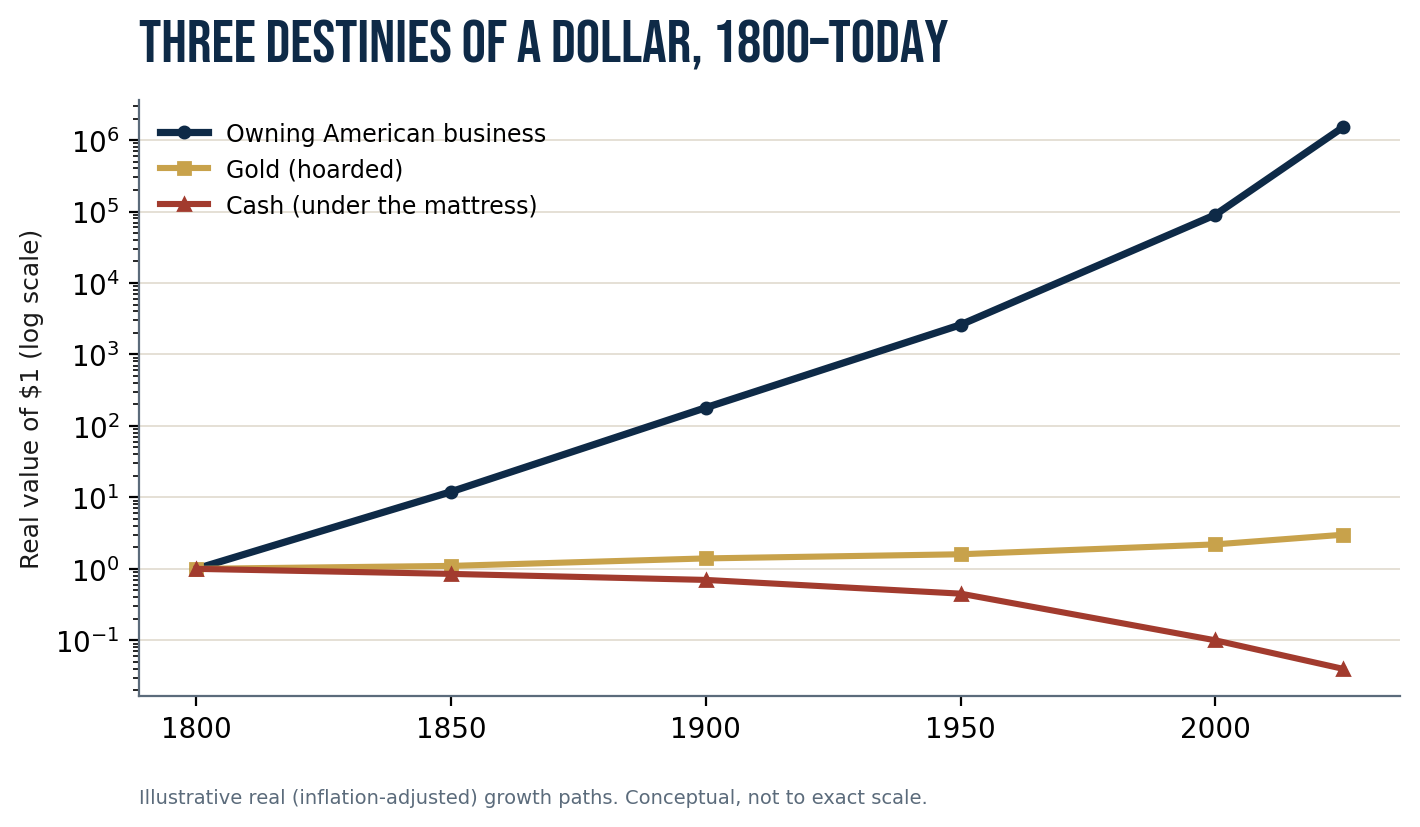
Figure 1.1 — Three destinies of a dollar, 1800 to today.
Let me put the case plainly before I argue it.
A single dollar invested in a broad basket of American stocks in 1800, with dividends reinvested and left utterly alone, would be worth millions of dollars today in real, inflation-adjusted terms. Not nominal dollars — real purchasing power. The same dollar held as gold would have roughly kept pace with prices and bought you about the same loaf of bread. The same dollar stuffed under a mattress would have lost nearly all its value to the slow theft of inflation.
The gap between those three outcomes — the patient owner of American enterprise, the hoarder of metal, the keeper of cash — is the gap between generational wealth and generational regret. And the entire difference comes down to a single decision made over and over again: did you stay invested in the productive machinery of this country, or did you flinch?
I want you to sit with how strange this is. Over the same two hundred years, the United States endured a civil war that killed three-quarters of a million people. It survived the near-total collapse of its banking system more than once. It lived through a depression so severe that a quarter of the workforce stood idle. It fought two world wars, a cold war, and a dozen smaller ones. It watched its stock market lose half its value, or more, on at least a dozen separate occasions. It suffered assassinations, oil shocks, stagflation, terrorist attacks, a financial crisis that nearly took down the global banking system, and a pandemic that shut the entire economy in a single month.
Through every one of those catastrophes, the patient owner of American business came out ahead. Not by a little. By an amount so large it strains belief.
That is the thesis of this book, and I will spend the rest of it proving the mechanism behind it. But you should know the conclusion now, because everything else depends on you believing it in your bones: *America has always been the bet, and the people who refused to make it have always paid the highest price of all.*
EVERY GENERATION GETS ITS REASON TO QUIT
Here is the part that almost nobody tells you. The pessimist is never obviously wrong in the moment. The pessimist always has a case.
In the 1840s, the case was that the country would tear itself apart over slavery, and a divided nation could not sustain a market. The pessimist was right about the war and wrong about the market.
In the 1890s, the case was that the railroads had overbuilt, the banks were rotten, and the gold standard was strangling growth. The Panic of 1893 wiped out fortunes. The pessimist was right about the panic and wrong about the recovery.
In 1932, the case was the most persuasive it has ever been. The market had fallen by nearly ninety percent from its peak. Banks had vanished. The pessimist said capitalism itself was finished, and millions of intelligent people agreed with him. He was right about the suffering and catastrophically wrong about what came next, which was the single greatest expansion of wealth and productive capacity in the history of the species.
In 1979, a famous magazine cover declared the death of equities. Inflation was eating everything. Stocks had gone nowhere for over a decade. The pessimist said the age of owning American business was over. He published this opinion roughly at the start of the longest, most powerful bull market the country had yet seen.
In 2009, with the financial system on life support and the headlines using words like "depression" without irony, the pessimist said the American century was finished and the future belonged to someone else. The decade that followed produced one of the longest economic expansions on record.
Do you see the pattern? It is not that the pessimist is stupid. The pessimist is often the smartest person in the room, armed with the best data, making the most sophisticated argument. The pessimist's problem is not intelligence. It is a category error. He mistakes a storm for the climate. He looks at the worst moment and assumes it is the permanent condition, when in fact it is the temporary condition that creates the next opportunity.
The optimist, meanwhile, is frequently mocked as naive. But the optimist about America has been right for two hundred and fifty years running. At some point, a forecast that has been correct for two and a half centuries stops being naivety and starts being wisdom.
WHY "THIS TIME IT'S DIFFERENT" IS THE MOST EXPENSIVE PHRASE EVER SPOKEN
There is a sentence that has cost investors more money than any other. It is uttered with great seriousness at the bottom of every crisis, by people who genuinely believe it.
This time it's different.
This time the debt is too high. This time the politics are too broken. This time the competitor — Japan in the eighties, China in the two-thousands — is too strong. This time the technology has changed the rules. This time the old playbook won't work.
I want to be fair to this sentence, because dismissing it cheaply would make me exactly the kind of glib optimist I just warned you about. Sometimes things genuinely are different. The world does change. Empires do decline. There is no law of physics that guarantees American prosperity forever, and anyone who tells you otherwise is selling you a fairy tale.
But here is what the historical record actually shows. In every single instance over two hundred and fifty years where investors said "this time it's different" and acted on it by abandoning American enterprise, they were wrong. Every time. The thing that made America's economy grow — its capacity to absorb shocks, reinvent its industries, attract talent, and convert crisis into renewal — was more durable than any individual threat to it.
The debt was supposedly fatal in 1790, when it consumed forty percent of the entire economy. It wasn't. Japan was supposedly going to own the future in 1989, when its companies were buying American landmarks and its stock market dwarfed New York's. It didn't; Japan entered a thirty-year stagnation while America innovated its way into the digital age. The internet was supposedly a bubble with no substance in 2000. The bubble burst, the substance remained, and the substance went on to build the most valuable companies the world has ever seen.
"This time it's different" is not always wrong about the problem. It is almost always wrong about the country's ability to solve it.
THE INVISIBLE ENGINE
So what is the mechanism? Why does this keep happening? Why does America keep converting its disasters into fuel?
I will spend entire chapters on the components — the innovation premium, the demographic dividend, the reserve currency, the depth of the institutions. But let me give you the one-sentence version now, because it is the spine of everything that follows.
The American economy is not a thing. It is a process. It is a self-renewing system that destroys its weakest parts and reinvests the proceeds into its strongest ones, faster and more ruthlessly than any economy in history. A buggy-whip maker goes bankrupt; the capital and the workers flow to the automobile plant. The automobile plant stagnates; the capital flows to the software company. The software company matures; the capital flows to the artificial intelligence lab. Nothing is sacred. Nothing is protected. The system is brutal to individual companies and magnificent for the whole.
This is why owning the whole — the entire productive engine of the country, rather than any single piece of it — has been the closest thing to a sure bet that the financial world has ever produced. You are not betting on one company surviving. You are betting on the process of renewal surviving. And that process has survived everything thrown at it for two and a half centuries.
When you understand this, the crashes stop looking like threats and start looking like what they actually are: the system doing its job, clearing out the dead wood, repricing assets, and setting up the next expansion. The crash is not the failure of the engine. The crash is the engine.
WHAT THE OPTIMIST ACTUALLY OWNS
Let me sharpen the distinction, because "optimism" is a word that gets thrown around loosely, and I do not want you to mistake my argument for the cheerful, evidence-free boosterism that gives optimism a bad name.
The optimist I am describing does not believe America is perfect. He does not believe its government is wise, its politics functional, or its people uniformly virtuous. He has read the same headlines you have. He knows about the dysfunction, the division, the debt, the decline narratives that fill every news cycle. The optimism I am defending is not a belief that nothing is wrong. It is a belief about what happens to things that go wrong in an economy structured like America's.
In a brittle system, a problem festers until it brings down the whole. In a self-renewing system, a problem becomes an opportunity for someone to profit by solving it, and the profit motive recruits the country's best talent and deepest capital to the solution. That is the entire difference. The optimist about America is not betting that problems won't arise. He is betting on the country's machinery for converting problems into solutions — a machinery that has, demonstrably, outlasted every individual problem thrown at it.
Consider what this machinery has actually digested. It absorbed the abolition of an entire labor system that the southern economy was built on, fought a war over it, and emerged within a few decades into the most rapid industrialization the world had ever seen. It absorbed waves of immigration so large that nativists in every generation predicted they would destroy the country, and turned each wave into a source of labor, talent, and demand that powered the next expansion. It absorbed the transition from an agricultural economy to an industrial one, and then from an industrial one to a digital one, shedding millions of obsolete jobs and creating millions of new ones in the churn. Each of these transitions was wrenching. Each produced real losers and real suffering. And each, at the level of the whole economy, ended in greater wealth and capacity than before.
To own American enterprise is to own a stake in that machinery of conversion. You are not buying a promise that the road will be smooth. You are buying the most reliable problem-solving engine in economic history, and betting — on the strength of two and a half centuries of evidence — that it will keep solving problems faster than new ones can sink it.
THE SEDUCTION OF THE SIDELINES
There is a particular trap I need to warn you about now, because it will tempt you more than any other, and it disguises itself as prudence.
The trap is the decision to wait. Not to sell in a panic — you would never do something so crude — but simply to wait for things to settle down before you commit. Wait for the election to pass. Wait for the recession everyone is predicting to arrive and clear. Wait for valuations to look more reasonable. Wait for the obvious crisis on the horizon to resolve itself one way or the other. Then, once the picture is clear, you will invest with confidence.
This sounds like wisdom. It is, in fact, one of the most expensive mistakes available to you, and it is expensive precisely because it never feels like a mistake. The person who waits never gets a dramatic moment of loss. He simply gets a quiet, invisible, ever-growing gap between where his money is and where it could have been.
Here is why the trap is so deadly. The picture is never clear. There has not been a single year in the last two and a half centuries where a thoughtful person could not have constructed a compelling case for waiting. There was always an election, a war, a bubble, a debt crisis, a political dysfunction, a foreign threat, a valuation that looked stretched. The clarity you are waiting for does not arrive, because the absence of visible threats is not a real state of the world — it is just the temporary condition where the threats haven't made the headlines yet.
And while you wait for a clarity that never comes, the engine keeps running. The dividends keep getting paid and reinvested. The companies keep growing their earnings. The compounding keeps compounding — for everyone except you, because you are on the sidelines, waiting for a signal that the market does not send.
The cost of being wrong by being invested through a downturn is real but recoverable; history shows the patient owner gets it back and more. The cost of being wrong by waiting is silent and permanent, because you can never go back and capture the years of growth you sat out. Time in the engine, not timing of the engine, is what builds the fortune. The sidelines feel safe. They are the most expensive seat in the house.
THE MOST EXPENSIVE EMOTION
If the logic is this clear, why doesn't everyone simply buy American enterprise and hold it forever?
Because logic is not the obstacle. Emotion is.
The human brain did not evolve to hold assets through a fifty percent decline. It evolved to run from danger, and a collapsing portfolio registers in the oldest parts of the mind as danger — a predator, a cliff, a fire. Every instinct screams sell, preserve, flee. The investors who lose are almost never the ones who picked the wrong companies. They are the ones who picked the right companies and then sold them at the bottom, transforming a temporary paper loss into a permanent real one.
The fortune in this country has never gone to the cleverest. It has gone to the calmest. It has gone to the people who could look at a burning Capitol, a failing bank, a screaming headline, and recognize the difference between a storm and the end of the world.
That calm is not a personality trait you are born with. It is a discipline you build, and the foundation of that discipline is understanding — knowing, in your bones, why the bet on America has always paid, so that when the storm comes, you are not gambling on faith. You are acting on evidence.
This book is that evidence.
THE PLEDGE
I am going to ask something of you before you turn to the next chapter. Not money. Not yet. Just a posture.
I am going to ask you to entertain the possibility that the most rational thing you can do with your financial life is also the simplest, and that the simplicity is exactly why it works. To own a piece of the most productive economic machine ever assembled, and to refuse — refuse — to be shaken loose from it by the noise of any given year.
The merchant in 1814 did not have a name for this discipline. He just had nerve. You have something better. You have two hundred and fifty years of evidence that the nerve was justified.
The neighbors who called him a fool are forgotten. Their thousand dollars is dust. His descendants are still compounding.
Choose which story is yours. Then turn the page, and let me show you exactly how the engine was built — starting with the man who designed it, broke at his desk, scribbling the financial blueprint of a nation that did not yet know it was about to become the richest in history.