Risk and Reward
Chapter 18
The Perfect Portfolio
“It is better to be vaguely right than exactly wrong.”
– CARVETH READ
WHEN ORVILLE WRIGHT was in first grade, he would often tinker with
pieces of wood at his desk. His first-grade teacher once asked what he was up to. Wright told her he was designing a machine that he and his brother, Wilbur, would use to fly someday. She patted him on the head and smiled politely. Little did she know.
Just five people showed up to watch the Wright brothers take their legendary flight on December 17, 1903 in Kitty Hawk, NC. The Flyer contained two propellers positioned between the wings. It rode on skids that were launched on a single wooden track that acted much like railroad tracks. The wire used to make the wings came from the same material used to make the Brooklyn Bridge. They used some cloth to cover the wings. There was a tiny one-gallon gas tank. Total time in the air on the first successful attempt was estimated at just 12 seconds. On the fourth try, they made it nearly a half mile for a one-minute flight. Their grade school dream became a reality.
Before taking that groundbreaking first flight, the Wright brothers conducted hundreds of test runs. Over four years, they faced skepticism, harsh weather, difficult conditions, injuries, remote locations, and plenty of crashes. While Wilbur and Orville had confidence in their design, they always brought reinforcements in case things didn’t go as planned. They carried extra parts for their flyers – not due to a lack of faith in their piloting or building skills, but because they knew setbacks were inevitable. The
spare parts served as a backup plan to ensure they could keep moving forward in the event things went wrong.
That’s not to say they weren’t risk-takers. Wilbur once stated, “If one were looking for perfect safety, one would do well to sit on the fence and watch the birds. But if you really wish to learn, you must mount a machine and become acquainted with its tricks by actual trial.” They simply had a plan for managing the risks they were taking because they knew crashes were going to happen. Call it risk management. Call it hope for the best but plan for the worst. Call it a hedge. The Wright Brothers were practicing diversification. To make it to the long term (flying an airplane) they had to survive the short term (the occasional crash).
Diversification comes at a cost – there are no guarantees. You never know when it will be necessary. All those extra parts could have been a waste of time, money and valuable storage space for the Wright brothers. But they knew it was wise to avoid putting all of your planes in one basket, so to speak.
The same is true of your portfolio. Spreading your bets does not guarantee better results. In fact, it guarantees you will always have something in your portfolio that underperforms and causes consternation. In the 1970s movie Love Story, Ali MacGraw plays Jennifer Cavilleri, who is dying of cancer. In a classic line MacGraw tells Oliver Barrett, played by Ryan O’Neal, “Love means never having to say you’re sorry.” The opposite is true of diversification. Financial writer Brian Portnoy once observed, “Diversification means always having to say you’re sorry.”
If you could predict the future there would be no reason to diversify, but no one has a crystal ball that tells you what comes next in the markets. Legendary investor John Templeton once said, “The only investors who shouldn’t diversify are those who are right 100% of the time.” Investing involves trade-offs. Diversification is about giving up the ability to hit a home run so you don’t strike out at the plate. It’s about accepting good enough returns to avoid the potential for terrible returns at an inopportune time. Diversification is not undefeated, but it’s never gotten blown out either.
The lost decade
Indeed, the S&P 500 went nowhere in the first decade of the 21st century. It
was a terrible, horrible, no good, very bad decade. Recall from Figure 17.1 in the last chapter there were plenty of other asset classes and strategies that picked up the slack during the lost decade from 2000 to 2009. While the S&P 500 went nowhere, there were gains to be had in small caps, emerging markets, bonds, REITs, mid caps and more.
If you had all of your money in the S&P 500 it was a painful decade to say the least. If you held a diversified basket of investment strategies and asset classes, you weathered one of the worst decades in U.S. stock market history.
Now, in Figure 18.1, let’s take a look at what happened in the decade after the lost decade for stocks.
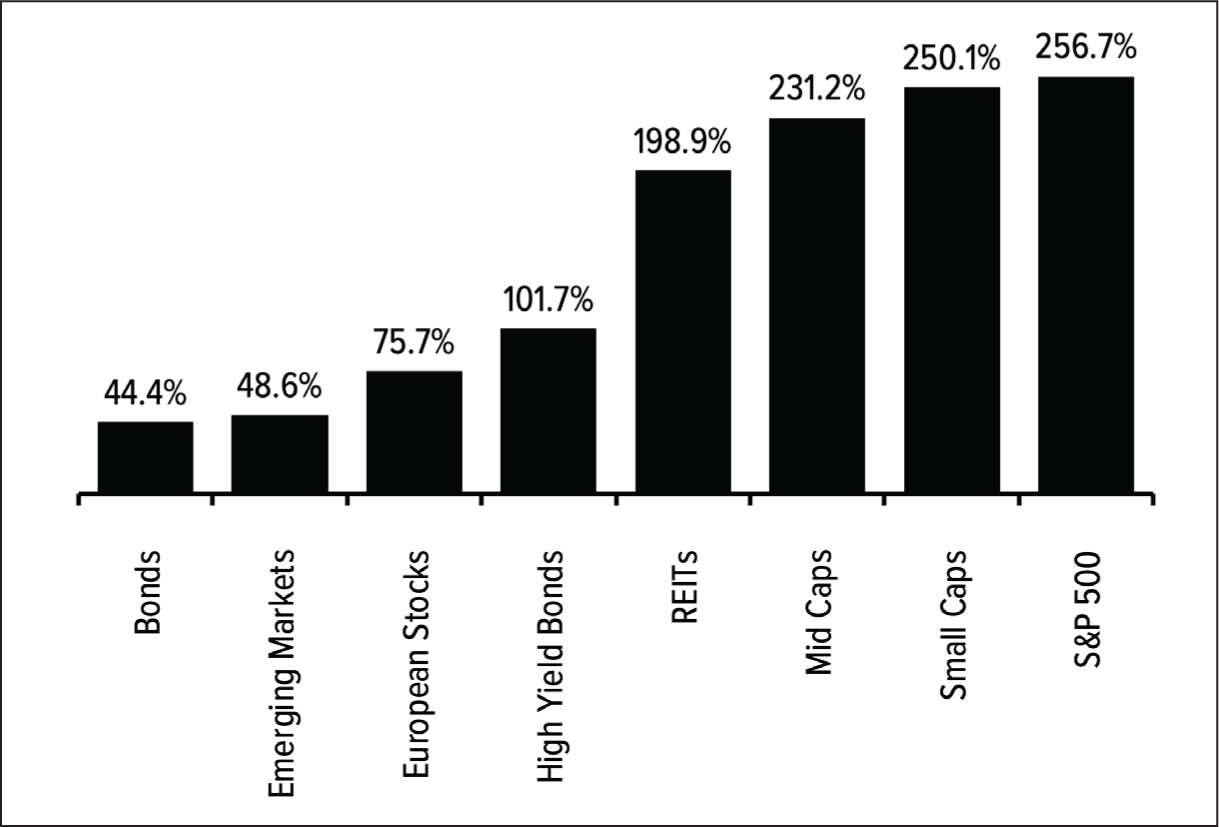
The S&P 500 went from worst to first. The cycle flipped. Many of the asset classes that outperformed in the 2000s went on to underperform in the 2010s. Some asset classes did well in both cycles. These relationships don’t always work out so neatly, but the beauty of diversification is that it frees you from needing to predict the winners or losers in advance by taking the extremes off the table.
It’s the decades that matter
The cycles aren’t always quite as extreme as what investors experienced at the outset of the 21st century. Still, a similar dynamic exists when looking at the returns for different country stock markets around the globe – the winners and losers are constantly changing. Take a look at returns for developed country stock markets by decade going back to the 1970s, as shown in Table 18.1.
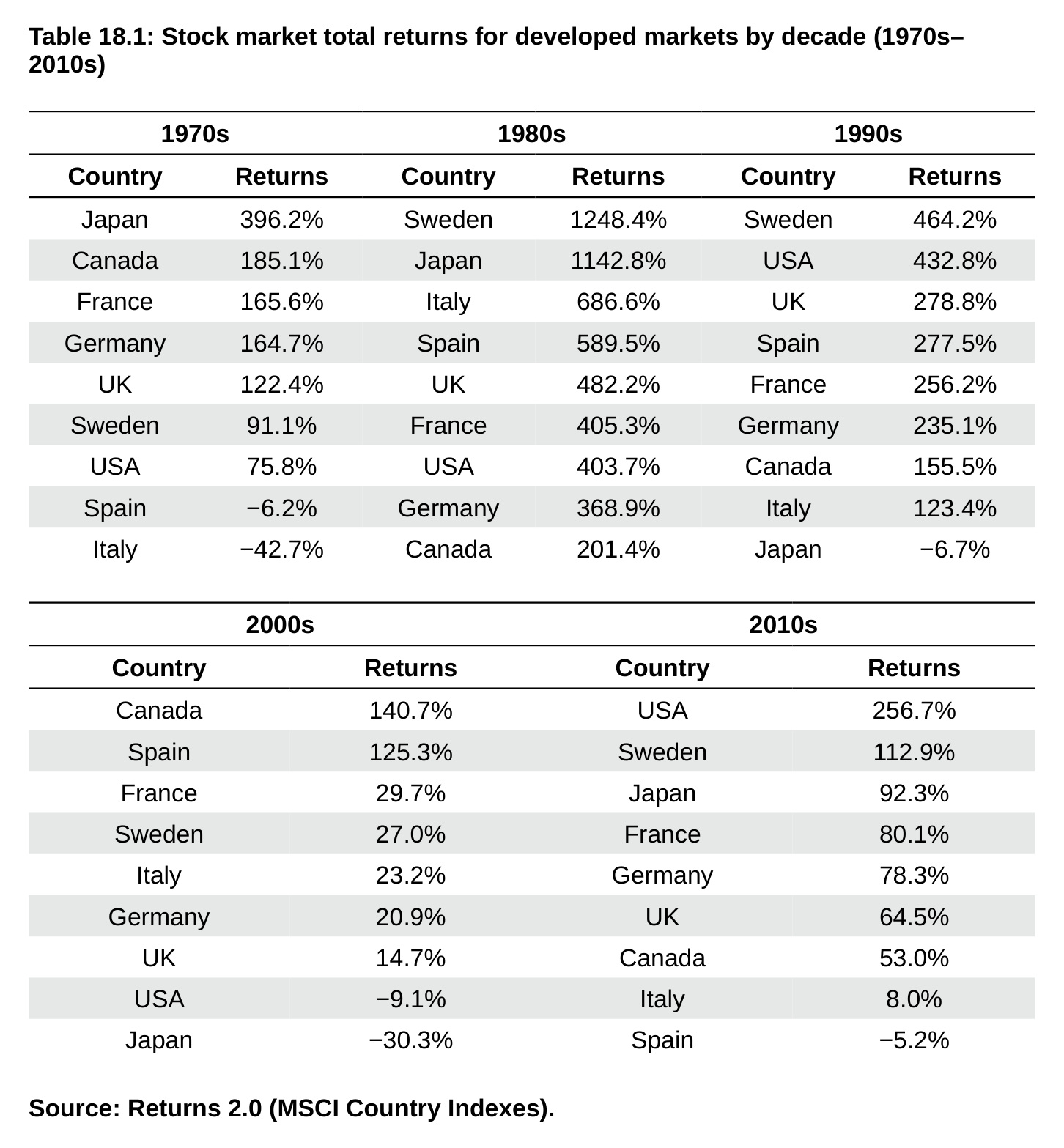
Table 18.1: Stock market total returns for developed markets by decade (1970s– 2010s) 1970s 1980s 1990s Country Returns Country Returns Country Returns Japan 396.2% Sweden 1248.4% Sweden 464.2% Canada 185.1% Japan 1142.8% USA 432.8% France 165.6% Italy 686.6% UK 278.8% Germany 164.7% Spain 589.5% Spain 277.5% UK 122.4% UK 482.2% France 256.2% Sweden 91.1% France 405.3% Germany 235.1% USA 75.8% USA 403.7% Canada 155.5% Spain −6.2% Germany 368.9% Italy 123.4% Italy −42.7% Canada 201.4% Japan −6.7% 2000s 2010s Country Returns Country Returns Canada 140.7% USA 256.7% Spain 125.3% Sweden 112.9% France 29.7% Japan 92.3% Sweden 27.0% France 80.1% Italy 23.2% Germany 78.3% Germany 20.9% UK 64.5% UK 14.7% Canada 53.0% USA −9.1% Italy 8.0% Japan −30.3% Spain −5.2% Source: Returns 2.0 (MSCI Country Indexes).
Every decade, there have been big winners and big losers, with wide spreads between the winning and losing countries. The United States was near the bottom of the pack in the 1970s, 1980s and 2000s. America was one of the best-performing stock markets in the 1990s and 2010s. Pick any country on this list, and you’ll find no rhyme or reason for the order in a given decade, save for the fact that no country wins or loses all the time.
Diversification is one of the best forms of risk management because it helps you avoid the extremes. Yes, that means you’ll never be fully invested in the best performer, but it also means you’ll never be fully exposed to the worst performer either. Diversification is a survival strategy. It might not protect you against bad years or even bad cycles. What it’s meant to do is protect you against terrible decades. Every country has them.
Even the United States.
The best stocks of all time
Being diversified opens you up to surprising winners too. Peter Bernstein once observed, “I view diversification not only as a survival strategy but as an aggressive strategy, because the next windfall might come from a surprising place.” This is true when it comes to owning the best stocks in the market as well. Diversification is important because the number of winning stocks over the long haul is much smaller than you think.
Hendrik Bessembinder’s groundbreaking work on historical stock market returns found that just 86 companies accounted for half of all the gains in the stock market since 1926. All of the wealth created in the stock market can be attributed to around one thousand of the top-performing stocks, which is just 4% of the total. Nearly 60% of stocks failed to beat T-bill returns over their lives, while the rest barely beat a cash position.*
The biggest winners are all household names – Apple, Amazon, Exxon, Google, Walmart, Berkshire Hathaway, Johnson & Johnson, to name a few. Some people look at this data and assume it means you should just pick the best-performing stocks.
I look at this data and assume you have no chance of consistently picking those huge winners that fall into the 4% club. So you let the market pick those winners for you and own stocks via index funds to cast a wide net. This is not a sexy strategy, but it’s effective.
No one knows where the big winners are going to come from. Holding concentrated positions in the stock market gives you the opportunity to outperform by a wide margin, but also increases your chances of
underperforming by a wide margin. If you miss out on just a handful of the big winners you might be out of luck.
The perfect portfolio
Cartoonist Randy Glasbergen has a single-frame comic of two gentlemen sitting in a wealth management office. The client probes his advisor, “Explain to me why enjoying life when I retire is more important than enjoying life now.”
This cartoon perfectly encapsulates the conflict that occupies nearly every financial decision you make in life. The essence of successful investing, retirement planning and life in general is balance. You have to plan for the future but live in the present. You have to enjoy the moment but prepare for old age. You have to invest for the long run but survive the short run. It’s difficult to balance enjoying life now and ensuring you have the resources to enjoy life later.
There is no ideal balance for everyone because we all have different goals, needs, resources, expectations, and desires. The hardest part about planning for your financial future is the simple fact that you don’t know what will happen. No one has it all figured out because no one knows the various curve balls life is going to throw at them. So you do the best you can. That’s true when you build a portfolio too.
Vanguard founder, the late Jack Bogle, is the godfather of long-term investing. His simple yet effective investing philosophy boils down to keeping costs low and staying the course. Bogle’s own portfolio was split evenly between stocks and bonds. When asked about his feelings on owning a 50/50 portfolio, Bogle admitted, “I spend about half of my time wondering why I have so much in stocks, and about half wondering why I have so little.”
That’s diversification for you. When creating a durable portfolio, you try to balance the following questions:
What happens if I’m right? What happens if I’m wrong?
Harry Markowitz was the creator of Modern Portfolio Theory (MPT).
Markowitz won a Nobel Prize for his work on the subject, which was the first mathematical theory used to allocate a portfolio among different asset classes based on mean-variance analysis.
That’s a lot of big words and finance-speak but, essentially, the idea is to combine assets with different levels of volatility to create a portfolio that optimizes return for a given level of risk. There is a decent amount of math involved in the process, but the hope is by combining assets that act differently at different times you can create a smoother ride in your portfolio. At least that’s the theory.
In plain English: diversification and asset allocation. So did Markowitz himself go through all of the calculations in the mean-variance analysis to create the optimal portfolio on the efficient frontier with his own money? Nope. When The Wall Street Journal’s Jason Zweig asked him how he allocated his portfolio, Markowitz admitted:
I should have computed the historical co-variances of the asset classes and drawn an efficient frontier. Instead, I visualized my grief if the stock market went way up and I wasn’t in it – or if it went way down and I was completely in it. My intention was to minimize my future regret. So I split my contributions 50/50 between bonds and equities.*
Each of these titans in the finance industry could have used all sorts of fancy models to create a portfolio. Instead, they used some old-fashioned common sense and simple diversification.
I know what you’re thinking.
Surely there is an optimal portfolio that will allow you to maximize your returns and minimize your risk, right? The perfect portfolio has to be out there somewhere. Someone has the ability to create a strategy that allows you to enjoy all of the upside with none of the downside, own the winners and avoid the loser and limit volatility. Where’s the Holy Grail?
Alas, there is no such thing as a perfect portfolio. It only exists with the benefit of hindsight. The best you can do is find the strategy that balances the following:
Your risk profile. What is your willingness, need and ability to take risk? What is your perception of risk in the markets and how does it change? Your time horizon. When are you going to spend the money? How long will your assets be invested for? Your current circumstances. Where do you stand right now in terms of your finances? How will your financial circumstances change going forward? Your goals. Where do you want to be in the future? What is the point of the money you are investing? Your emotional disposition. How do you react to fear and greed? What is your relationship with emotionally charged financial decisions?
The right asset allocation – your mix of stocks, bonds, cash and other investments – is the one that offers you a high probability of achieving your goals while balancing out the potential emotional strain from gains, losses and unexpected events. Jerry Seinfeld once told Howard Stern, “Your blessing in life is when you find the torture you’re comfortable with.”
That’s investing. It can be absolute torture at times, but there is no way around it.
George Carlin had a bit in his stand-up routine where he observed, “Have you ever noticed when you’re driving that anyone who’s driving slower than you is an idiot and anyone driving faster than you is a maniac?”
You have to figure out the right speed for your investments. The true perfect portfolio is the one you can stick with come hell or high water. And perfect is the enemy of good. The good strategy you can stick with is decidedly better than the perfect strategy you can’t stick with.
In the Conclusion of the book, let’s summarize what we’ve learned so far and walk through a list of ways to lose money along with my tried-and-true investment beliefs.