The Case for Investing in America
Chapter 3
Crashes, Wars, and Comebacks
How America Turned Every Catastrophe Into a Catalyst
There is a number I want to give you before I tell you a single story, because everything in this chapter is really just an elaboration of it.
If you had invested in a broad basket of American business at the worst possible moment before each of the major market crashes of the last century — buying at the very peak, the instant before the collapse, with the timing of a cursed man — you would still have made an enormous amount of money over the decades that followed. The crashes, in other words, did not destroy the long-term investor. They merely tested him. The ones who failed the test failed not because the market fell, but because they sold when it did.
This is the most counterintuitive truth in all of investing, and the entire history of American crises is the proof. Catastrophe, in this country, has not been the enemy of wealth. It has been its raw material.
Let me show you how that works, decade by bloody decade.
THE PANICS THAT BUILT THE PLUMBING
The nineteenth century was a slaughterhouse of financial crises. There was a major panic roughly every twenty years — 1819, 1837, 1857, 1873, 1893 — each one wiping out banks, businesses, and the savings of people who thought they had been careful. To live through them was to experience genuine ruin. Fortunes vanished. Families were destroyed. The suffering was real, and I do not want to wave it away with the easy confidence of someone reading about it two centuries later.
But watch what each crisis built on its way out.
The Panic of 1837 and the long depression that followed exposed how fragile the patchwork of state-chartered banks and wildcat currencies really was. The pain created the political will, eventually, for a more coherent banking and monetary system. The Panic of 1873, triggered by overbuilding in the railroads, washed out the weakest railroad companies — and the survivors, having absorbed their failed competitors' track and rolling stock at fire-sale prices, emerged as the great trunk lines that knit the continent into a single market. The Panic of 1893, the worst of the century, did the same on a larger scale: it consolidated a chaotic, overbuilt industry into a smaller number of stronger enterprises that would dominate the coming decades.
This is the pattern in its rawest form. A boom builds too much. A crash destroys the excess. The strong absorb the assets of the weak at pennies on the dollar. And the economy emerges leaner, more concentrated, and more powerful than before. The crash is not a malfunction of the system. The crash is the system clearing its throat.
The Panic of 1907 deserves a special mention, because of what it produced. The crisis was so severe that it took the personal intervention of a single banker, J.P. Morgan, locking financiers in his library until they agreed to backstop the system, to halt the collapse. The country looked at this and drew a sober conclusion: no nation should depend on one mortal man being alive and willing to save it. Out of the wreckage of 1907 came the impetus for a permanent central bank — the Federal Reserve, established in 1913. The catastrophe wrote the institution.
THE DECADE THAT SHOULD HAVE ENDED EVERYTHING
And then came the one that makes all the others look small.
Between 1929 and 1932, the American stock market lost nearly ninety percent of its value. Read that again. Not nineteen percent. Nearly ninety. If you had a dollar in the market at the peak, you had roughly a dime at the bottom. Thousands of banks failed, taking the savings of ordinary depositors with them, because there was as yet no insurance on those deposits. Unemployment reached a quarter of the workforce. In the worst-hit places, it was higher still. Men who had been prosperous sold apples on street corners. The suffering was not metaphorical; people went hungry, lost their homes, and died of it.
This is the moment when the pessimist's case was strongest in all of American history. Serious, intelligent people — not cranks — concluded that capitalism itself had failed, that the American experiment in self-renewing markets was finished, that the future belonged to some other system entirely. You cannot call them stupid for thinking so. The evidence in front of their eyes was overwhelming.
They were wrong. And the manner in which they were wrong is the single most important lesson in this book.
Because look at what the catastrophe of the 1930s actually built. It built deposit insurance, so that an ordinary person's savings would never again simply vanish when a bank failed. It built securities regulation and disclosure requirements, so that the games and frauds that had inflated the bubble could be policed. It built the entire architecture of investor protection that makes the modern American market the most trusted in the world. The worst financial decade in the country's history did not destroy American capitalism. It upgraded it. It stripped out the rot, installed the safeguards, and laid the foundation for what came next.
And what came next was the greatest expansion of productive capacity and broad-based wealth that any nation had ever experienced.
THE FORGE OF WAR
The instrument of that expansion was, of all things, the Second World War — which brings me to the strangest and most uncomfortable truth in this chapter.
War is catastrophe in its purest form. There is no sanitizing it, no investor's silver lining that could possibly outweigh the human cost. I want to be clear about that before I make the analytical point, because the analytical point can sound monstrous if you forget the cost.
The analytical point is this: the industrial mobilization required to win the Second World War transformed the United States into the dominant economic power on earth, and it did so by a mechanism that no peacetime policy could have achieved. To arm itself and its allies, America built factories at a scale never before imagined. It pulled millions of people, including millions of women, into the industrial workforce. It accelerated technologies — aviation, electronics, materials, computation, medicine — by years or decades. And when the war ended, all of that capacity, all of those trained workers, all of those new technologies, did not vanish. They turned to peace. The factories that had built bombers built refrigerators and automobiles. The research that had built radar and the atomic age built the entire postwar technological economy.
By 1945, the rest of the industrialized world lay in ruins. Europe was rubble. Asia was rubble. America's industrial base was not only intact but vastly expanded, and it stood essentially alone as the workshop of the planet. The investor who had held American enterprise through the depression and the war — through the worst decade and the worst conflict in modern history — now owned a piece of the only major economy left standing, at the dawn of its greatest boom.
Catastrophe in, catalyst out. Again.
THE CRISIS THAT TAUGHT PATIENCE
There is one more episode I want to put in front of you, because it is the crisis people forget, and forgetting it is dangerous.
The 1970s were not a crash in the dramatic sense. There was no single terrible day, no library full of bankers, no breadlines. Instead there was something slower and, for the investor, almost more demoralizing: a decade where it felt like nothing worked. Inflation roared, eating away the value of money even as it sat in your account. Oil shocks doubled and redoubled the price of energy. The stock market, in nominal terms, went essentially nowhere for years — and once you accounted for the inflation, the patient owner of American business watched the real value of his holdings erode across an entire decade.
This is a crueler test than a crash, in a way. A crash is over quickly; the pain is sharp and then it ebbs. The stagnation of the 1970s was a long, grinding disappointment that tempted investors to conclude, reasonably, that the whole proposition had stopped working. Near the end of it, a famous magazine cover pronounced equities dead. The case it made was not stupid. For more than a decade, owning American business had genuinely not paid.
And then it did. The investor who held through the long disappointment of the 1970s — who endured the years where the strategy seemed broken — was positioned at the start of the 1980s for one of the most powerful and sustained bull markets the country had ever produced. The disappointment was not the end of the story. It was the setup. The magazine that declared equities dead published its obituary almost exactly at the moment of resurrection.
I include this because the crashes, dramatic as they are, can actually be easier to endure than the long stretches where the engine seems to have simply stalled. A crash at least gives you a clear enemy and a clear bottom. Stagnation gives you only doubt, stretched across years, slowly wearing down your conviction. The investor who understands American history is armored against both — but it is the second test, the slow one, that quietly defeats more people than the first.
THE MODERN PROOF
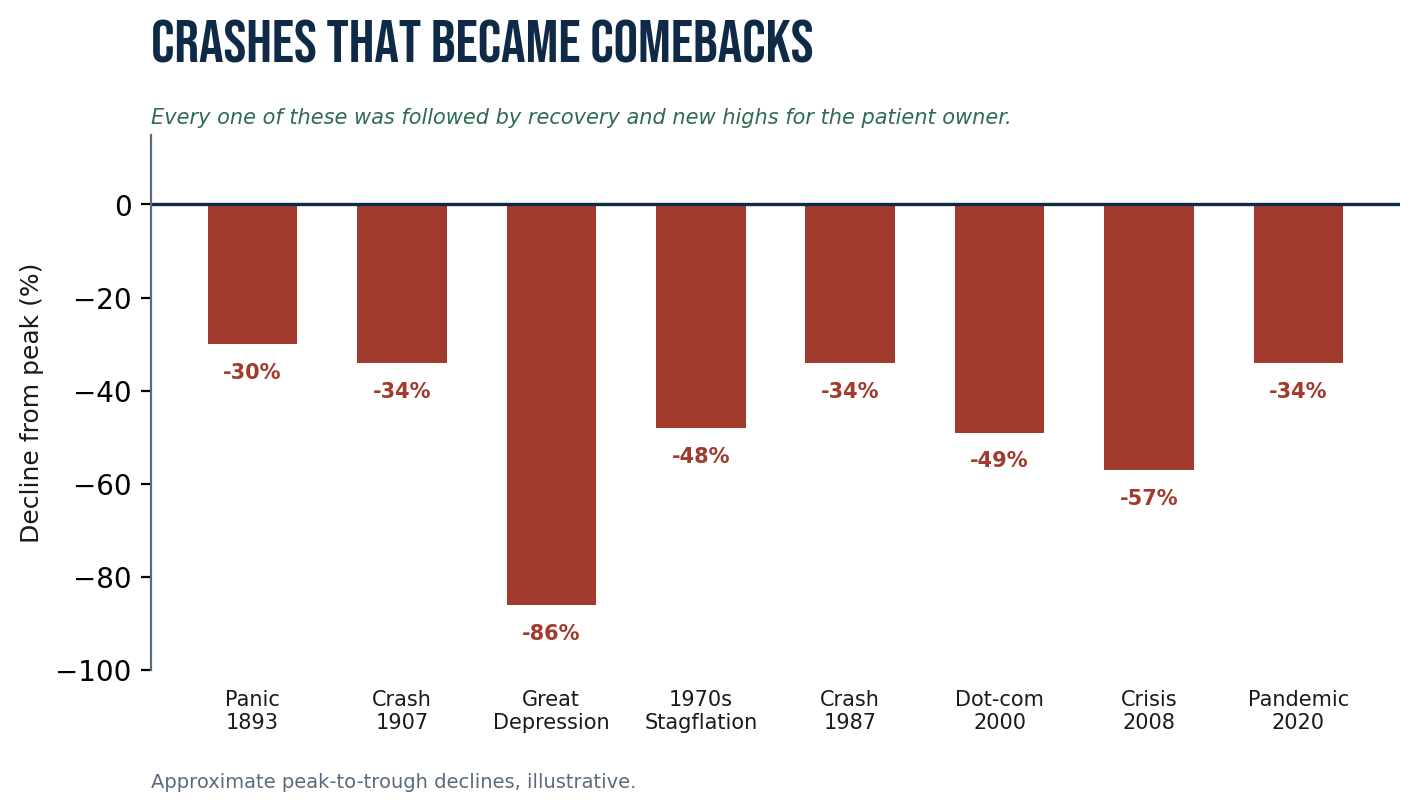
Figure 3.1 — Crashes that became comebacks.
You might be tempted to think this is all ancient history, that the great crises of the past were somehow different, that the modern, sophisticated economy doesn't work this way anymore.
So let me bring it up to the present, with the crisis you probably remember.
In the autumn of 2008, the global financial system came closer to total collapse than at any time since the 1930s. Storied institutions failed in a matter of days. Credit, the lifeblood of the entire economy, simply stopped flowing. The stock market lost more than half its value from peak to trough. Respectable commentators used the word "depression" without quotation marks. People watched their retirement accounts shrink by forty or fifty percent and felt the floor giving way beneath them. The pessimist's case was, once again, deeply persuasive: the American model of finance had broken, the era of American economic leadership was ending, and the smart money was getting out.
The investor who acted on that case — who sold at the bottom, who fled to cash, who waited for the "all clear" that never rings a bell — locked in catastrophic losses and missed what followed. Because what followed, beginning in 2009, was one of the longest economic expansions and one of the most powerful bull markets in the entire history of the country. The patient owner who simply held through the terror, who refused to be shaken loose, did not merely recover. He went on to multiply his wealth many times over in the decade that followed.
The same script ran, in fast-forward, in early 2020. A pandemic shut the entire economy in the space of a single month. The market fell with breathtaking speed. And then, faster than almost anyone predicted, it recovered and surged to new highs, as the economy adapted, innovated, and reopened. The investor who panicked in March missed the recovery by summer.
Two crises in a single generation, separated by little more than a decade, and the lesson was identical both times. The crash was real. The pain was real. And the patient owner of American enterprise came out the other side richer than before, while the panic-seller converted a temporary decline into a permanent loss.
THE HEADLINE IS NOT THE ECONOMY
Before I give you the mechanism, I want to address the thing that actually does the damage during every one of these episodes, because it is not the crash itself. It is the coverage of the crash.
During a crisis, the information reaching you is systematically distorted in a direction that encourages exactly the wrong behavior. This is not a conspiracy; it is structural. Fear commands attention, and attention is what the entire apparatus of news is built to capture. A headline that says "the worst may be over, hold your position" does not get read. A headline that says "experts warn of total collapse" gets read by millions. So the information environment during a crash is not a neutral picture of reality. It is a megaphone for the most frightening interpretation available, amplified precisely when your emotions are least equipped to discount it.
This matters enormously for the investor, because it means the intensity of your fear during a crash is not a reliable signal about the actual danger. The fear is partly manufactured — not falsely, the crisis is real, but amplified by an information system optimized to maximize alarm. The investor who does not understand this mistakes the volume of the alarm for the magnitude of the threat, and sells into the noise.
The discipline, then, is not to ignore the news. It is to recalibrate it — to remember, in the middle of the storm, that what you are hearing is the loudest possible version of the worst possible interpretation, and that the loudest version has been wrong, as a guide to long-term action, in every American crisis on record. The headline is describing the storm. You are an owner of the climate. Those are not the same thing, and confusing them has cost more investors more money than any actual economic event.
WHY THE PATTERN HOLDS
I have given you the stories. Now let me give you the reason, so that you understand it as mechanism and not as faith.
The pattern holds because of everything we discussed in the last chapter. The American economy is a self-renewing system bolted to solid legal ground. When a crisis hits, three things happen, reliably, every time. The weak and overextended parts of the economy are destroyed — painfully, but cleanly. The assets they leave behind, the factories and patents and skilled workers and customer bases, do not evaporate; they are absorbed by stronger hands at bargain prices. And the crisis itself usually exposes some structural flaw, which the country then fixes, emerging with better institutions than it had before.
Destruction, absorption, reform. That is the engine of the American comeback, and it has run on schedule through every catastrophe for two hundred and fifty years.
This is why a crash should not frighten the long-term owner of American business. A crash is the system performing its most essential function — repricing assets, clearing out excess, and setting the stage for the next expansion. The investor who understands this does not merely survive crashes. He recognizes them, eventually, as the moments when the patient and the calm quietly take ownership of the future from the frightened and the impatient.
THE TIMELINE OF FEAR
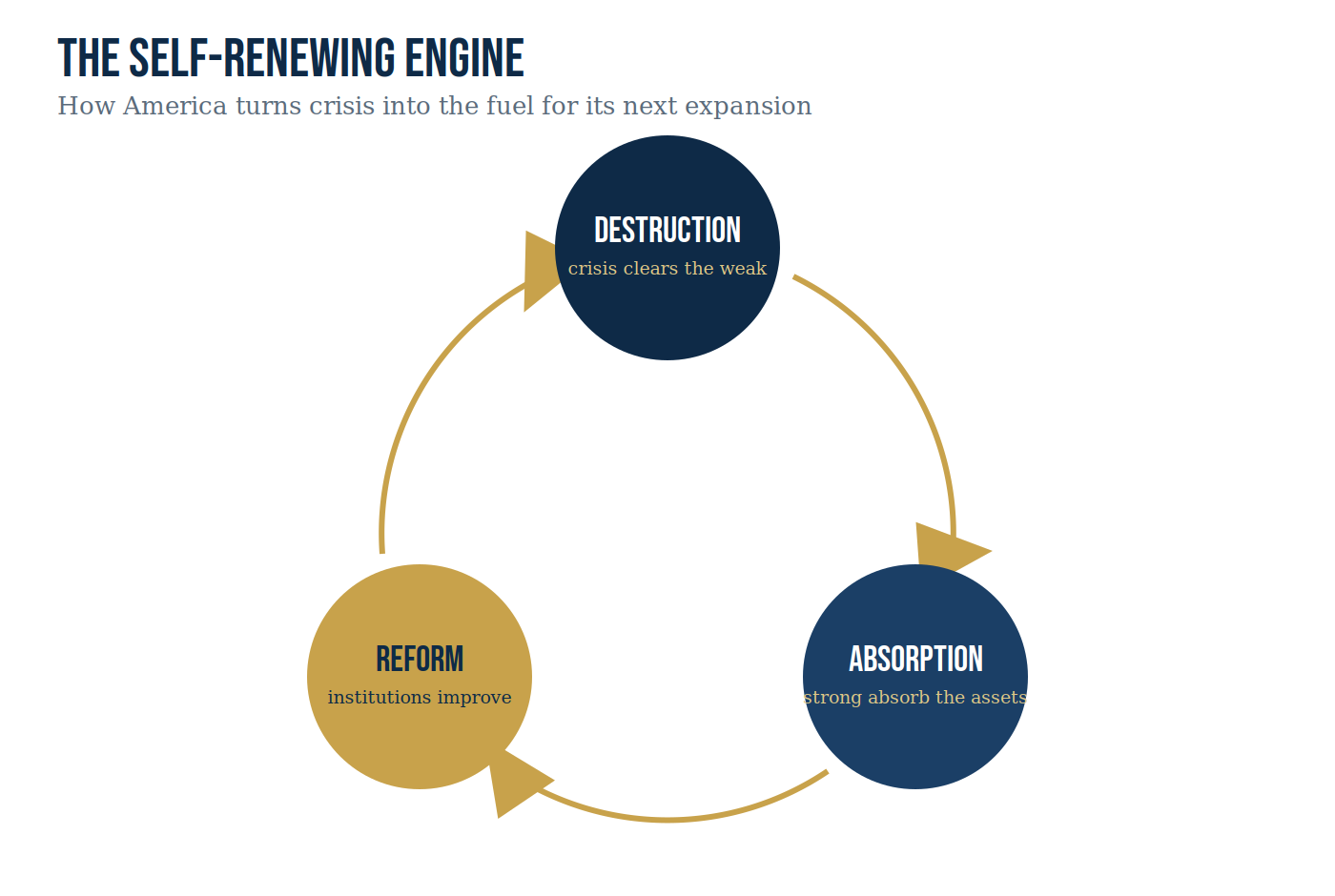
Figure 3.2 — The self-renewing engine.
If you were to draw the entire history of American markets as a single line, from 1800 to today, you would see something remarkable. Zoom in on any individual year and you might see terror — a crash, a panic, a war, a collapse. The line would look jagged, violent, frightening. You would understand completely why people sold.
But zoom out to the full two and a half centuries, and all of that terror compresses into tiny dips on a line that climbs, relentlessly, from the bottom left to the top right. Every panic that ruined fortunes becomes a barely visible notch. Every crash that ended careers becomes a momentary stumble in a staircase that never stops climbing.
That is the difference between the trader's view and the owner's view. The trader lives inside the jagged terror of the individual year. The owner stands back and sees the staircase. And the staircase has only ever gone one direction over any horizon long enough to matter.
The crises are not the exception to the story of American wealth. They are how the story of American wealth gets written — chapter by violent chapter, each catastrophe clearing the ground for the next ascent.
We have seen how the engine survives its worst days. Now let us look at what actually powers it on the good ones. Because the comebacks would not be possible without the thing America has never, in two hundred and fifty years, stopped doing: inventing the future.