The Case for Investing in America
Chapter 4
The American Innovation Premium
Why the U.S. Has Never Stopped Inventing the Future
There is a way to read the entire economic history of the United States as a single sentence, and the sentence is this: every time the world changed, the change tended to be invented, financed, or scaled in America first.
The steam age. The age of rails. The age of steel and oil. The age of electricity. The age of the automobile. The age of flight. The age of the transistor. The age of the personal computer. The age of the internet. And now, the age of the machine that thinks. Pick any technological revolution of the last two hundred years, and you will find America somewhere near its center — not always as the lone inventor, but almost always as the place where the invention was turned into an industry, an industry into a fortune, and a fortune into the seed capital for the next revolution.
This is the engine beneath the engine. In the last chapter, I argued that America's genius is converting catastrophe into renewal. But renewal toward what? The answer is innovation. When the old industry dies in a crash, the capital does not sit idle. It flows toward the next thing being invented. And in America, there has always been a next thing being invented, because the country built itself, from the founding, into a machine for producing the future.
When you invest in American enterprise, this is what you are really buying. Not steel, not oil, not software. You are buying a claim on human ingenuity, compounded across centuries. That claim has a name, and I call it the innovation premium.
THE PATTERN THAT SHOULD REFRAME HOW YOU SEE THE MARKET
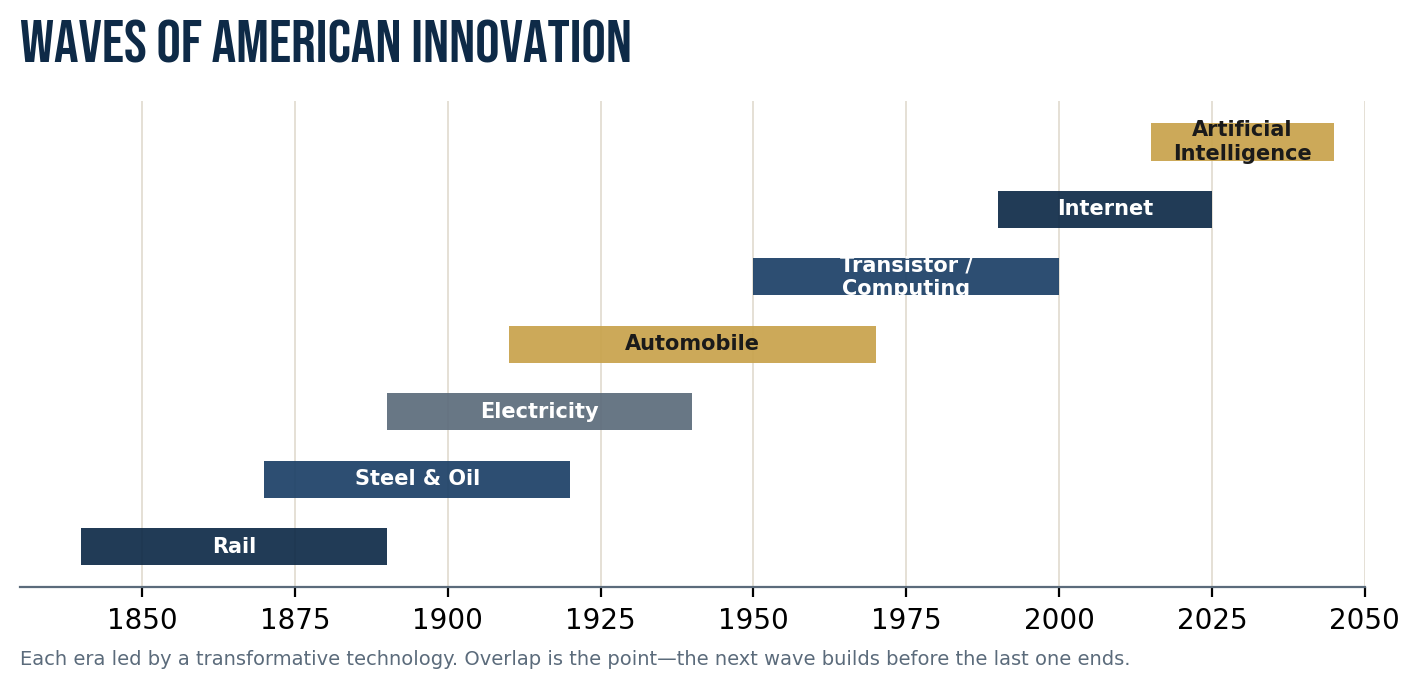
Figure 4.1 — Waves of American innovation.
Let me make the pattern concrete, because abstractions about "innovation" are cheap and I want you to feel the weight of the thing.
In the middle of the nineteenth century, the transformative technology was the railroad. It was the internet of its day — a network that collapsed distance, knit a continent into a single market, and made fortunes for the people who built and financed it. The railroad boom drew enormous capital, created vast new companies, and, inevitably, overbuilt itself into a spectacular crash. But when the dust settled, the country was permanently transformed. Goods, people, and information moved at speeds previously unimaginable. The railroad did not just create railroad wealth. It created the conditions for the next wave — national brands, national markets, the modern corporation itself.
Then came steel and oil, which built the physical body of the industrial economy. Then electricity, which is so fundamental that we forget it was once a wild new technology, lighting cities and powering factories and creating entire industries that had no precedent. Then the automobile, which did to the twentieth century what the railroad did to the nineteenth — reorganized where people lived, how they worked, what they bought, and minted a new generation of industrial giants.
And here is the part I want you to notice. At each stage, the same skeptics made the same argument. The new thing is a bubble. The valuations are insane. The technology is overhyped. And at each stage, they were partly right — there was usually a bubble, there usually was overhyped nonsense, and a great deal of money was lost on the specific companies that failed. But the technology was real, and the technology kept transforming the economy long after the bubble's froth had been skimmed off. The railroad bubble burst; the railroads remained. The dot-com bubble burst; the internet remained, and went on to build the most valuable companies in the history of the world.
The lesson is not that bubbles don't exist. They do. The lesson is that in America, the underlying current of innovation has been so powerful and so persistent that it has carried the patient owner of the whole economy through every individual bubble and bust, to higher ground every single time.
WHY HERE? THE QUESTION THAT ACTUALLY MATTERS
It is one thing to observe that America keeps inventing the future. It is another to understand why, and the why is what tells you whether the pattern will continue.
Innovation is not magic and it is not luck. It is the predictable output of a particular set of conditions, and America assembled those conditions more completely than any society in history. Let me name them, because if you understand the inputs, you can judge for yourself whether they are still in place.
The first input is the rule of law and property rights we discussed two chapters ago. An inventor will only invest years of his life in a new idea if he is confident he will own the reward. A financier will only fund a risky venture if he is confident the contracts will be honored and his stake protected. Strip away that confidence and innovation simply does not happen, no matter how brilliant the population. America's legal foundation is the soil in which innovation grows.
The second input is capital — and specifically, capital that is willing to take risks. This is where America's deep, liquid financial markets become a competitive weapon rather than just a convenience. A new idea needs money before it earns money. In most of history and most of the world, that money was scarce, conservative, and reserved for the well-connected. America built, over two centuries, the deepest pool of risk-tolerant capital the world has ever seen — money actively hunting for the next transformative idea, willing to lose it all on nine ventures for the chance to fund the tenth that changes everything.
The third input is a culture that does not punish failure the way most cultures do. This sounds soft, but it is profoundly economic. In many societies, a failed business is a permanent stain, a shame that ends a career. In America, failure has long been treated as tuition — the cost of learning, a credential rather than a disqualification. The entrepreneur who fails and tries again is the rule, not the exception, and this tolerance for failure is what allows people to take the enormous risks that innovation requires. You cannot have breakthrough invention without breakthrough failure, because the two are the same activity viewed from different ends. America, more than anywhere, made it safe to fail and try again.
The fourth input is talent, and here America has played a card no other nation could match: it imports the world's best minds. We will spend the next chapter and more on demographics and immigration, but note it here. The country has, for most of its history, been a magnet for the ambitious, the restless, and the brilliant from every corner of the earth. It did not have to grow all its own genius. It attracted everyone else's.
Rule of law, deep risk capital, tolerance of failure, and a global magnet for talent. Those are the four inputs of the innovation premium. As long as they remain in place, the premium continues. That, and not patriotic faith, is the real basis for confidence in America's inventive future.
THE VENTURE MACHINE
I want to single out one of these inputs for special attention, because it is the most distinctively American and the least understood: the machinery for funding new ideas.
Most people, when they imagine how a great company gets built, imagine a brilliant founder and a good product. But between the idea and the company stands a problem that has defeated brilliant people throughout history: who pays for the years between the idea and the profit? A new enterprise consumes money long before it makes any. Someone has to fund that gap, knowing that most such ventures fail entirely.
America built an entire ecosystem to solve this problem — a system of risk financing that channels capital toward unproven ideas at a scale and with a sophistication unmatched anywhere else. The system is brutal and clear-eyed about the odds. It expects most of its bets to fail. It is structured around the mathematics of the rare, enormous winner that pays for all the losers many times over. And it has functioned as the country's innovation accelerator, turning a steady stream of ideas into the companies that define each era.
This matters to you as an investor for a specific reason. The great companies that dominate the market today did not appear from nowhere. They were funded, nurtured, and scaled by this machinery, often years before they reached the public markets you can invest in. When you own a broad slice of American enterprise, you are positioned downstream of the most productive innovation-funding system in history — capturing the public-market fruit of a private process that has been reliably producing world-changing companies for generations. You do not need to find the next giant yourself. You need only own the economy into which the giants keep being born.
THE GEOGRAPHY OF GENIUS
There is one more feature of the American innovation machine that deserves its own treatment, because it explains why the premium has been so persistent and so hard for other nations to copy. Innovation in America does not happen evenly across the map. It clusters.
Throughout the country's history, invention has concentrated in particular places at particular times — regions that became, for a generation or more, the gravitational center of a whole technological era. A place becomes known for a kind of work, and that reputation draws the talent, the capital, and the ambition that the work requires. The talent attracts more talent, because the brightest people want to be near other bright people working on the same frontier. The capital follows the talent. The successful companies spin off founders who start the next companies. Knowledge spills informally from person to person, firm to firm, in a way that cannot be bottled or exported. A self-reinforcing ecosystem forms, and once it forms, it is extraordinarily difficult for any rival region — at home or abroad — to replicate, because you cannot simply assemble the ingredients; they have to grow into one another over time.
This clustering is one of America's least appreciated and most durable advantages. Many nations have tried, deliberately and at great expense, to build their own versions of America's great innovation hubs, and most have struggled, because the thing they are trying to copy is not a set of buildings or subsidies but a living ecosystem of people, capital, and culture that took generations to form. The ecosystem is the moat. And for the investor, it means the innovation premium is not a fragile thing that could easily migrate elsewhere. It is rooted in places and networks that have compounded their advantages for decades and show no sign of being dislodged.
The deeper point is that the innovation premium is systemic, not accidental. It does not depend on any one genius or any one company. It emerges from a self-reinforcing system — the clusters, the capital, the culture, the talent magnet — that keeps producing new inventors and new companies even as the old ones rise and fall. This is exactly why owning the whole economy captures the premium so reliably. You are not betting on a person or a firm. You are betting on a system designed to keep generating people and firms, and that system has been running, and self-reinforcing, for two hundred years.
THE TRAP OF PICKING WINNERS
This brings me to a warning, because the innovation premium tempts people into exactly the wrong behavior.
When you understand that America keeps producing transformative companies, the natural instinct is to try to identify them in advance — to find the one stock that will be the next great winner and concentrate your wealth in it. This is the dream the financial media sells relentlessly, because the story of the person who put everything into the right company at the right time is irresistible.
It is also, for the overwhelming majority of investors, a path to underperformance and heartbreak. Here is the uncomfortable truth that the innovation story hides. For every transformative winner, there are dozens of plausible contenders that looked just as promising and failed. At the moment of investment, you usually cannot tell which is which — and neither can the professionals who do this full time. The history of innovation is littered with the corpses of companies that were the obvious future, right up until they weren't. Concentrating your wealth in your best guess is a bet not on American innovation but on your own forecasting ability, and that is a far worse bet.
The elegant solution is the one this entire book keeps returning to. You do not need to pick the winner. You need to own the field in which the winners emerge. When you hold a broad basket of American enterprise, the winners that do emerge are automatically captured, their growth pulling up the whole, while the failures fall away and cost you only their small slice. You get the upside of the innovation premium without making the impossible bet of identifying which specific company will deliver it. The premium is real. The skill required to capture it through stock-picking is largely an illusion. Owning the field dissolves the problem entirely.
THE CURRENT CHAPTER OF AN OLD STORY
I have been writing in the past tense, of railroads and steel and the internet, because the past is where the proof lives. But the entire point of the innovation premium is that it is not a historical artifact. It is a living process, and you are standing inside its newest chapter right now.
The transformative technology of this moment is artificial intelligence — machines that can increasingly perform cognitive work that was, until recently, the exclusive province of human minds. I am going to resist the temptation to make specific predictions about which companies will win or how exactly it will unfold, because that is precisely the forecasting game I just warned you against, and because anything specific I write will date badly. But I will make the structural observation, because the structural observation is the one that has held for two hundred years.
The same four inputs are present. The rule of law still protects the inventor and the investor. The deepest pool of risk capital in the world is pouring into the new technology, exactly as it poured into railroads and microchips before it. The culture still rewards the audacious attempt and forgives the failure. And the global magnet for talent is still pulling the world's best minds toward the work. Whatever artificial intelligence becomes, the conditions that have caused America to lead every prior technological revolution are operating on this one too.
There is, as always, froth. There are surely overvalued companies and overhyped claims, and some fortunes built on this wave will evaporate when the inevitable shakeout comes. The skeptics who say so are, as always, partly right. But the underlying transformation is real, and if the historical pattern holds — if America once again converts a wild new technology into a permanent expansion of its productive capacity — then the patient owner of the whole American economy will capture that expansion, just as his predecessors captured every wave before it.
And waiting beyond artificial intelligence are the technologies whose names we barely know yet — in biology, in energy, in materials, in the machines we will send beyond the earth. The innovation premium is not a bet on any one of them. It is a bet that the machine which produced all the previous ones is still running. The evidence that it is still running is overwhelming.
WHAT YOU ARE ACTUALLY BUYING
Let me close by returning to the claim I made at the start, because now you can see its full weight.
When you invest in American enterprise, the return you earn is, at its root, a return on human ingenuity. The dividends, the earnings growth, the rising value of your stake — strip away the financial language and what remains is people inventing better ways to do things, building companies around those better ways, and creating value that did not exist before. That is what innovation is, economically: the creation of new value from new ideas. And the long upward march of American markets is, more than anything else, the financial signature of two and a half centuries of relentless invention.
This is why the innovation premium is the deepest source of the returns we have been discussing. The crashes test you. The institutions protect you. But the innovation is what actually grows the pie — what makes the staircase climb rather than merely wobble in place. America has never stopped inventing the future. As long as that remains true, the patient owner of American enterprise is positioned to capture the value of every future yet to be invented.
We have seen the engine of invention. Now we turn to a different kind of advantage — one that operates not in the laboratory but in the global financial system itself, and that quietly tilts the playing field in favor of every American investor. We turn to the dollar.