The Case for Investing in America
Chapter 9
The Sectors That Built American Wealth
A 250-Year Tour of the Industries That Never Stopped Paying
If you could travel back through the history of the American market and watch it grow, you would notice something that the broad story of "the economy always rises" tends to obscure. The rise was never uniform. At any given moment, the growth was concentrated — driven by particular industries that were, for their era, the beating heart of the whole. The economy advanced, but it advanced in waves, each wave led by a different sector that captured the spirit and the capital of its age.
Understanding these waves is more than a history lesson. It teaches you how American wealth is actually built — not evenly across some abstract "market," but sector by sector, as each industry has its era of dominance, throws off enormous returns, matures, and hands the lead to whatever comes next. The investor who understands this rhythm sees the market not as a single undifferentiated thing but as a succession of engines, each one roaring to life as the previous one settles into maturity.
This chapter is a tour through those engines — the great sectors that have powered American wealth across two and a half centuries — and an attempt to understand the rhythm well enough to think clearly about where the next wave may build. Not to pick winners, which we have established is a fool's errand, but to understand the pattern, so that the broad ownership we keep advocating is owned with comprehension rather than blind faith.
ENERGY: THE SECTOR THAT FUNDS CIVILIZATION
Begin with energy, because energy is the sector beneath all the others. Nothing in an economy happens without it. Every factory, every vehicle, every home, every computer runs on energy, and the story of American energy is the story of the American economy's physical foundation.
The American energy story has moved through distinct eras, and the movement itself is instructive. There was the age when older fuels powered an earlier economy, then the great age of petroleum that fueled the industrial century — the oil that ran the automobiles, the factories, the ships, and the armies, and that minted some of the largest fortunes in the nation's history. Petroleum did not just power the economy; for a century it was among the most important investment sectors in the country, throwing off vast returns to those who owned the companies that found, refined, and distributed it.
And now energy is moving again, into a new era whose ultimate shape is still being determined, as new sources and technologies reshape how the country and the world will be powered for the century ahead. I am not going to predict the winners of this transition, because that is the forecasting game. But the structural point holds across every era: energy is the sector that funds civilization, the demand for it is as close to permanent as any demand can be, and the American companies that supply it have been central to the country's wealth from the beginning and will remain so, whatever form the energy itself takes. The fuel changes. The centrality of the sector does not.
FINANCE: HOW AMERICA BECAME THE WORLD'S BANKER
The second great engine is finance, and we have already seen its origins in the chapter on the founding. Hamilton's machinery of credit and markets did not just stabilize a young nation; it planted the seed of what would become the most powerful financial sector in the world.
Finance occupies a special place among the sectors because it is, in a sense, the circulatory system of all the others. Finance is how capital moves from where it is to where it is most productively needed — from savers to builders, from the past to the future, from the mature industries throwing off cash to the young industries hungry for it. A great financial sector is what allows an economy to fund its own growth efficiently, and America built the greatest financial sector in history, the machinery that channels the world's capital toward its most productive uses faster and more reliably than anywhere else.
For the investor, finance has been one of the most rewarding sectors over the long sweep of American history, precisely because it captures a slice of all the growth flowing through it. When the broad economy grows, finance grows with it, because finance is the toll-taker on the flow of capital that growth requires. Finance also has its eras and its cycles — and it is, as we have seen in the crises, a sector that can amplify both booms and busts, which makes it both powerful and volatile. But across the full sweep, the rise of American finance from Hamilton's modest beginnings to the deepest capital markets on earth has been one of the central stories of American wealth, and the sector remains a core engine of the whole.
INDUSTRY AND THE LONG ARC OF TRANSFORMATION
The third engine is industry itself — the making of physical things — and its story across American history is the clearest illustration of the rhythm of sector waves.
There was an era when American wealth was overwhelmingly about industrial production: steel, machinery, manufactured goods, the physical output that made America the workshop of the world, especially in the decades when the rest of the industrial world had been flattened by war and America stood alone as the producer for the planet. The great industrial companies of that era were the titans of the market, and owning them was owning the muscle of the economy.
Then the rhythm shifted, as it always does. The pure industrial era gave way to other forms of value creation, and some of the old industrial leaders faded while the economy's energy flowed elsewhere. This is the part of the story that frightens people, because it involves decline — once-dominant companies and even whole industrial regions losing their place. But step back and see it correctly: this is the self-renewing economy doing exactly what we described in the early chapters. The capital and the talent did not vanish when the pure industrial era matured. They flowed toward the next engines, the next sources of value, exactly as the system is designed to do. And industry itself never disappeared; it transformed, becoming more advanced, more automated, more specialized, and in some forms is now returning home as the country reconsiders where it wants its critical production to happen.
The lesson of the industrial arc is the lesson of the whole chapter. No single sector reigns forever. Each has its era. The wealth of the patient investor comes not from clinging to yesterday's leading sector but from owning the whole economy as the lead passes from one engine to the next — capturing the rise of each new wave automatically, while the maturing of the old waves costs only their fading slice.
TECHNOLOGY: THE ENGINE OF THE MODERN ERA
The fourth engine is the one most associated with American wealth in recent memory: technology. And technology's story is really the innovation premium of an earlier chapter, expressed as a market sector.
Over recent decades, technology became the dominant engine of American market growth, the sector where the most value was created and the largest fortunes were made. The companies that built the digital economy — the hardware, the software, the networks, the platforms that reorganized how the entire world works, shops, communicates, and lives — became the most valuable enterprises in history. An investor who owned the broad American market through this era captured the rise of technology automatically, carried upward by the sector's extraordinary growth.
What makes technology distinctive as a sector is the sheer scale and speed of the value it can create. A technology company can, in a way that an industrial or energy company generally cannot, grow to serve much of the world with relatively little physical constraint, achieving a scale and profitability that earlier sectors could rarely match. This is part of why technology came to dominate the market so thoroughly, and why the gains were so concentrated in a relatively small number of enormous winners.
But technology is also where the warning of the earlier chapters bites hardest. The sector is brutal in its churn. Today's dominant technology company can be tomorrow's cautionary tale, displaced by a newer technology or a nimbler competitor, because the very forces that allow technology companies to grow so fast also allow them to be overtaken fast. The history of the sector is littered with companies that were the unquestioned future, right up until they weren't. This is the single clearest argument against concentrating your wealth in individual technology stocks, however brilliant they seem, and the clearest argument for owning the broad sector and the broad market, so that the inevitable churn — winners rising, leaders falling — works for you rather than against you.
THE TWO ROLES A SECTOR PLAYS
There is a subtlety in the rhythm of sectors that rewards a closer look, because it explains why even the mature, no-longer-leading sectors remain valuable to own rather than discard.
When a sector is in its era of leadership — technology in recent decades, industry in an earlier age, energy and finance in their own times — it plays the role of the growth engine, the source of the explosive returns that capture headlines and build the largest new fortunes. This is the glamorous phase, the phase everyone wants to own. But a sector's life does not end when its leadership era passes. It enters a second role, quieter but genuinely valuable: the role of the mature, cash-generating backbone.
A sector that has matured past its era of rapid growth does not become worthless. Often it becomes something an investor should be glad to own for a different reason. The great mature sectors — the established energy companies, the large financial institutions, the industrial stalwarts — tend to settle into being steady, profitable enterprises that generate substantial cash and return much of it to their owners. They are no longer the rocket; they are the ballast. They provide stability, income, and a foundation beneath the more volatile growth sectors, smoothing the ride and paying their owners along the way. A portfolio that holds the whole economy holds both roles at once: the explosive growth engines of the current era and the stable, cash-generating backbones of the previous ones.
This is yet another reason the broad-ownership approach is so powerful. It does not force you to choose between the exciting growth sectors and the dependable mature ones, or to guess when a growth sector is about to mature into a backbone. You own the whole spectrum at every moment — the engines roaring to life, the leaders at their peak, and the matured giants paying their steady returns. As each sector moves through its life, from speculative upstart to dominant leader to mature backbone, you capture every stage of its contribution. The rhythm of sectors is not just a sequence of leaders. It is a continuous cycle in which every sector, at every stage of its life, plays a useful role in the whole — and owning the whole means never having to be in the wrong place at the wrong time.
THE RHYTHM AND WHAT IT TEACHES
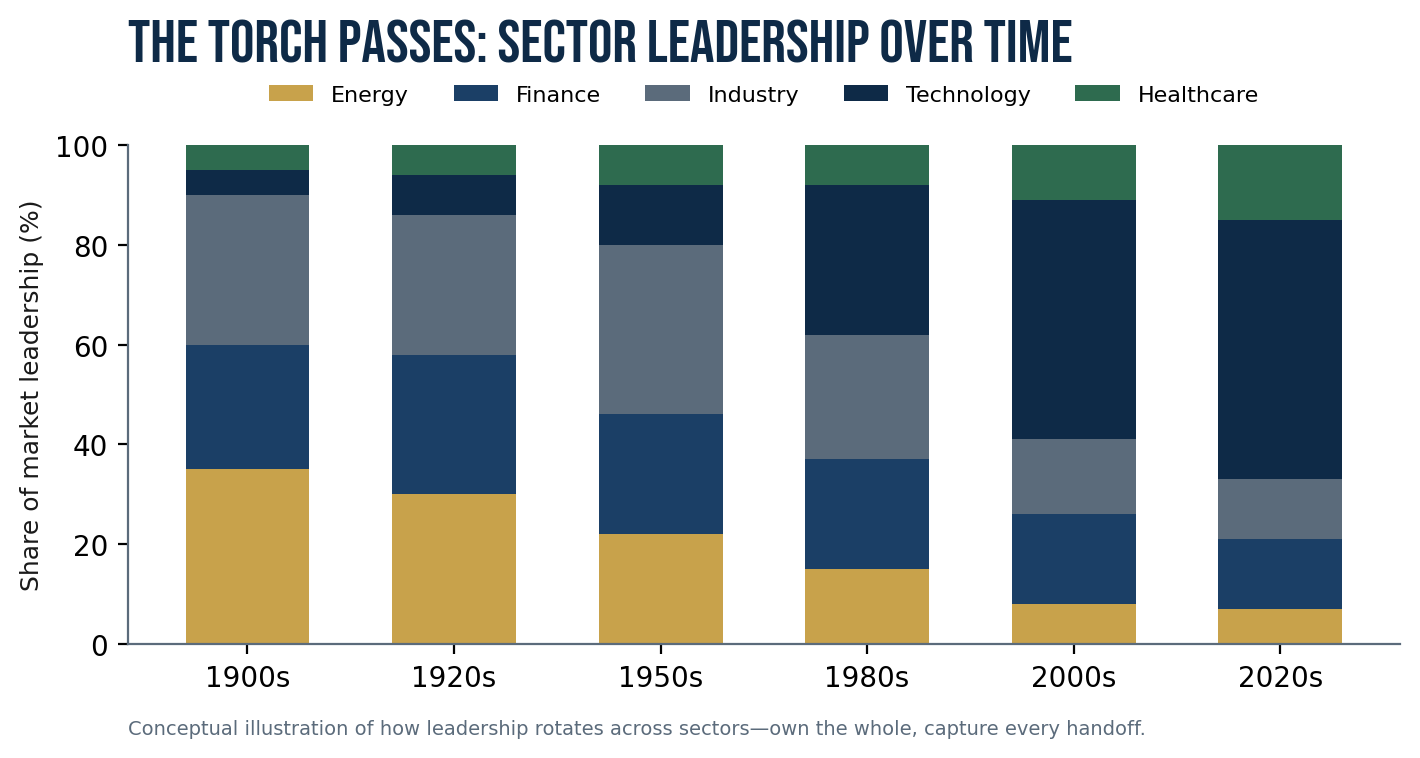
Figure 9.1 — The torch passes: sector leadership over time.
Step back now and look at the whole succession: energy, finance, industry, technology, and the new engines now forming. A pattern emerges that is the real point of this chapter.
Each sector had its era of leadership. Each threw off enormous returns to those who owned it during its rise. Each eventually matured, as the explosive growth slowed and the sector settled into being a large, stable, but no longer market-leading part of the economy. And as each matured, the lead passed to a new engine, often one that the previous era could barely have imagined. The buggy gave way to the automobile; the automobile economy's capital eventually helped fund the digital one; the digital economy's wealth is now funding whatever comes next. The torch passes, era after era, and the broad market captures each handoff.
This rhythm teaches the investor two things, and they point in the same direction.
The first lesson is humility about prediction. If you had tried, at the start of any era, to identify which sector would lead the next one, you would have faced a genuinely hard problem, and the history of confident sector predictions is mostly a history of being wrong. The next leading engine is often one that looks small, speculative, or even faintly ridiculous at the moment the current leader is at its peak. Betting your wealth on your guess about which sector leads next is a bet against a very humbling historical record.
The second lesson is the power of owning the whole. Because the lead reliably passes from sector to sector, and because the broad market automatically contains whatever the new leading sector turns out to be, the investor who simply owns the broad American economy captures every handoff without having to predict any of them. When technology rose, the broad-market owner rose with it, whether or not they saw it coming. When the next engine rises — and something always rises next — the broad-market owner will rise with that too, automatically. The rhythm of sectors, which looks like a reason to try to time and pick, is actually the deepest argument for doing neither. Own the whole, and you own the rhythm itself.
THINKING ABOUT THE NEXT ENGINES
I have deliberately avoided predicting the future throughout these chapters, and I will not abandon that discipline now. But I can say something about the shape of where the next engines may build, because the structural forces we have examined point in certain directions without my having to bet on specific companies.
The same artificial intelligence we discussed as the current chapter of the innovation premium is reshaping not one sector but, potentially, all of them — a force that may run through energy, finance, industry, technology, and beyond, rather than sitting neatly in a single category. The energy transition is reorganizing the oldest sector of all into new forms. The reconsideration of where critical things are made is breathing new life into domestic industry. Advances in the science of biology and medicine are turning healthcare into a frontier of value creation, amplified by the demographic forces of an aging, wealthy population that will demand more of it. And frontiers that sound like science fiction today — as every leading sector once did — are quietly being built by exactly the innovation machine we examined earlier.
I name these not as predictions but as illustrations of the rhythm continuing. There will be a next leading engine, and then one after that, just as there always has been. I cannot tell you which it will be, and neither can anyone else with any reliability. What I can tell you, with the confidence of two and a half centuries of evidence, is that the engines will keep coming, the lead will keep passing, and the patient owner of the broad American economy will keep capturing each new wave as it rises.
The sectors that built American wealth are not a closed list from the past. They are an open sequence still being written. Own the whole sequence, and you need never guess which chapter comes next.
We have now traced how American wealth was built, sector by sector, and how to capture it. But everything so far has assumed an investor sitting inside America. What about everyone else — the billions of people around the world who want a stake in this engine but do not live within its borders? That is where we turn next.