The Case for Investing in America
Chapter 8
Bear Markets Are Bull Markets in Disguise
The Counterintuitive Truth About Timing, Patience, and Wealth
I am going to start this chapter with a fact that, once you understand it, should change how you behave for the rest of your investing life. It is the single most important practical insight in this book, and almost nobody acts on it, because it runs directly against every instinct the human animal possesses.
Here is the fact. Over the long history of the American market, a startlingly large share of all the gains have come on a tiny handful of days. The market's very best days — the explosive rebounds, the sharp recoveries — are responsible for an enormous portion of the total return. And here is the part that matters: those best days cluster, overwhelmingly, right next to the worst days. They come in the depths of crashes, in the teeth of bear markets, in the periods of maximum fear, often within days or hours of the market's most terrifying drops.
Now follow the logic to its conclusion. If a huge share of all your lifetime returns comes from a few dozen explosive days, and those days arrive precisely during the periods of greatest fear — the exact moments when every instinct screams at you to sell and flee — then the investor who panics and sells during a crash is almost guaranteed to miss the rebounds that follow. He gets out to avoid the worst days and, in doing so, misses the best days, which are right beside them. Studies of this effect, run across decades of market data, find the same thing every time: an investor who sat out just the handful of best days saw their long-term returns cut dramatically, sometimes by half or more, compared to one who simply stayed invested through everything.
The market does not reward the clever. It rewards the present. And the cost of being absent at the wrong moment is the difference between building real wealth and watching it slip away.
THE ENEMY IS NOT THE MARKET
This leads to the most important reframing in all of investing, and I want to state it as plainly as I can.
The greatest threat to your investment returns is not the market. It is not crashes, recessions, bear markets, or any of the external dangers that fill the headlines. The greatest threat to your returns is you — specifically, your own instinct to act, to flee, to do something, at exactly the moments when the wisest action is to do nothing at all.
This is hard to accept, because it offends our sense of ourselves as rational agents. We like to believe that with enough intelligence, information, and effort, we can navigate the market's dangers, timing our exits before the falls and our entries before the rises. The financial media encourages this belief relentlessly, because a passive, do-nothing investor is not a customer for their constant stream of urgent advice. But the evidence is overwhelming and humbling. The investors who do worst are very rarely the ones who picked bad companies. They are the ones who picked perfectly good companies, or perfectly good index funds, and then sold them at the bottom of a crash — converting a temporary paper loss into a permanent real one, and missing the recovery that would have made them whole and then rich.
The market giveth its greatest gifts to those who simply refuse to let go during the storm. Not to the smartest. Not to the best-informed. To the calmest. And calm, in the face of a collapsing portfolio, is the rarest and most valuable trait an investor can possess — rarer than intelligence, more valuable than any analytical skill, and almost entirely a matter of psychology rather than knowledge.
WHY YOUR BRAIN IS THE PROBLEM
To master this, you have to understand why it is so hard, and the answer lies in the machinery of the human mind, which was not built for investing.
Your brain was shaped over millions of years to keep you alive in a world of physical dangers. In that world, when something signaled threat — a predator, a cliff, a sudden movement in the grass — the correct response was immediate, instinctive flight. The individuals who hesitated, who calmly analyzed whether the rustle in the grass was really a lion, were removed from the gene pool. We are the descendants of the ones who ran first and thought later. That instinct is wired deep, beneath conscious control, in the oldest parts of the brain.
Now put that brain in front of a collapsing portfolio. The screen is red. The headlines scream catastrophe. Your wealth, the security of your family, appears to be vanishing before your eyes. To the ancient threat-detection machinery in your skull, this registers exactly like the lion in the grass. Every alarm fires. Every instinct commands the same thing it commanded on the savanna: flee, preserve yourself, get out now. The feeling is not a reasoned conclusion. It is a primal survival response, and it is overwhelming precisely because it bypasses the rational mind entirely.
Here is the cruel trick. In the world your brain was built for, that instinct was usually right — fleeing from danger preserved your life. But in the world of investing, the instinct is almost exactly wrong. The moment of maximum fear, when every cell in your body is screaming to sell, is statistically the moment closest to the rebound, the worst possible time to act on the instinct. Your survival machinery, so well-suited to the savanna, is precisely calibrated to destroy your wealth in the market. The investor's central challenge is to recognize this hijacking when it happens and to refuse to obey it — to feel the full force of the primal alarm and sit still anyway.
This is why understanding matters so much. You cannot eliminate the fear; it is hardwired. But you can recognize it for what it is — an ancient survival reflex misfiring in a context it was never built for — and you can build the discipline to act against it. The knowledge is the armor. When the crash comes and the alarm fires, the investor who understands what is happening to his own mind has a fighting chance to stay still. The one who does not understand it will flee, every time, and pay the price.
BEAR MARKETS, RECONSIDERED
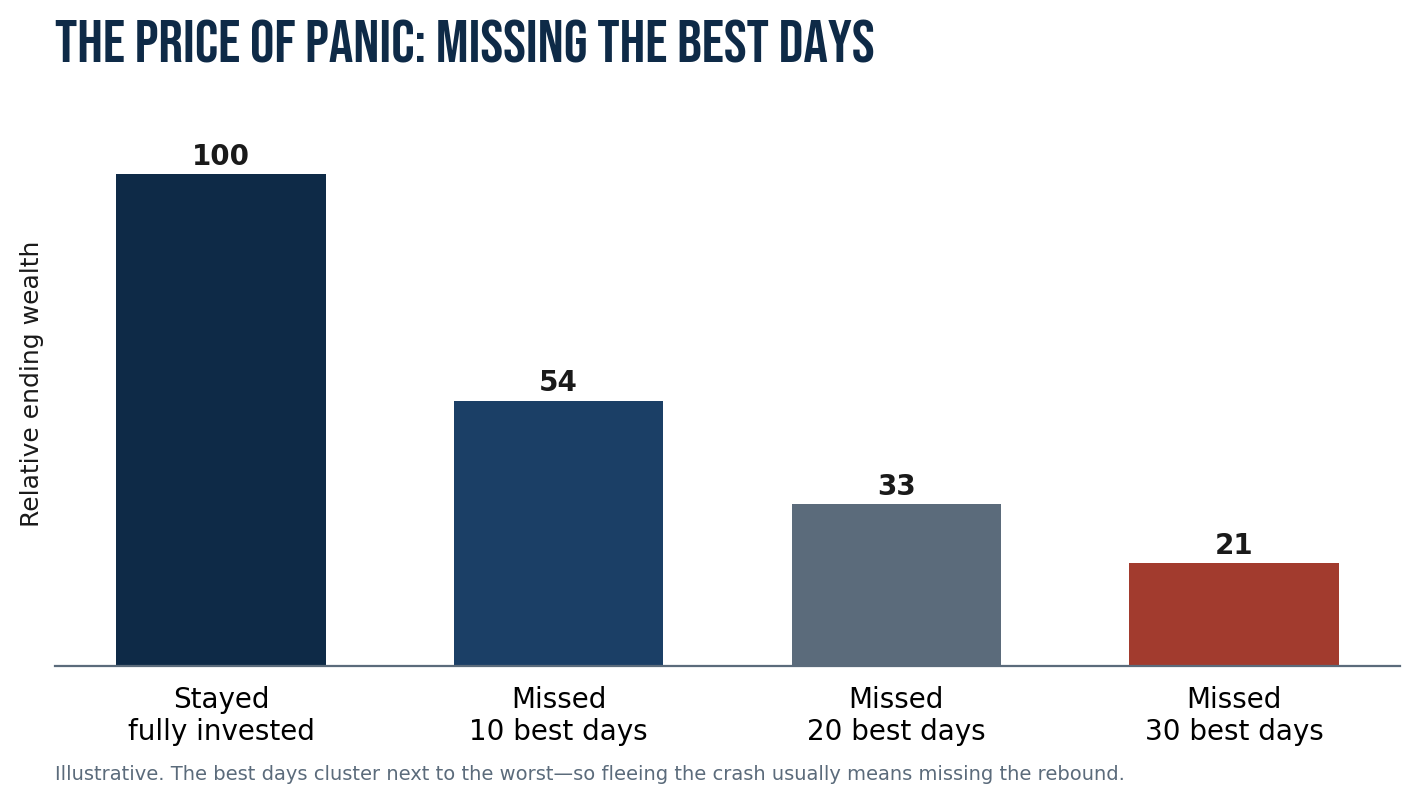
Figure 8.1 — The price of panic.
Let me now turn the conventional view of bear markets completely upside down, because the conventional view is the source of so much destroyed wealth.
In the ordinary telling, a bear market is a disaster — a period of loss, fear, and danger to be survived and escaped as quickly as possible. But consider the bear market from the perspective of a long-term owner of American enterprise who has internalized everything in this book so far. From that perspective, a bear market is something else entirely. It is a sale.
Think about what is actually happening during a bear market. The productive engine of the American economy — the companies, the innovation, the institutions, the demographic growth, all the structural advantages we have spent this book examining — none of that has been destroyed. The factories still stand. The inventions still work. The people still wake up and go to work and buy things. What has changed is not the underlying value of American enterprise but its price. Fear has driven the price down, often far below any reasonable estimate of the underlying worth. The bear market is a period when you can buy claims on the same magnificent economic engine at a discount, because other people are too frightened to want them.
For the investor who is still accumulating wealth — still earning, still saving, still putting money to work — this reframing is transformative. A bear market is not a catastrophe to be feared but an opportunity to be welcomed, a chance to acquire ownership of the American economy at marked-down prices. The young investor who experiences a brutal bear market early in their accumulating years and keeps buying through it is, in retrospect, enormously lucky, even though it never feels that way at the time. They are buying the future cheaply. The bull markets get the headlines and the celebration, but it is often the calm buying during the bear markets that builds the greatest fortunes.
This is what I mean by the chapter's title. A bear market, viewed correctly, is a bull market in disguise — the period when the patient accumulate the ownership that the impatient are too frightened to hold, setting up the gains that the next bull market will reveal. The disguise is fear. Beneath it is opportunity.
PAPER LOSSES AND REAL LOSSES
There is a distinction at the heart of all of this that most investors never properly grasp, and grasping it is the difference between surviving a crash and being destroyed by one. It is the distinction between a paper loss and a real loss.
When the market falls and your portfolio drops in value, you have not, in that moment, actually lost anything in a final sense. You still own exactly what you owned before — the same shares, the same claim on the same companies, the same slice of the same economy. What has changed is only the price that the market, in its current state of fear, is willing to quote for it. This is a paper loss: a number on a screen that has moved against you, but that represents nothing final, because you have not sold and the underlying value of what you own has not actually been destroyed. The companies still operate. The engine still runs. Only the quoted price has fallen.
A paper loss becomes a real loss at one specific moment, and one moment only: when you sell. The act of selling is what converts the temporary, recoverable dip in price into a permanent, locked-in destruction of wealth. As long as you hold, the paper loss remains merely paper, free to reverse itself as it always historically has when the fear subsides and the price recovers. The instant you sell at the bottom, you transform the recoverable into the irreversible. You take a loss that history was poised to undo and make it permanent with your own hand.
This is why the panic-seller is his own executioner. The market does not destroy his wealth; the crash alone never does that to the patient holder. He destroys his own wealth, in the act of selling, by converting a paper loss into a real one at the worst possible moment. And he usually does it in the depths of the fear, right before the rebound, locking in the loss just as the recovery that would have healed it begins. Understand this distinction in your bones and you have a powerful defense against the panic: the knowledge that as long as you do not sell, you have not truly lost, and that the only way to turn the storm's temporary blow into a permanent wound is to flee.
THE DISCIPLINE OF DOING NOTHING
If the great threat is your own instinct to act, then the great discipline is the capacity to do nothing — and "nothing" turns out to be the hardest action in all of investing.
We are conditioned to believe that doing something is always better than doing nothing, that action is responsible and inaction is negligent. In most of life, this is true. In investing, during a crisis, it is precisely backward. The investor who responds to a crash by frantically trading — selling here, hedging there, jumping in and out in an effort to outsmart the chaos — almost always underperforms the investor who simply does nothing, who holds their position and waits for the storm to pass. The frantic activity feels responsible. It is, in fact, the mechanism by which most investors destroy their own returns.
There is a deep wisdom in the discipline of stillness, and it rests on a humbling truth: the market moves faster and more unpredictably than anyone can reliably navigate. The drops and the rebounds come too quickly, clustered too tightly together, for anyone to consistently dodge the bad and catch the good. The attempt to do so requires being right not once but twice — knowing when to get out and when to get back in — and missing either one by even a little is enough to destroy the benefit. The professionals who do this for a living, with every resource and advantage, mostly fail at it. The individual investor, trading on fear from their phone at the bottom of a crash, has no chance at all.
So the discipline is not a sophisticated trading strategy. It is the cultivated capacity to sit still while every instinct screams at you to move, to hold your ownership of American enterprise through the worst storms, confident — on the strength of two and a half centuries of evidence — that the storm will pass and the engine will resume its climb. It sounds almost embarrassingly simple. It is simple. It is also, for psychological reasons we have explored, one of the hardest things a human being can do with their money. The simplicity is exactly why it works, and the difficulty is exactly why so few capture the reward.
A PROTOCOL FOR THE STORM
Let me make this practical, because abstract advice to "stay calm" is useless in the actual moment of terror. The investor needs a plan made in advance, when the mind is calm, to govern behavior when the mind is panicking. Here is the shape of such a plan, in principle.
First, decide your strategy before the storm, in a moment of calm, and write it down. The time to decide how you will behave in a crash is not during the crash, when your reasoning is hijacked by primal fear. It is now, in the clear light of an ordinary day, when you can think. A decision made in calm and committed to in advance is your defense against the decisions your panicking self will want to make.
Second, when the crash comes — and it will come, repeatedly, across an investing lifetime — recognize the fear for what it is. Name it. This is the ancient alarm misfiring. This is the savanna instinct in a context where it is wrong. The fear is real, but the danger it signals is not what it seems. The simple act of recognizing the hijacking weakens its grip.
Third, remember the history. Every crash in American history, without exception, was followed by recovery and new highs for the patient owner of the broad market. The pessimist's case felt overwhelming every single time, and was wrong every single time as a guide to long-term action. You are not gambling on faith when you hold through the storm. You are acting on the most consistent pattern in the entire history of finance.
Fourth, if you can, do better than merely holding: keep buying. The crash is a sale on the American economy. The money you invest during the fear, when prices are marked down, will, if history is any guide, prove to be the most productive money you ever put to work.
And fifth, then do the hardest thing of all. Nothing. Close the app. Stop watching the screen. Let the storm rage and the engine do its work. The fortune goes to the one who can stay, and staying, in the end, is mostly the art of leaving yourself alone.
The bear market is not your enemy. Your panic is. Master the panic, and you have mastered the single most important skill in all of investing — the one that separates the investors who build lasting wealth from the far larger number who watch it slip through their fingers at the worst possible moment.