The Case for Investing in America
Chapter 11
The Next 250 Years
Why America's Greatest Returns May Still Be Ahead
Here is a number that ought to reframe everything you think you know about whether you have missed the opportunity.
At the founding of the United States, its economy was a tiny fraction of global output — a small, agricultural, war-battered country on the edge of the world stage, of little economic consequence next to the great empires of its day. Today, two and a half centuries later, that small country produces roughly a quarter of everything the entire world makes. It went from the periphery to the center, from inconsequential to indispensable, over the same two hundred and fifty years that built the bull market this book is named for.
Now ask yourself the question that this transformation forces. If you had stood at the founding and someone had told you what America would become, would you have believed them? Almost certainly not — the claim would have sounded absurd, a fantasy. And yet it happened. The absurd, impossible growth was real. Which raises the question that this final stretch of the book must confront honestly: is that growth now finished? Has America had its run, and are you arriving at the party just as it ends? Or — and this is the possibility I want you to take seriously — is it possible that the same forces which drove the impossible growth of the past are still running, and that America's greatest returns may still lie ahead?
I cannot prove the future. No one can. But I can show you why the structural case for continued American growth is stronger than the perennial pessimism suggests, and why the investor who assumes the story is over may be making the same mistake that every generation of pessimists has made before.
THE FORCES HAVE NOT TURNED OFF
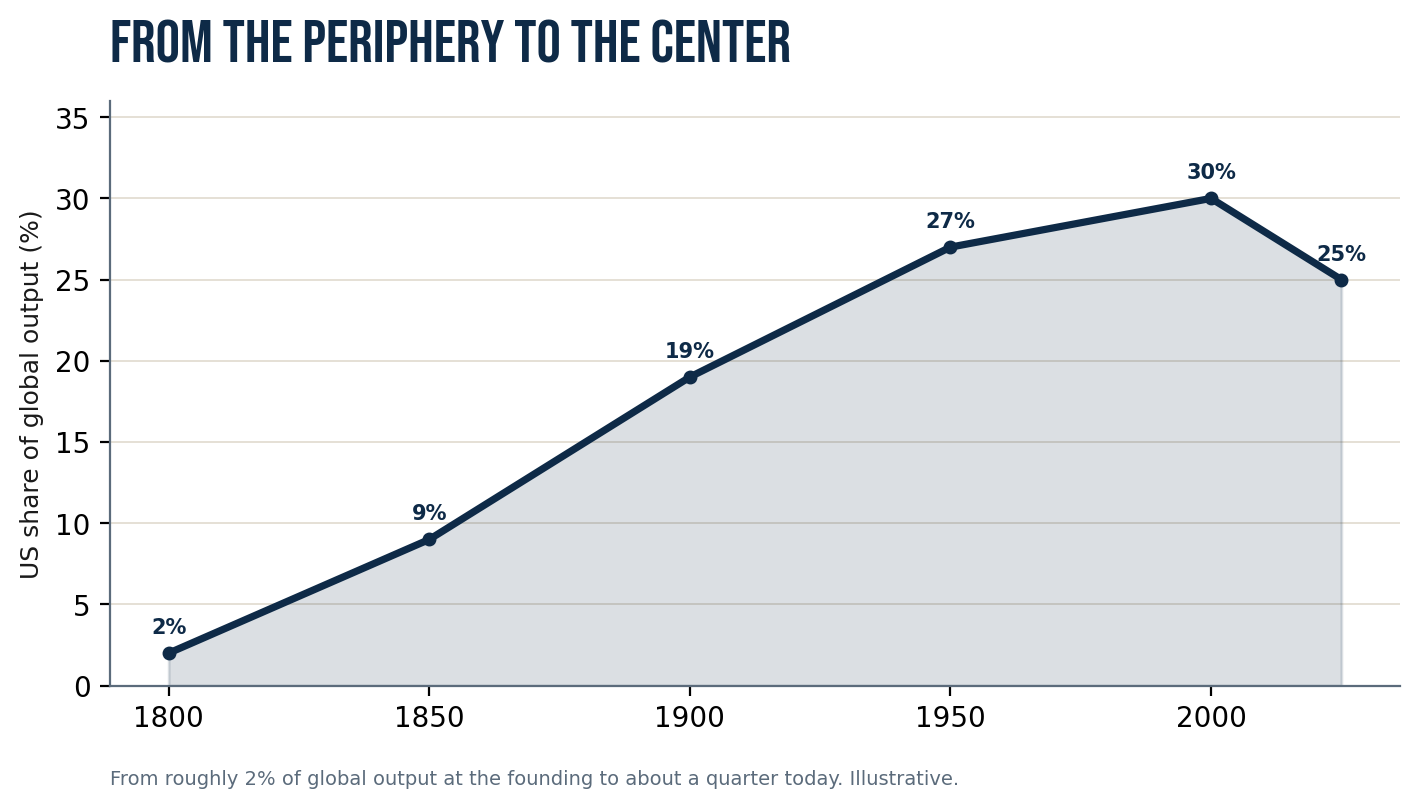
Figure 11.1 — From the periphery to the center.
Let me start with the most important observation, and it is a simple one. Every structural advantage we have examined in this book is not a historical artifact. Each one is still operating, right now, as you read this.
The self-renewing economy that converts crisis into growth — the engine of destruction, absorption, and reform — is still running. There is no sign that America has lost its capacity to clear out its weakest parts and reinvest in its strongest; if anything, the churn has accelerated. The innovation premium — the four inputs of rule of law, deep risk capital, tolerance of failure, and the global magnet for talent — remains in place, and the machine keeps producing world-changing companies. The dollar's empire still stands; the world still flees to American assets in every crisis and still treats the dollar as its safe harbor. The demographic dividend still favors America over a shrinking developed world. The institutional moat still holds, deepened by every crisis it has weathered.
This is the heart of the forward-looking case, and it is not based on optimism or faith. It is based on the observation that the causes of America's historical growth are still present. Growth is not magic; it is the output of specific conditions. When those conditions persist, the output tends to persist with them. The pessimist who declares the American story over must explain not merely that America faces problems — it always has — but that the deep structural engines of its growth have somehow switched off. And when you look at those engines directly, they are plainly still turning. The burden of proof is on the one who claims the impossible growth is finished, and that burden has not been met in any generation that has tried to carry it.
THE CURRENT WAVE
Every era of American growth has been led by a transformative technology, and the current era has one of the most powerful in the country's history: the rise of artificial intelligence, the machines that increasingly perform the cognitive work once reserved for human minds.
I have been deliberately disciplined throughout this book about not predicting which companies will win or exactly how any technology will unfold, and I will hold that discipline here, because it is precisely the forecasting game that humbles those who play it. But the structural observation is fair, and it is striking. We are, right now, in the early stages of a technological transformation that may rank among the most consequential in economic history — a wave with the potential to reshape not one industry but, in time, nearly all of them.
And consider where this wave is centered. The same four inputs that caused America to lead every prior technological revolution are operating on this one. The deepest pool of risk capital in the world is pouring into it. The talent magnet is pulling the world's best minds toward the work. The rule of law protects the inventors and investors building it. The culture of bold attempts and forgiven failures is driving the experimentation. If the historical pattern holds — if America once again converts a wild new technology into a permanent expansion of its productive capacity, as it did with railroads and electricity and the microchip and the internet — then we are not at the end of the American growth story. We are near the beginning of its newest and possibly largest chapter.
There will be froth, as there always is. There will be overhyped claims and overvalued companies and a shakeout that destroys some fortunes built on the wave's early enthusiasm. The skeptics who warn of a bubble are, as always, partly right. But beneath the froth, the transformation is real, and the patient owner of the broad American economy is positioned to capture whatever permanent expansion it ultimately produces — without having to guess which specific companies will deliver it.
THE OTHER ENGINES FORMING
Artificial intelligence is the most visible of the forces shaping America's future, but it is far from the only one, and a clear-eyed look at the horizon reveals several engines forming at once.
There is the reorganization of where critical things are made, as the country reconsiders, for reasons of resilience and security, how much of its essential production it wants to happen within its own borders. This reconsideration is breathing new life into domestic industry, channeling investment into manufacturing and infrastructure in ways that could power a meaningful expansion for years. There is the transformation of energy, the oldest sector of all, into new forms — a generational reconstruction of how the country and the world will be powered, requiring enormous investment and creating enormous opportunity, whatever specific technologies ultimately prevail. There is the frontier of biology and medicine, where advances in the science of life are turning healthcare into a domain of value creation, amplified by the demographic reality of an aging, wealthy population that will demand ever more of what this sector produces.
And there are the frontiers that sound like science fiction today, exactly as every leading sector once did before it arrived — the technologies being quietly built in laboratories and startups whose names most people have never heard, that may, a generation hence, be as central to the economy as the internet is now. The point is not that I can tell you which of these will be the great engine of the coming decades. I cannot, and neither can anyone else with reliability. The point is that there are many engines forming at once, each with the potential to drive significant growth, and that the broad-market owner captures whichever ones ultimately roar to life. The future is not a single bet. It is a portfolio of possibilities, and owning the whole economy is owning that entire portfolio.
THE HONEST RECKONING WITH THE RISKS
I have made the forward-looking case with conviction, and intellectual honesty now requires me to turn and look squarely at the other side, because a book that only argued the bull case would deserve the skepticism of any thoughtful reader. There are real risks to America's future, and pretending otherwise would undermine everything I have tried to build.
The accumulation of government debt is a genuine concern, and the abuse of the very privileges that have served America so well — including the reserve-currency status that lets it borrow so freely — could, if carried far enough, eventually erode the foundations of its financial strength. Reasonable people worry about this, and they are not wrong to worry. Political dysfunction and division are real, and a country that cannot govern itself effectively places limits on its own potential. The rise of capable rivals presents genuine competition in a way America has not always faced. The very dynamism that drives American growth also produces dislocation, inequality, and social strain that, if left to fester, could undermine the cohesion that the system depends on. And there is always the possibility of the shock no one foresees — the crisis that does not follow the historical script.
I take these risks seriously, and you should too. The case for America is not a case for complacency or for the belief that nothing can go wrong. No reserve currency has reigned forever; no great power has grown forever without setback; there is no law of nature guaranteeing American prosperity into perpetuity. An honest forward-looking case must hold the possibility of decline alongside the probability of continued growth, and weigh them soberly.
But here is the judgment that the historical record supports, offered with full awareness of the risks. In every prior generation, the risks looked at least as threatening as they do today — the debts, the divisions, the rivals, the shocks — and in every prior generation, America's capacity to absorb its problems and renew itself proved more durable than the threats. The pessimist who focused on the risks and abandoned the bet was wrong every time, not because the risks were imaginary, but because he underestimated the country's machinery for converting problems into solutions. The risks are real. The engine that has historically overcome such risks is also real, and it is still running. Weighing both honestly, the balance still favors the patient owner of American enterprise — not with certainty, which no one can offer, but with the weight of two and a half centuries of evidence behind it.
THE ARITHMETIC OF ARRIVING "LATE"
Let me address directly the fear that haunts so many would-be investors: the fear that they have arrived too late, that the great growth is behind them, that the opportunity belonged to earlier generations and they are showing up to claim scraps.
This fear has been felt, and been wrong, in every single generation of American history. The investor in 1950 felt they had missed the great industrial growth of earlier decades — and then watched the postwar boom dwarf everything before it. The investor in 1980 felt they had missed it — and then watched one of the most powerful bull markets in history unfold. The investor in 2010, surveying the wreckage of the financial crisis, felt the great American century was surely over — and then watched a decade of extraordinary growth. In every era, a thoughtful person could construct a persuasive case that the best was behind them. In every era, that case was wrong.
The reason it keeps being wrong returns us to the founding number of this chapter. America went from a tiny fraction of global output to a quarter of it over two and a half centuries of compounding growth — growth that no one at any single point along the way could have fully imagined was still coming. At every moment in that long ascent, it was possible to believe the growth was nearly finished, and at every moment that belief was premature. The staircase kept climbing past every landing where the pessimist was sure it would stop.
You cannot know that the future will resemble the past. But you can recognize that the feeling of having arrived too late is not new information — it is the same feeling that every generation of investors has had, and that every generation has been wrong to act on. The structural engines are still running. The feeling that you have missed it is, if history is any guide, exactly the feeling that has preceded every new chapter of growth. Arriving "late" to America has, so far, never actually been late at all.
THE LONG HISTORY OF PREMATURE OBITUARIES
It is worth dwelling, before we close the forward-looking case, on just how rich and continuous the history of American decline predictions actually is, because seeing the full pattern is the best inoculation against being swept up in the latest version of it.
In nearly every decade of the modern era, serious and intelligent people have declared that America's best days were behind it. The specific reason changed with the times — a rival that would surely overtake it, a crisis that would surely break it, a decline that had surely become irreversible — but the underlying prophecy was always the same: the American century is ending, the engine is sputtering, the smart money should look elsewhere. These were not the predictions of cranks. They were made by respected thinkers, in respected publications, with sophisticated arguments and real evidence behind them. They were persuasive. And they were, as a guide to long-term action, wrong essentially every time.
Notice what this long record of premature obituaries should teach you. It is not that decline is impossible — no honest analysis can promise that. It is that the prediction of American decline has been one of the least reliable forecasts in all of modern economic history, made confidently and continuously for generations, and falsified again and again by the country's stubborn capacity to renew itself. The pessimist about America has had countless turns at bat, swung with great conviction every time, and compiled a record of being wrong that ought to give the next pessimist pause.
This matters because, at the moment you are reading this, there is surely a fresh crop of confident declarations that America's decline is finally, this time, real and irreversible. There always is. And the fresh declarations always feel more compelling than the discredited old ones, because they are about the present, with all its vivid and frightening detail, rather than the past, whose fears have safely resolved. But the wise investor holds the long record in mind. The obituaries have been written in every generation. They have been premature in every generation. The burden of proof on the latest one is heavier than its authors ever acknowledge, and the track record of the entire genre is one of confident, sophisticated, persistent error.
THE BET, RESTATED
We have come nearly to the end of the argument, and it is worth restating the bet in its forward-looking form, because this is what you are actually deciding.
To invest in America today is to bet that the same forces which drove the impossible growth of the past two and a half centuries — the self-renewing economy, the relentless innovation, the dollar's strength, the demographic vitality, the institutional bedrock — will continue to operate, and to continue producing growth, into the decades ahead. It is to bet that the current waves still building, in artificial intelligence and energy and biology and the frontiers we cannot yet name, will follow the historical pattern and produce real expansion. It is to bet, in short, that America's story is not finished — that its greatest returns may still lie ahead, just as they always have for every generation patient enough to wait for them.
This is not a certain bet. I have been honest about the risks, and you should hold them in view. But it is a bet with two and a half centuries of evidence behind it, with every structural engine still visibly running, and with the entire weight of the global capital consensus on its side. It is, I would argue, the best bet available to a long-term investor anywhere in the world.
The engine is still running. The future is still being invented. And the patient owner of American enterprise is still positioned to capture it, just as the fool in 1814 captured the future his frightened neighbors fled. The only remaining question is what you will do with this knowledge — and that, the most personal question of all, is where this book must end.