The Ten Essential Principles for Portfolio Construction
Essential Principle 1
You Are a Saver, Not an Investor
WHEN I was writing my first book Pragmatic Capitalism, I kept running into an odd problem – the word “investing.” I was writing a book about economics and finance, but this word doesn’t have a consistent meaning in these two worlds. I know, what a weirdly essential word to be confused about, right?
In economics, investment means to spend for future production. But in finance the word investment means to allocate capital with the expectation of financial returns.
This inconsistency bothered me because the returns that firms generate are a function of how they spend for future production. If a firm allocates investment spending in an innovation, the return from that innovation is reflected in stock prices. Firms sometimes issue stocks or bonds to finance investment spending, but buying stocks and bonds is not the actual act of spending for future production. You generate income from your job, save some portion of that income and then reallocate it to assets on a secondary market like a stock or bond market.*
This distinction is important because most of us are not “investing” when we buy shares of stocks or bonds. In the case of secondary market transactions like most purchases/sales on a stock exchange, we are not financing a firm’s investment spending and we certainly aren’t spending for future production. We are reallocating our existing savings by buying/selling assets whose returns are largely a function of how the underlying firm invests and spends for future production.
The investments that most of us make in life are in ourselves and our skills. We then generate a certain amount of income selling those skills and what we don’t spend is leftover as savings. We can allocate some of those savings to stocks or bonds or other assets, but the process of buying those instruments is not investment in the proper economic sense.
I don’t like calling portfolios “investment portfolios” because it misconstrues this point. Instead, your investment portfolio should more appropriately be thought of as a “savings portfolio.” This is a valuable clarification because “investing” is generally synonymous with an aggressive “get-rich,” high-return-on-investment sort of endeavor, whereas saving is often thought of as prudent and boring. You’re not a gambler, you’re a prudent and thoughtful saver.
I like to think of our personal income statements and balance sheets as part of a “Total Portfolio.” We generate income, typically by selling our skills. Some portion of this goes towards the things we consume. And the rest flows into this Total Portfolio as savings. Your savings can be allocated across your investment portfolio and/or your savings portfolio. Your investment portfolio is comprised of the ways you spend for future production, typically by enhancing your skills, going to school, or starting a firm. Your savings portfolio is the savings you allocate into assets that help grow and protect the savings you earn from optimizing your total portfolio.
Figure 0.1: The Total Portfolio
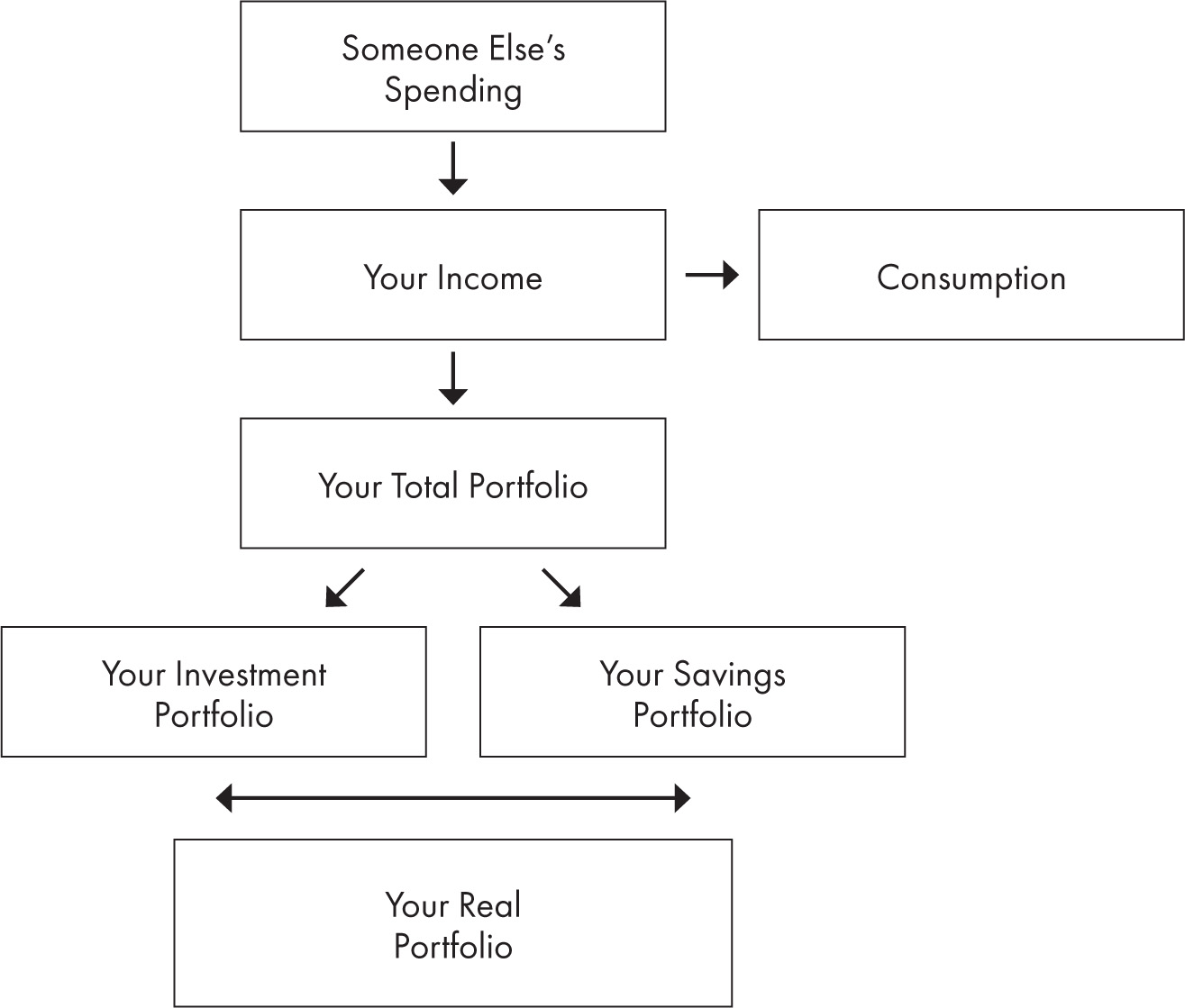
Our Total Portfolios, as depicted in Figure 0.1, are comprised of financial assets and non-financial assets. Financial assets are your liquid, cash-flow-generating instruments to help meet personal financial expenses. This can be broken down as follows:
Savings Portfolio – The financial assets that finance specific future expenses such as retirement spending. This will ideally be comprised of liquid cash-flow-generating financial assets with a high probability of future returns and principal reliability.
Investment Portfolio – This is where you spend for future production. If you are self-employed this would include any spending on your business. If you’re employed this could include any spending to enhance your personal skills or side skills.
Non-Financial Assets include your illiquid real assets:
Real Portfolio – The non-financial assets that you own for various reasons (real estate, cars, etc.). These instruments often have elements of both savings and investment and can therefore span both your Investment Portfolio and Savings Portfolio depending on specifics.
The strategies in this book will apply to constructing your Savings Portfolio. They are not get-rich-quick portfolios and if you’re looking for a get-rich-quick book then you should throw this book in the garbage right now. The portfolios and approaches in this book are best utilized as planning-based portfolios designed to help you allocate your savings in a prudent and thoughtful manner. That doesn’t mean you can’t potentially make a lot of money from these portfolios, but it’s smart to go into this process looking for a long-term companion and not a one-night stand.