The Ten Essential Principles for Portfolio Construction
Essential Principle 2
You Are Your Portfolio’s Worst Enemy
A THOUSAND years ago, a man walked out of his hut to retrieve some water from a nearby river. As he bent over, he noticed a gray wolf staring at him from the opposite side of the water. His immediate instinct was fight-or-flight. Being unarmed and afraid, the man’s instinct was to run. And if you’ve watched as much Discovery Channel as I have, you know running is the worst thing you can do, as it triggers the wolf’s instinct to attack.
Just a few lifetimes later modern man is rarely face-to-face with this physical danger, but we encounter similar psychological dangers in our economic lives all the time. And while the technological world has evolved very rapidly, our brains have not. The result is we are not well equipped or evolved to handle the sort of stress that often comes with the financial markets.
Biologist E.O. Wilson once said: “We have Paleolithic emotions, medieval institutions and Godlike technology.”
The investment world is a godlike technology that confounds our paleolithic emotions. For example, when we see our account balances falling for reasons we don’t understand, our fight-or-flight instinct often kicks in. Like an unarmed person, we typically lack a defense mechanism to control what’s happening, so our instinct to flee takes over. This natural response is the behavioral equivalent of selling a volatile asset in favor of a more stable one to eliminate the perceived threat of downside volatility. But when we abandon our asset allocation, we often fall prey to an irrational impulse – realizing a short-term loss at the expense of potential long-term gains.
A better approach is to identify our behavioral flaws before we face these kinds of environments and to build a portfolio that is robust enough to handle them, arming us psychologically to navigate the dangers ahead. We know there is risk in the financial markets and we need to prepare ourselves to be able to combat these threats before they happen so we don’t succumb to a million-year-old instinct that might not serve us well in the modern world.
Simon Ramo wrote a book in 1999 titled Extraordinary Tennis for the Ordinary Tennis Player in which he described how amateur tennis is a “loser’s game” that isn’t won by making optimal shots, but by limiting the number of errors you make. Asset allocation is very similar in the sense that it’s not so much about building the optimal portfolio as it is about avoiding colossal mistakes along the way.
A lot of this book is filled with theories about how to best manage a portfolio. But if you can’t control your own emotions these textbook concepts will be irrelevant. This is where the school of behavioral finance has added so much value in recent decades. It takes the theoretical underpinnings of finance and puts those theories in perspective by helping us understand how our behavior can impact the implementation of that theory.
After all, the process of portfolio management is similar to driving a car. You can understand every aspect of how a car operates, but if you don’t understand human behavior, you can’t fully understand how and why the vehicles on the road do certain things.
Ben Graham famously said: “The investor’s chief problem, and even his worst enemy, is likely to be himself.”
The world of portfolio management is a battleground of good/bad narratives. And fear, unfortunately, is a more powerful emotion than hope. Many of the narratives in the media and on the internet will prey on your fear to sell you certain goods or services. I would encourage you to never let fear or politics influence your financial planning. There’s nothing wrong with a hefty dose of skepticism, but an optimistic view with a dollop of critical thinking will serve you much better in the long run than falling victim to persistently pessimistic narratives.
I try to constantly remind myself of something I call the Viktor Frankl life hack. Frankl, the author of Man’s Search for Meaning, somehow found optimism while imprisoned in the Auschwitz concentration camp during World War 2. He teaches us that our surroundings do not dictate how we feel about those surroundings. Applied to the financial markets, this means the stock market cannot make you scared – you feel fear only if you allow the stock market to scare you. Over the course of my life, I’ve become virtually immune to market volatility, largely because I no longer allow myself to succumb to stock market fear. I control my reaction to the market; it cannot make me feel a certain way unless I give it that power.
Figure 0.2: The stock market wall of worry
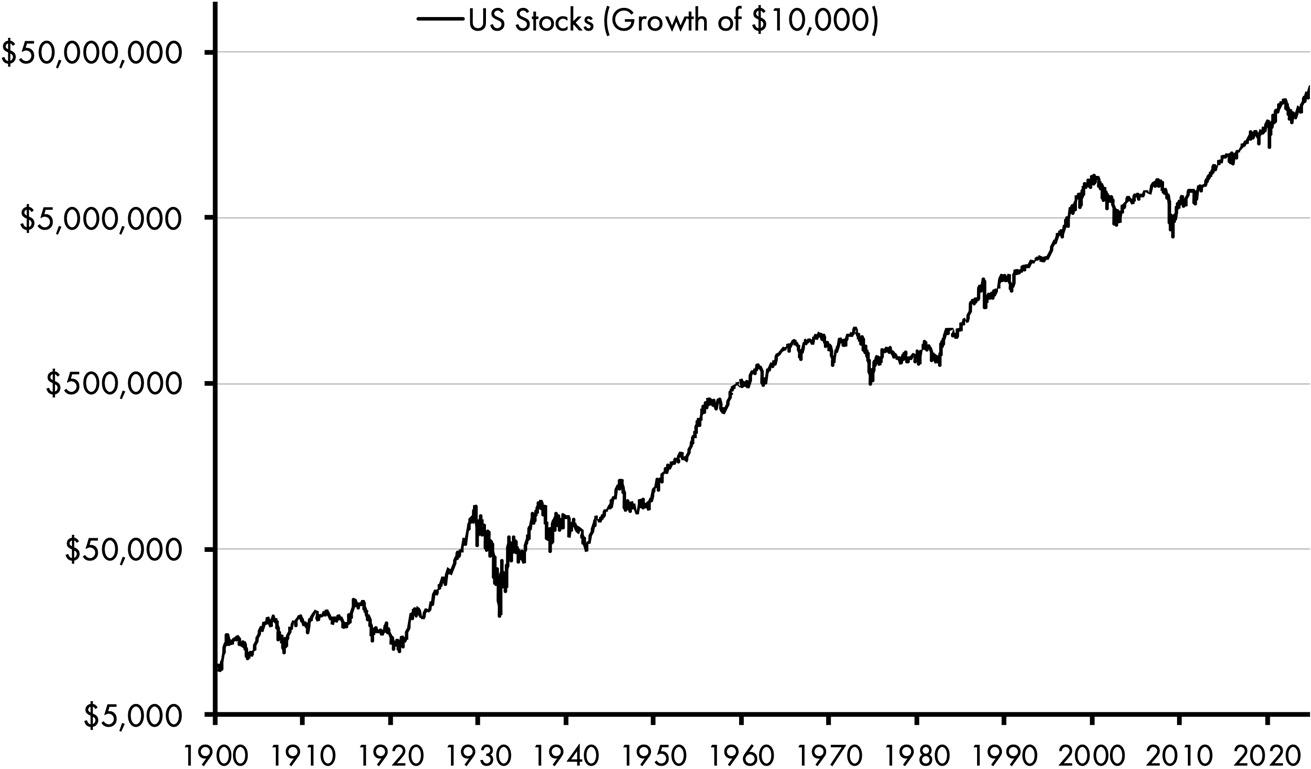
This notion is especially important in inherently volatile markets like the stock market. As shown in Figure 0.2, the market’s long-term rise is filled with short-term scares. The stock market is one of the few places where, when everything goes on sale, everyone runs out of the store. That’s customers losing their battle with the fight-or-flight instinct. To be the customer who runs into the store when things are frightening, you must first understand your own weaknesses – and then learn to overcome them – so you don’t let your animal instincts interfere with good long-term outcomes.
The strategies in this book are selected for their behavioral robustness. Some of them are behavioral hedges, designed to maintain portfolio stability without necessarily outperforming the market.