The Ten Essential Principles for Portfolio Construction
Essential Principle 5
The Cost Matters Hypothesis
JOHN BOGLE was the founder and CEO of Vanguard Group and arguably the most important person in the development of low-cost indexing strategies that have come to revolutionize the world of investing. In 2005 he wrote:
Gross returns in the financial markets minus the costs of financial intermediation equal the net returns actually delivered to investors.
What Bogle was saying was that the return investors earn is guaranteed to be reduced by the amount of friction investors incur. Bogle was always a harsh critic of high fees in large part because the guarantee of high fees rarely results in the guarantee of higher returns. But he also hated fees because these seemingly small sums add up to large costs in the long run.
Let’s quantify some figures here. For instance, if you invested $100,000 in US stocks 30 years ago with a 1% annual fee, you would have $1,632,788. Sounds great, huh? Well, if you had incurred fees of 0.5% per year along the way you’d have $1,897,459. That 0.5% fee sounds small, but it added up to $264,671, or a 14% smaller return. As we see in Figure 0.4, a seemingly small figure compounds to a relatively large difference by the time you might be retiring.
Figure 0.4: The big impact of small fees
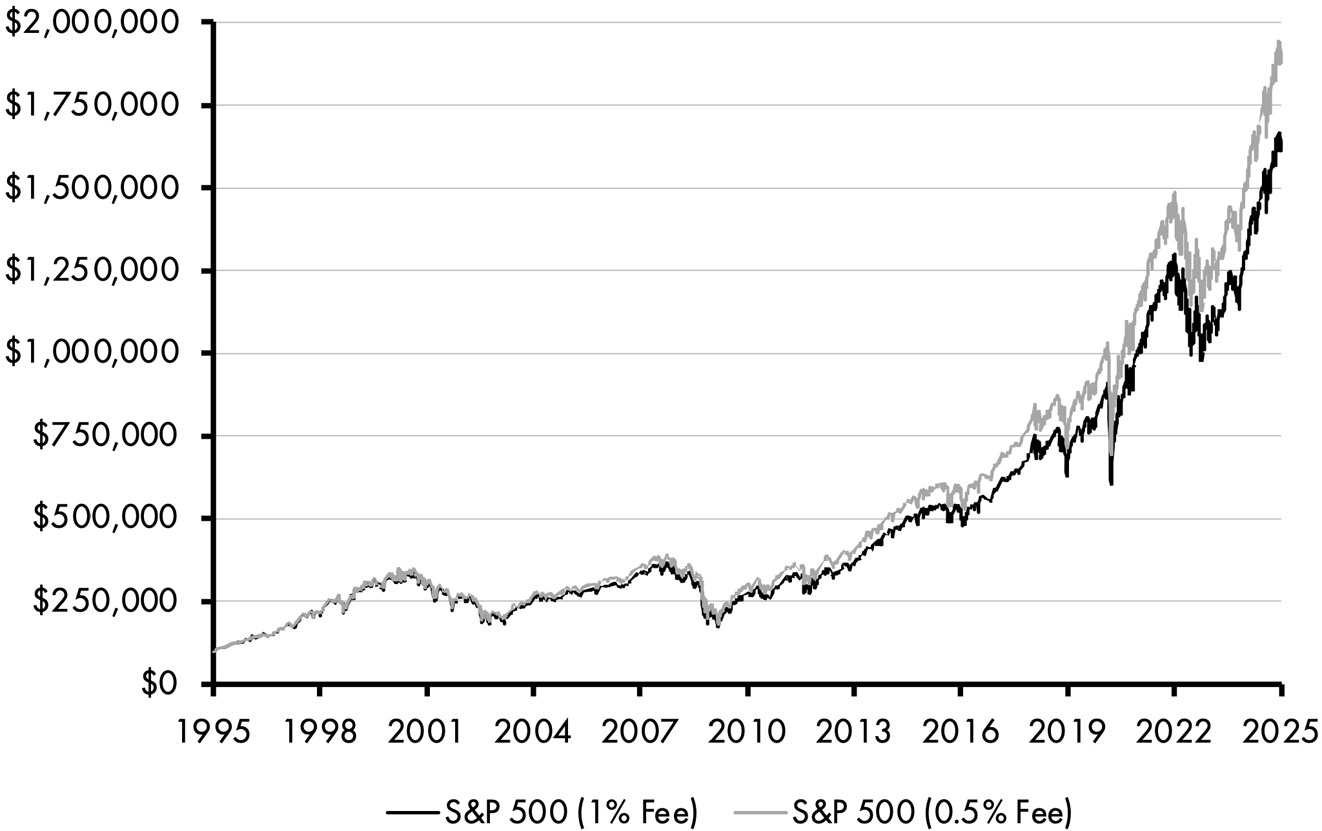
There’s an old saying in finance: “Where are the customer’s yachts?” The answer is that your yacht is sitting in New York harbor in your investment manager’s boat slip after they accrued $264,671 in fees while very likely underperforming a highly correlated index.
These fees not only seem like small amounts, but they can oftentimes be hidden because you don’t write a check or hand over cash to the manager. Meb Faber of Cambria Investments likes to tell a story that puts this into perspective – imagine you have a $1,000,000 portfolio and your investment manager charges 1% per year. When you meet with them once per year you will go to the ATM before that meeting and withdraw $10,000 and place it in a briefcase. When you leave that meeting you take the briefcase and leave the cash. Now ask yourself how that makes you feel? More importantly, do you pay your doctor that much? Your accountant? Your lawyer? Most likely not.
This doesn’t mean fees are never worth it. We will all incur some level of fees and the quality of services provided by financial professionals will vary greatly, but as a rule, a high fee (which I’d define as anything in excess of 0.5%) will have a higher probability of leading to diminishing returns for the client. At the same time, you don’t want fees to dictate all your decisions. The lowest-cost option is not necessarily the best option, but avoiding very high costs is one smart way to reduce the potential frictions you’ll experience across your lifetime.
I formulated all these portfolios with an emphasis on being able to reduce fees as best as possible.