The Ten Essential Principles for Portfolio Construction
Essential Principle 4
Diversification Is the Only Free Lunch
IN 1952 the godfather of modern finance, Harry Markowitz, wrote a paper called “Portfolio Selection.” One of the many useful conclusions from the paper was that diversification is the only free lunch.
What Markowitz meant by that was that an investor can generate better risk-adjusted returns by adding uncorrelated assets to their portfolio. When you diversify through uncorrelated assets with positively skewed long-term returns, you create less variance in your portfolio without necessarily sacrificing returns.
For instance, let’s take two stocks that generate the same 6% return over a one-year period, but they generate their returns in almost exact opposite ways. The returns might look something like Figure 0.3.
Figure 0.3: Why diversification works (12-month 6% return of two different assets)
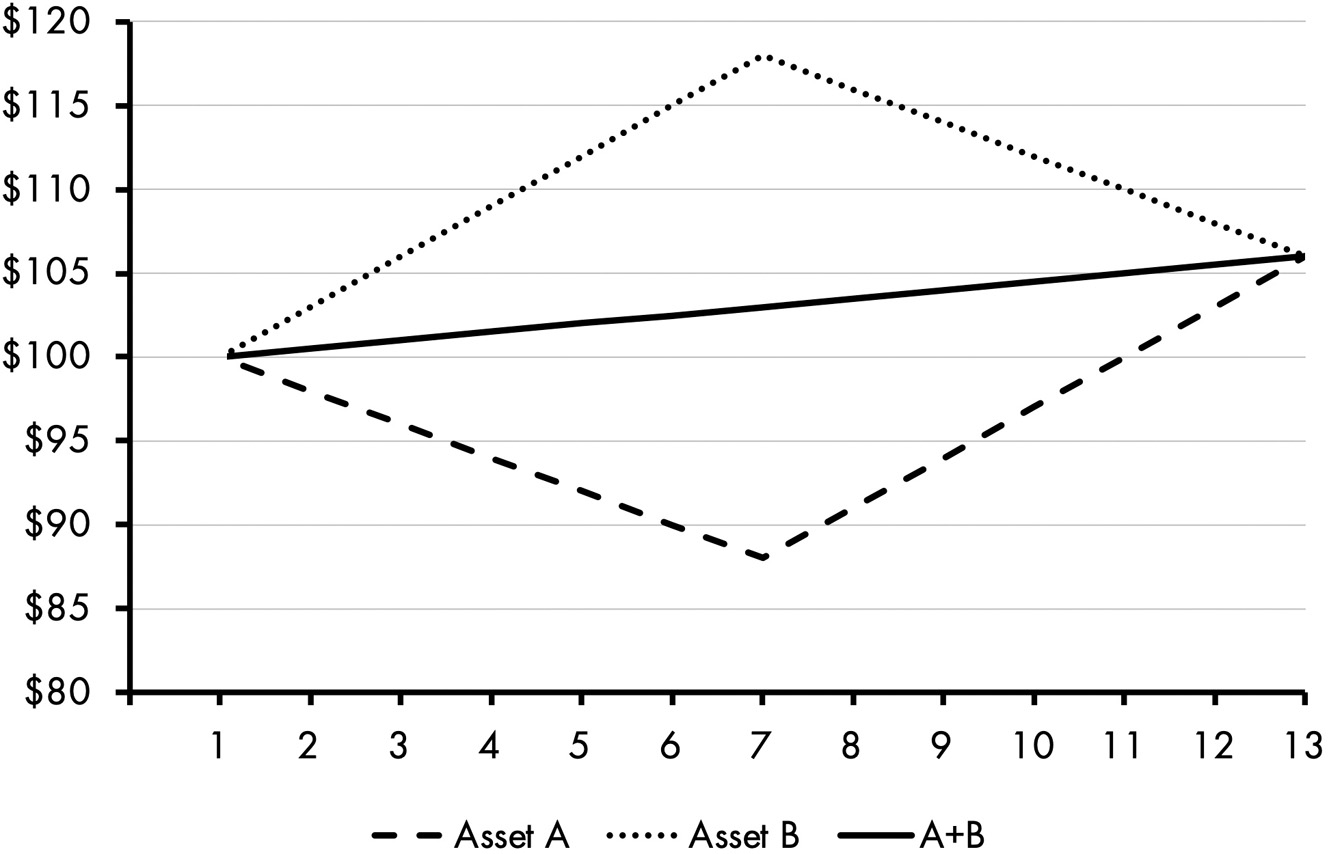
If you held one of these stocks alone, your 6% return ends up being quite bumpy. If, on the other hand, you’d added this basic bit of diversification, your portfolio return would look like a blended profile of these two stocks. In the diversified case you end up generating the same return, but with a much smoother return profile. In other words, you got something for nothing just by adding more diversification to your portfolio.
This is an oversimplified, but powerful, example that highlights the importance of building a portfolio that doesn’t have an excessive amount of concentrated asset class risk. Diversification is important in asset allocation because it helps reduce the variance of returns and when done appropriately it can mitigate or eliminate the risk of catastrophic losses that can derail a financial plan.
In 2004, J.P. Morgan began publishing a study titled “The Agony and Ecstasy,”4 which highlighted the difficulty of picking individual stocks. Get a load of some of the staggering facts they uncovered:
- Since 1980, over 400 companies have been removed from the S&P 500 due to financial distress.
- 40% of all companies that were ever in the Russell 3000 Index experienced a catastrophic decline of over 70%.
- 40% of the time, stocks in the Russell 3000 Index experienced a negative absolute return, meaning you would have been better off owning cash.
- 66% of all stocks in the Russell 3000 Index would have underperformed the index itself.
Picking stocks is hard. Beating the market is hard. Diversification works in large part because picking stocks is so difficult.
But while we say diversification is the only free lunch, it doesn’t mean it won’t come with behavioral hurdles that will try to steal that lunch. Brian Portnoy, the founder of Shaping Wealth, once said that diversification is learning to hate some part of your portfolio all the time. In other words, if your portfolio is all moving in the same direction all the time then it’s probably not well diversified.
A recurring theme in this book is the goal of structuring assets that are generating positive long-run returns that are uncorrelated in the short term. Like the illustration in Figure 0.3, you want Asset A in months 1–12 because you believe it will perform well over all 12 months, but you also have to understand that Asset A is going to drive you nuts during months 1–6. You need to learn to hate some part of your portfolio all the time. And then, right when you start loving Asset A, you’ll start hating Asset B. Good portfolio construction is learning to embrace this reality time and time again without constantly divorcing the parts that are driving you mad.
Okay, but what’s the right amount of diversification?
Great question. Most studies find that a portfolio of 25 or more diversified stocks will sufficiently reduce single entity risk. Investing in an index fund like the S&P 500 eliminates single entity risk almost entirely.
But when we study diversification using other instruments the answer gets much murkier. Azra Zaimovic, professor of finance at the University of Sarajevo, and her colleagues find that there is no optimal level of diversification because the portfolio depends not only on so many variable factors, but also on the goals of the person implementing the portfolio. So, we know that diversification is good, but the appropriate level of diversification is deeply personal, and you’ll need to assess and find that level for yourself.5
This is why an underlying plan is so important. Different instruments will diversify your portfolio in different ways. For example, if you have short-term liquidity needs diversifying solely within the stock market it is unlikely to be able to satisfactorily address the short-term risks associated with those needs. For short-term liquidity needs, you’ll need to diversify into cash, money market funds, Treasury bills or other inherently short-term instruments. This is one reason why I like to think about diversification not just across asset classes, but also across time horizons. In Chapter 20 we discuss what I call Defined Duration Investing and how you can introduce the element of time into a diversified asset allocation plan. That is, you shouldn’t only diversify specific asset class risk, but you should also be keenly aware of the temporal risks certain assets expose you to. After all, good financial planning optimizes certainty of consumption across time.
Then again, we want to be careful about diworsification. This is what happens when someone overcomplicates a portfolio to the point where you get so much diversification that it makes the portfolio worse.
The financial services industry has mastered the art of using complexity to create the illusion of sophistication. When I was a financial advisor at big Wall Street firms we had perfected this process. We would pick 25 stocks for a client, add 10 mutual funds, five closed-end funds and a fancy sounding “alternative” product. In the end we had constructed something that looked a lot like a 60/40 stock/bond portfolio, but the portfolio included so many different products that it was impossible for the client to unwind and even harder for the client to understand. Then we’d send them a statement every month that they couldn’t navigate because it was 40 pages packed with 10,000 numbers that looked like someone had dumped into a blender and translated into Mandarin. This. Was. Not. A. Good. Process.
You’ll find, especially as you age, that complexity breeds the necessity of simplicity. This is nowhere truer than in your finances. Life will get complex and messy as you age and simplifying your financial management will not only make it more efficient, but it will make you happier.
Because diversification is essential to sound financial planning, in this book I analyzed portfolios and approaches that specifically help you diversify your savings portfolio. At the same time, I’ve been mindful about the impact of diworsification and understanding that we want a sophisticated portfolio, but not an unnecessarily complex portfolio.