Risk and Reward
Chapter 2
Doing Nothing Is Hard Work
“The best investors make a habit of putting procedures in place, in advance, that help inhibit the
hot reactions of the emotional brain.”
– JASON ZWEIG
THERE IS AN old parable about a locksmith who takes on an apprentice.
When the apprentice first starts out, he struggles at picking locks. If someone gets locked out of their home or car, it takes him a long time to pick the lock. He uses many tools and different angles to get the job done. By the time the door is open, he’s practically sweating.
The clients see the time and effort he puts in, so they’re generous with tips. Over time, the master locksmith teaches him the tricks of the trade, and with practice, the apprentice improves. He gets faster, and more efficient. Eventually, picking a lock becomes second nature. However, this creates a problem for his pocketbook because now the people who hired him don’t think he’s working so hard anymore. Even though the apprentice is more skilled at lock-picking, his tips go down and he makes less money.
It takes a lot of hard work up front to make it look easy. Late-night host Jimmy Kimmel once proclaimed comedian Martin Short was the greatest dinner guest of all time and deserved to be on the Mount Rushmore of talk show guests. Short was once interviewed on the process he goes through in preparation for these guest spots:
What I do for a typical talk-show appearance, and I’m not exaggerating, is I’ll send in something like 18 pages ahead of time.
They could start with an idea for an opening and then it could go to
‘This story could work, and that story, and that story, and that story, and that story, and that story.’ Then we whittle it down. I’ll probably be on the phone with the segment producer for at least an hour-and-a-half going through ideas for material. Then you have to balance all that during the appearance by making it look improvised in the moment, not speaking too much, trying to find common ground with the host. Like if I’m doing Fallon’s show, I’ll make sure we talk about SNL for a bit.
Short distills nearly 20 pages of material and 90 minutes with a producer into a polished five-minute segment. During those five minutes, he describes his talk show appearances as “an impersonation of myself being relaxed.” It comes off as if he’s going off the cuff and improvising on the spot, but this is years and years of honing his craft to make it appear like a casual conversation.
Another example of this is Jerry Seinfeld’s well-known bit about Pop- Tarts in his stand-up:
I don’t know how long it took them to invent the Pop-Tart. But they must have come out of that lab, like Moses with the two tablets of the Ten Commandments. The Pop-Tart is here. Two in the packet. Two slots in the toaster.
Let’s see you screw this up. Why two? One’s not enough. Three’s too many. And they can’t go stale. Because they were never fresh!
Seinfeld told an interviewer he’d been working on this joke for two years before it was perfected. Two years!
You might assume stand-up comedians are naturally funny storytellers, but there’s an immense amount of behind-the-scenes work involved. Comedians don’t simply go play sold-out stadiums by telling jokes off the top of their heads. They go to dozens of smaller comedy clubs to work on their material before appearing in front of a large audience. They change their inflection or a specific word to test the responses from the audience until they’ve perfected the end joke.
Before doing a nine-minute monologue when he hosted Saturday Night Live, Aziz Ansari said he probably did more than 100 stand-up sets over a month-long period to get it exactly how he wanted it. Chris Rock, another comedian who spends an inordinate amount of time honing his routines, became Ansari’s mentor. Here’s what Rock had to say about his protege’s preparation for SNL in an interview:
Yeah, he knew he had to do it 100 times. Anybody that’s really good over-prepares, and he’s got no problem. He kind of embraces it. You go to the Comedy Cellar any night and Aziz is in the booth and he’s got his headphones on and he’s listening to his set from the night before. He’s not listening to the new Kendrick. [Laughs.] He’s going over his set.
When you watch these comedians perform, it looks effortless – like they were simply born with it. People who make it look easy undoubtedly have God-given talent, but more often than not, it’s their dedication and countless hours of practice that make the final result appear so natural.
Just as great performers prepare exhaustively to make their work look natural, investors succeed by creating a plan in advance that allows them to stay disciplined – often by resisting the urge to act. The good news when it comes to investing is you don’t necessarily need to be the hardest worker to succeed. You just have to put in some preparation ahead of time.
Doing nothing is a decision
Researchers in Israel studied nearly 300 penalty kicks from professional soccer leagues and championship matches to gain a general sense of the strategy for both goalies and strikers. For the uninitiated, each side gets five shots on goal in a sudden-death soccer match if it’s still tied after extra time. Whoever scores the most goals wins. Goalkeepers are at a severe disadvantage due to the sheer size of the goal. The striker has a clear advantage, so they score a goal in roughly four out of five opportunities, on average.
The study discovered the goalkeeper would dive left or right nearly 94% of the time, meaning the other 6% of the time they stayed in the middle hoping the kick would come right down the pipe. But what about the strikers? As you can see from the distribution of kicks in Figure 2.1, the strikers kicked it dead center far more often than the goalies stayed put.
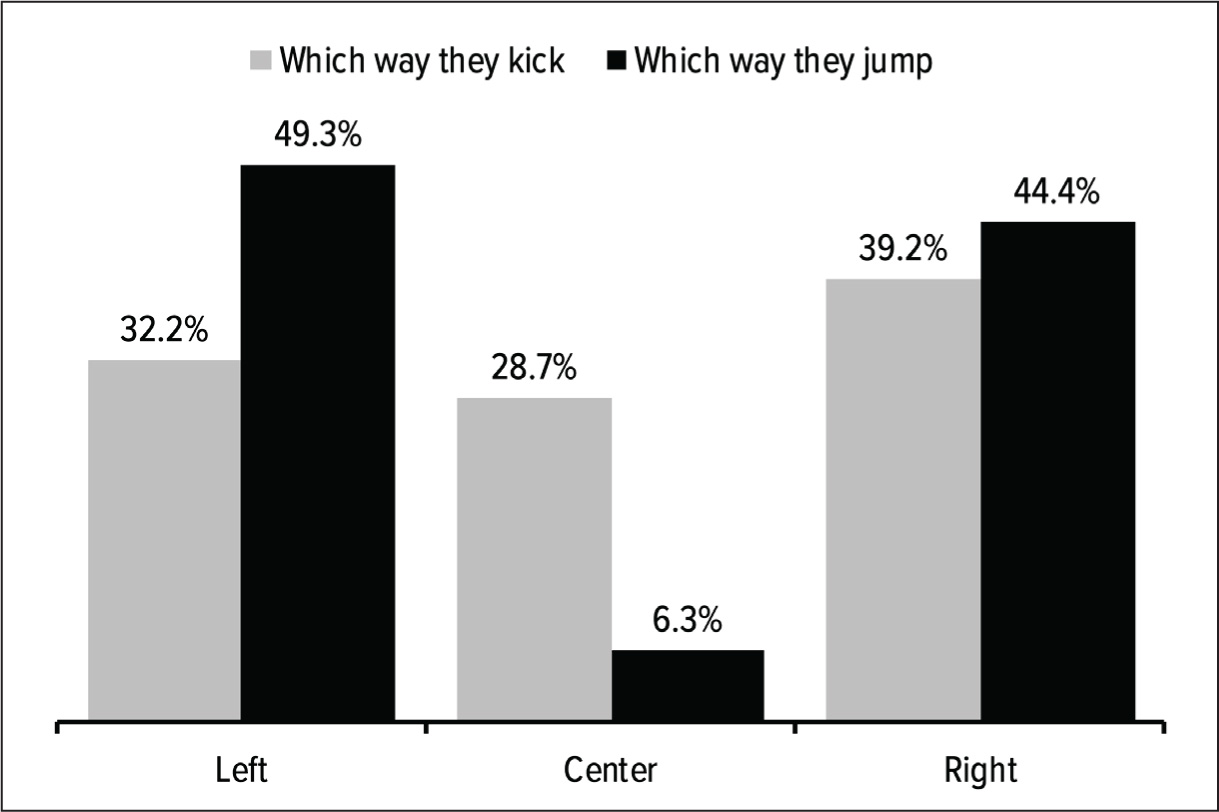
The distribution of kicks was fairly even across the left, center, and right sides of the goal. However, goalkeepers disproportionately dove to the left or right when attempting to make saves. Those are the highlight plays you see on SportsCenter and social media.
In fact, the ball strikers were five times more likely to kick it down the middle than goalies were to stay in the center. This imbalance led researchers to investigate whether goalkeepers could improve their save rate by guarding the middle more often. Their findings suggested that save percentages could nearly double if goalkeepers distributed their save positioning more evenly among left, right, and center positions.
When shown the results of the research, goalies told the academics to kick rocks. Many goalies admitted they would feel a greater sense of regret staying in the middle and conceding a goal to the sides than if they dove and missed. Diving shows effort. At least they tried. Standing still and watching the ball simply wasn’t an option because they don’t want to look like a fool.
This study offers a fascinating look into human psychology – our innate bias toward action over inaction. Taking action provides a sense of control, even if that control is merely an illusion.
That illusion of control applies to investing as well.
How to win at investing
In many areas of life, effort correlates with results – study harder, and your grades improve; practice more, and you get better at sports; hit the gym consistently, and you can transform your body. Unfortunately, this principle doesn’t apply to investing. There are no extra points awarded for degree of difficulty in your portfolio. Ironically, the harder you try, the worse your results tend to be. More action often leads to unnecessary and avoidable mistakes.
In his classic investment book, Winning the Loser’s Game, legendary investment thinker Charles Ellis lays out three different ways you can win the game of investing:
1. The first way is physically exhausting. You outwork the competition.
You put in more time and energy in hopes of gaining an informational or structural edge in the markets. 2. The second way is mentally exhausting. You outsmart the competition.
You use your brainpower and intellect to outsmart other market participants. 3. The third way is emotionally exhausting. You are more rational than
the competition. You have an unemotional long-term process you follow come hell or high water.
The problem with option one is there is little evidence of a high correlation between trying harder and investment performance. More activity doesn’t necessarily make you better at investing. Warren Buffett once said, “The stock market is designed to transfer money from the active to the patient.”
The problem with option two is that there will always be people who are smarter than you. Millions of MBAs, CFAs, PhDs, and literal rocket scientists are trying their hand at beating the market. They have better technology, data and researchers than you do. Luckily, surviving in the markets doesn’t necessarily require you to have the highest IQ to win. Buffett also said, “Investing is not a game where the guy with the 160 IQ beats the guy with the 130 IQ. Once you have ordinary intelligence, what you need is the temperament to control the urges that get other people into trouble in investing.”
Temperament brings us to the most realistic option for most investors –
the emotionally exhausting approach, option three. An emotionally exhausting investment approach does present its own set of challenges. You have to be willing to look past short-term outcomes when following a long-term approach. You have to be willing to live with volatility and losses at times. It’s also boring and not as sexy to take a longer-term stance in the markets. And maybe the hardest part of all is that it’s much easier to do something rather than nothing, even when doing nothing is the right move.
In the information age, the bias towards action will only increase in the future. It’s never been easier to pay attention to every headline. Social media glorifies day traders and people who get rich overnight. Patience is a virtue no one has time for anymore. The only way you can do nothing is by performing all of the heavy lifting up front. You need a durable investment plan that you can stick with through a wide range of market and economic environments.
Vanguard’s Jack Bogle liked to say, “Don’t just do something. Stand there!” In other words, stay the course.* Staying the course means going against your own emotions at times. Staying the course means thinking and acting for the long term even when it doesn’t feel right in the short term. Staying the course means preparing not predicting. Staying the course means doing nothing when that’s what your plan calls for. Unfortunately, doing nothing is hard work because markets constantly tempt you into changing your portfolio.
One of the best ways to stay the course is by automating good decisions in advance. You can use technology to create guidelines that will automatically buy, sell, or change your asset allocation using pre-established rules. You can automate your contributions, dividend reinvestment, portfolio rebalance and buy/sell rules. Making those decisions ahead of time helps you avoid many of the most common investor mistakes, which are typically made in the heat of the moment.
Investing is hard. You’re forced to deal with constant uncertainty, volatility, fear, greed, and an endless stream of noise. Your worst enemy in the markets is not the person on the other side of the trade – it’s you.
Doing more, trying harder, making more trades and paying more attention to your portfolio can be hazardous to your wealth. The most important work you can do as an investor is proper preparation. And when it is time to act, it will be because your plan tells you to, not because of