Risk and Reward
Chapter 4
The Three Best Inflation Hedges
HEDGES
“People who buy things are suckers.”
– RON SWANSON
A MILLION DOLLARS IS a lot of money. Households worth $1 million or
more make up just 1.5% of the world’s population.*
The Millionaire Next Door by Thomas Stanley and William Danko was originally published in 1996. It belongs on the Mount Rushmore of personal finance books because it broke new ground on how most Americans become millionaires. Most millionaires aren’t flashy spenders, but rather people who live below their means and save diligently. True wealth is the spending you don’t see. These millionaires next door accumulated their riches by prioritizing hard work, discipline, long-term investing and solid financial habits that compound over many years into a two-comma net worth.
However, a million dollars doesn’t go nearly as far as it used to. One million dollars in 1996 was worth just $475,000 by the end of 2024. Said another way, it would take more than $2 million in 2024 to be on equal footing with $1 million in 1996 in terms of spending power. A 3% inflation rate cuts the value of a dollar in half in 23 years. At 4%, inflation cuts your money in half in 17 years.
You can complain all you want about this, but it’s not going away as long as the economy keeps growing and workers demand higher wages. You just have to be intelligent about how to hedge the inflationary beast.
Let’s look at the three best ways for investors to combat inflation.
The three best inflation hedges
The three best hedges against inflation for most people are a good job, home ownership and stocks for the long run. Let’s review each of these in turn.
1. A good job
The inflation rate can be helpful for understanding trends in the overall economy, but it’s an imperfect measure for your specific household. You are not the aggregate inflation rate. Your household inflation rate is personal. It depends on where you live, how you live, how much you spend, what you spend your money on and, most importantly, your job. Wage growth is personal too because people’s income trajectory does not necessarily match the averages.
The ability to grow your income in the face of rising prices is your best hedge against inflation. The best career advice I’ve ever received is to become indispensable to whoever you’re working for. Easier said than done, but that helps ensure you’re paid a fair wage and have the ability to negotiate a higher salary over time. One of the best ways to improve your career prospects is to become a lifelong learner.
When asked for a piece of career advice at a conference, Nvidia’s Jensen Huang replied, “Dedicate yourself to learning all the time, doing the best possible work you can, and leave everything on the field. I’m not at all ambitious. I don’t aspire to do more. I aspire to do better at what I’m currently doing.”
As Steve Martin once said, “Be so good they can’t ignore you.” Most personal finance experts focus on saving, investing and frugality. You can only cut so much from your budget. The way to really get ahead is to invest in yourself and improve your earning power. The more you make the more you can save and invest.
2. A home with a fixed-rate mortgage
When inflation rears its ugly head, consumers focus on the price of eggs, gas and bacon going up, but the two biggest spending categories for
households by far are housing and transportation. This is illustrated in Figure 4.1.
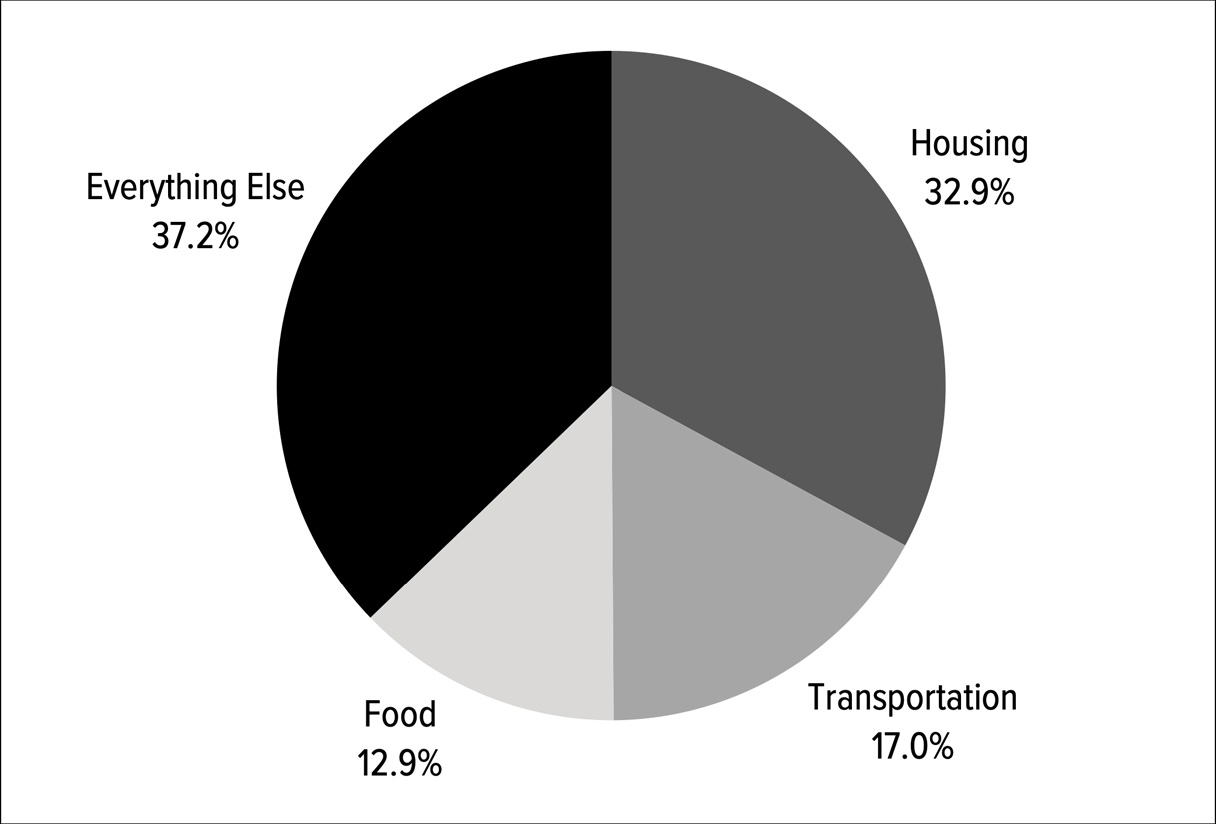
Housing and transportation make up half of all household consumption. Get them right from a budgeting perspective and your financial life becomes much easier. Overspend on these two areas and it becomes much harder to get ahead financially. This is why a fixed-rate mortgage can be so beneficial if you choose the right house and have the ability to service the debt.
You should earn more money as you progress in your career. That makes fixed payments easier to stomach from a budgeting perspective over time. You can also write off the interest you pay on the loan as a deduction for tax purposes in the U.S. Plus, inflation eats into the value of your payment slowly but surely over time. Housing prices also tend to rise when inflation moves higher. Owning a home is a wonderful hedge against inflation.
Let’s do a deep dive into why that is the case.
A short history of fixed-rate mortgages
The 30-year fixed-rate mortgage is one of the greatest consumer financial products ever created. It happened almost by accident. The fixed-rate mortgage originated as a result of the Great Depression. Before that economic avalanche reshaped the United States, homeowners typically took out mortgage loans with terms of three to five years. At the end of the loan term, borrowers would either pay off the remaining balance in a large lump sum, or refinance into a new loan with similar terms. Down payments were significantly higher too, at around 50% of the home’s value.
The economic devastation of the 1930s made it nearly impossible for homeowners to keep up with their mortgage payments. By 1933, over 40% of mortgages were in default. Foreclosure, which was once considered a shameful last resort, lost its stigma during the Great Depression as homeowners stopped paying their mortgages in large numbers. Franklin Delano Roosevelt’s New Deal reshaped how banks and homeowners alike approached the home-buying process to help lower the strain on the financial system. Loans were extended to 15-year terms and eventually pushed out ever further to 20-, 25- and finally 30-year increments to make it easier for borrowers to make their monthly payments. Mortgage loans now comprise more than 70% of all consumer debt in the United States. By the mid-2020s, almost 95% of all mortgages outstanding in the United States had a fixed rate.*
Most homeowners in the United States put down anywhere from 5–20% and finance the rest. Sure, you have to pay interest on that loan, but the payment never changes if you choose a fixed rate for 30 years. Every single month, you pay the principal and the interest on the loan and the total never changes.* To paraphrase Wooderson – Matthew McConaughey’s breakout role – from Dazed and Confused, “That’s what I love about these fixed-rate mortgages, man, I make more money, the payment stays the same.”
The Great Depression changed the way households finance the biggest purchase of their lives but it wasn’t until the Great Inflation of the 1970s that housing turned into the American Dream in a big way.
The American Dream
Investors had it tough in the 1970s. Stocks were dead money. Bonds got crushed by inflation and rising interest rates. You could earn money in cash-like investments, but that’s not very exciting to talk about at cocktail parties. So investors were forced into the loving arms of housing as both an investment and inflation hedge.
Joe Nocera explains in his book, A Piece of the Action:
Among those who already owned a home, the talk had an awed, slightly obsessive, even giddy quality; among those who didn’t, it had
an awed, slightly embittered, and frankly envious quality. A house wasn’t just part of the American dream anymore; it was part of the money revolution. And that was sad.
In 1979, an economist for Paine Webber pleaded for Americans to buy a home, writing in The New York Times, “‘Never buy what you can’t afford’ was the admonition of our parents. Today, the statement has been changed to, ‘You can’t afford not to buy it.’”
Once upon a time, the American Dream was not just to own your own home but to own it outright by paying off your mortgage. That vision began to fade in the 1970s because of soaring inflation. Paying off a mortgage wasn’t practical when inflation took huge bites out of your debt payments. Why pay it off early if waiting made each successive payment worth less and less on a real basis? A house went from being a roof over your head to the biggest financial asset for most families and the simplest way to hedge sky-high inflation. This shift happened largely because housing was one of the few assets that appreciated in the 1970s.
Housing prices nationwide were up nearly 130% in the 1970s, good enough for annual returns of almost 9% per year. Housing was one of the only asset classes that actually beat inflation (see Figure 4.2).*
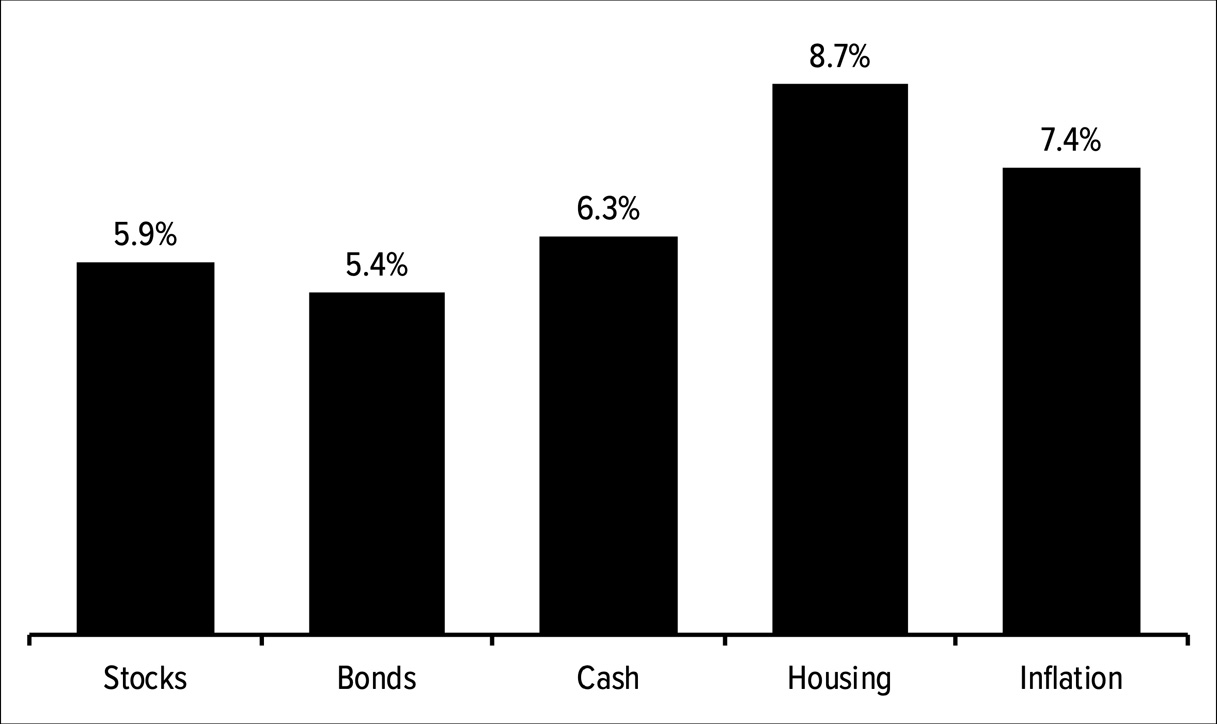
This begs the question: How did housing protect homeowners when the other main asset classes faltered?
Think about it this way – let’s say the inflation rate averages 3% per year
over the next 30 years. If you stash your savings under your mattress for the entirety of that time frame, by the end of three decades, every dollar you started with would be worth just 40 cents. This is why you want to invest your cash instead of just sitting on it.
A fixed-rate mortgage works like that but in reverse. Let’s say you take out a $400,000 loan at 6% using a 30-year fixed-rate mortgage. Your payment would be roughly $2,400 a month (not including things like property taxes and home insurance). Your $2,400 monthly payment stays the same for the life of the loan. But the nominal dollars you use to repay that loan will be worth less and less in the future because of inflation.
Plus, wages rise when prices rise, making it more expensive to hire construction workers. The cost of building materials goes up. Commodity prices increase. All of these factors make it more costly to build new homes which, in effect, makes existing homes worth even more from a replacement cost perspective. Inflation causes housing prices to rise and eats away at your debt.
Robert Shiller assembled a database of U.S. home prices going back to 1890. The inflation-adjusted return for housing nationwide from 1890 through 2024 was around 0.6% per year. If we measure from 1970, it’s a 1% real return. This doesn’t sound all that great compared to the stock market, which has real returns of 5–7% depending on the lookback period.
However, it’s worth mentioning that calculating the return on the roof over your head is nearly impossible. You have to include the ancillary costs (insurance, property taxes, upkeep, etc.), the leverage involved and the imputed rent because you have to live somewhere whether you own or rent. I’d venture to guess there isn’t a single homeowner alive who knows what the actual dollar-for-dollar return is on their home. And that’s OK! Owning a home is not like buying and holding a stock. You can’t live in your Apple or Microsoft or index fund shares.
However, even if we take Shiller’s numbers at face value, earning a return only slightly above the rate of inflation over the long term on a building you and your family are happily living in is a wonderful deal.
3. Stocks for the long run
The stock market can struggle with an inflationary spike in the short term,
but stocks for the long run are still your best investment hedge against the corrosive effects of inflation.
The U.S. stock market has beaten the inflation rate by nearly 7% per year over the long haul. One of the reasons for this is the fact that corporations grow their earnings and dividends at a healthy clip above inflation. Dividends have grown more than two percentage points faster than the annual inflation rate over the long haul. Inflation-adjusted earnings growth has come in at around 3% per year over the past 100 years or so.
And while real returns can suffer during higher periods of inflation, you hedge against those times when inflation is running low. Take a look at the cycles of real returns over the years in Table 4.1.
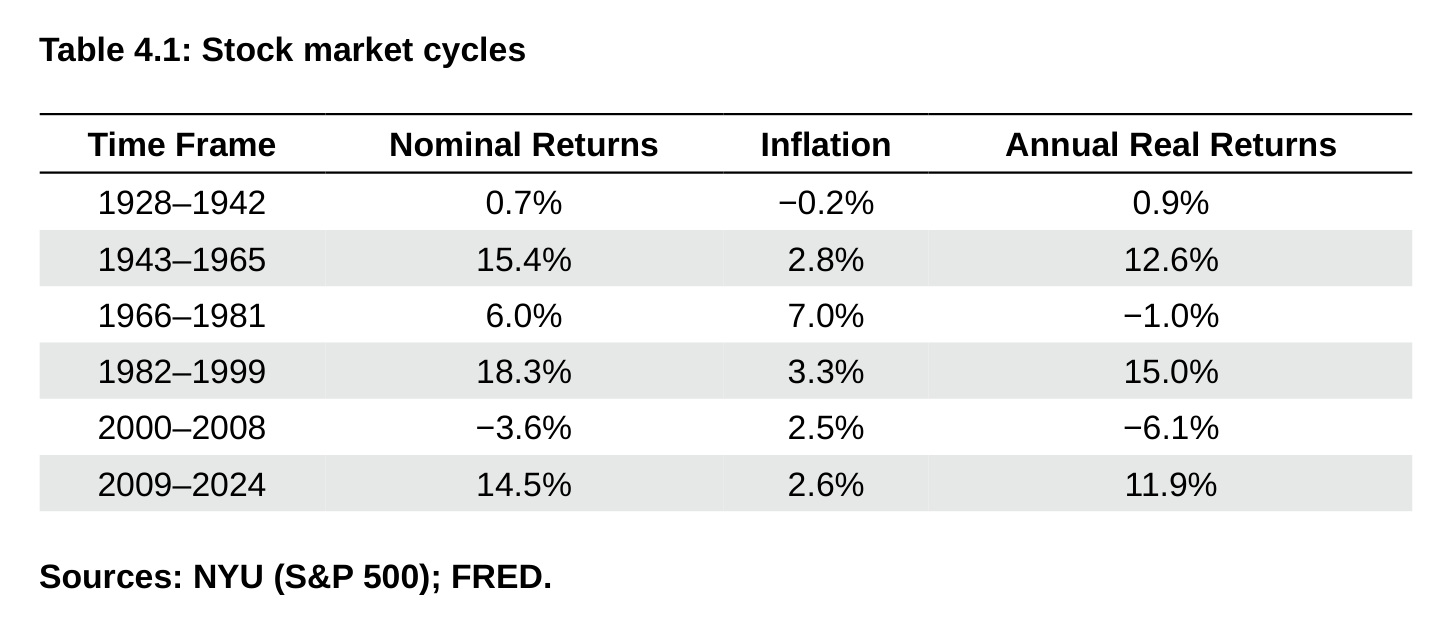
Table 4.1: Stock market cycles Time Frame Nominal Returns Inflation Annual Real Returns 1928–1942 0.7% −0.2% 0.9% 1943–1965 15.4% 2.8% 12.6% 1966–1981 6.0% 7.0% −1.0% 1982–1999 18.3% 3.3% 15.0% 2000–2008 −3.6% 2.5% −6.1% 2009–2024 14.5% 2.6% 11.9% Sources: NYU (S&P 500); FRED.
The data shows that inflation spiked in the 1970s, leaving investors with decent nominal returns but awful real returns. Investors in the U.S. stock market lost more than 35% after adjusting for inflation from 1966 to 1981. The 1980s and 1990s still experienced some inflation, but it was falling and that led to glorious returns for investors. The 2000 to 2008 time frame was bookended by two gargantuan crashes of more than 50%. When you take into account the 3% inflation, investors lost more than 6% per year for nearly a decade. Ouch.
Some claim that periods like 1966 to 1981 show why the stock market isn’t always your best bet. But it’s because of periods like this that you have to stay invested. Yes, returns from 1966 to 1981 were negative on a real basis. But let’s combine that inflationary bust with the booms that preceded and followed it.
From 1943 to 1981, nominal annual returns were 11.4%. With a 4.5% annual inflation rate, real returns were roughly 7% per year over the entire period. From 1966 to 1999, nominal annual returns were 12.3% against a 5% annual inflation rate, leaving investors with 7.3% real returns over 34 years. The same applies when we combine other down cycles with up cycles. From 1982 to 2008, real returns were 7.3% per year. The boom of the 1980s and 1990s smoothed out the bust from 2000 to 2008.
The best way to prepare for terrible periods in the stock market is by staying invested during the glorious times. The best way to offset periods of low real returns is by staying invested during periods of high real returns. There’s only one guaranteed way to lose money to inflation – don’t invest your savings at all.
Some of you might be thinking: No thanks, I’ll just invest in stocks when returns are high and sit on the sidelines when returns are low.