Risk and Reward
Chapter 5
Timing the Market
“Timing the market is a fool’s game, whereas time in the market is your greatest natural advantage.”
– NICK MURRAY
IN OCTOBER 2008, Warren Buffett penned an op-ed for The New York Times
with a simple headline that read:
Buy American. I Am.
He explained:
The financial world is a mess, both in the United States and abroad. Its problems, moreover, have been leaking into the general economy, and the leaks are now turning into a gusher. In the near term, unemployment will rise, business activity will falter and headlines will continue to be scary.
So. . . I’ve been buying American stocks.
Buffett was taking his own advice about being greedy when others were fearful. And boy was everyone fearful.
The financial system was on the verge of collapse. Lehman Brothers, which had been operating for nearly 160 years, went out of business in September. The U.S. government nationalized the federal mortgage insurers
Freddie Mac and Fannie Mae. The Fed was forced to bail out AIG while the Treasury injected $700 billion to bail out the country’s biggest banks. Banks were going under left and right. Stocks were crashing. Our pets’ heads were falling off! It was a bloodbath.
When Buffett wrote his op-ed, the S&P 500 had already cratered by over 40%. Investors hoped the legendary investor’s calm words would stop the bleeding. Buying when there is blood in the streets tends to work out over the long term, but there was much more blood to be spilled during this crisis.
From the day Buffett’s piece was published through the eventual bottom a few months later, the stock market shed a further one-third of its value. That means investors experienced a 40% crash through the fall of 2008 followed by an additional 33% shellacking from there until the market finally found a bottom. All told, the S&P 500 was down nearly 60% from the peak in October of 2007 through the bottom in early March of 2009.
Of course, Buffett admitted even he couldn’t time the market perfectly (emphasis is mine):
Let me be clear on one point: I can’t predict the short-term movements of the stock market. I haven’t the faintest idea as to whether stocks will be higher or lower a month or a year from now. What is likely, however, is that the market will move higher, perhaps substantially so, well before either sentiment or the economy turns up. So if you wait for the robins, spring will be over.
Buffett was buying individual stocks at the time, but let’s say you heeded his advice by buying an S&P 500 index fund on October 16, 2008. Yes, you would have almost immediately gone through a 30%+ crash over the next five months. But had you held on for the long term, that crash would become a distant memory.
From the time Buffett bought America through the end of 2024, the S&P 500 was up a staggering 750%, good enough for an annualized return of more than 14% per year.
Short-term pain for long-term gain. Things might not work out so wonderfully every time stocks go down in the future. Like Mr. Buffett, you or I cannot predict what will happen next in the stock market. The good news is you don’t have to pinpoint the exact bottom of a bear market to make out like a bandit. As long as you can keep a long enough time horizon, even large losses in the stock market tend to be swamped by the eventual gains.
Hindsight bias
In 1966, Buffett was still running an investment partnership, managing money for some friends, family and business associates. That was a rough year for the stock market, which took a nosedive right out of the gates. After the Dow entered correction territory, a few investors in Buffett’s partnership felt the need to inform him what would happen next. They warned that the stock market likely had further to fall.
Buffett gave his written response in an investor letter in May 1966:
(1) If they knew in February that the Dow was going to 865 in May, why didn’t they let me in on it then; and, (2) If they didn’t know what was going to happen during the ensuing three months back in February, how do they know in May?
Buffett’s investors wanted him to wait until the coast was clear. He explained his thinking on short-run market moves like this:
There is also a voice or two after any hundred point or so decline suggesting we sell and wait until the future is clearer. Let me again suggest two points: (1) the future has never been clear to me (give us a call when the next few months are obvious to you – or, for that matter the next few hours); and, (2) no one ever seems to call after the market has gone up one hundred points to focus my attention on how unclear everything is, even though the view back in February doesn’t look so clear in retrospect.
Emotions are heightened during downturns, so it’s no surprise that investors pay more attention and believe they can predict what comes next. It feels more comfortable to have your hands on the steering wheel. The reality is the market doesn’t care about your feelings and the steering wheel
doesn’t work, no matter how hard you grip it. The market is in the driver’s seat at all times.
The reason hindsight bias can be so detrimental to your investment performance is because it makes you feel like you can guess what’s coming next when you look at the past. But it’s never clear what the future will bring. I’ve heard countless investors over the years say some variation of the following:
Let’s just sell everything and wait for the dust to settle. I’ll go to cash and then buy after the market crashes. Piece of cake. But what if I put money to work in stocks and the market crashes even more? I’m just going to wait until the market bottoms. . . then I’ll buy.
The market doesn’t give you an all-clear signal. No one rings a bell at the top. No one sounds an alarm at the bottom. The market won’t hold your hand to make investing easier. John Templeton once said, “The investor who says, ‘This time is different,’ when in fact it’s virtually a repeat of an earlier situation, has uttered among the four most costly words in the annals of investing.”
The eight most costly words of market timing are, “I’ll just wait until the coast is clear.”
This is true of both tops and bottoms.
Tops and bottoms
Financial historian Frederick Lewis Allen wrote about the 1929 top before the Great Depression crash in his book Since Yesterday:
No headlines will announce tonight that the Big Bull Market has reached its climax; for no headline writers – nor anybody else for that matter – can see into the future. The financial reporters will remark, to be sure, that bullish enthusiasm has resulted in ‘another in the long series of consecutive new high records established by the share market,’ but the comment will be casual. Men do not whip themselves into frenzies over the usual. None of us is aware, on September 3, 1929, that the people of the United States are crossing one of the great divides of national history. The way ahead is hidden, as always, by fog. Surely, we imagine, there is higher ground just ahead. Yet at this very moment the path under our feet is about to turn downward.
The crash would send stocks spiraling down more than 85% over the next three years (more on this crash later in the book). Tops are challenging to see on the horizon, but so are generational bottoms. Joe Nocera wrote about the end of the 1970s stagnation when the stock market finally bottomed in the early 1980s:
On an otherwise inauspicious Friday in August – Friday the 13th, as it happens – the Dow Jones Industrial Average opened at 776.92. Up until then, all but one trading session that month had been a losing one; indeed, most trading sessions for the previous year and a half had resulted in losses. Volume was light. The market seemed moribund. But when trading ended that day, the Dow had risen twelve points. The following Monday it rose another four points, and the day after that, the 17th of August, it closed at 831.24, for a gain – highly unusual in the early 1980s – of close to 40 points. Volume wasn’t just heavy, it was history-making: More shares were traded the third week of August 1982 than had ever been traded in any five-day stretch before. By the end of the month, the Dow stood at 901.31. It had gained 125 points in 13 sessions.
That was the start of perhaps the greatest bull market in U.S. stock market history. No one saw it coming. Pinpointing tops and bottoms after they’ve already taken place is easy – just look at a chart to see where the market turns. These turning points are rarely obvious in the moment because you never know how far human nature will take things in the good or bad times.
The stock market can be counterintuitive. I could give you the headlines ahead of time and you still might not be able to predict what comes next. Investing looks easy in the rearview mirror, but the future is always unknown. The good news is you can be a successful investor without trying
to guess what comes next. It just requires a touch of discipline and a dash of automation.
What about Bob?
Remember our guy Bob, the world’s worst market timer, from the Introduction? I updated Bob’s numbers through 2024 to see how things would have looked given some more recent downturns. This time I assumed Bob began his investment journey in 1983 and retired at age 65 at the end of 2024. Using the same assumptions from before,* this time I used five different purchases at stock market peaks:
1987 just before the worst single day in history (-20%) when stocks fell more than 30% in a week. The end of 1999 right before the dot-com bubble burst, cutting the stock market in half. The fall of 2007 just before the Great Financial Crisis caused the stock market to drop nearly 60%. In February of 2020 before the onset of the Covid pandemic saw stocks fall 34% in a little over a month. In January of 2022 as the stock market was about to drop more than 25% from the pandemic-induced inflationary spike.
Not great, Bob. Every purchase came right at a market peak before a major decline. Figure 5.1 shows the peak-to-trough declines from the points at which Bob made his purchases.
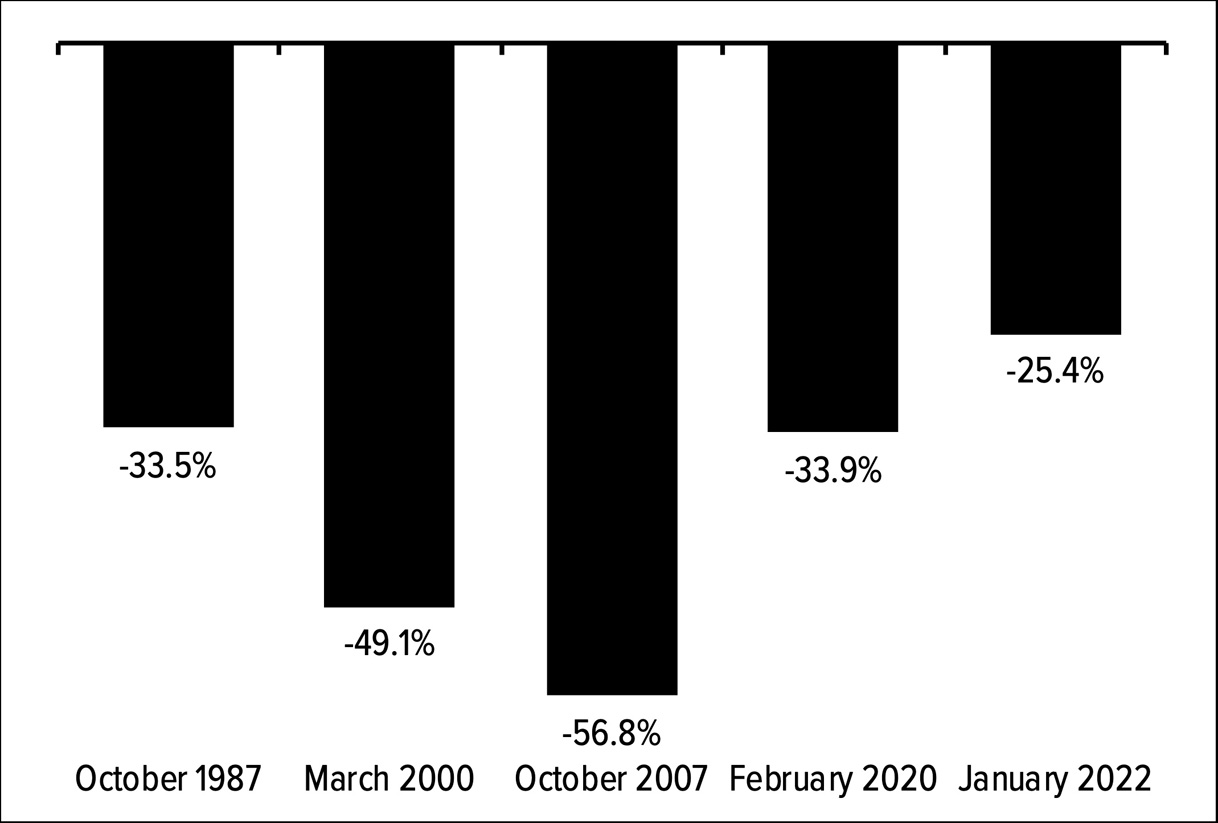
Bob saved more than $200,000 in total, but ended up with nearly $1.1 million by the time he retired at 65 in 2024 because he never sold out of the stock market. That’s pretty good considering he picked the five worst entry points over the course of his investing lifecycle. Even poorly timed purchases in the stock market can work out if you have a long enough time horizon.
However, Bob could have done much better by taking market timing out of the equation. What if Bob kept things simple and instead of trying to time the market by sitting in cash and waiting, he invested on a regular basis? Most normal people dollar cost average into the market by saving periodically from their paychecks, so let’s assume Bob did that.
Let’s say that Bob decided to invest his money on a monthly basis instead of trying to time the market. These are the amounts Bob would have saved per month over his saving and investing lifecycle:*
1983–1992: $167/month 1993–2002: $333/month 2003–2012: $500/month 2013–2022: $667/month 2023–2024: $833/month
With a dollar-cost averaging strategy where Bob dutifully invested his money each and every month, held onto his investments for the long haul and went on living his life, he would have entered retirement at age 65 heading into 2025 with nearly $2.3 million. That’s a much better result with very little effort on Bob’s part – he doesn’t need to monitor the market or choose his entry points, he just automatically invests consistently every month.
Now let’s consider the opposite of Bob’s terrible market timing purchases. What if instead of investing at the top right before a giant market crash, Bob invested towards the bottom after those crashes had already occurred? Let’s transform Bob from the world’s worst market timer into the best.
Using the same original assumptions where Bob built up his cash on the sidelines, what if instead of investing at the top of the market he invested closer to the market bottoms? This market timing strategy yielded better results than the bad market timing, with an ending balance of $1.7 million, but that’s still far less than the dollar cost averaging strategy. Plus, to get this result Bob had to precisely time the bottom of those bear markets, something that no one can do with consistency.
The siren song of market timing is ever tempting, but not worth the heartache and anxiety. Jumping in and out of the market to wait for a pullback is like a gateway drug to a cash addiction. You have to be right twice – when you buy and when you sell. Pulling the trigger on a sale during a down-trending market is easy. Just get me out at any price! But then you have to figure out when to get back in. That’s psychological warfare.
I’ve spoken with hundreds of investors over the years who sold out of their stocks during the 2008 financial crisis. Years later, while a new bull market was already well underway, they were still sitting in cash. They were always an emotional train wreck because they didn’t know whether to wait for another crash or rip the Band-Aid off and get back in.
Market timing is an impossible long-term strategy. Warren Buffett can’t do it. You can’t do it. I can’t do it. The only people who can do it on a consistent basis are either lucky or lying. You’re better off buying stocks on a regular basis, creating an asset allocation you can stick with and keeping your emotions in check.
In the next chapter we’ll take a look at the most important concept in all of finance to show why investors are so tempted to time the market and what you can do about it.