Risk and Reward
Chapter 6
The Most Important Concept in Investing
IN INVESTING
“You lose money fast in the stock market. You can’t
make it fast.”
– PETER LYNCH
ANDRE AGASSI IS one of the most decorated professional tennis players of
his era.
Agassi won eight Grand Slam tournaments, an Olympic gold medal and was the number-one-rated player in the world for more than 100 weeks throughout his illustrious career.
It didn’t always come easy. After turning pro as a teenage prodigy, Agassi burst onto the professional tennis scene but couldn’t win the big one. He reached three Grand Slam finals in 1990 and 1991, but came up short each time. Sportswriters began calling Agassi a fraud and a choke artist. That all changed when he finally broke through and won his first Grand Slam title at Wimbledon in 1992.
Winning, however, didn’t change how he felt about past losses. Agassi shared the following in his excellent biography:
But I don’t feel that Wimbledon has changed me. I feel, in fact, as if I’ve been let in on a dirty little secret: winning changes nothing. Now that I’ve won a slam, I know something that very few people on earth are permitted to know. A win doesn’t feel as good as a loss feels bad, and the good feeling doesn’t last as long as the bad. Not even close.
This dirty little secret is true in sports and many other facets of life – losing hurts more than winning feels good. Everyone knows this feeling. You remember the pain of your favorite team’s close losses more acutely than the pleasure of their wins. It’s human nature.
Nobel-prize-winning behavioral psychologist Daniel Kahneman came up with the name for this inherent human condition – loss aversion. Over the years, Kahneman posed a simple question to various groups: If you lost $100 for incorrectly calling a coin toss, how much would you need to win on a correct call in order to take that bet? Most people settled on $200, suggesting that losing stings twice as bad as winning feels good.
This is why losing money in the markets causes so much strain on your emotions. You panic when you see your portfolio going down in value. Losses change your perception of risk. Losses are so painful you can relive them in your sleep.
Losses often lead to poor investment decisions because they activate the part of your brain that’s responsible for the fight-or-flight response. Imagine someone suddenly jumping out at you from behind a bush, or coming across a spider or snake in the wild – you instinctively jump, your heart races, and adrenaline kicks in. This reaction is hardwired into you through millions of years of evolution. Our ancestors didn’t have the luxury of hesitation; when faced with a tiger on the plains, survival depended on an immediate response – run or risk being eaten. Loss aversion has been good to us as a species, but it works against you in the markets.
This is why loss aversion is the most important money concept of all. It doesn’t matter how rich or successful you are – loss aversion impacts us all. After retiring from late-night television, David Letterman talked about what it was like to compete with other late-night hosts his whole career:
I think there’s something wrong with me. It’s either a character flaw or a personality disorder. It’s one or the other. I haven’t heard back from the lab. Maybe life is the hard way, I don’t know. When the show was great, it was never as enjoyable as the misery of the show being bad. Is that human nature?
Yes, Dave, that’s human nature.
Now that we know about loss aversion, let’s discuss why the stock market amplifies it for investors.
You don’t live in the long term
One of the stock market’s most wonderful features is that the longer your time horizon, the higher your chances of experiencing gains. This is illustrated in Figure 6.1.
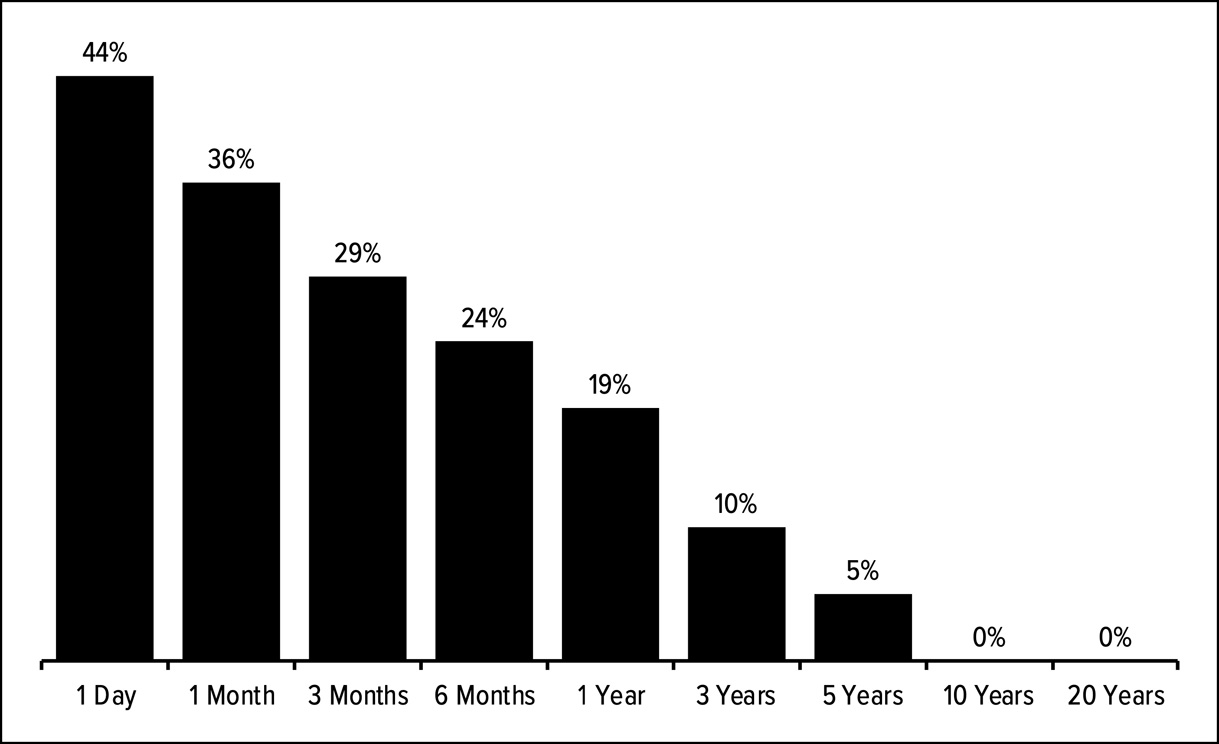
As you can see, the U.S. stock market has never experienced losses over a 20-year time horizon. The historical win rate over five and 10 years is excellent as well. Even a one-year time frame has averaged gains in four out of every five years, on average, since 1950.
These percentages aren’t promised going forward, but it’s the trend that matters. The longer your time horizon, the more likely it is that the market will be up. You’re more likely to see losses over shorter time horizons. On a monthly basis, stocks have been positive roughly two-thirds of the time. If we drill down to daily returns, now you’re looking at a little better than a coin flip, with the market positive on 56% of all trading days and negative 44% of the time.
The long term gives you a higher probability of success, but ignoring the short term is impossible because you’re only human. When Kahneman won the Nobel Prize for his work on human foibles, he said the following in his acceptance speech:
It is worth noting that an exclusive concern with the long term may be prescriptively sterile, because the long term is not where life is lived. Utility cannot be divorced from emotion, and emotion is triggered by changes. A theory of choice that completely ignores feelings such as the pain of losses and the regret of mistakes is not only descriptively unrealistic. It also leads to prescriptions that do not maximize the utility of outcomes as they are actually experienced.
Long-term returns are the only ones that matter but, as Kahneman so eloquently put it, the long term is not where life is lived. The long term is a series of short terms. And the short term includes 24/7 news, alerts on the tiny supercomputer in your pocket and apps that show your investment performance every second of the day. Ignore the noise is financial advice that sounds useful in theory but is now impossible in practice. In the information age the volume is always cranked up.
The stock market makes you feel terrible every day
Richard Thaler stood on the shoulders of Kahneman’s work by taking loss aversion a step further. Thaler understood that looking at the stock market on a daily basis increases your chances of seeing a loss. The more often you look at your performance, the more likely you’ll feel the down days. He coined the phrase “myopic loss aversion.” Myopia is the idea that the more frequently you look at your portfolio, the more likely you are to experience the sting from loss aversion since losses are more frequent in the short run.
If you check your performance on a daily basis, the stock market will make you feel terrible every single day. Allow me to explain:
The stock market has nearly as many down days as up days – 56% up days versus 44% down days. Loss aversion makes those losing days sting twice as bad as the up days feel good. If the gains give you one unit of pleasure while the losses give you two units of pain, when you look at your performance on a daily basis, the bad feelings will completely wipe out the good feelings and then some.
The only solution to loss aversion is extending your time horizon and not
overreacting to short-run performance. If you’re constantly monitoring the scoreboard for your portfolio, you’ll feel the losses more often. Stop looking at your investment performance so much and you can reduce the impact of loss aversion.
How to beat loss aversion
The prescription for myopic loss aversion is to stop paying so much attention to the markets and your portfolio. That’s good advice, but not effective advice in today’s day and age of smartphones, social media and endless alerts.
Here are some other ways to avoid the pitfalls of loss aversion on your psyche:
Systematically take your lesser self out of the equation. Outperforming the market is hard, so your goal should be to avoid underperforming your own investments. You have to recognize your weak spots and find ways to minimize the damage when building an investment plan. Automating good decisions ahead of time helps take your lesser self out of the equation. A rules-based framework based on pre-established guidelines helps you avoid mistakes in the heat of the moment.
Filter your sources of information. My colleague Josh Brown likes to say a good financial advisor is like a bouncer who keeps the riff-raff out of the club. That same mentality should apply to your information diet. Only allow trusted sources of information behind the velvet rope for your news, analysis and opinions about the markets. The best investment decisions you make are often the things you don’t invest in. The same is true of who you follow and, more importantly, avoid. The firehose of information is only harmful to those who lack a discerning filter.
The ability to ignore what others are doing with their money. One of the many unintended joys of having children is that it has forced me to avoid caring about what other people think about me as much as I did in the past. So much of my focus is on my three kids that I don’t have the time or energy to care about what others think about me. It’s a wonderful feeling because it frees you up from a lot of unnecessary envy, heartache and stress.
Finding contentment with your investment strategy or wealth status works in much the same way. You can’t put a price on the ability to ignore what others around you are doing with their money. There will always be someone who is richer, smarter or better looking than you are. And there will always be someone making money faster than you are in the markets. Shrugging your shoulders at those situations to avoid FOMO (the fear of missing out) is a financial superpower.
Getting rich slowly. At the Sun Valley Conference a number of years ago, Jeff Bezos told a story about asking Warren Buffett for advice on a phone call. It went like this:
Bezos: “If you’re the second richest guy in the world and your investment thesis is so simple why isn’t everyone just copying you?”
Buffett: “Because no one wants to get rich slow.” There is no formula for getting rich in a hurry. It’s pure luck or timing. But there is a formula for building wealth slowly. You have to live below your means, have a healthy savings rate, regularly invest your money into risk assets and then wait.
Waiting is the hardest part, but a combination of patience and a long time horizon will always be tough to beat in the markets. A longer time horizon also helps reframe the pain of day-to-day losses in the stock market.