Risk and Reward
Chapter 7
The Worst Crash of All Time
“If you’re not willing to react with equanimity to a
market price decline of 50% two or three times a century you’re not fit to be a common shareholder.”
– CHARLIE MUNGER
THE FIRST HALF of the 20th century was a minefield of financial panics,
war and geopolitical crises.
The Panic of 1907 nearly brought down the banking system in the United States. The financial system might have gone under if John Pierpont Morgan hadn’t stepped in to save the day. The banking system was so shoddy in those days that Morgan slowed the pace of bank runs by instructing bank tellers to count out money as slowly as possible to stem the tide of withdrawals (it actually worked).
The First World War remains one of the deadliest ever fought. It’s estimated 70 million military members were involved worldwide. Upwards of nine million soldiers and seven million more civilians perished in what was one of the most brutal wars on record. In 1914, the stock market closed for around four months because liquidity all but dried up once the war began.*
The war also played a major role in the spread of the Spanish Flu, which raged from 1918 to 1919. Epidemiologists today calculate somewhere in the range of 50–100 million people may have died in the worst pandemic in history. That was roughly 5% of the world’s population at the time. Half of those who died were in their prime ages (20s and 30s). It lasted nearly two years, but two-thirds of the deaths took place over a 24-week period.
At the same time the pandemic spread across the globe, the United States
fell into a seven-month recession that saw the economy shrink by 25%. Just 10 months after that downturn ended, the economy went into a depression. GDP contracted more than 38% in 1920, which remains the most deflationary year on record in modern economic history in the United States, with prices falling nearly 40%.
After everything that was thrown at them in this dark period, people were ready to let loose at the first glimpse of optimism. The good news came in the form of the Roaring Twenties. Inhibitions fell to the wayside as consumers experienced groundbreaking innovations that transformed their daily lives on a massive scale. The 1920s ushered in the automobile, motion pictures, the radio, the assembly line, the refrigerator, the electric razor, the washing machine, the jukebox and much more. The number of automobiles on the road tripled between 1921 and 1929. There was an unrivaled explosion of consumer spending.
After the immense pressure of the Great War, people were eager to have fun and spend money. As technological advances accelerated, consumer debt skyrocketed. By the end of the decade, an estimated one-eighth of all retail purchases were made on credit.
Borrowing was happening in the stock market too, which went parabolic in the latter half of the 1920s. Margin debt in the stock market spiraled out of control as speculators took over, deploying an excessive amount of leverage. By 1929, nearly 20% of all listed stocks were purchased on margin. Figure 7.1 shows the Dow’s run from 1915 to 1929 along with the major events that transpired.
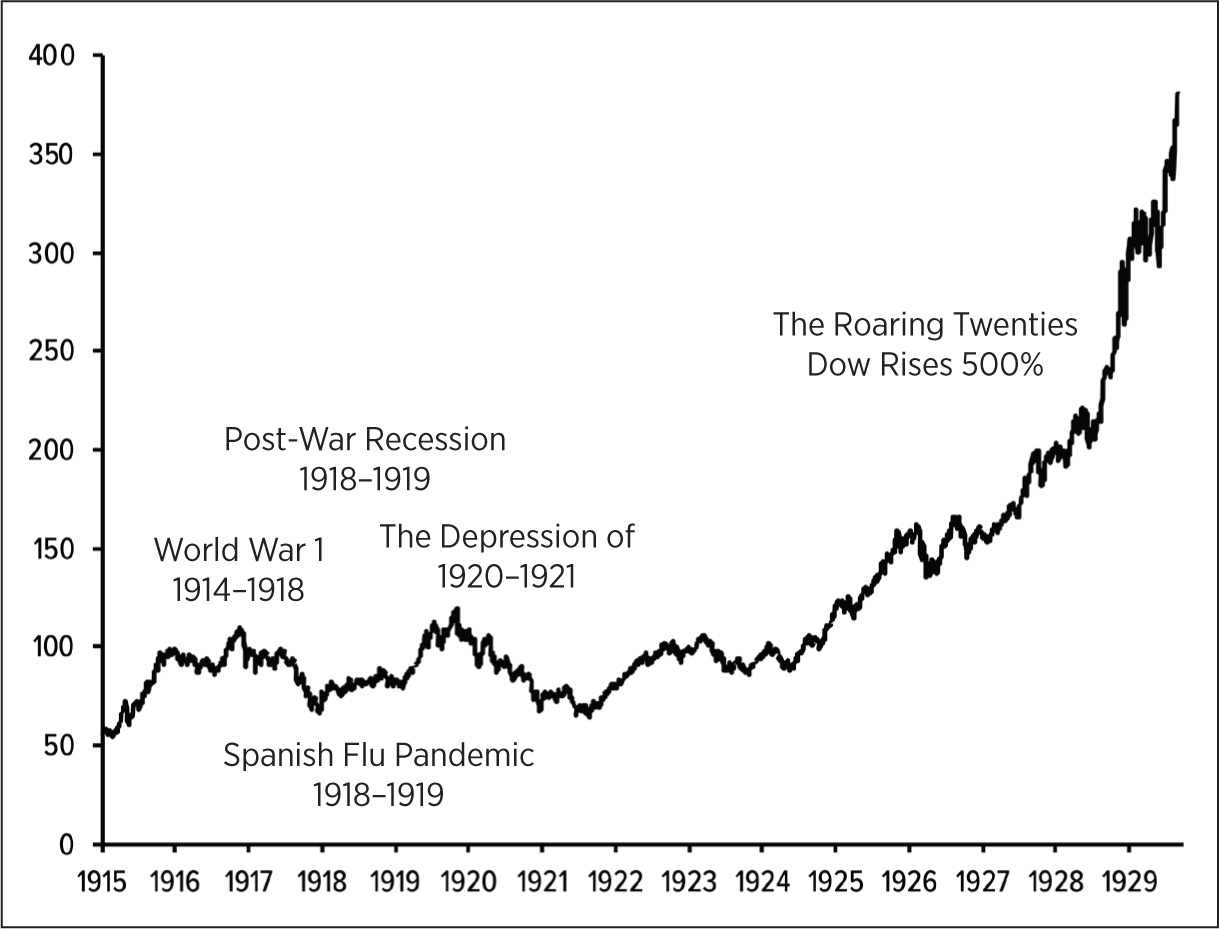
In the two-year window from 1927 to 1928, the Dow Jones Industrial Average was up nearly 100% in total as the Roaring Twenties went to another level. Investor Bernard Baruch initially called the speculative rise in stock prices “madness” and claimed investors were in a state of “delirium.” Baruch could only fight the bull market for so long. By 1929, he published an article that predicted lasting prosperity. The euphoria reeled him in. Most people assumed the good times would last indefinitely. Yale economist Irving Fisher infamously stated just before the stock market peaked, “Stock prices have reached what looks like a permanently high plateau.” Fisher later doubled down, proclaiming, “There may be a recession in stock prices, but not anything in the nature of a crash.”
It was a decade of growth and optimism the likes of which the U.S. had rarely seen. Heading into 1928, President Calvin Coolidge declared the country had entered “a new era of prosperity.”
It wouldn’t last.
An abrupt end to the Roaring Twenties
When it all blew up, F. Scott Fitzgerald declared, “The most expensive orgy in history is over because the utter confidence which was its essential prop received an enormous jolt, and it didn’t take long for the flimsy structure to settle earthward.”
There was no warning. No one rang a bell to let investors know the top was in. The selling began and didn’t let up until a gargantuan stock market crash wiped everyone out. The Dow Jones Industrial Average reached its Roaring Twenties peak on September 3, 1929. It would decline 10% for the rest of that month. Then the real fun began.
Modern investors associate Black Monday with October 19, 1987, when the stock market suffered its worst single-day crash, dropping more than 20%. The original Black Monday took place on October 28, 1929, when the Dow dropped 13.5%, the worst day in stock market history until that point. The next day the market was down almost 12%. In just two days the stock market lost nearly one-quarter of its value. Just like that – poof, gone.
A few days later President Hoover tried to calm the public’s mood by stating, “The fundamental business of the country is on a sound and prosperous basis.” John Rockefeller, who hadn’t made a public statement in decades, said he was buying the dip, “Believing that fundamental conditions of the country are sound my son and I have for some days been purchasing sound common stocks.” Comedian Eddie Cantor later joked, “Sure who else has any money left?”
The answer – no one. Buyers were nonexistent. Things got so bad that there were talks of closing the market. October 1929 was one of the worst months in stock market history. Between 1929 and 1933, U.S. stocks fell by double-digits in 13 different months. Three of those months were losses of 20% or more! The worst came in September 1931, when the market lost nearly one-third of its value.
From 1926 to 2024, the U.S. stock market experienced 26 months with negative double-digit returns. Eighteen of those 26 months took place between 1929 and 1940. Volatility during the Great Crash was otherworldly. In the nine-month stretch from September 1931 through May 1932, the stock market plunged an ungodly 66%. After all of the carnage, the market finally bottomed in the summer of 1932. In a two-month window from July to August of 1932, the stock market surged more than 90%.
In two months! This would mark the bottom. The stock market collapsed by 86% in total, by far the worst crash in U.S. stock market history. This level of loss turned $1 into 14 cents, $1,000 into $140 or $10,000 into $1,400. A $1 million portfolio would be worth $140,000 when all was said and done. It was an unfathomable loss.
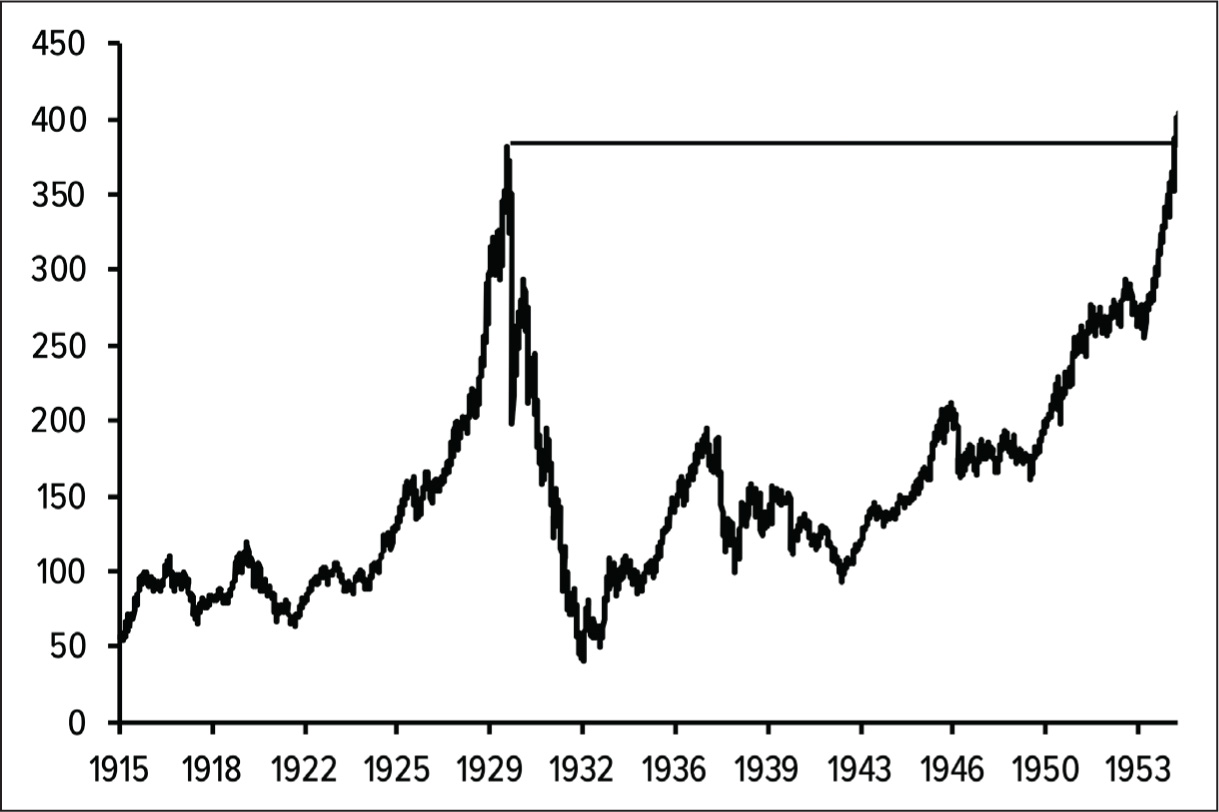
You would need a gain of 615% just to break even on an 86% loss. The stock market wouldn’t reach new all-time highs again on a price basis until 1954 (as shown in Figure 7.2).
Stocks for the long run my derriere, right?
Did the Great Crash cause the recession?
As bad as the stock market crash was in the early 1930s, the economic fallout was even worse. Fred Schwed explained it like this: “The Crash hurt people who had bought common stocks on margin; the depression hurt about everyone who was alive and some not yet born.” The only silver lining to the car crash in the stock market is that most people couldn’t afford to invest in stocks in the first place. It’s estimated that just 2–3% of American households even owned stocks heading into the 1929 peak.
There are still debates to this day about whether the stock market crash caused the Great Depression, or vice versa.
I’ll settle that debate right now – the stock market crash didn’t cause the economic contraction because it was already underway by the time the market peaked in September 1929.
The economy entered a recession the month prior. From September to November of 1929, the unemployment rate in the United States rose from 750,000 to nearly three million. And that was just the beginning.
Financial historian Frederick Lewis Allen dutifully chronicled the American experience in the 1920s and 1930s. He wrote at the time, “Statistics are bloodless things.” The bloodless statistics from the Great Depression are hard to fathom:
The unemployment rate hit nearly 25%. GDP contracted by almost 30%. There were more than 9,000 bank failures. Corporate profits fell by 70%. By 1933, more than 40% of all mortgages were in default. Wages dropped by 60%. In 1929, more than 90% of U.S. companies made a profit. That fell to less than 39% by 1933. Economic production didn’t hit 1929 levels again until 1941 thanks to the Second World War.
The 1930s were filled with breadlines. People couldn’t find jobs. Cash was scarce. Many people couldn’t buy food or pay their bills. Businesses couldn’t pay workers, and banks wouldn’t accept checks they couldn’t cash immediately. Hooverville settlements of makeshift shacks constructed of boxes and scraps were set up on the outskirts of cities on vacant lots. The marriage rate and birth rate fell. Divorces also declined during the Great Depression because couples couldn’t afford to split up.
There was a story about a doctor who smoothed out a single dollar bill on his desk. It was the only money he had taken in for an entire week of work. Teachers went without pay because the banks had no money in their vaults. In the spring of 1932, a crowd of some 50 men were fighting over a garbage can of leftovers in the back of a restaurant. People were literally fighting for scraps of food.
The never-ending depression
The most painful aspect of the 1930s was the sheer length of the economic pain that was seemingly never-ending. The recession itself lasted three years and seven months, but the shockwaves were felt for years after the Great Depression. Out of a U.S. population of roughly 123 million, 13 million people were out of work by 1933. The average number of unemployed workers only fell below 8 million once in the entirety of the 1930s, and that was briefly in 1937 before the onset of yet another recession and stock market crash. By 1938, the unemployment rate was still 20%.
Benjamin Roth was a young lawyer in Ohio during the Great Depression and he kept a journal of his experiences throughout the 1930s. In the summer of 1931, Roth wrote, “It hardly seems possible that things could get worse.” In the spring of 1933, he went back to that original prediction, noting, “This was a poor guess. Conditions in 1932 were much worse.”
The stock market had gained nearly 190% from 1933 to 1936, but the recovery wouldn’t last. The stock market was cut in half, falling more than 50% during the 1937 crash. From 1929 to 1941, the U.S. stock market finished down in nine out of 13 years. That 13-year period saw stocks down 35% in total, an annual return of -3.3% for nearly a decade and a half.
The Great Depression didn’t truly end until the Second World War started and the war-time spending boom kicked in. The Roaring Twenties were a killer party no one wanted to leave. The 1930s were the hangover that wouldn’t quit. The crash was one of biblical proportions that would create an entire generation of investors who didn’t trust the stock market.
So that settles it. This level of risk to the stock market and the economy makes investing in stocks far too dangerous over the long run, right?
Not so fast, my friend. Buy and hold gives you the good with the bad, the ups with the downs and the booms with the busts. The U.S. stock market was up 10% per year from 1928 to 2024. Those returns include the Great Depression. They include the 86% crash. They include the lost decade of the 1930s. Those long-term returns are warts and all.
Let’s say we take out some of those bad times. From 1932 to 2024, the stock market earned annual returns of 11.1% per year. If you start after the Second World War in 1950, it jumps to 11.5% annually. That’s better, but it’s incredible how the U.S. stock market could experience such wonderful results even when you include the worst economic and stock market event in its history. It’s also incredible that you only get around a one percentage point difference in long-term annual returns by taking out the Great Depression crash.
Stocks for the long run depend on your time horizon. There will always be volatility over the short term. You could even experience godawful returns over a decade. But when you have a multi-decade time horizon, the compounding you experience in the stock market can be incredible.