Risk and Reward
Chapter 8
Normal Accidents in the Stock Market
STOCK MARKET
“Another lesson I learned early is that there is nothing new in Wall Street. There can’t be because speculation is as old as the hills. Whatever happens in the stock market today has happened before and
will happen again.”
– JESSE LIVERMORE
WHEN PRESIDENT JOHN F. KENNEDY declared in 1961 that the United
States would put a man on the moon, it was a pipe dream. The government had no rockets, launchpads, spacesuits, computers or knowledge about what it would take to land on the moon. And it wasn’t simply a lack of resources – experts had never studied the problem before so no one even knew what they didn’t know. Scientists didn’t have a clue what the course would be even if they had all of those resources.
NASA spent just $1 million on the space program in 1961 when Kennedy made his bold proclamation. Five years later they were spending $1 million every three hours on the Apollo missions. There were 14 manned Apollo missions in total, the most famous being Apollo 11 when Neil Armstrong and company took one giant leap for mankind by first stepping foot on the moon.
Apollo 13 was more infamous because it never completed its journey. Halfway to the moon, an oxygen tank exploded, stranding astronauts Jim Lovell, Jack Swigert, and Fred Haise in space and knocking out the spacecraft’s primary source of oxygen. The blast was so powerful it was visible from Earth. This was the first disaster of its kind, and the crew had no idea what had happened. They had trained for countless scenarios, but nothing this catastrophic. Swigert later remarked, “Nobody thought the spacecraft would lose two fuel cells and two oxygen tanks. It couldn’t happen. If somebody had thrown that at us in the simulator, we’d have said, ‘Come on, you’re not being realistic.’”
A spacecraft is an intricate web of interdependent components and variables. One malfunction can trigger a cascade of additional problems. Within an hour of the explosion, it became clear the moon landing was out of the question. Getting the astronauts home was now the only priority.
NASA thrives on checklists, but the checklist they now needed didn’t exist. Hundreds of experts on the ground had to invent solutions on the fly, working around the clock. They tried to stay calm under pressure, though one NASA employee later admitted that “a lot of stomachs were turning over.”
The astronauts moved into the Lunar Module which was originally designed for the moon landing. It became a makeshift lifeboat after the main spacecraft lost power and life support. Using the Moon’s gravity as a slingshot, they figured out a course to make it home. Despite near-freezing temperatures and limited power, water, and oxygen, the astronauts executed the new plan to perfection. The crew splashed down safely in the Pacific Ocean and were rescued by the USS Iwo Jima.
Normal accidents and complex systems
Sociologist Charles Perrow calls what happened on the Apollo 13 spacecraft a “normal accident.” Perrow spent his career studying accidents that occurred at nuclear power plants, airplanes and large ships at sea. Perrow argues that in highly complex and interconnected systems, failures are bound to happen due to the unpredictable interactions between the different components at play. These accidents are “normal” in the sense that they are an inherent part of the system’s design, rather than being caused solely by human error or technical failure. And the more complex these systems become, the more prone they are to accidents. Perrow explains:
As systems grow in size and in the number of diverse functions they serve, and are built to function in ever more hostile environments,
increasing their ties to other systems, they experience more and more vulnerable to unavoidable system accidents.
We construct an expected world because we can’t handle the complexity of the present one, and then process the information that fits the expected world, and find reasons to exclude the information that might contradict it. Unexpected or unlikely interactions are ignored when we make our construction.
The Apollo 13 spacecraft was a marvel of engineering, but its complexity made it inherently prone to an accident no one could have possibly foreseen. There are few actions more complex than sending astronauts to the moon. It requires precise calculations, state-of-the-art technology and an unmatched level of planning, training and detail. Perrow says normal accidents will occur within complex systems like this, even if you try to make them safer.
Just as the Apollo 13 disaster demonstrated the unpredictable nature of complex systems, the same forces of interdependence, rapid changes, and unforeseeable events make accidents in the stock market inevitable too. You should expect normal accidents in the financial markets on occasion.
Trying to eliminate risk when dealing with the markets is a futile exercise because risk never completely goes away; it just changes shape. Perrow cautioned against the idea of trying to eliminate risk when he wrote, “Risk can never be eliminated from high-risk systems, and we will never eliminate more than a few systems at best. At the very least, however, we stop blaming the wrong people and the wrong factors, and stop trying to fix the systems in ways that only make them riskier.”
The greatest normal accident in the history of the markets was the Great Depression. And like most complex systems that fail, there was plenty of blame to go around.
What caused the Great Depression?
Finance is a complex, interconnected system and it’s never just one variable that causes the collapse. The Federal Reserve bungled its role as lender of last resort by implementing overly restrictive monetary policy during a rapidly slowing economy. The Hoover administration made many policy mistakes as well. Governments around the globe placed tariffs on commodities and devalued their currencies following the First World War. The gold standard was too rigid. There were too few rules and regulations in place for the banking sector. Households had no financial backstop from the government and no protection from financial predators. There was no unemployment insurance or Social Security checks to rely on. Consumers also borrowed too much money.
My favorite explanation of the Great Depression comes from financial humorist Fred Schwed in his classic book Where Are the Customers’ Yachts?:
In 1929, there was a luxurious club car which ran each week-day morning into Pennsylvania Station. Near the door there was placed a silver bowl with a quantity of nickels in it. Those who needed a nickel* in change for the subway ride downtown took one. They were not expected to put anything back in exchange; this was not money – it was one of those minor conveniences like a quill toothpick for which nothing is charged. It was only five cents.
There have been many explanations of the sudden debacle of October, 1929. The explanation I prefer is that the eye of Jehovah, a wrathful god, happened to chance in October upon that bowl. In sudden understandable annoyance, Jehovah kicked over the financial structure of the United States, and thus saw to it that the bowl of free nickels disappeared forever.
The fear of the First World War and the Spanish Flu pandemic led to the euphoria of the Roaring Twenties. And the euphoria of the 1920s led to the Great Depression and its aftermath. Crashes in the stock market are inevitable because human nature is inevitable. Normal accidents are bound to occur in the stock market because human nature – fear, greed, panic and euphoria – is the one constant across all market cycles.
There are so many competing opinions, goals, time horizons and investment styles that the stock market is bound to be knocked off its axis from time to time. Financial panics and stock market crashes are a feature, not a bug, and they’re never going away. However, just because crashes are inevitable does not mean you should forgo investing in the stock market.
The best and worst 30-year returns ever
The stock market crash of 1929 to 1932 was downright nasty, but it doesn’t necessarily refute the merits of long-term investing. Yes, the stock market was bludgeoned to the tune of an 80%+ wipeout. Yes, stock market investors earned a negative return for the entire decade of the 1930s. Yes, it took many years for investors to break even.
But for investors who measured their time horizon in decades rather than years, they would have made it out just fine. Honestly!
Figure 8.1 shows the annual 30-year rolling returns for the U.S. stock market going back to 1926.
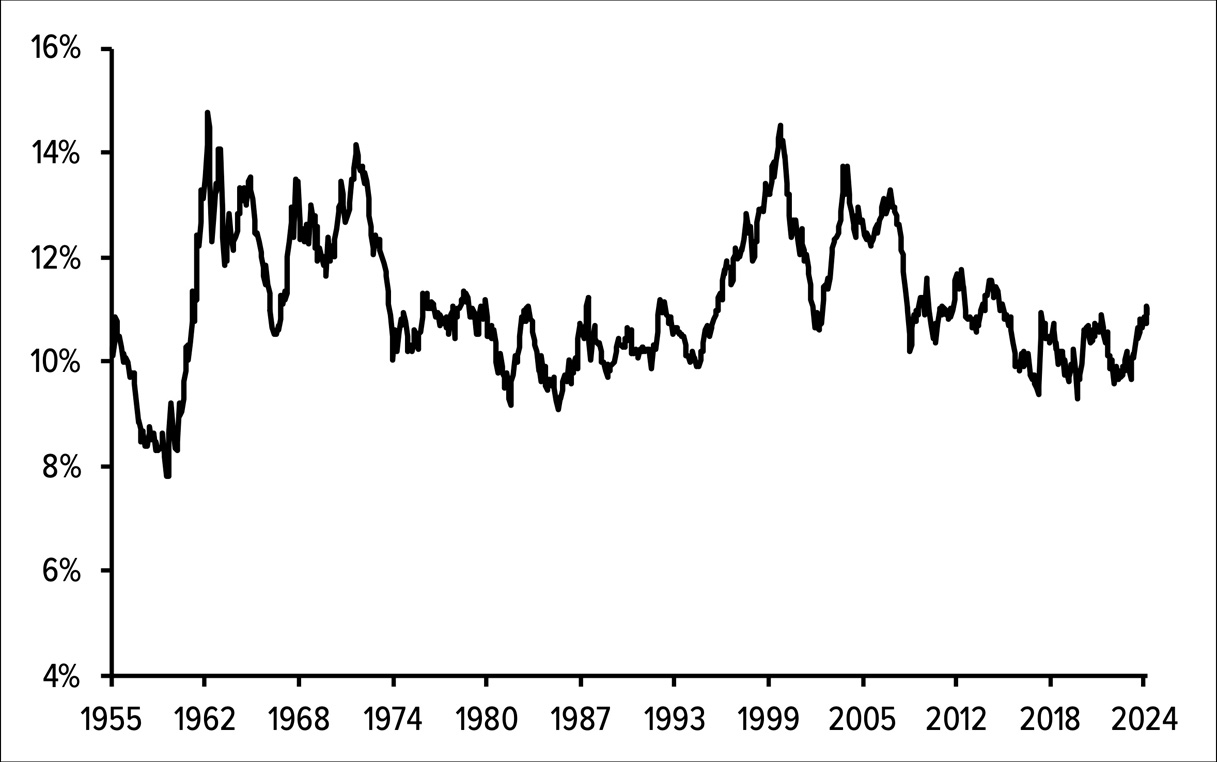
The worst 30-year return in that time was a cumulative gain (including dividends reinvested) of a little more than 850%. That’s good enough for an annual return of 7.8% per year.*
To repeat, the worst 30-year return over the past 100 years or so of U.S. stock market data was a total gain of more than 850%. Time is your friend in the stock market.
That 30-year period ending in the summer of 1959 just so happened to start in September 1929. The onset of the Great Depression was the worst starting point in stock market history (so far), yet those returns would have turned $10,000 invested into nearly $100,000 when all was said and done. The hard part is you would have seen that initial $10,000 fall to less than $2,000 to get there.
Interestingly enough, the highest 30-year return of all time came less than three years later, at the depths of the crash in 1932, with annual returns of 15% per year for three decades. The worst entry point in stock market history quickly turned into the best entry point in a few short years.
And while it is true the stock market didn’t breach the 1929 all-time highs again until 1954, the breakeven, when you include dividends reinvested, came much sooner for real-life investors.
Breaking even
The math of breaking even in the stock market is not pretty at times. If you lose 50% of your money, it requires a return of 100% just to be made whole. If you lose 86% of your investment, the return required to break even is more than 600%. From the summer of 1932 through the summer of 1945, the U.S. stock market was up around 600% in total, recouping all of the losses from the Great Crash. That was good enough for annual returns of more than 16% per year. A lost decade-plus is no fun, but that’s a remarkable comeback considering the size of the crash.
I don’t know if the U.S. stock market will ever experience a calamity of Great Depression-like proportions again. The government has learned from the mistakes of the past and is better equipped to handle financial crises when they hit. The U.S. economy is far more mature, dynamic and diversified; markets are more professionalized; and the Fed has more power to step in as the lender of last resort than it did in the 1930s. But even if we don’t experience a cataclysmic 80% crash in the future, there will still be corrections, bear markets and ferocious losses. Normal accidents are bound to happen when you combine the speed of information with the size and complexity of the global financial markets. The reason for the setbacks doesn’t matter nearly as much as how you react to them.
Building wealth mostly happens by making good decisions ahead of time and staying out of your own way. This is why it’s so important to remain dedicated to a long-term mindset during a downturn. Bear markets tempt you into thinking the days are more important than the years and the years are more important than the decades. My general investment philosophy is that the more bearish things feel in the short run, the more bullish you should be in the long run. There is no guarantee that buying stocks when
they are down will lead to better outcomes, but expected returns should be higher when prices are lower.
Stock market history is littered with cycles of huge gains followed by cycles of bone-crushing losses. It has to be this way or the wonderful long-run returns wouldn’t exist. If the stock market were easy everyone would be a buy-and-hold investor. The fact that it’s not always easy is one of the biggest reasons the stock market goes up over the long term. It’s also why true buy and hold investors succeed.
There’s a scene in Forrest Gump where Forrest and Lieutenant Dan take their shrimp boat, Jenny, out to sea during a hurricane. Forrest was scared. Lieutenant Dan was angry. The storm was intense but, miraculously, their boat survived the massive storm while all the other boats were destroyed. Forrest says, “After that, shrimping was easy.” That’s buy and hold investing. Sometimes you have to ride out a nasty storm to find profits on the other side of it.