Risk and Reward
Chapter 15
The Biggest Bubble Ever
“Nothing obscures your financial judgment on investments more than the sight of your neighbor
getting rich.”
– JP MORGAN
NUI ONOUE WAS raised in a small village in Japan where she lived a life
of poverty.
After moving to Osaka, Japan’s second-largest city, as a young woman she worked in a bar as a hostess, serving drinks to wealthy businessmen. Onoue worked her way up and by the time she was in her mid-30s, she owned her own restaurant and mahjong parlor. For decades, she ran her restaurants without drawing much attention to herself.
By the end of the 1980s, this obscure restaurant owner would become the largest individual stock market investor in all of Japan, which by then was the largest stock market in the world. This woman who had no finance ties whatsoever was worth more than Warren Buffett (on paper). At one point, Onoue owned some $800 million worth of shares in just 20 stocks. She claimed to receive stock tips straight from God Almighty. Her brokers were required to attend weekly Buddhist prayer sessions if they wanted her business and they obliged. Those stock tips from a higher power worked wonders when the Japanese stock market rocketed higher throughout the 1980s. Unfortunately, she didn’t get a heads-up from a higher power before the bubble popped.
J. Paul Getty once said, “If you owe the bank $100, that’s your problem. If you owe the bank $100 million, that’s the bank’s problem.” When the
Japanese stock market blew up, the diminutive restaurant owner was the bank’s problem.
Onoue was in debt to the tune of $3 billion to a handful of Japan’s biggest banks. She was later charged with fraud for using $2.5 billion-worth of forged certificates of deposits as collateral to buy stocks on margin. In short order, Onoue went from being the biggest individual shareholder in Japan to the largest individual debtor in the country once she filed for bankruptcy.
The mania in Japan during the latter half of the 1980s was so insane the banks or the brokers didn’t bat an eyelid at lending billions of dollars to a restaurant owner who claimed to receive stock picks from above. As long as the stock market was going up, no one cared. But stocks eventually stopped going up and it all came crashing down. Onoue was sentenced to 12 years in prison for fraud.
How is it possible that this small-time business owner secured billions of dollars in loans to buy stocks?
It was the biggest financial asset bubble in history, that’s how. With all due respect to tulip mania in the 1600s, the South Sea Bubble of the 1700s, the railway bubble of the 1800s, the Roaring Twenties and the internet bubble of the 1990s, nothing compares to the 1980s financial asset bubble in Japan.
It was uncharted territory, as Japan had never really experienced a financial bubble before. Remarkably, the country is home to over 33,000 businesses that are at least 100 years old – more than 40% of the world’s total. Among them, more than 3,100 have lasted at least 200 years, and 140 have endured for over 500 years. This deep-rooted stability reflects a culture of patience and long-term thinking, a stark contrast to the United States, where economic bubbles seem to emerge every decade or so.
If we’re judging purely by fundamentals alone, the biggest bubble in U.S. stock market history was the dot-com mania of the 1990s. After the S&P 500 rose nearly 650% from 1980 to 1994, the stock market ripped off consecutive gains of 37%, 23%, 33%, 28% and 21% from 1995 to 1999. The Nasdaq 100 was up an ungodly 817% in those same five years. That’s annual returns of 55% per year for five years, which would have turned an initial $10,000 investment at the outset of 1995 into more than $91,000 by the end of 1999.
Every financial asset bubble in history starts out as a good idea that gets
taken too far. The internet has given us everything and more that people were extrapolating back in the 1990s, but we had to go through the dot-com boom bust to get there. Things got silly in a hurry during the boom times. Newly listed tech companies were doubling and tripling the day they went public. Investors were clamoring for any company with .com in its name – business model, revenue or profits be damned. It was the height of euphoric behavior in the U.S. stock market as herd behavior replaced any semblance of rational analysis.
At the apex of the dot-com mania, the U.S. stock market would reach its highest valuations in history by the end of 1999. The stock market was trading at a multiple of almost 45x earnings compared to the long-term average of 17x. To put this number in perspective, the previous high at that point was 33x, which occurred at the stock market peak in September 1929, just before the Great Depression.*
After the dot-com bubble burst in the spring of 2000, the U.S. stock market was cut in half over the ensuing two-and-a-half-year bear market. It was the largest crash investors had experienced since the 1970s. The tech-heavy Nasdaq fell more than 80% and took nearly a decade-and-a-half to break even from those lows.
Despite the exuberance of the dot-com era, the valuations look tame compared to the peak of Japan’s stock market bubble in 1989. Chart 15.1 shows the run-up to peak valuation levels for both Japanese stocks in the 1980s and U.S. stocks in the 1990s on the same scale.
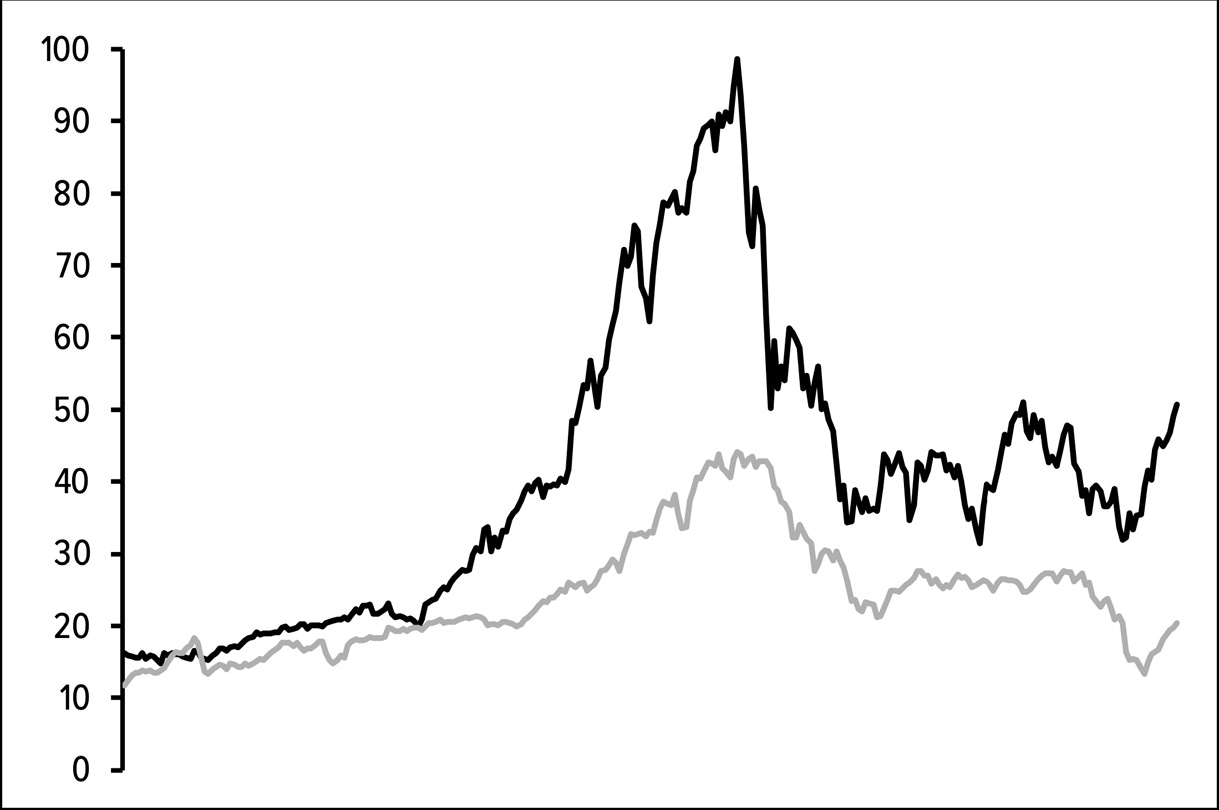
By 1989, valuations for Japanese stocks were more than double the dot-com peak for the S&P 500 in 1999. You could say the dot-com bubble is not in the same ballpark as Japan’s stock market bubble, but that’s not going far enough. It’s not even in the parking lot adjacent to the ballpark. Japan’s stock prices were in a different stratosphere.
In the 1980s, share prices increased three times faster than corporate profits for Japanese corporations. Returns for Japanese equities were ludicrously high in the 1980s, and that was after they performed well in the 1970s. From 1970 to 1989, Japanese large-cap companies were up more than 22% per year, while Japanese small-cap stocks gained closer to 30% per year – for 20 years! A $100,000 investment in Japanese large-cap stocks in 1970 would have turned into more than $5 million by 1989. In small cap stocks over that same time frame, $100,000 would have grown to $19 million. A nation’s stock market simply cannot grow at those rates for that long without causing major imbalances in the economy and financial sector.
Japan’s financial situation was imbalanced to the nth degree. The stock market in Japan went from 29% of GDP in 1980 to 151% by 1989. In 1980, Japan made up 15% of global equity markets by market capitalization. By 1989 it represented closer to 45% of total world stock markets. And this happened while the U.S. stock market appreciated more than 17% per year! Japan was lapping the field.
By the end of the 1980s, everywhere you looked there were magazine cover stories about Japan overtaking the United States as the world’s preeminent economic power. U.S. corporations were being pressured to adopt Japan’s business practices. The market value of Japanese stocks was double that of American corporations, even though the United States had a GDP that was twice the size of Japan’s economy. Japan had seven of the 10 largest banks in the world while the biggest bank – Nomura – had more capital at its disposal than the five largest banks in the U.S. combined.
The craziest thing is the stock market wasn’t even the biggest financial asset bubble in Japan during the 1980s – it was the housing market.
A willful suspension of disbelief
Japan was the biggest asset bubble in history because it wasn’t just a stock market bubble – it was an everything bubble. The housing market was even more overvalued as land speculation took off like an Apollo spacecraft.
Here are some crazy but true Japanese real estate facts and figures from the bubble times:
From 1956 to 1986, land prices increased by 5,000% even though consumer prices only doubled in that time. By 1990, the total Japanese property market was valued at over 2,000 trillion yen, or roughly 4x the real estate value of the entire United States, despite the U.S. being 25x larger in terms of landmass and having 200 million more people. Tokyo itself was on equal footing with the U.S. in terms of real estate values. At the market peak, the grounds of Tokyo’s Imperial Palace were estimated to be worth more than Canada’s entire real estate market. The property market in Japan in 1989 was five times the size of Japan’s economy.
A common trait every financial bubble shares is the deliberate suspension of disbelief, and the Japanese housing boom was no exception. People in Japan adopted a misguided mindset, believing they didn’t need to worry about skyrocketing land values because land transactions are infrequent in the country. Both the public and government officials convinced themselves that the soaring land prices were illusory – an attitude that is a hallmark of financial manias.
Christopher Wood, the former editor of The Economist in Japan, wrote about how this suspension in disbelief played out in the Japanese housing market in his book, The Bubble Economy:
For all its high-tech gadgetry and automated vending machines, Japan remains a feudal society at heart whose members, like peasants throughout the ages, believe in the value of land. Behind many a salaryman there is a grandfather or elderly relative still toiling in the fields. Their blue-suited salaried offspring still count their net worth primarily as the dirt on which their prefabricated houses sit.
In Japan virtually all of the value of a property lies in the land, not the building. As a result, buildings are knocked down and replaced with almost reckless abandon.
I guess since they valued the land so much more than the buildings
the assumption was the actual price of the land didn’t matter.
The problem with this mindset was the sheer number of individuals and financial institutions that received loans backed by land with sharply rising values. Banks issued these loans, insurance companies invested in the bonds tied to them, and households borrowed against their inflated value. Expecting people to overlook the fact that their paper wealth had soared was delusional.
It’s irrelevant whether properties are rarely sold. A stock market mania can create a wealth effect that influences corporate behavior and household risk-taking. A housing boom affects even more parts of the economy – banks, loan officers, construction, households, institutional investors, and more. It’s nearly impossible to prevent the ripple effects from spreading throughout the economy.
Charles Kindleberger referred to the Japanese bubble economy as a “perpetual motion machine.” Higher real estate prices led to higher stock prices which led to more capital available for lending at the Japanese banks.
In 1979, consumer debt in Japan was nine trillion yen. By 1991, it had increased sevenfold to 67 trillion yen. Wealthy Japanese business tycoons began borrowing against their real estate holdings to purchase vast art collections. One Japanese collector doubled the previous record for sales of Van Gogh and Renoir paintings. More than 160 golf courses were built in Japan between 1989 and 1991. There were another 1,200 under construction or in the approval process that never got completed once the bubble burst. The price of the golf memberships traded like stocks. There were over 20 golf clubs that cost more than $1 million to join. At the peak of the euphoria, Japan’s 1,700 golf courses were estimated to have a total membership market value of some $200 billion.
Of course, Isaac Newton’s theory of gravity showed up in Japan eventually. Japan’s central banks had seen enough and began raising interest rates to slow the speculation. They set out to prick the bubble and did they ever. Interest rates doubled between early 1989 and late 1990, which finally stopped the mania in its tracks. The perpetual motion machine then began to unwind.
Quantitative investment pioneer Cliff Asness once remarked, “The term bubble should indicate a price that no reasonable future outcome can justify.” By the late 1980s, valuations in both Japanese stocks and real
estate had soared to such extreme heights that no conceivable future outcome could justify them.
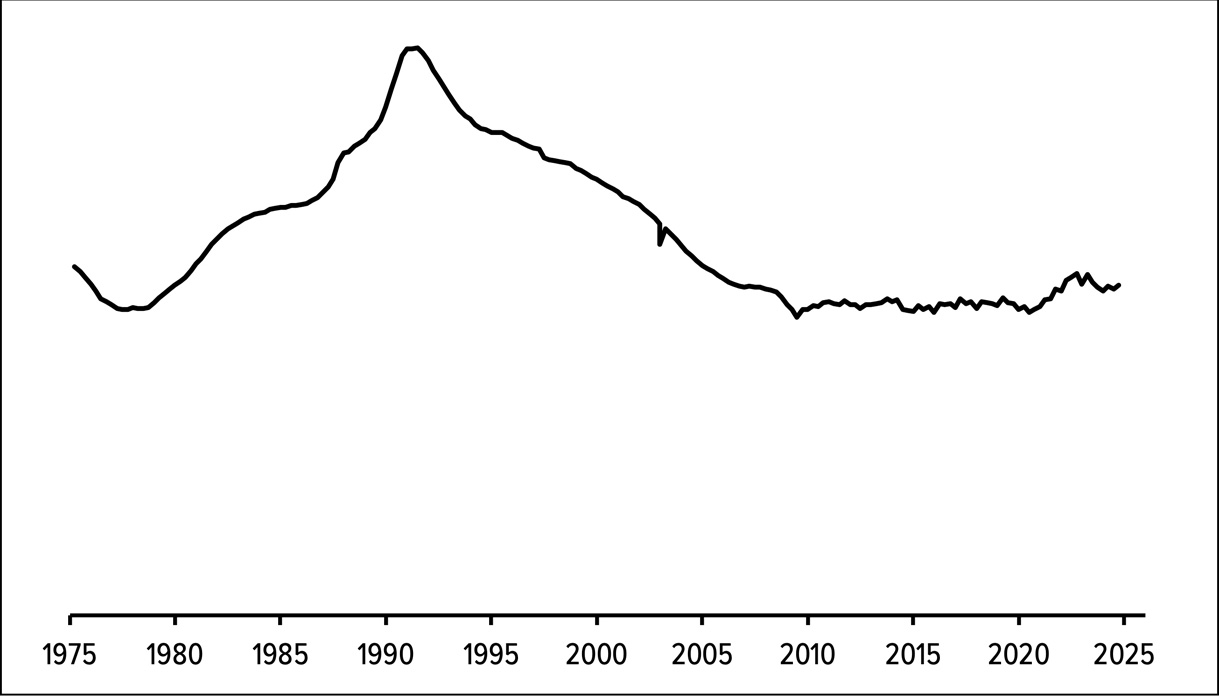
Thirty-five years later, housing prices in Japan were still more than 40% below where they were at the peak of the bubble in 1989 on an inflation-adjusted basis, as shown in Figure 15.2.
From 1970 to 1989, the worst drawdown for the Nikkei 225 index of Japanese stocks was -37%. Once the bubble burst, the Nikkei fell nearly 50% in the first nine months of 1990 alone. By 1993, the market was down almost 60%. As bad as those losses were, the worst part about it wasn’t necessarily the magnitude of the crash but the length of time over which it occurred. There have been lost decades, singular, in the U.S. stock market. Japanese stock market investors experienced back-to-back-to-back lost decades.
The Nikkei didn’t technically bottom until the end of the Great Financial Crisis in early-2009, a full 20 years after the peak! At that point, the Japanese stock market was down more than 80% from the 1989 highs. The stock market finally started going up in the 2010s, but remained underwater from the 1989 highs until new all-time highs were finally reached in 2024.
On a total return basis, which includes dividends reinvested, the MSCI Japan Index was up a grand total of 63% from 1990 to 2024. That’s an annual return of 1.4% per year. You would have been better off investing in bonds or T-bills for three-and-a-half decades than investing in Japanese stocks at the peak in 1990, with much less volatility to boot. By 2024,
Japan’s stock market was just 6% of world stock market capitalization, down from the peak of 45% in 1989. Japan was all risk with little-to-no reward for three-and-a-half decades.
This is why Now show Japan exists. An entire generation of stock market investors in one of the biggest developed economies in the world experienced dreadful, terrible, no-good returns over the long run.
Japan was such a money loser for investors for so long that it disproves the idea of stocks for the long run, right? How could you possibly believe in buy-and-hold when a situation like this has played out?
I still believe! Long live buy and hold! In the next chapter, I’m going to put Now Show Japan into perspective and provide some context around how to think about the long run when investing in the stock market. As you’ll see, the Japan story is the very reason why it’s so important to think and act for the long term when it comes to compounding your capital.