The Case for Investing in America
Chapter 5
The Dollar's Empire
Why the World's Reserve Currency Is the Investor's Greatest Tailwind
In July of 1944, while the Second World War was still being fought, delegates from forty-four nations gathered at a hotel in the mountains of New Hampshire to decide something that sounds technical and turned out to be momentous. They were going to choose the world's money.
The setting was a resort called Bretton Woods, and the question on the table was how international trade and finance would work once the war ended and the world had to be rebuilt. The British delegation, led by the economist John Maynard Keynes, proposed a neutral international currency belonging to no single nation. The American delegation proposed something simpler: the dollar. And because the United States at that moment held the majority of the world's gold reserves and stood as the only major industrial power not in ruins, the American proposal won. Other currencies would be pegged to the dollar; the dollar would be convertible to gold. The dollar became, in effect, the world's money.
That decision, made in a mountain hotel before most of the men in the room knew who would even win the war, set in motion an advantage that every American investor still enjoys today, usually without realizing it. The dollar's role at the center of the global financial system is the most underappreciated tailwind in investing. It is the wind at your back that you cannot feel because you have never known anything else.
This chapter is about that wind — where it comes from, how it benefits you, what threatens it, and why, despite the perennial predictions of its demise, it has proven remarkably durable.
THE PRIVILEGE WITH THE PERFECT NAME
In the 1960s, a French finance minister named Valéry Giscard d'Estaing — who would later become president of France — gave this arrangement a name so apt that it has never been improved upon. He called it America's exorbitant privilege.
He did not mean it as a compliment. He meant it as a complaint, and to understand his irritation is to understand the advantage precisely. Consider what it costs to produce a hundred-dollar bill — a few cents of paper and ink. Now consider that other nations must hand over a hundred dollars' worth of real goods and labor to obtain that bill, because they need dollars to trade, to hold as reserves, to price their oil and their debt. The United States produces the thing the world must acquire at great cost, and produces it almost for free. From the French finance minister's chair, that looked exorbitant indeed.
But strip away the resentment and look at the mechanism, because the mechanism is what matters to you. When the entire world needs to hold dollars — to conduct trade, to stabilize their own currencies, to keep as a safe reserve — there is permanent, structural demand for dollars and for dollar assets. And the safest, most liquid dollar asset of all is the debt of the United States government. So the world's need for dollars translates directly into the world's appetite for American government bonds.
This is where the privilege becomes concrete for the investor. When there is enormous, persistent global demand for your government's bonds, that government can borrow more cheaply than it otherwise could, because it does not have to offer high interest rates to attract buyers — the buyers are already lined up out of necessity. Cheaper government borrowing ripples through the entire economy. It lowers the baseline cost of capital against which every other investment is measured. It makes mortgages, business loans, and corporate financing cheaper than they would be in a country without this advantage. The whole American financial system runs on cheaper fuel, and cheaper fuel means a faster engine.
THE TAILWIND YOU HAVE NEVER FELT
I called this an invisible wind, and I want to explain why the invisibility is the whole point.
An investor in most countries lives with a quiet, constant drag that the American investor never experiences and therefore never appreciates. If you invest in a smaller economy with a less-trusted currency, you carry a permanent risk that the value of your currency will erode against the dollar, silently destroying your returns even when your investments perform well in local terms. You carry the risk that in a crisis, capital will flee your currency for the safety of the dollar, crushing the value of everything you own. You carry higher borrowing costs, because the world does not line up to buy your government's debt. These drags are so constant for most of the world's investors that they simply accept them as the weather.
The American investor lives in a different climate and rarely notices. When global crisis strikes — and we have seen that crises strike regularly — capital does not flee America. It flees to America. In the worst moments of fear, when investors everywhere are desperate for safety, the thing they buy is dollars and American government bonds. The dollar is the storm shelter of the entire world. This means that the American investor's home currency tends to strengthen precisely when global danger is highest, exactly the opposite of the experience of nearly every other investor on earth.
Think about what that does over a lifetime of investing. The investor in a weaker-currency nation is swimming against a current; the American investor has the current at his back. Both might pick the same companies, earn the same nominal returns, and yet end up in dramatically different places, because one of them spent decades fighting currency erosion and crisis flight while the other was quietly carried forward by the world's demand for his money. This is the dollar tailwind, and it is one of the strongest arguments for anchoring an investment life in American enterprise — including, as we will see, for investors who do not even live in America.
FROM GOLD TO OIL TO TRUST
The dollar's role has not stood still since 1944, and the way it has evolved tells you something important about its durability.
The original Bretton Woods arrangement, with the dollar tied to gold, eventually broke under its own success. By the early 1970s, the United States had issued far more dollars than it had gold to back them, as it funded foreign commitments and domestic programs. Foreign governments, sensing the imbalance, began demanding gold for their dollars, and the gold was draining away. In 1971, President Nixon ended the dollar's convertibility to gold — a moment that should, by the logic of the original system, have destroyed the dollar's special status.
It did not. And the reason it did not is the most revealing fact in this entire chapter. The dollar remained the world's reserve currency even after the gold that supposedly justified it was gone. The arrangement that replaced gold was, in part, the role of the dollar in global energy markets — oil priced and traded in dollars, which kept the world needing dollars to buy the most essential commodity on earth. But beneath even that lay something deeper and harder to name: trust. The world continued to use the dollar because the alternative was worse, because American markets were the deepest and most liquid, because American institutions — courts, the central bank, the rule of law — were the most reliable, and because no other currency offered the same combination of safety, liquidity, and scale.
This is the crucial insight. The dollar's dominance is not ultimately backed by gold or even by oil. It is backed by the same thing that backs everything else in this book: the depth, reliability, and trustworthiness of American institutions. The dollar is strong because America is a place where, when you park your wealth, you are confident you can retrieve it, in a functioning currency, protected by a functioning legal system, in the deepest market in the world. Strip the dollar of its gold and it survived. That is how you know what it actually rests on.
THE PRIVILEGE IN A CRISIS, MADE CONCRETE
Abstract talk of "demand for dollar assets" can stay abstract until you watch it operate in a real emergency, so let me make it concrete with the pattern that repeats in every global panic.
When fear sweeps the world's markets — a financial crisis, a war, a sudden shock no one saw coming — investors everywhere do the same thing almost reflexively. They sell whatever they consider risky and rush toward whatever they consider safe. And the destination of that flight, again and again, is the United States: its currency and its government bonds. Money pours into America at exactly the moment it is fleeing almost everywhere else. The dollar strengthens. American government bonds rise in value as buyers pile in. The very center of the storm becomes the calmest harbor in it.
Pause on how strange and how valuable this is. In some crises, the trouble originated in America, and yet the world still fled toward American assets for safety, because even an American crisis felt safer to global investors than the alternatives. There is no clearer demonstration of what the reserve role really means. It is not that America never has problems. It is that, when the whole world is frightened, American assets are where the frightened money goes — which means the American investor's home base tends to be the strongest thing standing precisely when strength is scarcest.
For the investor, the lesson compounds the argument of the earlier chapters. We saw that crises are temporary and that the patient owner of American enterprise recovers and grows. Now add this: during those very crises, the dollar and American bonds tend to act as ballast, strengthening as fear peaks. The reserve role does not eliminate the storms, but it ensures that an investor anchored in American assets is anchored in the one place the entire world treats as shelter. That is an advantage you cannot buy and cannot easily replicate by any other means. It comes built into the choice to own American enterprise.
THE CHALLENGERS, HONESTLY ASSESSED
I would be writing propaganda rather than analysis if I did not take seriously the predictions that the dollar's reign is ending. These predictions are made constantly, by serious people, and intellectual honesty requires me to engage them rather than wave them off.
The case against the dollar usually runs like this. America runs large deficits and carries enormous debt, funded in part by the very privilege we have been discussing — and privileges abused tend eventually to be lost. Rival powers, resentful of American financial dominance and the leverage it gives Washington, are actively working to build alternatives, to trade in their own currencies, to reduce their dependence on the dollar. New forms of money, including digital currencies, threaten to route around the dollar entirely. Surely, the argument goes, no arrangement lasts forever, and the dollar's day will eventually end.
Here is my honest assessment. The long-run argument is not wrong in principle. No reserve currency in history has reigned forever; the dollar inherited the role from the British pound, which inherited it from others before. It would be foolish to claim the dollar is eternal. The abuse of the exorbitant privilege is real, and the accumulation of debt is a genuine vulnerability that a wise investor should not dismiss.
But the predictions of imminent dollar collapse have been made, continuously, for over half a century, and they have been wrong the entire time — for a reason that the challengers consistently underestimate. To replace the dollar, the world does not merely need to dislike it. It needs an alternative, and the alternative must offer the same depth, the same liquidity, the same institutional reliability, the same rule of law, the same trustworthiness in a crisis. And no such alternative currently exists. The rivals who wish to displace the dollar do not yet offer markets as deep, institutions as trusted, or legal protections as reliable. Resentment of the dollar is abundant; a credible replacement is not. Until one exists, the dollar persists not because the world loves it but because the world has nowhere better to go.
For the investor, the practical conclusion is balanced. Do not assume the dollar's dominance is permanent and unshakeable; that complacency is its own risk. But do not be stampeded by the perennial collapse predictions either, because they have a perfect record of being early by decades. The tailwind is real and durable, even if it is not eternal.
WHAT THIS MEANS FOR HOW YOU INVEST
Let me bring this down from geopolitics to your actual portfolio, because that is where it has to land.
The dollar's role reinforces, rather than complicates, the central argument of this book. The same structural advantage that lets the American government borrow cheaply, that draws the world's frightened capital to American shores in every crisis, that makes American markets the deepest and most trusted on earth — that advantage accrues to the owner of American enterprise. When you anchor your investing in American business, you are not only buying the innovation premium of the last chapter. You are also positioning yourself in the currency and the markets that the entire world treats as its safe harbor.
There is a subtle further point worth making. Because so much of the world's wealth flows toward American markets seeking that safety, American enterprise enjoys access to a deeper, cheaper, more reliable pool of capital than businesses almost anywhere else. The companies you own can raise money on better terms, fund their growth more cheaply, and weather storms more easily, precisely because they operate inside the financial gravity well that the dollar's role creates. The reserve currency advantage is not just about your returns in a crisis. It is woven into the everyday competitive position of every American company you own.
This is why even an investor sitting in another country — in Lagos or London, Mumbai or São Paulo — has good reason to anchor a portfolio in American enterprise. They are not abandoning their home. They are accessing the deepest, most liquid, most institutionally reliable market in the world, denominated in the currency that the entire global system treats as its foundation. In a later chapter we will get practical about exactly how a non-American investor does this. For now, hold the principle: the dollar's empire is a tailwind, and the tailwind is available to anyone willing to invest in American business.
THE WIND AT YOUR BACK
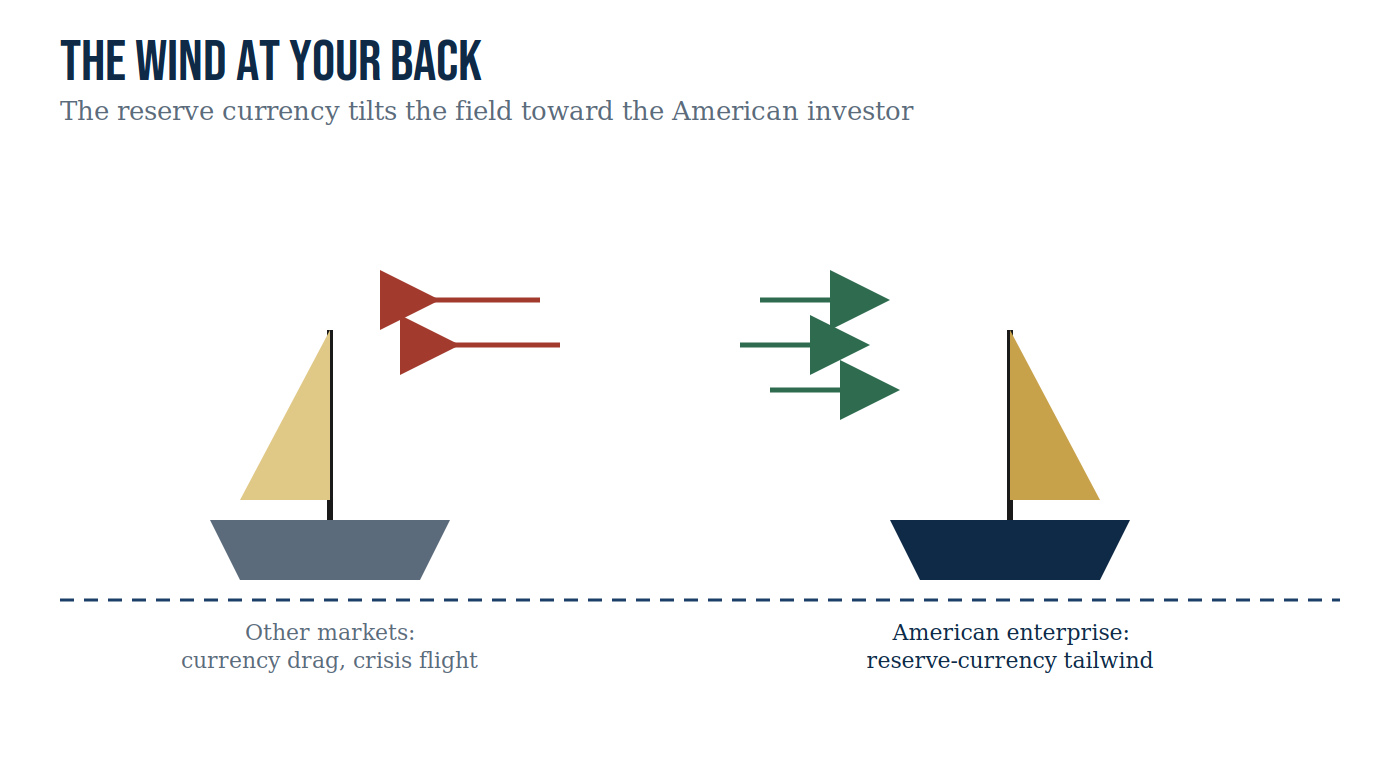
Figure 5.1 — The reserve-currency tailwind.
Every investor wants an edge — some advantage that tilts the odds in their favor over a lifetime of compounding. Most of the edges people chase are illusions: the hot stock tip, the clever timing, the secret formula. The real edges are structural and boring, and this is one of the biggest of them all, hiding in plain sight.
To invest in American enterprise is to invest with the world's reserve currency at your back — to own assets denominated in the money that the entire planet treats as safety, in markets the whole world funds, protected by the institutions the world trusts most. The French finance minister called it an exorbitant privilege, and he was right, though he meant it as an accusation. For the investor, it is simply the wind at your back, blowing in the same direction for eighty years and counting.
We have now seen three of America's structural advantages: the self-renewing economy that converts crisis to growth, the innovation premium that grows the pie, and the dollar's empire that tilts the financial field. Next we turn to an advantage so fundamental that it underlies all the others, and so simple that it is easy to overlook. America, almost alone among the wealthy nations of the world, never stops growing. We turn to people.