The Case for Investing in America
Chapter 6
The Demographic Dividend
America's Secret Weapon — It Never Stops Growing
Here is a fact that sounds too simple to be important, and is actually one of the most important facts in this entire book.
An economy is, at its foundation, people. People working, people inventing, people buying things, people building families and households that need homes and food and cars and education and ten thousand other things. Strip away all the financial sophistication and what you have left is this: more people, doing and wanting more things, is the raw fuel of economic growth. And a nation that keeps adding people — the right people, in the right way — has a structural growth advantage that compounds quietly across generations, beneath all the noise of markets and politics.
The United States has this advantage to a degree that almost no other wealthy nation can match. While much of the developed world is aging and, in many cases, beginning to shrink, America keeps growing. This is its secret weapon, hiding in plain sight, and it is one of the deepest reasons to believe the long upward march of American enterprise has decades of fuel left in the tank.
This chapter is about that fuel: where it comes from, why it matters so much more than people realize, and what it means for an investor trying to position for the next several decades.
THE DEMOGRAPHIC DIVERGENCE
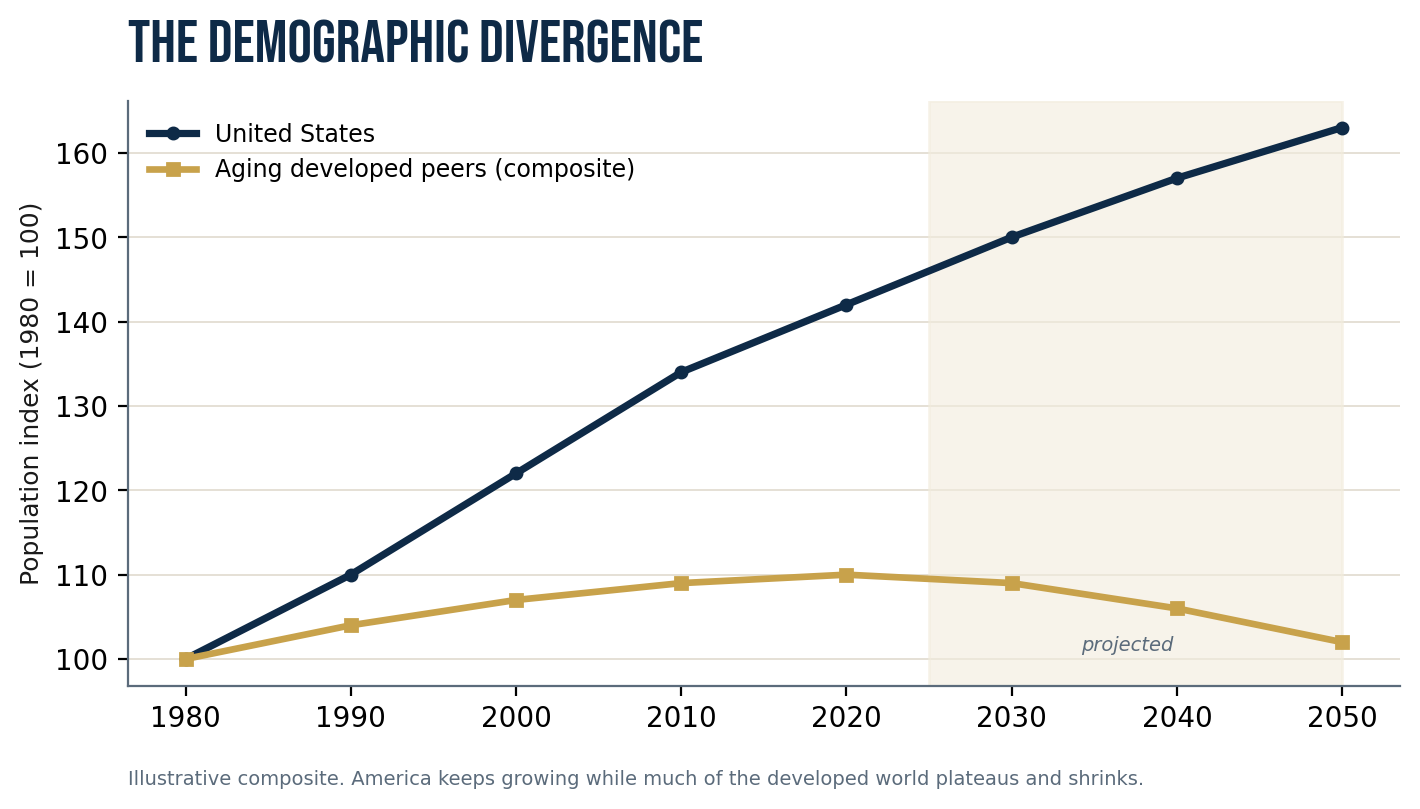
Figure 6.1 — The demographic divergence.
To understand America's advantage, you have to see it against the backdrop of what is happening elsewhere, because the contrast is stark and getting starker.
Across much of the developed world, the story is one of demographic winter. Birth rates have fallen below the level needed to maintain a stable population. The result, working its way through these societies with the certainty of arithmetic, is populations that are growing older and, increasingly, smaller. Fewer young people enter the workforce. More older people leave it and draw on it. The ratio of workers to retirees deteriorates. This is not a forecast that might or might not come true; it is largely already baked in, because the children who would reverse it were not born twenty and thirty years ago and cannot be conjured now.
A shrinking, aging population is an economic headwind of the most fundamental kind. Fewer workers means less production. Fewer young households means less of the spending — on homes, on goods, on raising families — that drives so much economic activity. More retirees drawing on fewer workers strains every system built on the assumption of growth. An economy in demographic decline is an economy trying to climb a staircase that is slowly turning into a descending escalator.
America is not immune to these pressures — its own birth rate has declined, and its population is aging too. But America has a release valve that the others largely lack, and that valve has been the country's demographic secret for its entire history. America grows its population not only by birth but by attraction. It has been, for most of its existence, the place the world's people want to come to. And that single difference changes everything.
THE ENGINE OF ARRIVAL
I want to handle this carefully, because immigration is among the most politically charged subjects there is, and I have no interest in arguing anyone's politics. My purpose here is narrow and economic: to explain, as neutrally as I can, why a steady inflow of people has been such a powerful engine of American growth, regardless of what one thinks about any particular policy.
Start with the basic arithmetic. When the developed world is aging and shrinking, the nation that can still add young, working-age people to its population gains a relative advantage automatically, simply by not declining when others are. America's history of attracting people from elsewhere has meant that, even as its own birth rate fell, its total population kept rising and its workforce kept being replenished. While other wealthy nations face the grinding math of more retirees and fewer workers, America's inflow of people has softened that math considerably.
But the advantage runs deeper than raw numbers. Consider who tends to undertake the enormous effort of moving to a new country to build a life. It is, disproportionately, the ambitious, the determined, the willing-to-risk — the people with enough drive to leave everything familiar behind and start over. A nation that attracts such people is importing not just workers but a particular kind of human capital: energy, ambition, and risk tolerance, the very traits that fuel the entrepreneurship and innovation we discussed two chapters ago. It is not a coincidence that an extraordinary share of America's most transformative companies were founded by immigrants or their children. The engine of arrival and the innovation premium are connected; the people who come are precisely the people who build.
And there is a third layer, which is demand. Every new household is a new source of economic activity — a family that needs housing, that buys goods and services, that participates in the economy as both producer and consumer. Population growth is not just more workers; it is more customers. It is a continuously expanding base of demand that gives American companies a growing home market while companies in shrinking nations fight over a shrinking one. For the investor who owns American enterprise, this expanding domestic demand is a tailwind underneath the earnings of nearly every company in the portfolio.
Workers, builders, and customers. That is what the engine of arrival has delivered, and it is why America's demographic profile has been such a durable economic advantage.
THE WEALTH IN MOTION
There is a second demographic force at work in America right now, distinct from immigration and enormous in its own right, and it will shape markets for decades. It is the largest transfer of wealth in human history, and it is just beginning.
The generations that accumulated vast wealth over the postwar decades are now aging, and their wealth is beginning to pass to their children and grandchildren. The sums involved are staggering — tens of trillions of dollars moving from one generation to the next over the coming years. This is not abstract. It is a tidal movement of capital that will reshape who owns assets, how they are invested, and where demand flows in the economy.
For the investor, this wealth in motion matters in several ways. The generations inheriting this capital will need somewhere to put it, and the deep, trusted American markets are the natural destination, reinforcing the flow of capital into American enterprise. The inheritors are also entering or occupying their prime earning and spending years, the stage of life when households form, homes are bought, and consumption peaks — adding another layer of demand to the economy. And the sheer scale of the transfer means that the patterns of investment among the next generations will be one of the defining market forces of the coming decades.
I raise this not to make a specific prediction about how it will unfold — that would be the forecasting game I keep warning against — but to make you aware of the magnitude of the demographic forces in play. America is not a static population slowly aging into decline. It is a country with a continuous inflow of new people at one end and the largest wealth transfer in history flowing through the middle, both of them feeding demand and capital into the economy you are investing in.
HOW PEOPLE BECOME EARNINGS
It is worth slowing down to trace exactly how something as broad as "population growth" turns into something as specific as the rising value of a portfolio, because the chain is more direct than most investors realize, and seeing it makes the demographic argument concrete rather than vague.
Start with a simple truth about what a stock actually is. When you own a share of a company, you own a claim on that company's future earnings. The value of your stake, over the long run, rises and falls with the company's ability to earn more over time. So the real question for any long-term investor is: what makes the companies you own able to grow their earnings, decade after decade?
A large part of the answer is demand. A company's earnings grow when more people buy more of what it sells. And in an economy with a growing population, the pool of potential customers expands automatically, year after year, household after household. The home market for nearly every American company gets larger over time, not smaller. A retailer has more shoppers. A homebuilder has more families needing homes. A bank has more customers needing accounts and loans. A maker of goods has more buyers. This expansion of demand flows directly into the earnings of the companies you own, and through their earnings, into the value of your investment.
Now set that against a company operating in a shrinking nation, fighting for a slice of a market that gets smaller every year. Even a brilliantly run company faces a brutal headwind when its customer base is contracting. It must take share from rivals just to stand still, because the pie itself is shrinking. The American company, by contrast, can grow simply by serving a growing population — the pie itself is expanding beneath it.
This is the mechanism by which the demographic dividend becomes investment returns. People become customers; customers become demand; demand becomes earnings; earnings become the rising value of the enterprise you own. The chain is unglamorous and utterly reliable, and it runs underneath the entire American market, quietly lifting the earnings power of the broad economy in a way that compounds across the very decades a long-term investor cares about most.
WHY DEMOGRAPHICS IS DESTINY, SLOWLY
There is an old saying among those who study these things: demographics is destiny. It overstates the case, as slogans do, but it points at something true and worth understanding, especially for an investor.
What makes demographic forces so powerful is precisely that they are slow and nearly impossible to reverse. The number of twenty-five-year-olds twenty-five years from now is already constrained by the number of children alive today. The aging of a population unfolds with the steadiness of a tide because it is driven by birth and death rates that change only gradually. This makes demographic trends among the most predictable forces in all of economics — far more predictable than interest rates, market cycles, or political outcomes, which lurch and surprise.
For the investor, this predictability is a gift, because it lets you position for a tailwind that you can actually see coming. You cannot know what the market will do next year. You cannot know which company will win the next technological race. But you can know, with unusual confidence, that America's population is likely to keep growing while much of the developed world's shrinks, that this divergence will compound over decades, and that a growing population of workers and consumers is a structural tailwind beneath American enterprise. Among all the forces shaping long-term returns, demographics is the one you can most nearly count on.
This is why the demographic dividend belongs in the same conversation as the innovation premium and the dollar's empire. It is not a flashy advantage. There is no dramatic story to tell about population growth the way there is about a breakthrough invention or a financial crisis. It works in the background, slowly, invisibly, decade after decade. But slow, invisible, and reliable is exactly what you want in the foundation of a multi-decade investment. The demographic dividend is the quiet ballast beneath the whole American story.
THE HONEST CAVEATS
I have made demographics sound like an unalloyed advantage, and intellectual honesty requires me to complicate the picture, because the picture is genuinely more complicated.
America's own birth rate has fallen, as I noted, and the long-run trajectory of its population growth depends heavily on factors — including immigration policy — that are contested and uncertain. It would be wrong to tell you that America's demographic advantage is guaranteed to persist at its historical strength. Policy choices, cultural shifts, and global conditions could all alter the inflow of people that has been so central to the country's growth. The advantage is real, but it is not automatic, and it depends on choices the country continues to make.
There are also real costs and frictions associated with population growth and demographic change — strains on infrastructure, on housing, on public services, and genuine social and political tensions that I am deliberately not wading into because they are beyond the scope of an investment argument. I mention them only so that you understand I am not painting a naive picture. Demographic growth is a powerful economic tailwind and a source of real challenges, both at once. Mature judgment holds both truths.
But here is the comparison that ultimately matters for the investor. Every advantage is relative. The question is not whether America's demographic future is perfect — it is whether it is better than the alternatives. And on that question, the answer is clear. A nation wrestling with the challenges of a still-growing, still-renewing population is in a fundamentally stronger position than a nation facing the grinding, hard-to-reverse arithmetic of decline. America's demographic challenges are the challenges of growth. Much of the developed world faces the challenges of shrinkage. Given the choice, the investor wants to own the economy with the growth problems.
POSITIONING FOR THE LONG DEMOGRAPHIC TAILWIND
Let me close, as I have in each of these chapters, by connecting the structural advantage back to the actual practice of investing.
The demographic dividend reinforces, once again, the central thesis of this book: that the patient owner of broad American enterprise is positioned to capture forces far larger and more durable than any individual investment decision. You do not need to do anything clever to benefit from America's demographic advantage. You do not need to identify which companies will benefit from population growth or the wealth transfer. You simply need to own the broad American economy, and let the rising tide of people, demand, and capital lift the whole.
This is the recurring elegance of the argument. Each of America's structural advantages — the self-renewing economy, the innovation premium, the dollar's empire, and now the demographic dividend — points to the same conclusion. The advantages are too broad, too structural, and too deeply woven into the whole economy to be captured by picking individual winners. They are captured, automatically and reliably, by owning the whole and holding it across the decades over which these slow forces compound.
A growing population is the most basic engine of economic growth there is, and America, almost alone among the wealthy nations, still has it running. While the rest of the developed world confronts the descending escalator of demographic decline, America keeps climbing, fueled by the people who keep arriving and the wealth that keeps moving. For an investor thinking in decades rather than quarters, that is among the most reassuring facts there is.
We have now assembled four of America's great structural advantages. But advantages mean nothing without something to protect them — without the deep institutional bedrock that ensures the engine keeps running, the rules keep holding, and the wealth you build is actually yours to keep. That bedrock is the real moat, and it is where we turn next.