The Case for Investing in America
Chapter 7
Institutions That Hold
Why America's Market Infrastructure Is the Real Moat
Picture two investors, both alive in the autumn of 1929, both watching their wealth evaporate as the stock market collapses around them. One of them lives in the United States. The other lives in Germany. At that moment, their situations look identical — the same fear, the same losses, the same sense that the floor has given way.
Now run the clock forward twenty years and look at where each one ended up.
The American investor lived through a brutal depression, then a war, then emerged into the greatest economic expansion in history, his property intact, his rights protected, his claim on American enterprise still meaningful and now enormously valuable. The German investor lived through hyperinflation that had already destroyed savings once, then the rise of a regime that seized property, controlled markets by decree, conscripted the economy into war, and ultimately presided over the physical destruction of the country. Same starting point. Almost unimaginably different destinations.
The difference was not the crash. Both had the crash. The difference was the institutions — the legal, regulatory, and financial machinery that determined what happened to ownership, property, and rights after the crash. This is the advantage that underlies all the others in this book, and it is the one investors think about least, because it is the one they most take for granted. It is the bedrock beneath the engine. And it is, in the end, the real moat.
THE MOAT YOU CANNOT SEE
In business, a "moat" is the durable advantage that protects a company from competitors — a brand, a network, a cost advantage, something that lets it earn good returns year after year without being overrun. When investors evaluate companies, they hunt for moats obsessively.
But there is a moat that sits beneath every American company, one so fundamental that it is almost never discussed because it is simply assumed: the institutional infrastructure of the United States itself. The courts that enforce contracts. The laws that protect property. The regulators that police the markets. The central bank that backstops the financial system. The accounting standards that make a company's books mean something. The disclosure requirements that let an ordinary investor know what they are actually buying. This machinery is the moat around the entire American economy, and it is the deepest competitive advantage the country possesses.
I want to make this vivid, because its very familiarity makes it invisible. When you buy a share of an American company, an extraordinary chain of institutional promises stands behind that purchase. The company's financial statements have been prepared according to enforced standards and audited by independent parties, so the numbers are not simply invented. The shares you bought are recorded in a system that reliably says they are yours. If the company's managers steal from you, there are laws against it and courts to enforce them. If you want to sell, there is a deep, liquid, regulated market where you can do so in seconds at a fair price. If the whole financial system wobbles, there is a central bank whose job is to keep it from collapsing.
None of this is natural. None of this is free. All of it was built, painfully, over two centuries, often in direct response to catastrophe. And in most of the world, across most of history, much of it simply did not exist. That is why most of the world stayed poor — not for lack of talent or resources, but for lack of the institutional machinery that turns talent and resources into compounding wealth that ordinary people can actually own and keep.
BUILT FROM DISASTER
Here is the part that connects this chapter to everything before it. America's institutions were not handed down by wise founders in finished form. They were forged in the fire of the country's worst moments, which means the institutional moat got deeper with each crisis rather than shallower. The catastrophes that tested the system also built it.
We saw in an earlier chapter that the financial panic of 1907 was so severe it took one banker locking financiers in his library to halt the collapse, and that the country, sobered by its dependence on one mortal man, responded by creating a permanent central bank. That is institution-building from disaster. The system failed, the country diagnosed the failure, and it constructed machinery so the failure could not recur in the same way.
The same thing happened, on a far larger scale, after the collapse of the early 1930s. The catastrophe exposed that ordinary depositors could lose their savings overnight when a bank failed, with no protection whatsoever. So the country built deposit insurance, ensuring that an ordinary person's savings would not simply vanish in a bank failure ever again. The catastrophe exposed that the stock market had been riddled with manipulation, fraud, and games played at the expense of ordinary investors, who had no way to know what they were really buying. So the country built securities regulation and disclosure requirements — the machinery that forces companies to tell the truth about their finances and polices the worst abuses.
Think about what this means for the investor. The very worst financial disaster in American history did not weaken the institutional moat. It deepened it, dramatically, installing protections that have safeguarded investors ever since. This is the institutional version of the pattern we saw in the chapter on crashes: America converts catastrophe into improvement. The economy renews itself through crisis, and so do the institutions that govern it. Each disaster leaves behind a stronger, better-defended system than existed before.
WHY RULE OF LAW IS THE WHOLE GAME
Let me isolate the single most important institutional advantage, because if you understand only one thing from this chapter, it should be this.
The rule of law — the principle that rules apply predictably, that contracts are enforced, that property is protected, that the powerful cannot simply seize what they want — is the precondition for all long-term investment. I touched on this when we discussed the founding, but it deserves fuller treatment here, because its importance is almost impossible to overstate.
Consider what investing actually requires you to do. It requires you to part with your money now in exchange for a claim on value later. You hand over real wealth today and accept, in return, a promise — a share certificate, a bond, an ownership stake — that will only pay off in the future, often the distant future. The entire act depends on your confidence that the promise will be honored, that your claim will still be yours years from now, that no one will simply take it, that the rules under which you invested will not be rewritten to expropriate you.
In a place without reliable rule of law, that confidence is impossible, and so long-term investment is impossible. Why would anyone hand over wealth today for a future claim if a powerful official could seize it tomorrow, if the courts answered to whoever paid the largest bribe, if the rules could change overnight to benefit the connected and rob everyone else? In such places, people do not invest for the long term. They hold wealth in forms they can hide or carry, they move it abroad to safer jurisdictions, they consume rather than invest, because the future is too unsafe to plant anything in. The absence of rule of law does not just slow growth. It strangles the very mechanism by which wealth compounds.
America's deep, reliable rule of law is therefore not one advantage among many. It is the ground on which every other advantage stands. The innovation premium requires it, because no one funds risky ventures without confidence their stake is protected. The dollar's reserve role rests on it, because the world parks its wealth in America precisely because America's institutions are trusted. The demographic engine depends on it, because people come to a place where they believe their efforts will be protected and rewarded. Pull out the rule of law and the entire structure collapses. It is the keystone.
THE CENTRAL BANK, HONESTLY
I should address the Federal Reserve directly, because it is the most controversial piece of America's institutional machinery, and a book that simply praised it would lose the trust of any thoughtful reader.
The central bank is not perfect, and it has made serious mistakes. It has been blamed, with some justice, for contributing to crises through errors of policy, for fueling bubbles, and for decisions whose consequences fell unevenly across society. Reasonable people disagree, sometimes fiercely, about its proper role and its track record. I am not going to pretend these criticisms do not exist or that they have no merit, because they do, and waving them away would be exactly the kind of propaganda I have promised not to write.
But here is the institutional point that survives all the legitimate criticism. The existence of a central bank capable of acting as a backstop to the financial system — a lender of last resort that can prevent a localized failure from cascading into a total collapse — is, on balance, an enormous source of stability and confidence. We have watched, more than once in recent memory, the central bank intervene to prevent a financial panic from becoming a financial apocalypse. Imperfect as those interventions were, and debatable as their side effects may be, the alternative — a financial system with no backstop at all, where every panic can spiral without limit, as happened repeatedly in the nineteenth century — is plainly worse.
The honest assessment is this. America's central bank is a flawed institution that makes real mistakes and provokes real, legitimate debate. It is also a profound source of systemic stability that has repeatedly prevented catastrophe. Both things are true. For the investor, the relevant fact is that the American financial system has a capable backstop, which makes it more stable and more trustworthy than a system without one — even granting every fair criticism of how that backstop is operated.
THE QUIET MIRACLE OF KNOWING WHAT YOU OWN
There is one institutional advantage so woven into the daily experience of American investing that it has become invisible, and it deserves to be dragged into the light, because most of the world's investors have never enjoyed it.
When you consider buying a share of an American company, you can find out, in detail, what you are buying. The company is required to disclose its finances on a regular schedule, prepared according to enforced standards, audited by independent parties, and published for anyone to read. You can see its revenues, its profits, its debts, its risks, the compensation of its leaders, the lawsuits it faces. You are not buying blind. You are buying with your eyes open, on the basis of information that the company is legally compelled to provide truthfully, under penalty for lying.
Pause on how extraordinary this is against the backdrop of history. For most of the past, and in much of the world still, an outside investor had almost no reliable way to know what was really happening inside a company. The books could say anything. The insiders knew the truth and everyone else guessed. Investing under those conditions was closer to gambling, because you could not distinguish a sound enterprise from a rotten one until it was too late. The information asymmetry between insiders and outsiders was so severe that ordinary people were systematically fleeced, which is exactly why, before the disclosure requirements existed, the American market itself was riddled with the manipulation that helped inflate the bubble of the late 1920s.
The machinery of mandatory disclosure changed the entire nature of the relationship between a company and its investors. It made the outside investor something close to an equal participant, armed with reliable information rather than rumor. This is what allows an ordinary person, with no special access and no insider connections, to invest sensibly in American enterprise — to know what they own. It is a quiet institutional miracle, and it is one more layer of the moat. The investor who owns American companies owns them transparently, inside a system specifically engineered to let outsiders see the truth. That transparency is not the law of nature. It is the achievement of institutions, built from the wreckage of the era when its absence ruined people.
DEPTH AS A MOAT OF ITS OWN
There is one more institutional advantage that deserves naming, and it is subtle: the sheer depth of American markets.
Depth, in this context, means the size, liquidity, and sophistication of the markets where American assets trade. American capital markets are the largest and most liquid in the world by a wide margin. This is not merely a matter of national pride or convenience. Depth is itself a competitive advantage that compounds, and it is very hard for rivals to replicate.
Consider what depth gives you. It means you can buy or sell almost any American asset, in almost any quantity, almost instantly, at a fair and transparent price, with minimal cost. It means companies can raise capital efficiently, on good terms, because the pool of available capital is so vast. It means the prices of assets reflect an enormous amount of information and participation, making them more reliable signals. It means that in a crisis, there is enough liquidity that markets keep functioning even under stress. Each of these is valuable on its own. Together they make American markets the most usable, trustworthy, and efficient in the world.
And depth feeds on itself. Because American markets are the deepest, they attract more participants and more capital, which makes them deeper still, which attracts even more. The world's investors come to American markets because that is where the liquidity and the reliability are, and their coming reinforces the very advantages that drew them. This is a moat that has been widening for over a century, and it is one of the central reasons that even investors in other countries, as we will see, so often anchor their portfolios in American enterprise. They are not just buying American companies. They are buying access to the deepest, most reliable market machinery ever built.
WHAT A MOAT IS WORTH
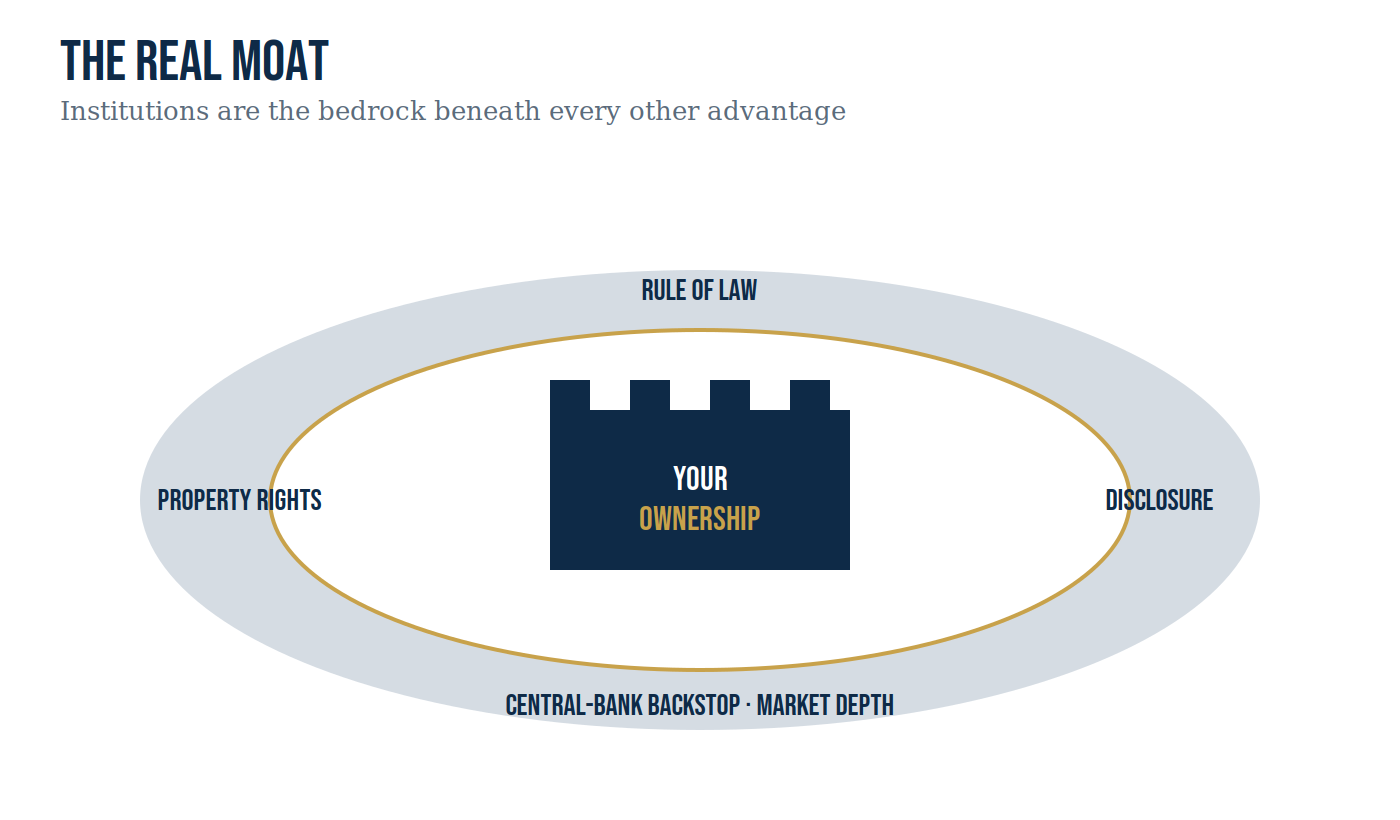
Figure 7.1 — Institutions as the real moat.
Let me draw this together by returning to the two investors of 1929, because their story contains the whole lesson.
The crash hit them both. The fear was the same, the losses were the same. What differed was everything that came after the crash — and what came after was determined by institutions. The American kept his property, his rights, his functioning markets, his enforceable claims, and rode the institutional bedrock through the storm into the greatest expansion in history. The other watched institutions fail or be deliberately dismantled, and with them went the security of everything he owned.
This is why I call institutions the real moat. The other advantages we have discussed — the self-renewing economy, the innovation premium, the dollar, the demographic dividend — are powerful, but they all depend on the institutional bedrock holding. The economy can only renew itself if property and contracts are protected through the renewal. Innovation only flourishes if inventors and investors trust the system. The dollar only commands global trust because American institutions are trusted. Population growth only compounds into wealth if that wealth is secure. Institutions are the foundation that makes every other advantage possible, and they are the thing most likely to be taken for granted precisely because, in America, they have held so reliably for so long.
For the investor, the practical lesson is one of perspective. When you own American enterprise, you own it inside the deepest institutional moat in the world — a moat that has not only held through every crisis but been deepened by each one. This is the quiet, unglamorous foundation of the entire case for investing in America. Not the exciting story of innovation or the drama of crashes and recoveries, but the boring, magnificent reliability of institutions that hold.
Those institutions are what let you do the single most important thing an investor can do, which is also the hardest. They let you stay. They let you hold through the storms, confident that what you own will still be yours on the other side. And staying, as we are about to see, is where nearly all the money is actually made — and nearly all of it lost.