The Portfolios
Chapter 11
The Boglehead Three-Fund Portfolio
AS a former manager of the Wellington Fund and founder of Vanguard, John Bogle became one of the most influential people in modern finance. His focus on low costs and simplicity shook the industry to its core and revolutionized the way people allocate their assets.
Bogle was always an advocate for the small investor and championed the mutual fund company structure that helped democratize modern investment products. His influence inspired a well-deserved, cult-like group of followers known as the Bogleheads.
Perhaps the best known Boglehead is a man named Taylor Larimore, whom Bogle referred to as the “king of the Bogleheads.” Larimore was a paratrooper in the 101st Airborne Division during the Battle of the Bulge in World War 2 and would go on to become a life insurance underwriter and chief of the financial division for the Small Business Administration in South Florida.
Larimore became enamored with Bogle’s work in the 1980s. He told me he was living in Miami at the time, and his wife, Patricia, was the highest-paid model in the city. For the first time in his life, he had what he considered a significant amount of money and began to question whether his Wall Street stockbroker was truly acting in his and his wife’s best interest.
Around this time, he began obsessively reading about investments, the structure of mutual funds and especially low-cost index funds. Bogle’s book Bogle on Mutual Funds completely changed Larimore’s investment philosophy and convinced him that his broker was more interested in fees than investor returns.
Larimore spent much of the next four decades getting to know Bogle personally and working with him to bring these complex topics to the average investor. Larimore has become an expert in his own right and the famous Boglehead Forum, which Larimore has moderated for decades, is now one of the most informative and populated investment roundtables in the world.
In 1999, Larimore created a basic global allocation using four funds: a US stock fund, a foreign stock fund, an aggregate bond index, and a cash component. As interest rates declined and the value of a separate cash allocation diminished, he eventually reduced the portfolio to three funds. The result was a beautifully simple, low-cost, and broadly diversified portfolio that checked all the boxes of the Bogle investment philosophy. In fact, the idea was so elegant in its simplicity that it has become a widely adopted approach for DIY investors following a Boglehead approach.
BUILDING YOUR OWN BOGLEHEAD THREE-FUND PORTFOLIO
As you can probably guess, this one’s pretty easy to construct. It is, as its name suggests, comprised of just three simple funds.
Larimore advocates taking three funds and allocating them across stocks and bonds in a proportion that is consistent with the investor’s risk profile. The stock sleeve could be comprised of two funds that hold the global market cap of stocks and the bond piece should be a simple, low-cost total bond market fund. Larimore tends to prefer an overweight US stock position, but I am using an equal weight allocation for the sake of simplicity.
Figure 11.1: How the Boglehead Three-Fund Portfolio might look
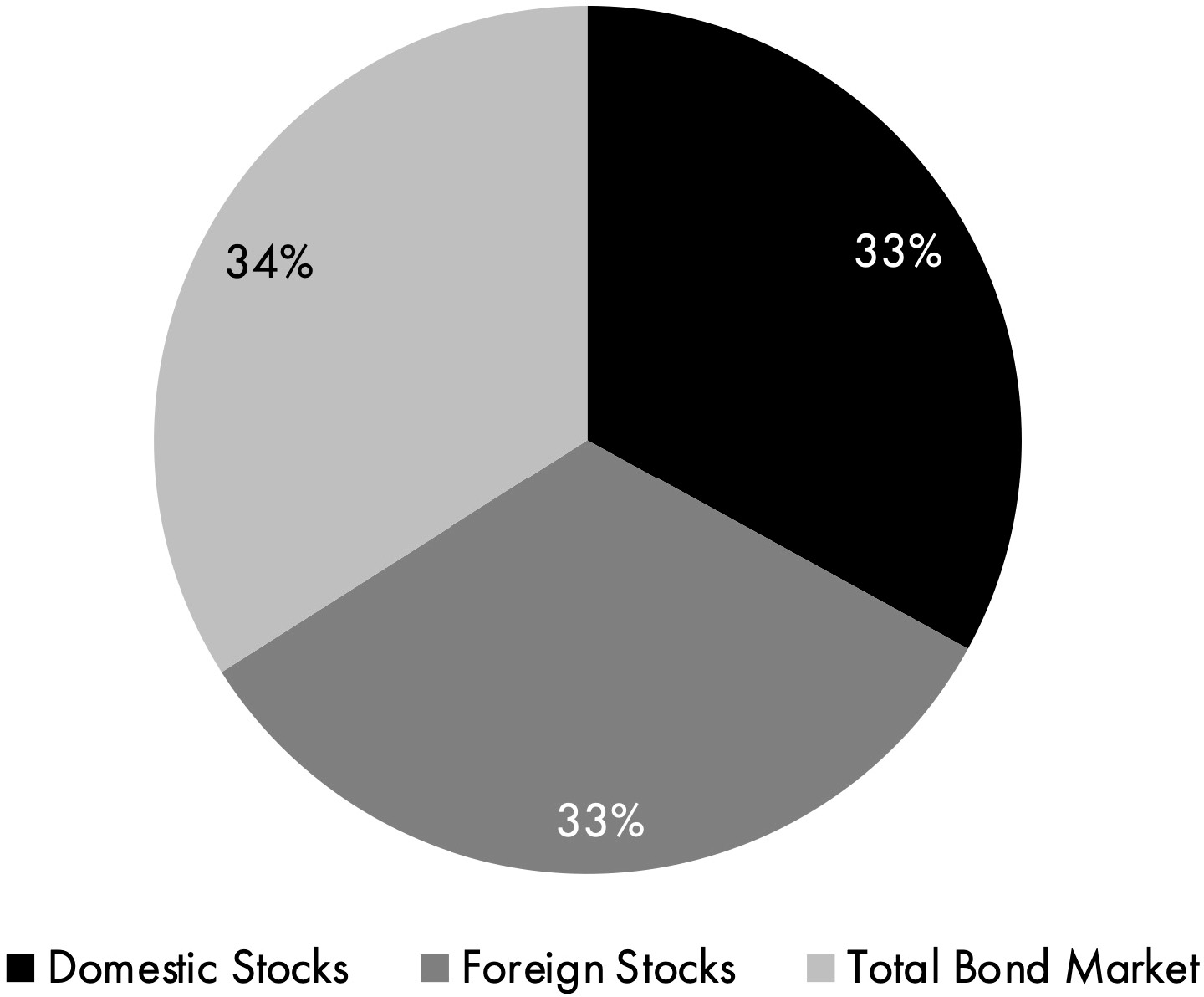
Doesn’t get much cleaner than that.
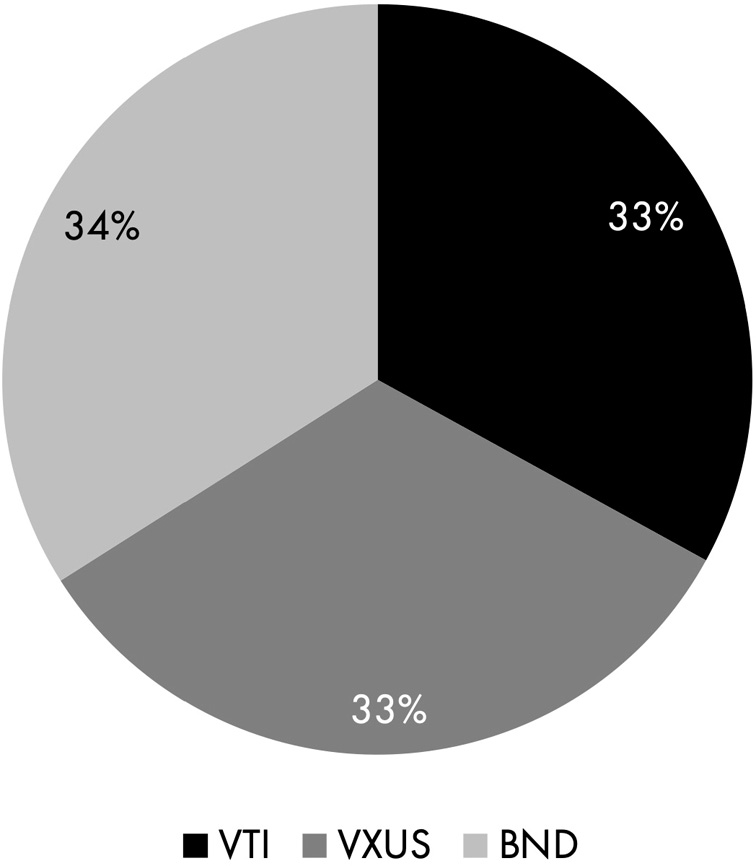
In terms of specific funds, you can apply this with just three holdings – Vanguard funds, of course:
- 34% Total Bond Market (ticker: BND)
- 33% Total US Stocks (ticker: VTI)
- 33% Total Ex-US Stocks (ticker: VXUS)
Figure 11.2: Boglehead Three-Fund Portfolio
WHY THE BOGLEHEAD THREE-FUND PORTFOLIO WORKS
The Boglehead Three-Fund Portfolio is beautifully effortless while also being broadly diversified across low-cost fund options. Christine Benz, the Director of Personal Finance at Morningstar, has described the Three-Fund Portfolio as “the ultimate in elegant minimalism.”25
The strategy works in large part because it’s very close to the efficient market portfolio, the GFAP. It is a hugely diverse portfolio despite being such a simple structure. In Larimore’s own words, he thinks this is the optimal portfolio for the following 21 reasons:
- Avoids wasted time and the possibility of mistakes trying to pick the best of thousands of mutual funds and ETFs.
- No individual stock risk.
- Highest return with lowest risk.
- Very diversified with over 20,000 worldwide securities (lower risk).
- Very low expense ratios.
- Very low (hidden) turnover costs.
- Very tax efficient.
- The many advantages of simplicity.
- No advisor risk.
- No fund manager risk.
- No style drift.
- No asset bloat.
- No tracking error to cause abandonment of the strategy.
- No fund overlap.
- No front-running that reduces sub-index returns.
- Automatic rebalancing within each fund.
- No need for a portfolio tracking program.
- Less worry. Never underperforms the market.
- Easy to maintain for the owner, spouse, caregivers, and heirs.
- More free time.
- Mathematically certain to outperform most investors.26
There’s not too much to analyze, but we’ll run the numbers as always.
THE BOGLEHEAD THREE-FUND PORTFOLIO ANALYSIS
This portfolio is not terribly complex and can be customized around an investor’s particular risk profile, but Figure 11.3 and Table 11.1 demonstrate how the figures look assuming we used a simple three-fund allocation with 66% stocks and 34% bonds.
Figure 11.3: Three-Fund Portfolio performance
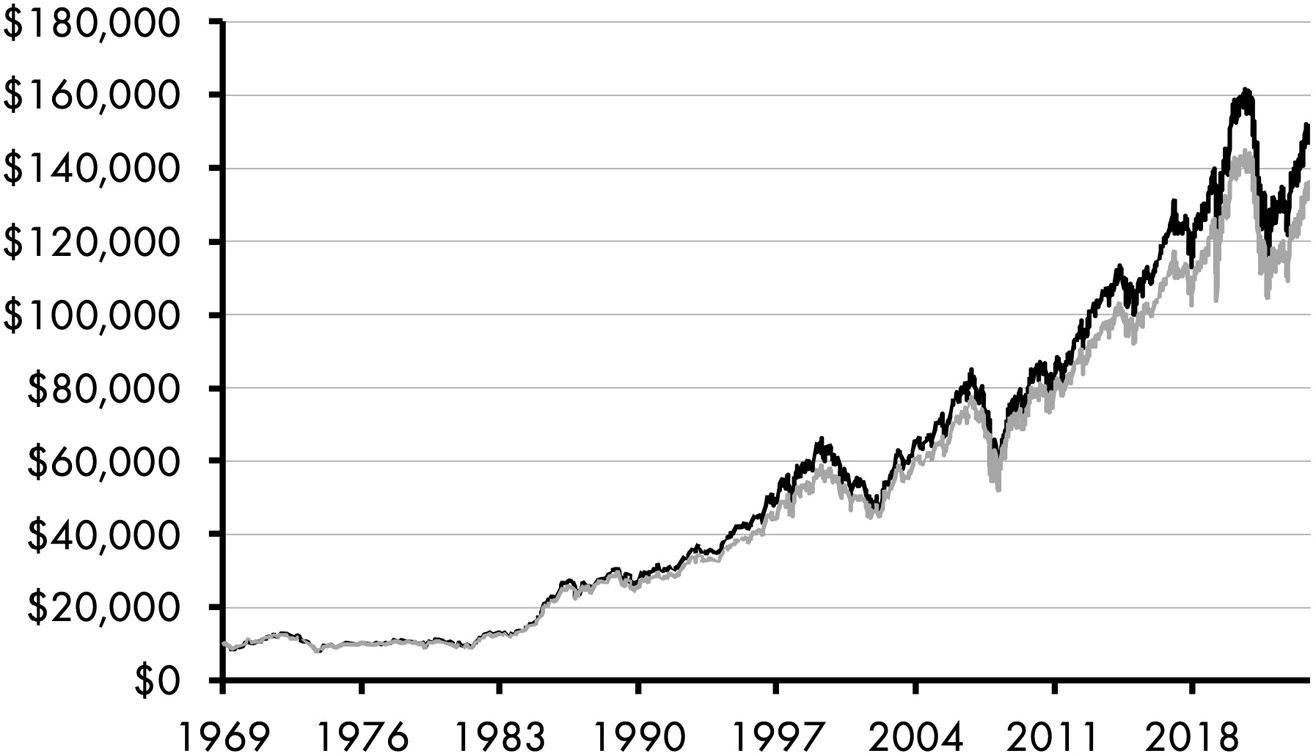
Table 11.1: Portfolio analysis
|
Three-Fund |
Global 60/40 | |
|---|---|---|
|
Real Returns |
5.02% |
4.80% |
|
Volatility |
10.30% |
9.75% |
|
Sharpe Ratio |
0.47 |
0.47 |
|
Sortino Ratio |
0.67 |
0.67 |
|
Max Drawdown |
−39.74% |
−37.65% |
|
Ulcer Index |
12.77 |
11.79 |
|
Market Correlation |
0.51 |
0.47 |
Given its simplicity, the performance is better than you might expect. Over the period from 1970 to present, the Boglehead Three-Fund Portfolio would have generated 5.02% annual returns with 10.30% volatility, while the global 60/40 Portfolio generated 4.80% annually with 9.75% volatility.
On a risk-adjusted basis, the Boglehead Three-Fund Portfolio looks surprisingly good. The global 60/40 Portfolio and the Three-Fund Portfolio generated the same risk-adjusted return over the period, with a Sharpe ratio of 0.47 and Sortino ratio of 0.67. Further, the Ulcer Index for the Boglehead Three-Fund Portfolio was just 12.77, compared to 11.79 for the global stock market, only modestly worse.
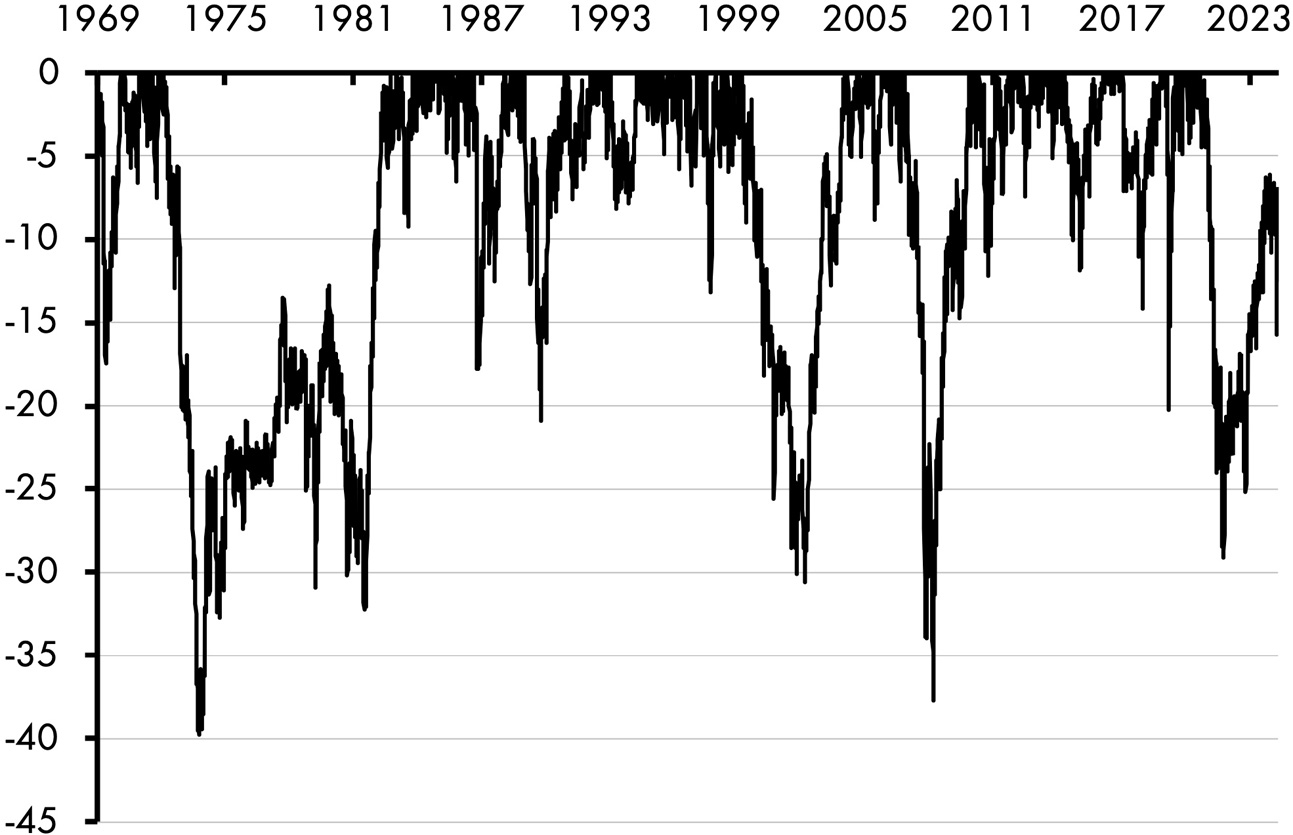
This isn’t just a basic and low-stress portfolio based on maintenance and implementation needs. It has also been a relatively low-stress portfolio to own based on its drawdowns, as seen in Figure 11.4.
Figure 11.4: Three-Fund Portfolio drawdowns (%)
THE BOGLEHEAD THREE-FUND PORTFOLIO PROS AND CONS
This one might be simple, but that doesn’t mean its pros and cons are. First the bad news:
- This portfolio is arguably too simple, which we’ll dig into below.
- Because of its simplicity the portfolio will not always be diversified given it is only comprised of stocks and bonds.
- Three funds could create some behavioral hurdles. There’s a certain discomfort in owning just a handful of funds. I am generally a believer in the idea that less is more, but that is not always true in asset management. One fund, for instance, is not usually sufficient for many reasons we’ve already discussed. Three funds might also not be enough depending on certain circumstances. There is a fine line in asset management between avoiding excessive complexity and creating just the right amount of sophistication to meet your financial needs.
- You likely need a fourth allocation here to provide for cash and emergency reserves. The aggregate bond component has a duration of six years and an average effective maturity of 8.4 years, which exposes it to meaningful interest rate and principal risk in the short term. An aggregate bond fund alone is not a sufficient source of liquidity.
Now the good news:
- You read 21 pros directly from Larimore. I’ll spare you the rinse-and-repeat.
SUITORS FOR THE BOGLEHEAD THREE-FUND PORTFOLIO
The Boglehead Three-Fund Portfolio is especially good for people who want simplicity and ultra-low costs. There’s nothing fancy going on here so this won’t be intriguing to someone who likes more bells and whistles, or wants to shoot for the moon. The portfolio also has a moderately long time horizon given that it has no cash component. This simple portfolio is best for patient people who know not to tinker with it and who want to adhere to a more “passive” methodology.
FINAL THOUGHTS
Well, that’s about as straightforward as it gets. But we all know that the world is a complex place and with all the behavioral biases we’re confronted with we might require some embedded guardrails to help navigate the roller-coaster ride of the financial markets.
What if we could take the principles of John Bogle and apply them in a behaviorally robust “stay the course” portfolio that took more of a contrarian view on things?
The Countercyclical Rebalancing Portfolio is up next and it’s about as pure a play on behavior as you’re going to find.