The Portfolios
Chapter 14
Dividend Investing and Anti-Dividend Investing Portfolios
WARREN BUFFETT was far from being the first activist investor – 334 years before Buffett Partners was formed a group of activist shareholders revolted against the directors of the Vereenigde Oost-Indische Compagnie (VOC), also known as the Dutch East India Company. The VOC was the world’s largest corporation at the time and dominated the global spice trade. As the company grew increasingly large and complex, its shareholders became tired of the various inefficiencies that cropped up and they demanded greater oversight and control.
In 1610, Isaac Le Maire, a former director of the VOC who had been barred for fraud, established a short position in the company’s shares and began a relentless public attack, accusing the VOC of mishandling shareholder funds. Le Maire had an axe to grind and hoped to drive the share price low enough that other shareholders would redeem and force an eventual liquidation of the company. This would enable Le Maire and his partners to initiate competing companies that could take over the VOC’s monopoly on the spice trade.
Le Maire’s efforts appeared to be working until the VOC outed his syndicate and convinced the government to ban short selling. Le Maire and his partners spent much of the next few years trying to cover their debts and ultimately went into hiding. But while his efforts failed, the directors conceded in part by paying a dividend to shareholders, paid in spice at a value of 75% of the nominal capital. A cash dividend soon followed.30
The VOC went on to pay a dividend for over 100 years and it was a consistent sign of the company’s financial prowess until its ultimate demise in 1799.
Throughout early stock market history dividends were a key symbol of financial strength. It was one of the ultimate symbols that a firm had a strong and healthy balance sheet because, as Peter Lynch once said, “A company cannot fake that which it does not have.” Dividends continue to be a symbol of company health to this day.
WHY DIVIDEND INVESTING WORKS
Who doesn’t love a stream of sweet, sweet cash? That’s the appeal of any dividend-paying strategy. You get to clip those coupons and watch the cash flow into your portfolio. It makes intuitive sense: as the old saying goes, two in the hand is worth one in the bush. It’s the same reason people gravitate toward safe bonds, but with dividends, you get the added potential for upside through stock price appreciation.
Dividend-driven strategies are, at their core, fundamentally driven. That’s because stock returns are comprised of dividends plus capital appreciation and while capital appreciation is nice, your stock market returns aren’t real until you sell the shares and realize the gains. So, there’s a lot of uncertainty around unrealized capital appreciation. Dividends, on the other hand, give you a more tangible return.
Dividends are typically paid out of a company’s net income or retained earnings and often signal strong or stable profitability. Like the VOC, many dividend-paying firms generate consistent cash flow, allowing them to regularly return a portion of their profits to shareholders. This means that owning dividend-paying stocks can provide not just a steady stream of income, but also exposure to companies that are financially sound and capable of sustaining those payouts over time.
This is especially true in diversified index funds where you can reduce single entity risk and own a stream of dividends coming from many different entities. With a dividend-paying ETF you can virtually eliminate single entity risk and get your low risk coupon payments. In short, owning dividend-paying stocks works because dividends only flow if the firm itself is working.
WHY ANTI-DIVIDEND INVESTING WORKS
The story is more complex though and while I appreciate the allure of dividends they’re by no means a free lunch. This is where the anti-dividend view comes into play.
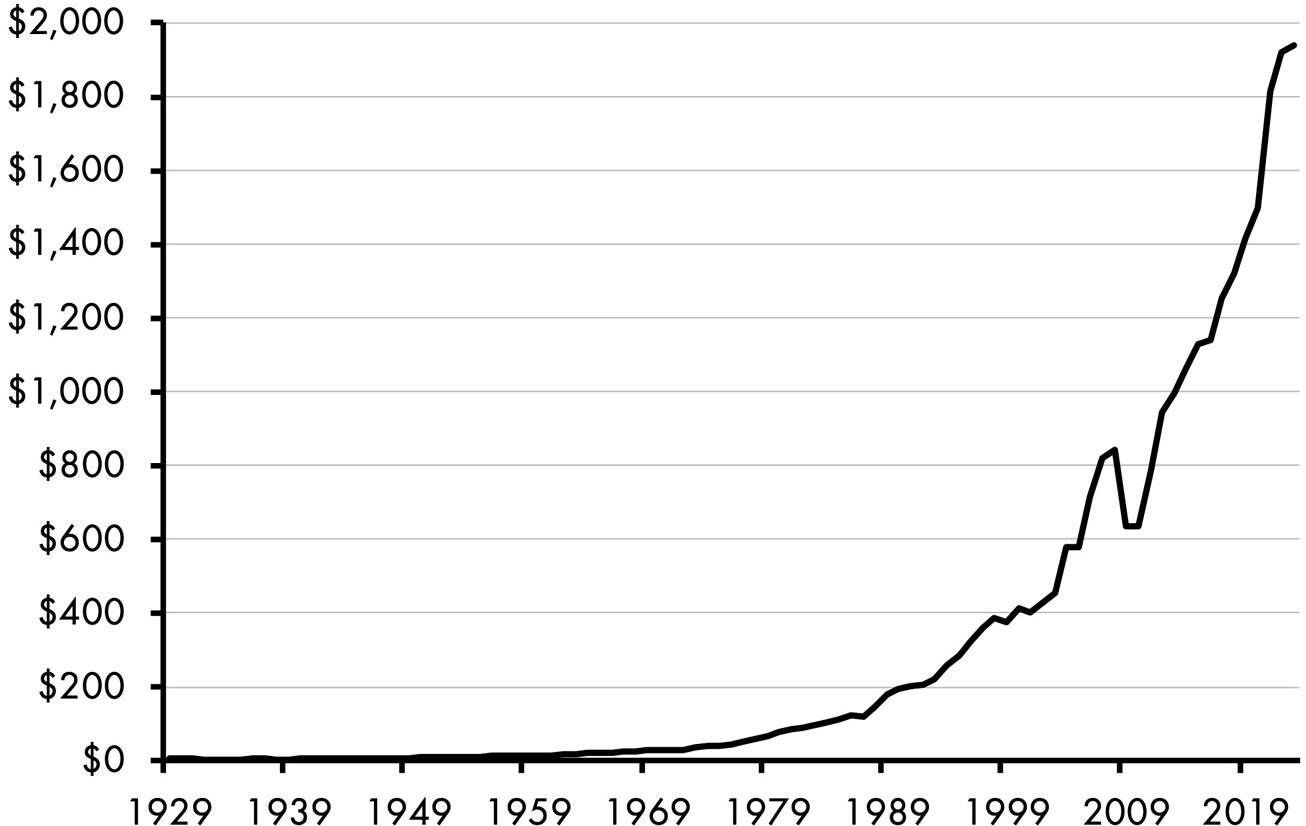
Dividends remain very popular as seen in Figure 14.1, but firms are increasingly starting to return capital via share repurchases. There’s quite a bit of controversy and misunderstanding around this topic so it’s worth spending a little time on this.
Figure 14.1: Net US corporate dividend payments ($bn)
When a company pays a dividend, the shareholder incurs taxes whether they wanted the income or not. In effect, the company is creating a tax liability for its investors. But what if a company could return capital to shareholders without immediately triggering that tax bill? In other words, what if investors could choose when to realize the tax liability? That’s essentially what a stock buyback, or repurchase, accomplishes.
A stock buyback involves the corporation using some of its cash to repurchase outstanding shares that were previously issued. For example, if the corporation initiates a buyback for $100, then shareholders receive $100 of cash from the corporation when they sell their stock back to the company. The corporation pays $100 of cash to the shareholders (just like they would with a dividend) and retires some portion of stock that was previously issued. If a shareholder is selling the stock at a long-term capital gain rate they might receive more favorable tax treatment than they would if they had received a dividend. And regardless of tax rate, the firm is using the repurchase to allow shareholders to determine whether they even get a tax bill in the first place by giving them the option to sell or not.
In short, dividends and buybacks are both ways of returning cash to shareholders, but the buyback puts the tax control in the hands of the shareholders. Pretty fair, huh?
In his 2012 annual shareholder letter Warren Buffett went over this topic in some detail describing the four ways that firms can handle cash:
- Reinvest in the company (i.e., pursue organic growth).
- Acquire other companies.
- Repurchase shares.
- Pay dividends.31
He then explained that he prefers to repurchase shares in Berkshire when they’re selling at a discount to intrinsic value because dividends don’t treat all shareholders fairly due to the uneven tax treatment and the fact that different shareholders prefer different size payouts.
This is similar to what billionaire investor Ken Fisher calls “homegrown dividends.”32 Fisher is an advocate of using capital appreciation to sell an investor’s shares opportunistically over time to create your own form of dividends at superior tax rates and to better align with personal needs.
People sometimes confuse dividend income with bond fixed income. These things are not the same and they should not be utilized the same way. While stock dividends can be a signal of financial strength they are by no means stable in the same way that bond-like income is. And that’s because the underlying principal value of the securities is wildly different.
We often hear the financial media compare something like a 3% yielding five-year government bond to the 3% dividend yield of the S&P 500. You might say these things are similar in that they both pay reliable income. But the main point of owning bonds in a portfolio is to create certainty of principal over time with income. We know, for a fact, that a five-year US T-note yielding 3% will mature at $100 in five years while having paid out 3% all along the way. There is no uncertainty of principal or income in this instrument over five years.
The stock market is a completely different animal. You might get 3% dividend payments along the way and persistent negative total returns across the same five-year period. You have no certainty of principal in the stock market, even over five-year periods. Dividend-paying stocks, while likely to be more stable than non-dividend paying stocks, are not an apples-to-apples income and principal stabilizer in the same way that government or investment-grade bonds are.
It’s also worth noting that, in truly perilous economic environments like the GFC, dividend-paying stocks do not protect you and some of the safest stocks like utilities fell by 60% or more, in part because dividend-paying firms often cut or halt their dividends during recessions.
Buybacks are not a free lunch though. Despite putting more power into the hands of shareholders, the existing shareholders incur a certain degree of added risk because management is making an asset allocation that may or may not be in the best interest of shareholders. Firms should always try to maximize reinvestment in their own firm by putting money back into organic growth or acquisitions, but firms like the VOC or more modern-day firms like Apple end up with such enormous cash hoards that they end up returning cash to shareholders in what equates to the firm saying: “Here, you reallocate this because we’ve reinvested all of our cash as wisely as we believe we can and we think you might have a better use for this.”
Reinvesting cash in a business is difficult, especially when you’re a large, successful firm. Some people are quick to say buybacks are “financial engineering” that drives up stock prices, but if we look at some publicly listed buyback ETFs such as the PowerShares Buyback Achievers Fund (ticker: PKW), it’s unclear that firms repurchasing shares exhibit any sort of superior performance when compared to the broader market. In fact, they look nearly identical, as reflected in Figure 14.2.
Figure 14.2: Buyback Funds versus S&P 500
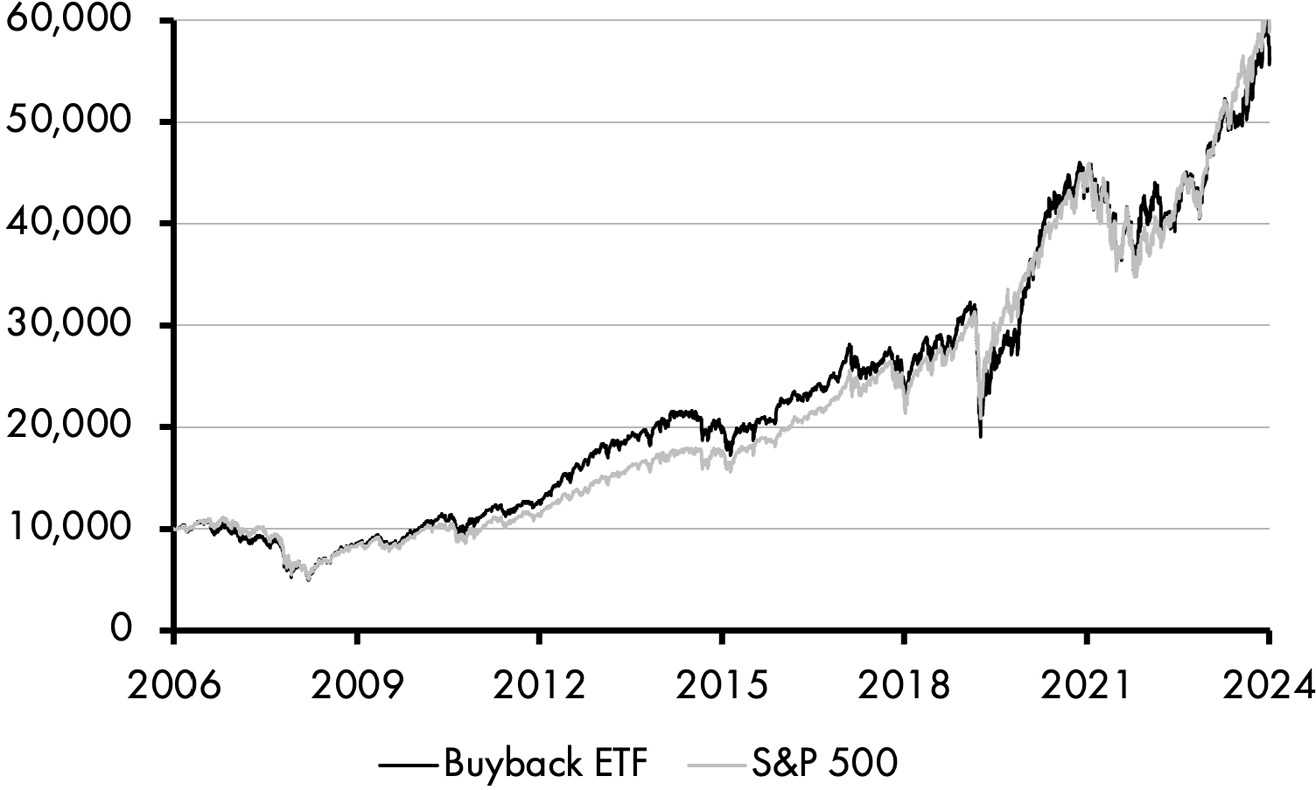
And so this brings us to an interesting conclusion. From a pure return-on-investment perspective, the difference between buybacks and dividends appears inconclusive at best, but we know for a fact that the buyback investors benefit from superior tax treatment.
At the same time, some of the criticism of buybacks is fair. When firms borrow money to buy back shares, offset new dilution, or buy back shares well above intrinsic value, they are potentially doing their existing shareholders a disservice. While there are certainly instances of this, there is no clear evidence that buybacks are definitively good nor bad in and of themselves.
Further, an interesting thing is happening in the US capital markets as buybacks grow in popularity – dividends are no longer the reliable symbol of financial strength they once were as buybacks are increasingly being used to send the signaling effect: “Hey you, we have cash and we’re buying back our shares because we think our shares are undervalued!”
So, the value of buybacks is inconclusive relative to dividends, but the good news is that we don’t have to pick just one. We know that people like cash in the hand, but people also hate taxes. So, what if you could have your cake and eat it too? This is where the seemingly conflicted views can be used to complement one another.
In 2005 William Priest wrote a paper titled “The Case for Shareholder Yield as a Dominant Driver of Future Equity Returns.” This idea focuses on building strategies around firms that return capital to shareholders through all the available methods. This helps capture the traditional signal of financial strength that shareholders have relied on for hundreds of years while also capturing the valuation signal that buybacks often reflect.
Meb Faber of Cambria Investments has expanded on this concept in recent years and points out that dividend strategies miss two key indicators of strong cash flow:
Using this we could calculate total shareholder yield as shown in Figure 14.3.
Figure 14.3: Shareholder yield calculation
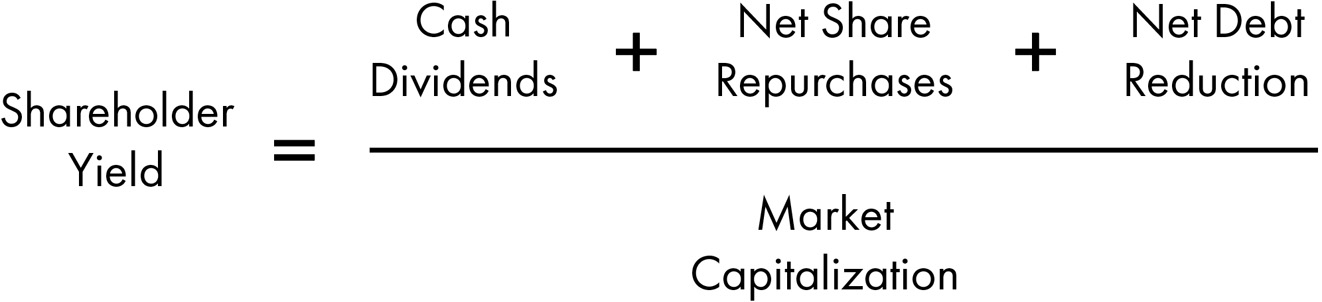
Cambria uses an example as follows. Consider a firm that pays cash dividends of $1,000,000, repurchases shares of $150,000, issues $30,000 of new shares and implements $1,000,000 of net debt reduction. If they have a market cap of $30,000,000 then their total shareholder yield would be:
Figure 14.4: Shareholder yield calculation example

As you can see this formulation does a good job of capturing the way in which firms return capital to investors.
BUILDING YOUR OWN (ANTI) DIVIDEND PORTFOLIO
There is no shortage of dividend and income-oriented ETFs out there. Broadly diversified dividend ETFs like Schwab US Dividend Income (ticker: SCHD) or Vanguard High Dividend Yield ETF (ticker: VYM) are great options. Blending it with something like Vanguard International High Dividend Yield (ticker: VYMI) would give you a more globally diversified allocation.
As mentioned before, you could also get pure play buyback firms via the PowerShares Buyback Achievers Fund (ticker: PKW).
And if you wanted to explore an option that does all the above you might research Cambria Shareholder Yield ETF (ticker: SYLD) which focuses on all three ways of returning cash to investors.33
(ANTI) DIVIDEND PORTFOLIO ANALYSIS
Dividend, repurchase, and shareholder yield funds do not exhibit reliable forms of alpha. They are best thought of as income-paying funds that will have a high correlation with their related market.
Many of these dividend-specific funds will also look like value or quality factor funds because the dividend focus tends to be consistent with firms that have similar attributes to value and quality factors. So they’ve tended to underperform or correlate with the broader market over time.
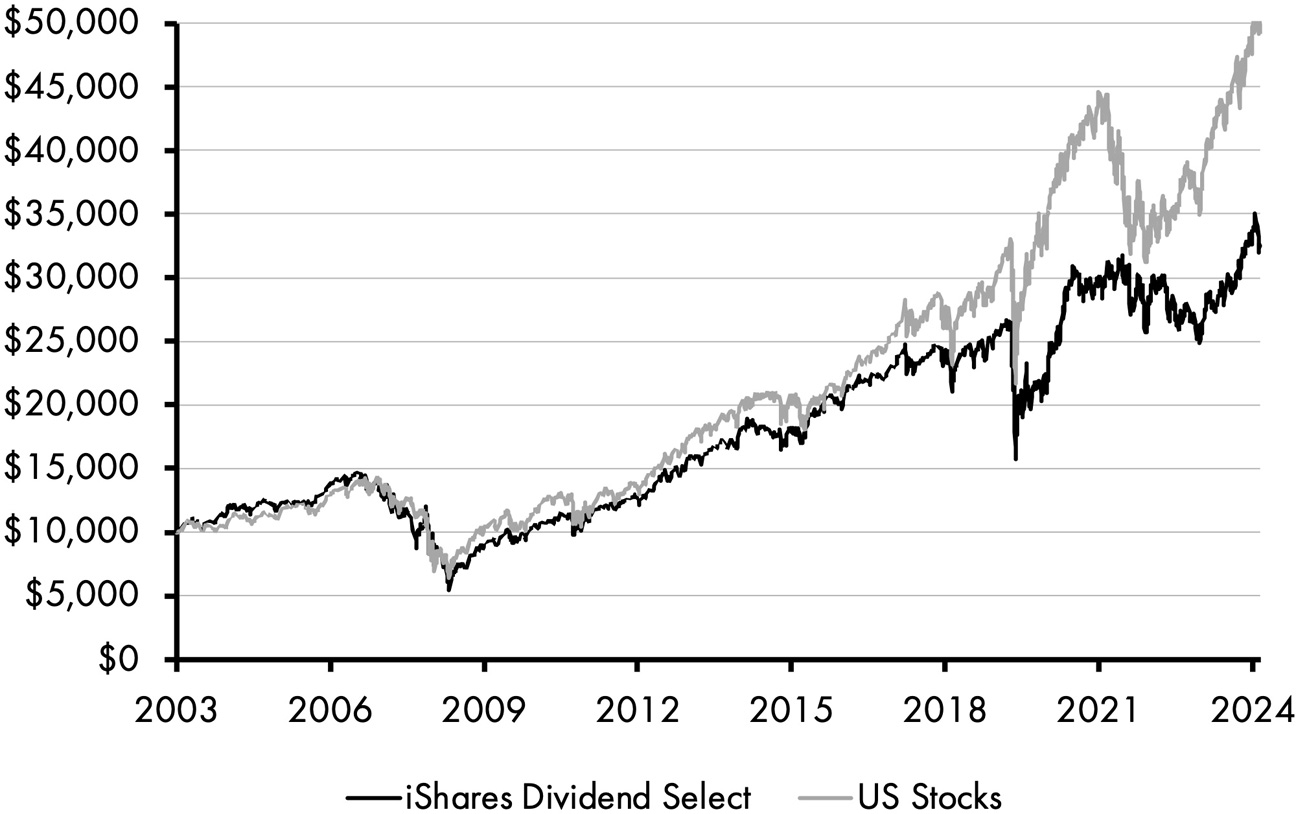
One that was especially memorable for me (because I owned it at the time) was the iShares Dividend Select ETF, one of the earliest dividend ETFs. This fund has significantly lagged the market over time with just 5.70% real returns versus the total market’s returns of 7.82%, as shown in Figure 14.5.
Figure 14.5: Dividend Select versus total market stocks
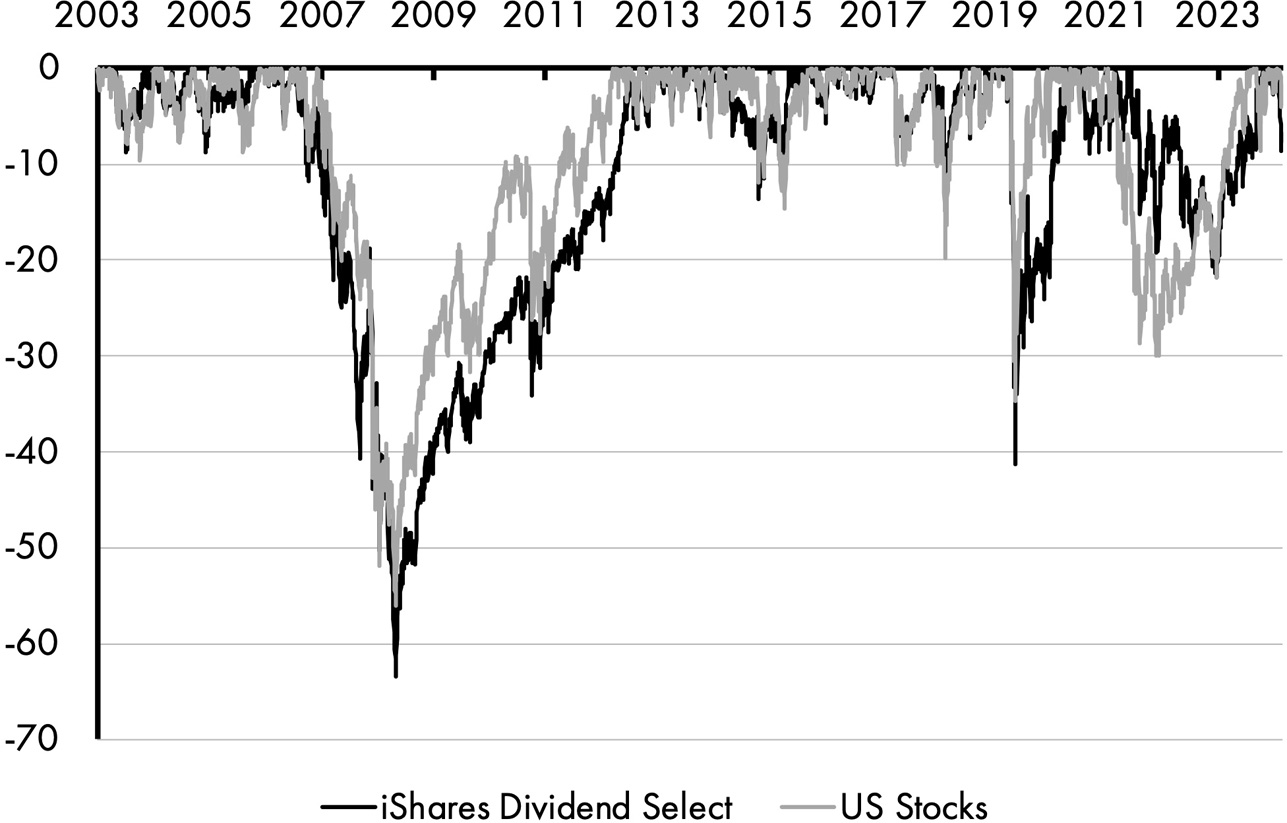
The thing that made this fund so memorable to me was the way it performed in 2008 during the GFC. As seen in Figure 14.6, this fund fell 63% from peak to trough, more than the broad market. Its problem was that it was loaded with seemingly safe dividend-paying stocks in the finance and utilities sectors. And when the crisis hit many of those firms halted their dividends, which exacerbated the selling. This is one reason why it’s very important to think of dividend-paying stocks as a different animal than something like US government bonds. They cannot be relied upon to be safe at the times when safety is most desired.
If we look at this more broadly, in Figure 14.7 we see that newer funds like Vanguard Dividend Appreciation (ticker: VIG) and Schwab US Dividend ETF (ticker: SCHD) do a better job of tracking the market, but still comparatively look more like value and quality factors.
Figure 14.6: Dividend ETF drawdowns (%)
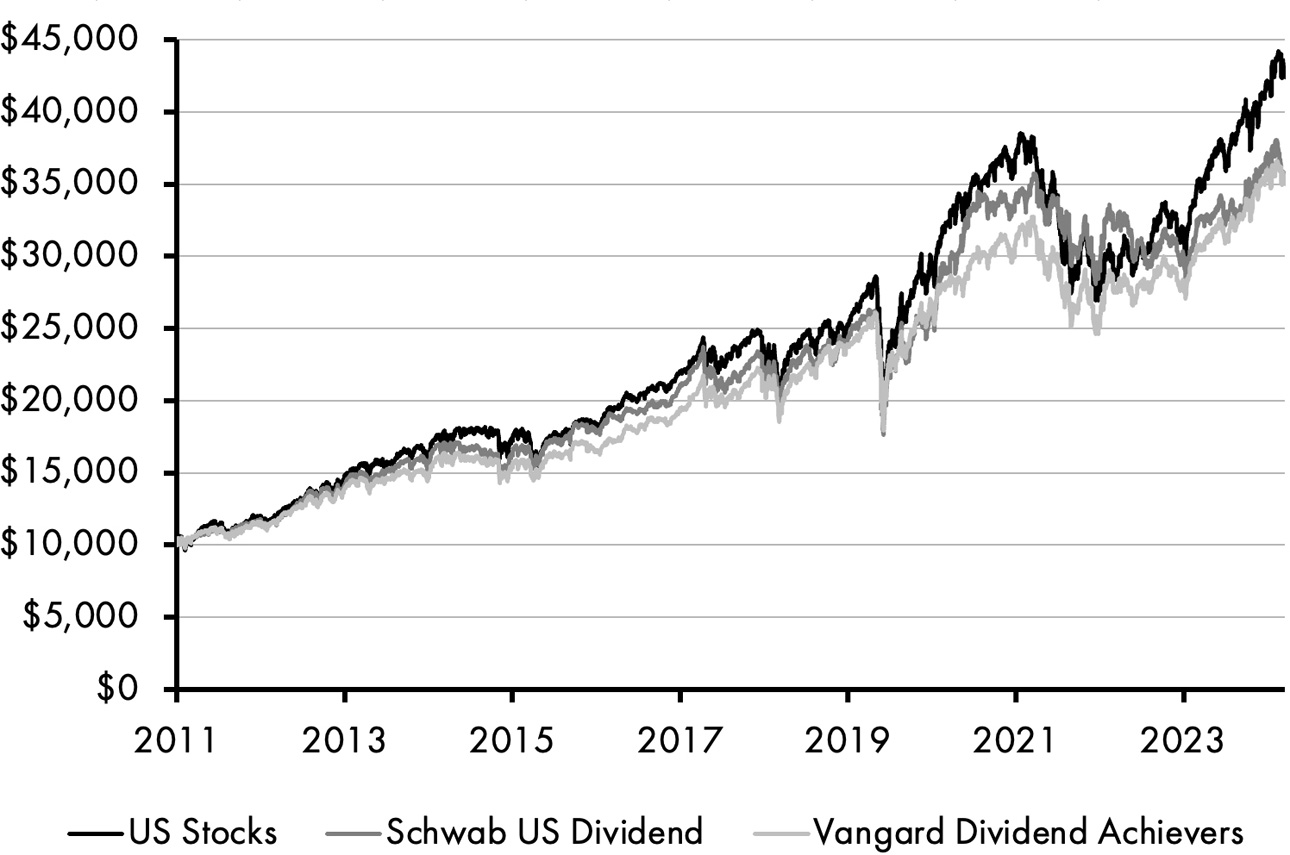
Figure 14.7: Dividend fund performance
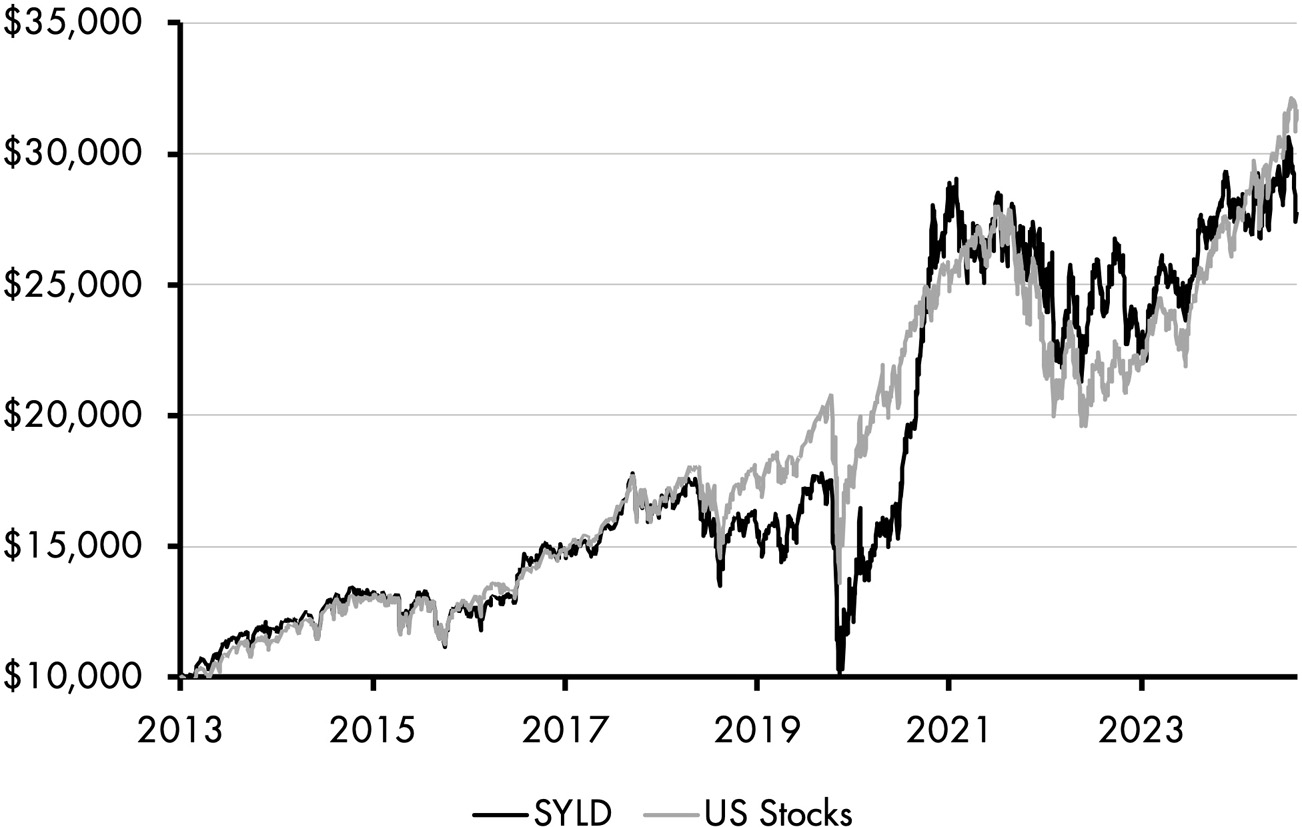
Cambria’s Shareholder Yield ETF is an interesting new entrant to the shareholder yield world and the purest play on capturing the concept. Although it’s relatively new the fund has captured more of the total market return when compared to funds like SCHD and VIG, as depicted in Figure 14.8.
Figure 14.8: SYLD versus VTI
I should also note that these income-generating strategies have become more and more prevalent and, unfortunately, oftentimes prey on investor ignorance of these concepts. As noted, dividend-paying stocks do not generally outperform the broader market. And they are not a reliable bond replacement. But this hasn’t stopped dozens of Wall Street firms from creating shiny objects that are called names like “the Safe 100% Yield ETF.” I made that up, but there are so many of these funds out there now that advertise attractive yields by using options or other complex strategies. They often sound appealing because of the income, but in practice they tend to underperform because they’re using expensive overlays to get that extra income.
I know we all like income and purportedly high returns, but double and triple check these when you come across them. Heck, send them to me for an independent assessment if you’d like. There are only a few things in this world that make me happier than helping people sidestep a shiny looking investment object that is actually a high-fee landmine.*
(ANTI) DIVIDEND PORTFOLIO PROS AND CONS
Let’s talk about the good news and the bad news. Bad news, you’re up to bat:
- These are all-stock strategies and, as I noted earlier, we shouldn’t confuse the safety of stocks for the safety of bonds. This portfolio could be good for the stock-specific portion of your allocation when used to build a total income portfolio.
- Dividend-focused strategies incur income by definition, so you’ll want to be aware of the tax implications.
- Dividend-paying stocks don’t demonstrate a strong tendency to outperform the broader market. So, not only are you incurring more taxes along the way, but you’re not outperforming either. This might make some people wonder why they’d focus on dividends when they could own a similarly diversified total market fund and implement something like Fisher’s home-grown dividends.
- Beware of the types of dividend funds you consider. It’s become very popular in recent years for new funds to promise huge yields. These funds are usually paying big dividends out of principal or trying to generate income by selling options or implementing other expensive and risky alternatives. These funds rarely beat correlated indices, but almost always have high(er) fees. As the old saying goes, if it seems too good to be true it probably is.
And what about the good news?
- People love income. And if income keeps you invested then that’s great. You have to find what you like and stick with it. If income helps you achieve behavioral robustness then this is a good thing.
- There is a compelling argument that the shareholder yield approach generates superior returns when compared to pure dividends. This could be magnified after taxes given the inherent tax focus of the strategy.
- I talk a lot about duration and time in my methodologies. One way to reduce duration and increase certainty in a portfolio is to generate income. Capital appreciation is great and all, but dividends are high-probability, short-term profit payouts, while capital appreciation is far from being high-probability in the short term. Any strategy that helps you boost certainty is worth considering.
SUITORS FOR THE (ANTI) DIVIDEND PORTFOLIO
Dividend portfolios and shareholder yield portfolios are great for people who want steady income and don’t love getting it only from bonds. Shareholder yield funds are arguably more reliable and updated ways of owning firms that are returning cash to shareholders due to their own underlying financial strength.
Many of these funds will frame themselves as market-beating, but I’d argue they’re more behavioral than anything else. That is, they’re likely to generate returns similar to or lower than the broader market, but if the income or signaling effect helps you stay the course or better plan for your expenses then these are good for you.
In general, these types of strategies are most suitable for someone who’s a little more conservative and perhaps in retirement or nearing retirement. Since income and shareholder yield can be more consistent with value and quality, it’s a good option for people who want a little more certainty in their equity slice when compared to something like an aggressive growth fund.
Taxes could play an important role in these strategies so if you earn a high income or are in a higher tax bracket you might consider more tax-efficient ways of generating income.
FINAL THOUGHTS
Firms that pay out consistent dividends, like the VOC, tend to be firms that have positively trending revenues and profits. These positively trending financials give investors certainty and help provide them with a stable stream of income.
But can we use trends that don’t relate to either dividends or factors to predict market prices? And would such a strategy be useful?
Behind Door #15 is a strategy called Trend Following and this one’s really fascinating.