The Portfolios
Chapter 13
The Bernstein No-Brainer Portfolio
I HAD the great honor of interviewing William Bernstein, one of my personal investing heroes, for this chapter. His website, “Efficient Frontier,” is a bottomless gold mine of financial insight and research. A lot of the concepts in this book are things I learned from Bill.
Bernstein began his career as a neurologist and built his wealth in the medical field. He then got interested in how best to allocate his own savings when he became suspicious that a financial advisor might not have his best interests at heart.
Bernstein didn’t just learn about how finance and investing works. He immersed himself in understanding the field and became a legendary thought leader and eventually a financial advisor himself. Over time he arrived at many of the same conclusions that Taylor Larimore and the Bogleheads did – diversify, minimize taxes and fees, and keep it simple.
A strategy that Bernstein has become known for is called the Bernstein No-Brainer. But the version you’ve seen online isn’t exactly his preferred approach – so let’s take a closer look at how he actually thinks about building a No-Brainer Portfolio.
Here’s my interview with Bill.
***
CR: Can you share the historical context and inspiration behind the No-Brainer Portfolio, and your broader approach to asset allocation?
WB: The No-Brainer is an old portfolio that I played around with in the electronic versions of The Intelligent Asset Allocator (TIAA), which first came out in 1995. I came up with it in response to a journalist inquiry. That said, it’s a fine portfolio for someone who’s highly risk-tolerant; it is, after all, 75% stocks. Far, far more important than one’s precise allocation, beyond selecting the overall stock/bond mix, is sticking with it. A “suboptimal” portfolio you can stick with is better than an “optimal” one you can’t.
CR: How did your personal journey as an investor influence the development of the No-Brainer Portfolio, and how has your perspective on it evolved over time?
WB: The backstory is simple: I live in a country without a functioning social safety net and I realized I was going to have to save and invest on my own for retirement. I proceeded the way I thought anyone with scientific training would: reading basic texts, the peer-reviewed literature, and building models. That wasn’t easy for a small investor in the 1990s, and by the time I had finished I realized that I had done something that small investors could use, and I finally got TIAA published. History is an important part of investing, and it was the part of the writing I enjoyed the most, so I’ve also written four history books.
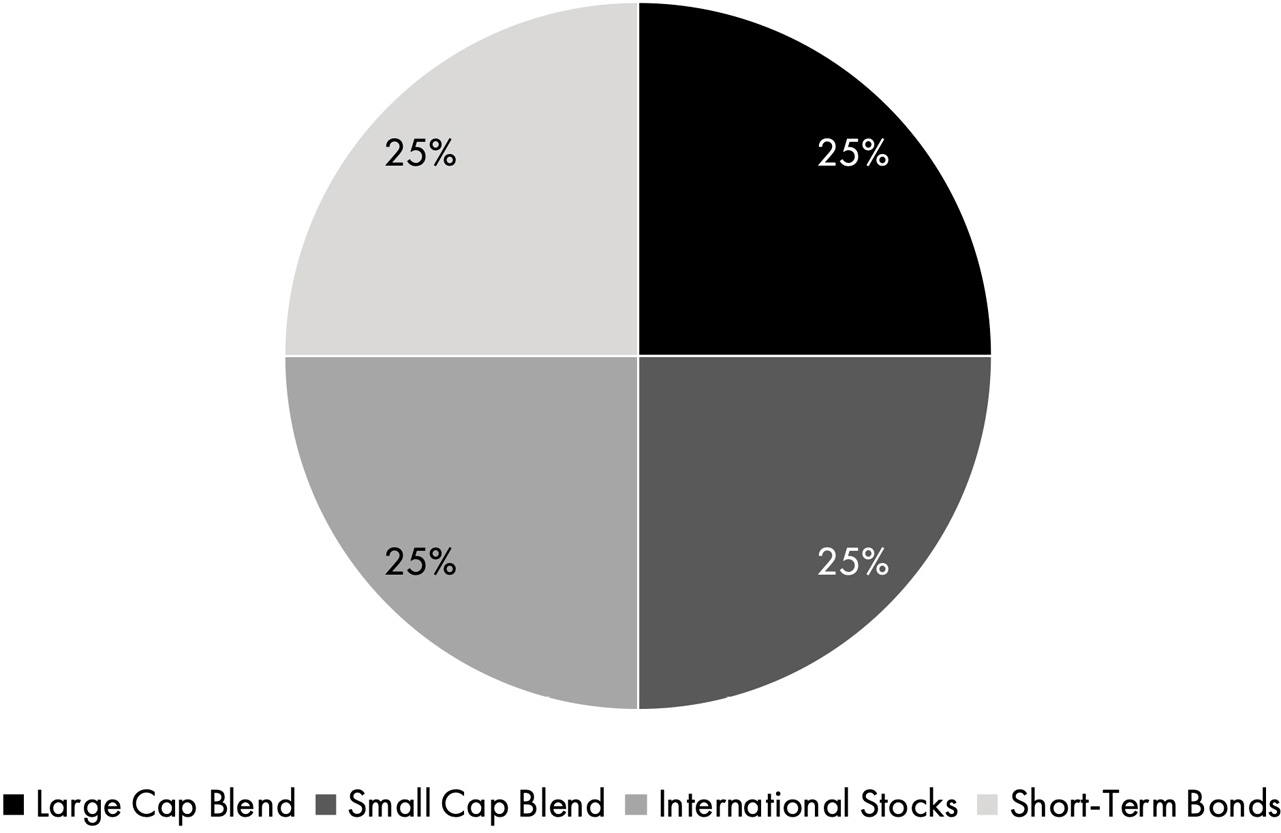
I picked the portfolio about 30 years ago. There’s nothing special about it, beyond that it’s reasonably well diversified, has an aggressive 75/25 stock/bond split, and the stock portion is 67/33 domestic/foreign [as seen in Figure 13.1]. My books generally start with very simple portfolios, similar to the above, and work up to tilted ones with up to a dozen or so stock asset classes. I don’t think I’ve recommended the “no-brainer” for a long time.
Figure 13.1: Bernstein’s No-Brainer
FUN SIDE NOTE
Bill has written some incredible history books, including:
A Splendid Exchange: How Trade Shaped the World
The Birth of Plenty: How the Prosperity of the Modern World was Created
Masters of the Word: How Media Shaped History from the Alphabet to the Internet
The Delusions of Crowds: Why People Go Mad in Groups
CR: Who most influenced your development of the No-Brainer Portfolio? Was there any academic or factor-based reasoning?
WB: Probably the most influential was Brinson’s Determinants of Portfolio Performance from over 30 years ago that talked about portfolio optimization, as well as Markowitz, and Fama and French’s research which supports tilting. But, as I’ve implied above, it’s not possible to pick “optimal” portfolios in advance. Better to pick something reasonable and stick with it.
CR: Do you have any criticisms of the portfolio or aspects you might consider altering in the future?
WB: Nope, my thinking about asset allocation hasn’t changed much in the past 20 years. Here is my current recommended allocation for the stock part of a portfolio. These percentages, of course, get diluted down with bonds to taste for risk tolerance, capacity or need.
- 37.5% US total market
- 12.5% US small value
- 10% REITs
- 2.5% energy stocks
- 2.5% precious metals stocks
- 10% European
- 10% Pacific
- 5% developed market small value
- 7.5% emerging market
- 2.5% emerging market small value
Will this do any better than the one-third each of US large, US small, and foreign recommended in the original No-Brainer? I haven’t the foggiest. As I said, that’s unknowable in advance, and sticking with your allocation is more important than the actual allocation.
***
Bernstein is really speaking my language with all this talk about how the potentially suboptimal portfolio you stick with is likely to be superior to the optimal portfolio you abandon.
Of course, the most interesting part here is that even though Bill likes the original No-Brainer Portfolio, it’s clear that he has a more nuanced appreciation for the need to customize beyond the simplest of allocations.
For instance, I know that Bill is sometimes a little bit critical of the Boglehead Three-Fund Portfolio for its lack of cash liquidity. That is easily solved with one position, but Bernstein also knows that an investor might need to go a bit beyond something that looks like a very simple No-Brainer.
I also like his emphasis on the role of bonds in a portfolio. Bernstein likes to highlight that the purpose of bonds is not to generate high returns. They are for providing principal stability and income across very specific time horizons. This is one reason why he isn’t a huge fan of corporate bonds or junk bonds. Like myself, he believes these instruments oftentimes look like stocks in disguise due to their credit risk and potential for permanent principal losses.
Another thing that Bill has mentioned in his work is that he’s a big fan of owning Treasury Inflation Protected Securities (TIPS) for the bond allocation when you’re drawing down a portfolio and trying to create greater certainty of consumption in the future. He likes building out custom TIPS ladders for this purpose. He says:
A TIPS is risky in the short term and riskless in the long run, which is precisely the opposite of, and complementary to, a T-bill, which is riskless in the short term but, because of reinvestment rate volatility, risky in the long run.29
I appreciate that description and it’s a very useful way to balance the risks of bonds in a portfolio. Bill likes using bonds in an asset-liability matching approach that isn’t all that different from my Defined Duration Strategy (see Chapter 20). He argues TIPS are the only instrument that can give you absolute certainty of meeting future inflation-adjusted consumption when structured over a bond ladder. Based on this broader understanding of Bill’s approach I’ve created what I call the “Updated No-Brainer Portfolio.”*
Let’s start digging into this entire portfolio in more detail.
HOW THE UPDATED NO-BRAINER PORTFOLIO WORKS
The Updated No-Brainer Portfolio is another very broadly diversified portfolio that focuses on capturing as much of the market’s returns as possible while also minimizing taxes, fees, and activity. At the same time, it’s more sophisticated than what we’ve seen with some of our other indexing strategies. In fact, the Updated No-Brainer Portfolio has quite a lot of tilting going on. Will that work? As Bill notes, we don’t really know, but it’s grounded in the same sound logic that underpins the Boglehead Three-Fund Portfolio and the Factor Investing Portfolio.
Bill’s overall approach is also somewhat similar to the Flying Ladder in that it’s structured as two very distinctly different pieces serving very different needs. In short, the stock component of the Bernstein No-Brainer Portfolio is based on broad diversification with empirically supported factor tiling. And then our bond slice is based on sound judgment of how bonds should best be utilized and the proper instruments that can be used to match certain income and spending needs over time.
So, this portfolio works because it’s diversified, low-cost, and can be personalized to meet someone’s financial planning needs.
BUILDING YOUR OWN UPDATED NO-BRAINER PORTFOLIO
The Bernstein No-Brainer Portfolio has two very specific components that serve different purposes. Bill uses bonds as an income and financial planning tool to help an investor try to match certain assets with future liabilities. And then he builds a stock portfolio along with this bond component to help generate growth.
The bond component is pretty clean and we’re going to focus on using T-bills and TIPS, as Bill discussed earlier.
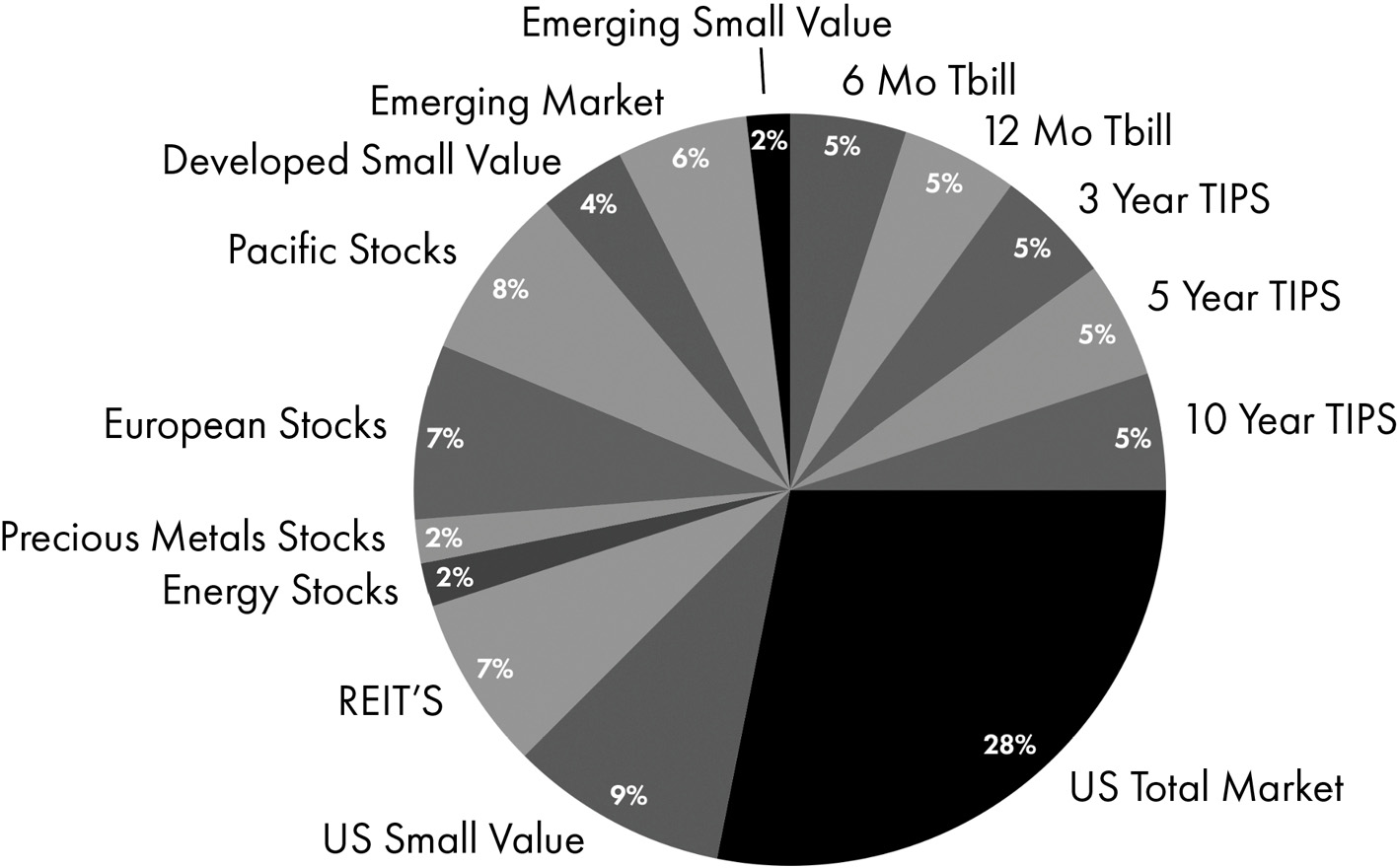
The stock component is where Bill gets a little fancier and does a decent amount of tilting both to factors, sectors, and regions. Although the portfolio can be customized, we’re going to assume a starting point consistent with the original 75/25 stock/bond target. Based on this, the Updated No-Brainer Portfolio would look something like Figure 13.2.
Now we’re talking. As you can see, our perfect portfolios are building on one another as we expand the approaches and begin to integrate them with one another. Now let’s dig into the analysis of this portfolio.
Figure 13.2: The Updated Bernstein No-Brainer
UPDATED NO-BRAINER PORTFOLIO ANALYSIS
The Updated No-Brainer Portfolio can be customized to meet an investor’s needs, but we’ll run our analysis here using our Updated No-Brainer holdings within the 75/25 stock/bond weighting that is consistent with the overall weighting of the Original No-Brainer Portfolio. Our analysis begins in 1997, as TIPS were not issued before then, but this still provides a meaningful period for evaluation.
Despite being comprised of 25% TIPS and T-bills, the Updated No-Brainer Portfolio does surprisingly well, earning 4.95% average annual returns, compared to 5.20% for the global stock market over the same period. It achieves this return with 11.98% volatility, compared to 18.84% for the global stock market. Granted, this was an especially good period for bonds, but the equity piece of the portfolio still performs well over the same period. Keep in mind that while we’re comparing the Updated No-Brainer Portfolio to an all-stock portfolio, it’s important to note that with its 75/25 allocation, it’s likely to fall somewhere between a 100% Stock Portfolio and a traditional 60/40 Portfolio in terms of aggressiveness and risk. Global 60/40 returned 4.35% per year with 10.21% volatility over this same period so the No-Brainer does well compared to both global stocks and global 60/40. This is visually clear in Figure 13.3:
Figure 13.3: Updated No-Brainer performance
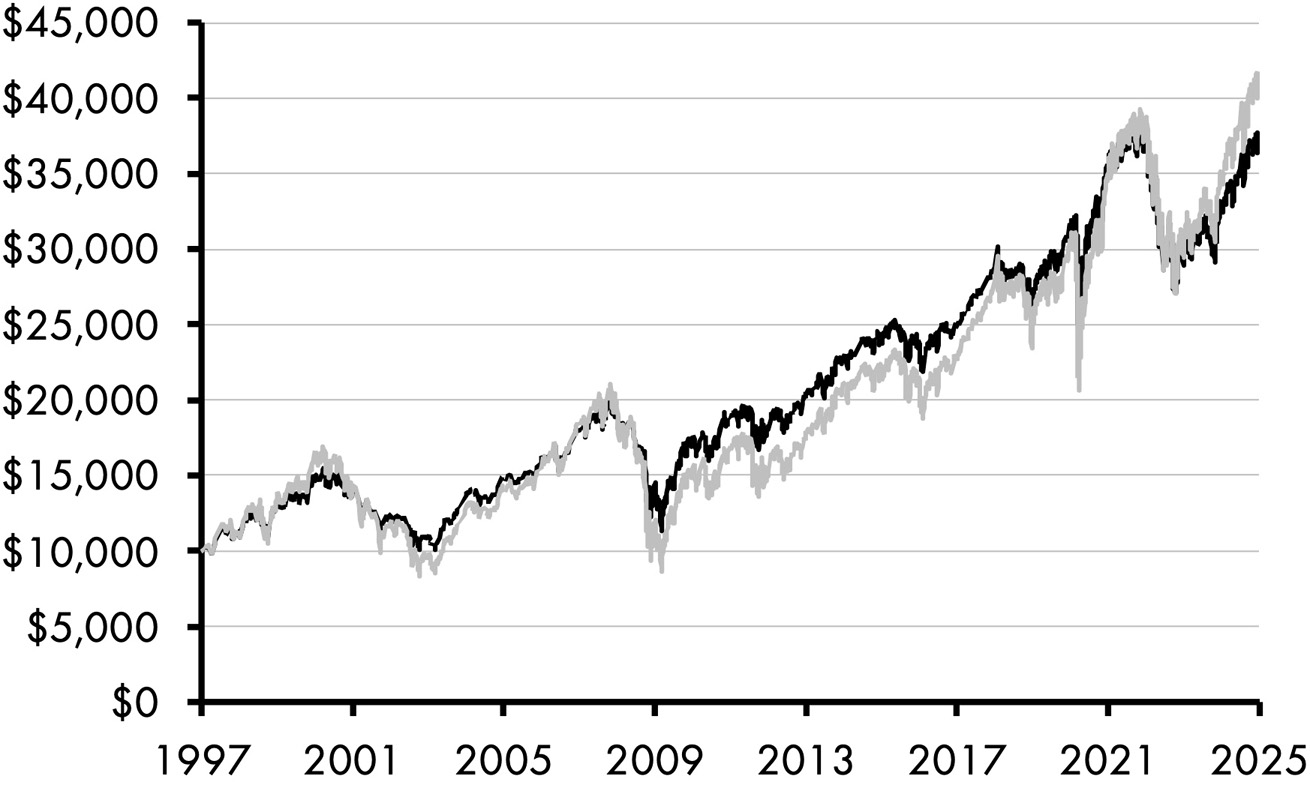
Table 13.1: Portfolio analysis
|
Updated No-Brainer |
Global Stocks | |
|---|---|---|
Real Returns | 4.95% | 5.20% |
Volatility | 11.98% | 18.84% |
Sharpe Ratio | 0.42 | 0.37 |
Sortino Ratio | 0.59 | 0.52 |
Max Drawdown | -44.85% | -58.88% |
Ulcer Index | 13.87 | 19.20 |
Market Correlation | 0.60 | 0.89 |
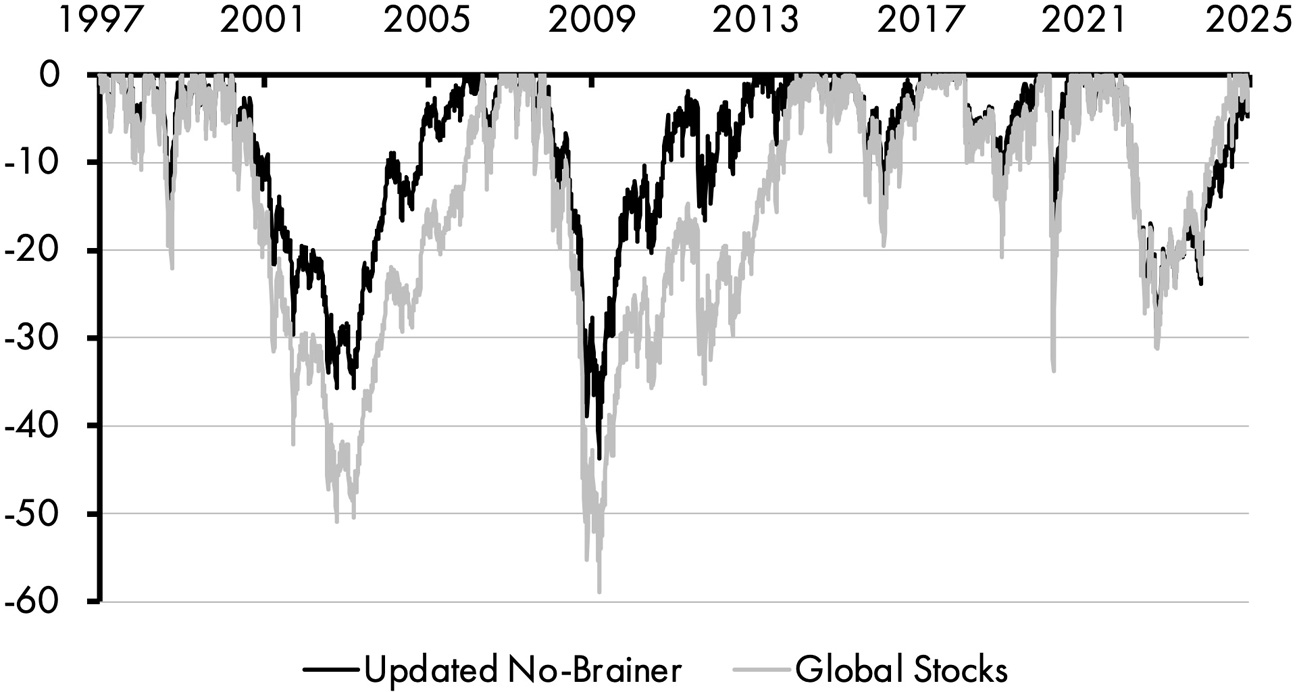
Drawdowns and risk metrics are also much more favorable for the Updated No-Brainer Portfolio, with a Sharpe ratio of 0.42 compared to 0.37 for stocks. A Sortino ratio of 0.59 compared to 0.52 shows that it protects better for downside volatility, with a max drawdown of 44.85% compared to 58.88% for global stocks, as seen in Figure 13.4. Its Ulcer Index of 13.87 compares with 19.20 for global stocks and is consistent with a portfolio that will be more behaviorally robust.
Figure 13.4: Updated No-Brainer drawdowns (%)
There’s a lot going on here, but it obviously works well.
Let’s get into the pros and cons.
UPDATED NO-BRAINER PORTFOLIO PROS AND CONS
Let’s get the bad news out of the way first, as usual:
- The baseline No-Brainer is aggressive so as Bill noted you need to be someone with a relatively high risk tolerance. This has an element of the Flying Ladder Portfolio when used with the TIPS ladder, so you need to compartmentalize the roles of the ladder relative to the equity sleeve.
- There’s a lot going on here between the TIPS ladder and the numerous tilts. Some of those tilts are also so small that it raises a valid concern over how meaningful they are and whether they’re worth the added annoyance of seeing them every day. This may not be suitable for the investor who wants to keep things simple.
- There’s not a great deal of evidence that this type of portfolio is much better than the Three-Fund Portfolio outside of the bond slice. That is, are all those stock tilts better than just owning what Taylor Larimore recommends with two equity funds?
- I go back and forth about TIPS. The argument is that you will generate a more reliable inflation-adjusted fixed income stream. But the problem there is that inflation is measured at a national level and experienced at a local level. National TIPS aren’t guaranteed to give you purchasing power protection. Further, TIPS are largely an interest rate bet. If rates go down, plain vanilla Treasuries will do better. And if rates go up then TIPS will do better over specific time periods. You need to be aware that you’re making a bit of an interest rate bet when you buy TIPS versus straight Treasuries.
- The portfolio is only stocks and bonds so in environments where equities and fixed income become highly correlated, you’ll feel undiversified.
And what about the good news?
- The portfolio is simple, all things considered. Especially if you’re not using the TIPS ladder. And the stock tilts, while arguably excessive, do give you the potential to generate a little extra return.
- The Updated No-Brainer Portfolio improves on the fixed income piece of the Three-Fund Portfolio in a big way. Especially if you’re drawing down your portfolio and trying to attain more certainty than what you’ll get in the total bond position of the Three-Fund Portfolio.
- The more sophisticated investor might like having all these stock tilts that give them a little more optionality and potential for superior returns.
- Although the portfolio doesn’t have pure play inflation hedges like gold or commodities, it does tilt to some more specific hard asset classes and inflation hedges like REITs, energy stocks, precious metals, and TIPS. Bill is getting some inflation hedging in there without having to own more costly inflation hedges.
SUITORS FOR THE UPDATED NO-BRAINER PORTFOLIO
The Updated No-Brainer Portfolio is ideal for the investor who wants a little more nuance and potential return from their portfolio. While Bernstein is a Boglehead, he also understands the importance of customization and adding some layers where it makes sense. The portfolio is right for the person who likes the idea of the Three-Fund Portfolio, but finds it a bit too simple for their personal needs or desires.
It’s also worth noting that this portfolio requires the right temperament. While the TIPS/T-bill ladder is designed to provide stability, the 75% stock allocation will still feel like a roller coaster at times. Since most of the portfolio’s risk comes from its equity exposure, it’s important to recognize that a 75% stock allocation will likely take some hard hits along the way. That’s why this portfolio works best when tailored to match your specific risk profile.
FINAL THOUGHTS
An Updated No-Brainer Portfolio from a brainiac who also happens to be an expert about the human brain. Pretty cool.
But what if you don’t want to overthink things? What if you’d rather just clip coupons, skip the academic mumbo jumbo, and focus on that sweet, sweet cash flow?
Well, in that case you’re going to like the dividend-oriented strategies that are behind Door #14. You might be surprised about where these strategies came from and how they’re likely to evolve in the future.