The Portfolios
Chapter 15
The Trend Following Portfolio
IN late 1987 I followed my father into the Loudon County Virginia Courthouse where he was arguing a case on behalf of a teenage boy. I twiddled my thumbs patiently waiting for him to finish until a loud scream filled the courtroom and the boy jumped into my father’s arms in celebration as he was absolved of a noise violation. The judge slammed his gavel and called for order.
Given his reaction I was convinced my dad had saved this boy’s life and as the two of them walked my way the overzealous boy wasted no time in giving me a high five that still hurts to this day. This was the first time I would meet my friend Michael Covel, the most important advocate of what has famously become known as Trend Following.
The next time I would see Covel was when I was a young stockbroker at Merrill Lynch. We were having lunch in Tyson’s Corner, Virginia, and he handed me one of the first ever published copies of Trend Following, an intriguing book that described a relatively unknown investment strategy. By then, he was a totally different person than the raucous boy I had met long ago, and he stoically explained the basic idea of the strategy and the many fascinating people who had become fabulously wealthy from it.
Like the older, trend-evolved Covel, the strategy was unemotional and stoically systematic, but still reflected a glimmer of the young Covel in that it was considered a contrarian, Wild West part of the investment world. It had the added benefit of performing especially well in circumstances when other asset classes did not. It did not just trend with the market, but tended to move one way when bigger asset classes, like stocks, moved the other direction.
I read the book in a single day and was lucky enough to have access to one of the most famous trend followers Covel wrote about. Merrill had begun offering an investing program in partnership with an investor named John W. Henry. I knew the name primarily because, as an avid Yankees fan growing up, I recognized the man who had just purchased my arch-nemesis, the Boston Red Sox.
FUN SIDE NOTE
I want to brag about my amazing dad. He once defeated Chuck Norris in a lawsuit. As a result of this the only two men who ever defeated Norris are Brien Roche and Bruce Lee.*
I called up the team that had constructed the investment program and I grilled them on the intimate details of the strategy. I had been hired to be a salesman, but I found myself being sold and I was hooked on Trend Following. Who knew that my love affair for Trend Following would grow from my hatred of the Boston Red Sox?
The Trend Following story is much older than J. W. Henry or Covel. In fact, one of the best-known Trend Followers was the most famous stock market speculator in history, Jesse Livermore. In his 1940 book How to Trade in Stocks Livermore distilled his process into a single paragraph:
It may surprise many to know that in my method of trading, when I see by my records that an upward trend is in progress, I become a buyer as soon as a stock makes a new high on its movement, after having had a normal reaction. The same applies whenever I take the short side. Why? Because I am following the trend at the time. My records signal me to go ahead!34
Livermore famously won and lost more money than most of us can ever imagine, and his losses ultimately resulted in a severe decline in mental health and suicide. Although Livermore was an original Trend Follower, he also had a knack for doubling down on ending trends. This compounding of risk helped teach modern-day Trend Followers the most important rule of all – the trend is your friend until it ends.
WHY TREND FOLLOWING WORKS
Trend Following refers to a broad range of strategies that implement time series momentum. Time series momentum focuses on a single asset’s past returns to determine the trend of the instrument. This is different from the momentum factor, which uses a cross-sectional measure of momentum. A cross-sectional momentum approach takes a particular instrument (typically stocks only) and compares the past performance to the momentum of other correlated assets. This relative momentum helps determine whether an instrument has strong momentum when compared to similar instruments, as opposed to the pure Trend Following strategy which focuses on the absolute momentum of a singular instrument relative to its own past performance.
While Trend Following is distinctly different from the momentum factor, it works for similar reasons. There tends to be behavioral reasons for assets to move in a trend as investors feed on herd behavior. In the case of Trend Following, the goal is often to bet on small trends with the hope that they turn into larger ones. This is why Trend Following often results in huge asymmetric and uncorrelated returns. Because they’re buying uncorrelated assets, trend followers often benefit from extreme market moves where a small trend, like the 2008 stock market downturn, turns into a crash. This is where Trend Following really shines and provides its outsized uncorrelated returns.
Research shows that Trend Following has worked for hundreds of years and has consistently exhibited uncorrelated returns throughout history (see Figure 15.1). Hurst, Ooi, and Pederson showed in 2017 that the trends are especially interesting in periods of great turmoil.35
Figure 15.1: 100+ years of Trend Following
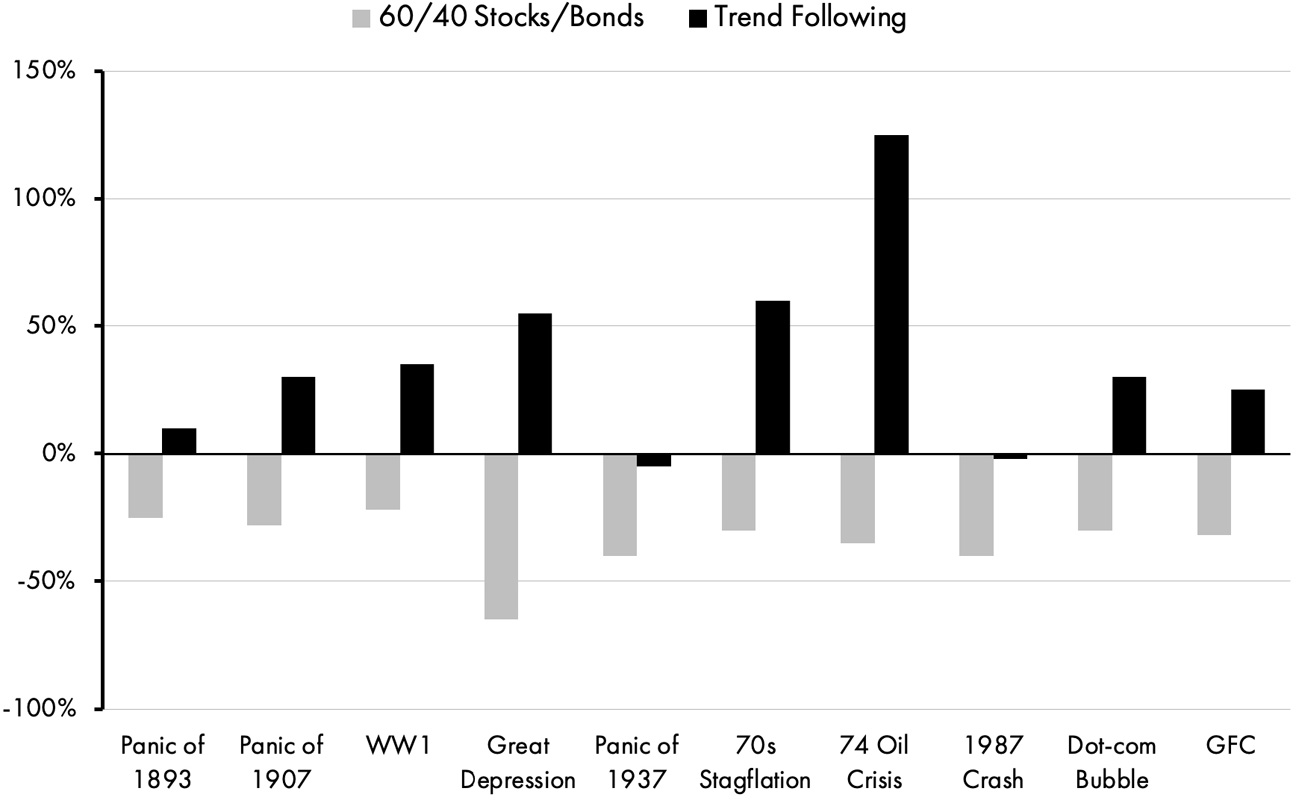
They created an equal weighted index across one-, three- and 12-month time horizons using 67 markets and found that trend strategies generated net annual returns of 8.6% (adjusted for inflation), with positive returns in every decade since 1880. More importantly, they found virtually no correlation to stocks and bonds. They concluded:
[A] large body of research suggests that price trends exist in part because of long-standing behavioral biases exhibited by investors, such as anchoring and herding [and I would add to that list the disposition effect and confirmation bias], as well as the trading activity of non-profit-seeking participants, such as central banks and corporate hedging programs.
The theory says that behavioral biases such as herding lead to sustained trends:
The intuition is that most bear markets have historically occurred gradually over several months, rather than abruptly over a few days, giving trend followers an opportunity to position themselves short after the initial market decline and profit from continued market declines. In fact, the average peak-to-trough drawdown length of the 10 largest 60/40 drawdowns between 1880 and 2016 was approximately 15 months.
Uncorrelated returns that perform especially well when we most need them. Sounds useful, huh? Let’s dig into how we can implement something like this.
BUILDING YOUR OWN TREND FOLLOWING PORTFOLIO
There are hundreds of different ways to skin this cat because Trend Following doesn’t constrain us to a particular market or instrument. That’s one of its benefits – it’s a “go anywhere” type of strategy. You might be long oil and short interest rates one month, only to find yourself long pork bellies and short fart jars the next day. Just kidding, you can’t short fart jars even though there was a market for them in 2021 during the heyday of the NFT craze. You get my point though – these strategies can go anywhere and it’s the unconstrained nature of Trend Following, within a rigid systematic style of trading, that makes it so interesting.
I talked to Covel about why Trend Following works and he emphasized that it’s because so much of what passes for “fundamentals” is nonsense. When you’re Trend Following, you’re using a pure price signal. There’s no fundamental analysis required and so you’re not relying on accountants, analysts, or backward-looking data to forecast anything. You’re just using price trends.
But within that seemingly simplistic approach you’re building a strict set of systematic rules. Rules are important because, as legendary investor Jim O’Shaughnessy writes in What Works on Wall Street, “If we can remove emotion and subjectivity from our investment strategies, we can beat the market in the long run.” When you’re Trend Following you’re taking the behavior and the fundamentals out of the equation and simply trading a systematic price methodology. This can improve performance by reducing the potential for catastrophic mistakes. And while this might appear dissimilar to many of the strategies in this book, the general principles of Trend Following are consistent with most of the broader themes we’ve discussed, including:
- Focus on trends, not predictions: Trend Following is all about riding the momentum of market trends rather than trying to predict market movements. It is essentially a version of extrapolative expectations wrapped around a rigorously systematic trading approach.
- Use clear rules: Covel emphasizes the importance of easy-to-follow rules without complex analysis or predictions. This means focusing on basic technical indicators and avoiding overcomplicating the strategy.
- Risk management: Proper risk management is crucial. This includes setting stop-loss orders to limit potential losses and determining position sizes based on your risk tolerance and goals.
- Discipline and consistency: Stick to your strategy and rules without letting behavior drive your decisions. Stay the course with your systematic approach!
- Diversification: Spread your investments across different markets and asset classes to reduce risk and increase the chances of capturing trends in various sectors. Diversify your trends so you increase the odds of capturing the big trends.
- Patience: Trend Following requires patience, as trends can last for long periods, and it’s crucial not to jump in and out of positions too quickly.
I would recommend reading Covel’s books, not only because they explain how to implement the strategy at a more customizable level, but also because they’re a fantastic historical read on the topic.
That said, there are numerous different ways to implement this strategy using publicly available funds. A few that you might consider doing more research on include:
- iMGP DBi Managed Futures Strategy ETF (ticker: DBMF)
- Simplify Managed Futures Strategy (ticker: CTA)
- First Trust Managed Futures Strategy Fund (ticker: FMF)
- KraneShares Managed Futures (ticker: KMLM)
- Arrow Managed Futures Strategy Fund (ticker: MFTNX)
- Virtus AlphaSimplex Managed Futures (ticker: ASFYX)
- AQR Managed Futures Strategy Fund (ticker: AQMIX)
- AQR Managed Futures Strategy HV Fund (ticker: QMHIX)
TREND FOLLOWING PORTFOLIO ANALYSIS
We’re going to use the KMLM Index, one of the longer existing Trend Following indices and one that is also tracked by real-time funds for this analysis. Their fee-adjusted historical data begins in 1992 so we’re somewhat limited by the historical data on trend analysis.
You’ll notice something very interesting here – this strategy is almost inversely correlated with global stocks in the short term, even though they both trend higher in the long term. In fact, over the last 45 years you’d have ended up in nearly identical places despite very different paths, as seen in Figure 15.2. While both approaches generated about 5% annual real returns, they did so with almost no correlation. Their volatility profiles are quite different, with Trend Following generating 13.55% volatility per year and global stocks generating 18.85%.
Figure 15.2: Trend Following performance
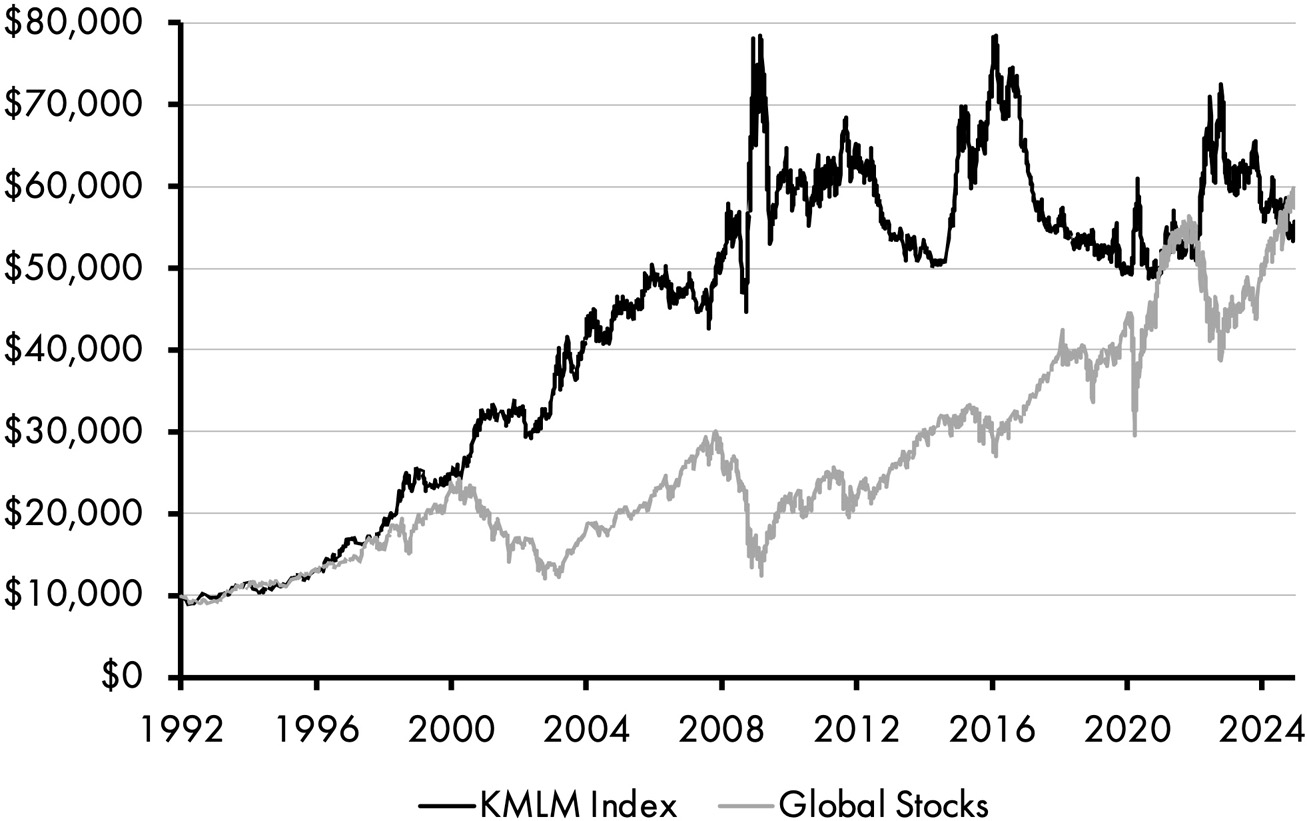
Table 15.1: Portfolio analysis
|
KMLM Index |
Global Stocks | |
|---|---|---|
|
Real Returns |
5.34% |
5.41% |
|
Volatility |
13.55% |
18.85% |
|
Sharpe Ratio |
0.46 |
0.39 |
|
Sortino Ratio |
0.65 |
0.54 |
|
Max Drawdown |
–38.00% |
−58.88% |
|
Ulcer Index |
19.00 |
17.78 |
|
Market Correlation |
−0.16 |
0.88 |
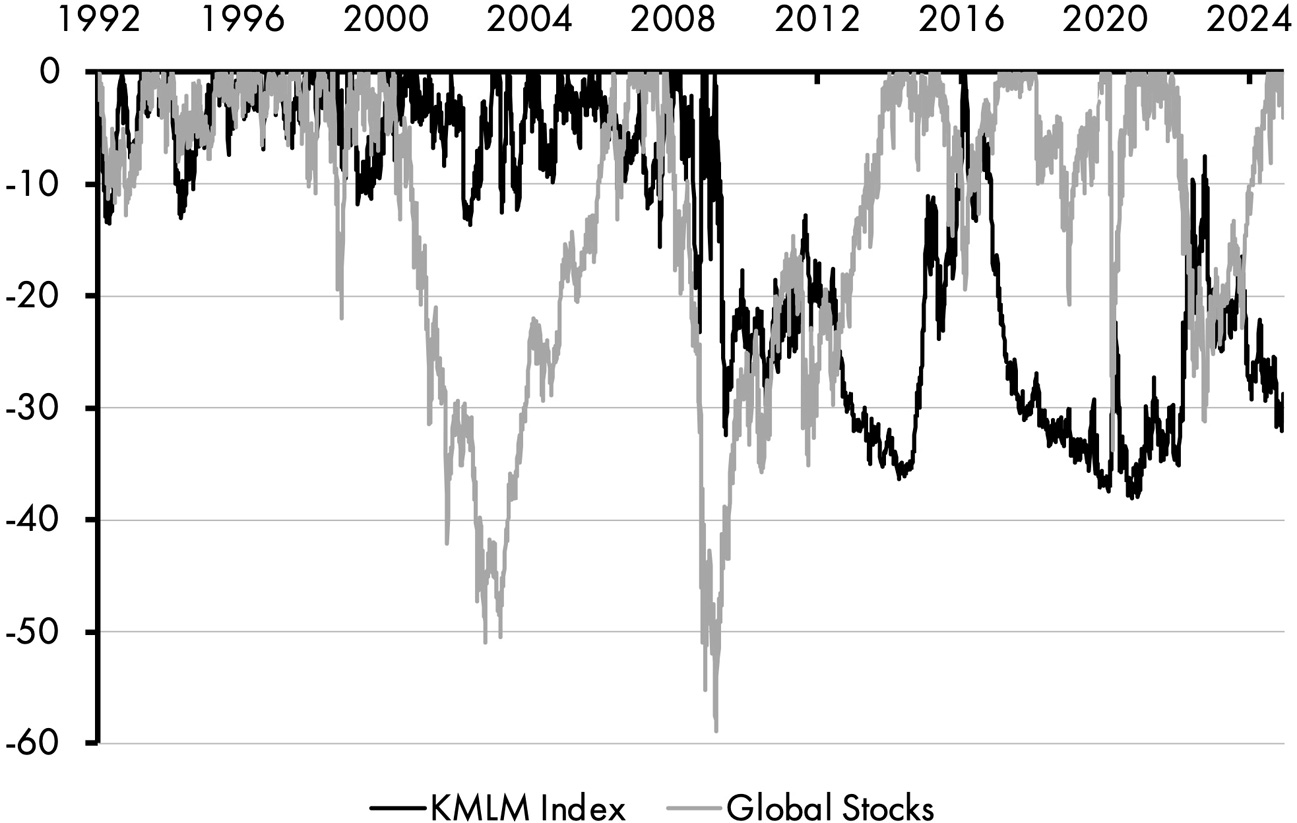
This Trend Following index achieved its returns with far smaller but longer lasting drawdowns (see Figure 15.3). That’s due to the boom and bust nature of the trends being captured here. As noted, you’re often capturing these very large asymmetric trends where a small trend builds into a major one and then, as Jesse Livermore learned, often mean reverts. Again, the trend is your friend until it ends. This emphasizes the importance of rules-based trading and having stop losses or systematic sell signals.
Figure 15.3: Trend Following max drawdowns (%)
TREND FOLLOWING PORTFOLIO PROS AND CONS
I’ve got good news and bad news for you here. Of course, I’ll break the bad news to you first.
- This is, by design, a trading strategy. And we all know the math of the markets by now. The more active you are, the more likely you are to reduce overall returns. Trend Following also tends to operate in negative-sum markets where you don’t have the benefit of patiently waiting on capital appreciation from corporate cash flows. Markets like futures are constrained to specific time horizons which make them zero-sum or negative-sum games in the aggregate during that time horizon.
- There’s no guarantee that Trend Following will generate positive returns in the long run because we’re not always dealing in cash-flow-generating assets like stocks and bonds.
- The taxes and fees are usually unkind. Double check any specific funds you use to ensure the fees aren’t egregious.
- Trend Following strategies can go through long periods of sideways movement, especially in markets where there are no exaggerated trends.
And what about the good news?
- These strategies are truly uncorrelated. It’s hard to find consistently uncorrelated strategies, but Trend Following is one of the few that fits the bill.
- Trend Following strategies aren’t just uncorrelated, but tend to be the least correlated when it matters most. For instance, during the bear markets of 2002, 2008, and 2020.
- These strategies don’t rely on bull or bear markets or understanding fundamental analysis. There’s no forecasting of economic or financial conditions.
- Trend Following strategies are purely rules-based. There are no behavioral biases involved because the systematic nature of the strategy removes human emotion from the equation.
- I like to think of these kinds of strategies as insurance. As I’ve noted, insurance is something you own and don’t expect a positive sum return from in the short run. But, in certain unexpected environments, insurance pays out a huge asymmetric positive return. Trend Following strategies are often similar. They can go years without showing much of a trend, but when big trends become pronounced (typically during big market swings like market crashes), Trend Following funds shine as those little trends suddenly turn into larger ones that lead to big returns.
SUITORS FOR THE TREND FOLLOWING PORTFOLIO
These strategies are volatile and unreliable in the short term, requiring an investor who is both patient and risk-tolerant. They also demand an appreciation for the role of unusual, uncorrelated assets and insurance.
In practice, the investors who adopt these approaches are those who understand how such strategies can function as part of a broader allocation and complement other assets.
FINAL THOUGHTS
Unemotional strategies are great. I am a big advocate of making your entire portfolio systematic to protect you from your own worst enemy. But I also know that investing requires a certain degree of activity and emotion. And if a little emotion helps you stay in the game then by all means introduce some emotion.
In the next chapter we’re going to discuss the pros and cons of politically biased investing and what’s come to be known as ESG investing. This one might ruffle a few feathers, so please keep reading, but remember to send all hate mail to the current Chairperson of the Federal Reserve and not me!