The Portfolios
Chapter 22
Odds and Ends
AS you pursue your perfect portfolio you’ll encounter numerous competing narratives that will influence your decisions. In this chapter I am going to provide some clarity on many of these narratives to help you further narrow down your search.
IS THE PURSUIT OF ALPHA BAD?
We now know that beating the market is really hard. Then again, if we’re all active to some degree then we’re all implicitly trying to optimize our portfolios for the amount of return we generate per unit of risk. In other words, we’re all aiming for alpha, even if it’s not an explicit goal. The key difference lies in how we pursue that alpha. As I’ve mentioned before, there are smart ways to be active – and not-so-smart ones.
There’s a popular joke in financial circles that says you can’t eat risk-adjusted returns. In other words, while it might be interesting mental gymnastics to calculate metrics like a Sharpe ratio, the statistical output isn’t something you can eat. For example, if a hedge fund is touting a 9% return with 10% volatility versus a 10% return in the S&P 500 with 20% volatility, the thinking says that the investor who owned the S&P 500 can eat more despite the fact that the S&P 500 had worse risk-adjusted returns. You can eat realized returns because it’s actual dollars in your pocket, but you can’t eat the Sharpe ratio. While I am a critic of high-fee active strategies, I also think this is wrong.
Let me explain why.
As you know, I like to view everything through very specific time horizons. The financial services industry does a terrible job of explaining time horizons to investors, in part because most of the commentary in the industry is about stocks, and stocks do not have a defined time horizon. That’s part of the problem I’ve tried to solve with the Defined Duration approach by quantifying an implied equity duration and then helping investors understand a reasonable time horizon over which they might expect a certain return.
What we all really want is predictable returns over specific time periods. We want the straight line in Figure 22.1, but what we get is the bumpy outcome. The degree to which you can smooth that ride with various diversifiers will allow you to eat more predictably across time.
So, you might end up diversifying a portfolio and reducing your average returns over time, but if it creates a smoother ride across specific time horizons then you do end up being able to eat the risk-adjusted returns because you can consume more predictably over time.
The real problem with most high-fee stock-picking strategies or multi-asset strategies is they are inherently long-duration buckets in our financial plans. In the Defined Duration model, most homogeneous diversified portfolios end up being 10+ years in duration because they’re a blend of stocks or stocks/bonds and other instruments. These investment managers are oftentimes trying to turn water into wine and help you consume out of a long-term bucket. They fail for two reasons:
- The overwhelming evidence shows that lower-cost alternatives have a strong tendency to outperform over long periods of time.
- You cannot make an inherently long-term instrument act like a short-term instrument on average.
Figure 22.1: Needs and wants, stock market edition
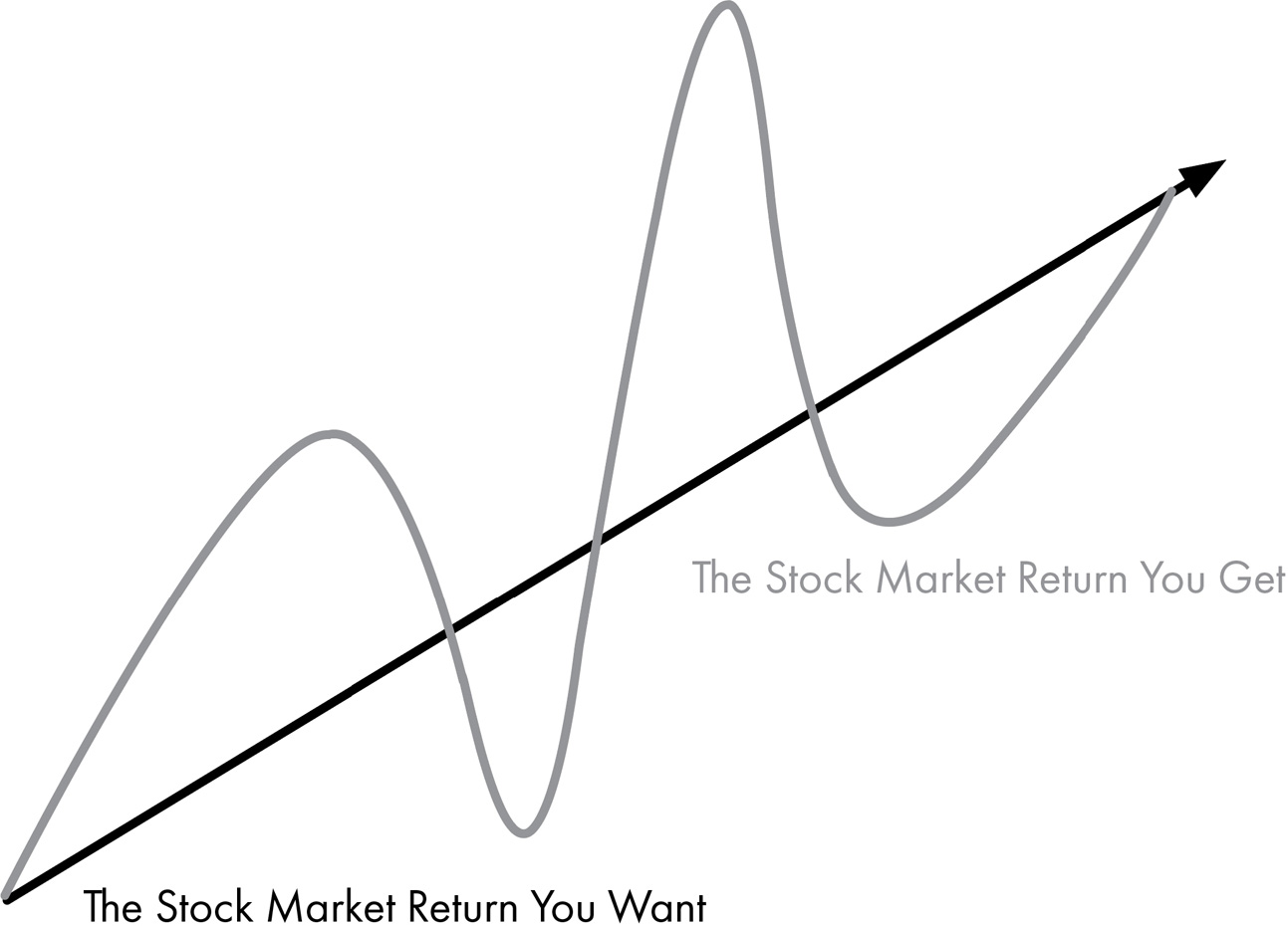
The result is, when you buy the ABC Multi Asset Stock Bond Hedge Fund with a 1.5% expense ratio, you’re probably buying an instrument that has a duration of about 10+ years (because bonds will average five-plus-years duration and stocks are 15+ years). And when you compare that to something like a boring, low-cost 60/40 index fund, you’ll find that the funds don’t outperform over long periods of time because they cannot outperform in aggregate, and their taxes/fees end up eating too much of the total return to outperform.
But more importantly, you cannot predictably consume out of this bucket because it creates too much short-term uncertainty. That is, after all, why diversified multi-asset funds like a 60/40 Portfolio work in the long run – you have to be willing to sacrifice short-term liquidity to allow long-term cash flows to accrue to the underlying instruments.
None of this means that the pursuit of high risk-adjusted returns is irrational though. It just shows that it’s very hard to achieve using inherently long-duration instruments. Still, it does display what we all want – we want stable returns over specific time periods. And we want stable returns because you can eat those returns with greater predictability. In other words, you can plan your life more clearly if you know how much money you’ll have at specific times in the future.
Here’s the big conclusion – the pursuit of stable and steady returns is a good goal. And you can absolutely eat risk-adjusted returns. You just need to be mindful about the cost of those returns and the specific time periods over which you’re trying to achieve them.
YOUR HOUSE AS AN INVESTMENT
Probably the most important asset you’ll ever purchase is your house. Houses are basically big blocks of depreciating commodities (wood, cement, etc.) built on top of an appreciating piece of land. That big block of commodities is enormously expensive to maintain and the real returns we generate from this asset are likely to be lower than we think.
I know this all too well as I purchased a fixer-upper in 2017 with zero experience in construction. It took us two years to get a permit (yay, California) and then we found out we were expecting our first child about nine months later. I asked our general contractor how long the project would take and when he told me 15 months, I decided I needed to become a part-time construction worker. I would work my day job from 6 a.m. to 3 p.m. and then become a construction worker every day for nine months from 3 p.m. to 9 p.m. to ensure it was done before my daughter came.
While I can now brag about being proficient in framing, drywalling, and skid steer driving, I also lost about 10 million brain cells and nearly a few limbs along the way. I’ve slowly acquired the equivalent of a small Home Depot in my house as I regularly repair and update things. While my situation was unique, these are the kind of negative returns a lot of homeowners don’t like to tell you about.
Let’s talk about the empirical data though. Bob Shiller, the creator of the Case-Shiller Housing Index, has compiled data on the long-term real returns of housing which shows that houses have generated about 0.59% per year in real returns since 1890. The vast majority of these returns came in the run-up to the housing bubble of 2008 and the post-Covid housing euphoria. See Figure 22.2.
Figure 22.2: US house price real returns
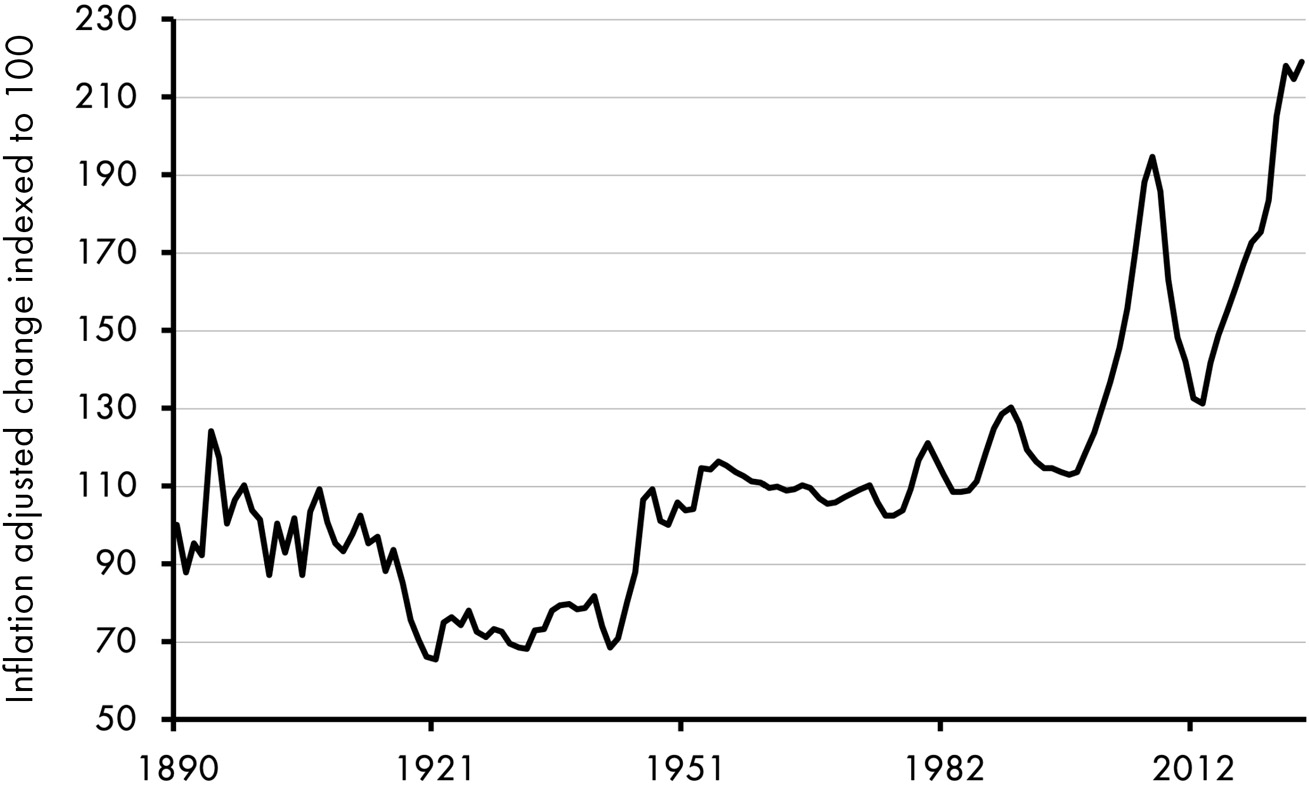
When you back out inflation, maintenance, and transaction costs there’s a strong probability that your house will not be a great investment. And unless you operate a real estate business I don’t think you should consider your house as an investment at all. It is, first and foremost, a place for you to live and raise a family. It’s not a money-making endeavor. Sure, it would be great if you make some money on the house as you’re living in it, but you should own it for personal and practical reasons, not pure financial reasons.
All that being said, one consideration in the scope of our discussion that could be very important is whether you own or rent a home. In the same way that your income is like a bond, you can think of your house as a commodity allocation. That is, if you own a house you should consider that you already own a significant commodity allocation. And this might mean you don’t need a large commodity allocation in your savings portfolio.
Further, if you have a fixed-rate mortgage then you are effectively short the bond market. That is, your mortgage operates like a hedge against your interest rate risk and this could play a role in how you think about your other bond allocations. I made a lot of dumb decisions while building our house, but the 2.5% mortgage we locked in has turned out to be one of the best investments I’ve ever made, in large part because it hedged all my other bond positions across my portfolio and has allowed me to earn a hefty excess return on the stocks we maintained (as opposed to buying the house without a mortgage).
When you approach the buy versus rent decision you’ll come across a million different opinions and online calculators. None of them can apply your personal circumstances and financial or familial needs and wants. I like to think of a house as a long-duration instrument. And this means your buy versus rent decision is mostly a temporal decision. The odds of you losing money in real estate over a 15-year period is very low. In my Defined Duration model, residential real estate comes out to be a 19-year instrument. If you’d purchased a home at the very peak of the 2006 housing bubble you’d be indifferent to that price change, in real terms, within 15 years. So it’s a very long duration instrument and you should go into any buy versus rent analysis with time as an essential consideration.
As a rule of thumb, your buy versus rent decision comes down primarily to how long you plan on being in a particular location. If you’re planning to be in a certain area for 15+ years and you can afford the mortgage and down payment then you should probably consider buying. If you’re planning to be somewhere temporarily then it’s probably wiser to rent.
In short, don’t pursue the purchase of a home primarily based on financial returns. Purchase a home that you can afford and makes sense for your family over certain time horizons. If it turns out to be a sound financial investment then that’s just icing on your cake.
LET’S TALK ABOUT INSURANCE
I’ve spent a lot of time in this book talking about the various ways to insure your portfolio. But I would be remiss if I didn’t briefly talk about insurance more generally as well. I have a mixed experience with the insurance industry and while a younger Cullen would have been more critical of most forms of insurance, I’ve come to appreciate it thanks to getting older (and hopefully wiser) and realizing the value of certainty across time. And that’s what insurance is designed to do – protect certain assets across certain time horizons to give you peace of mind. Your perfect portfolio might just end up working better because it’s better insured.
My first job out of college was selling variable annuities and long-term care insurance. Every morning I would walk into a room filled with 50 other recent college graduates where each of us was making cold calls from a copy of the White Pages.* I had a real problem with this job because I was bad at selling stuff and I was interested in analyzing the product we were selling. I once walked into my boss’s office and said, “Terry, I’ve run some numbers on this product and it doesn’t do what the sales material claims it does, can you help me understand this so I can explain it to potential customers?” He took the paper, looked at it, looked at me and threw it in the trash. He said, “Cullen, you don’t get paid to analyze the products, you get paid to sell the products.” Let’s just say I didn’t last long at that job.
I often joke that the investment management business has mastered the art of selling the hope of market-beating returns in exchange for the guarantee of high fees. There’s an uncomfortable amount of truth to this – there are a lot of financial products that I personally believe should not exist. In the last 30 years the industry has created numerous forms of “alternative” investments that masquerade as alternatives to a 60/40 Portfolio but are largely high-fee products that don’t add much value over the core assets in our economy.
At the same time, many of these products are perfectly fine. For example, I’ve never been a big fan of whole life insurance, but a product like term life insurance is a very practical part of any financial plan. A term life insurance policy is a financial asset that has a negative expected future real return over a specific term. But in the off chance that the policy is needed it can provide a very large asymmetric real return that insures someone in case of death. This could provide life-changing support for the dependents of the insured person.
If we think of stocks and bonds as the center of our financial asset ecosystem then we can look at many of the satellite instruments as forms of insurance. After all, the main argument in favor of portfolio insurance and many alternative asset classes is that stocks and bonds will not always be sufficient diversifiers on their own. That’s because these instruments very often become correlated. Bonds don’t always zig when stocks zag. And in periods where they both zig at the same time, it can be helpful to own something that is more likely to zag at that time. More broadly speaking, from a financial planning perspective insurance should always be a consideration in the context of our total portfolio.
So, as we’ve seen with many of the previous portfolios in this book, it can make a lot of sense to add something that is completely different.
Term life insurance
Buy term and invest the difference. That’s the old saying that term life insurance advocates would use and it’s exactly right. Term insurance should be used to cover you during a period where your dependents would be devastated by a loss of income. For example, a 35-year-old father who’s the sole income earner should consider a 20–30-year term life insurance policy so that his wife and children are covered in case of untimely death. There’s no need to overthink this sort of stuff. Buy term and invest the difference.
Whole life insurance*
This is a never-ending debate in financial circles. Especially for Americans. Should we own foreign stocks or does owning US stocks give you enough foreign exposure?
Companies included in the S&P 500 generate about 40% of their revenue from abroad. Some people will argue that this is sufficient to hedge foreign exposure, which means you don’t need any foreign stock exposure. This is partially true, but it doesn’t change the fact that foreign stocks beat the pants off US stocks during periods of US dollar depreciation.
In the last 50+ years there have been three major USD depreciation events: 1970–1980, 1985–1990, and 2001–2008. During each of these periods foreign stocks more than doubled S&P 500 returns and did so with significantly uncorrelated returns. Table 22.1 shows the difference in performance across these environments.
Table 22.1: USD depreciation = foreign stock outperformance
|
USD Depreciation |
1970–1980 (CAGR) |
1985–1995 (CAGR) |
2001–2008 (CAGR) |
|
US stocks |
5.86% |
19.22% |
4.97% |
|
Foreign stocks |
9.49% (Beta 59%) |
34.83% (Beta 37%) |
10.28% (Beta 65%) |
In short, the main benefit of owning foreign stocks is that you’re hedging your domestic currency risk. Yes, this hasn’t often been a significant problem for Americans and the US’s global reserve currency status, but it’s a very significant risk for foreign investors and could potentially become a problem for Americans. As I write this in 2025 it appears that we could be on the verge of the fourth major USD devaluation and foreign stocks are outperforming US stocks in 2025, as expected.
When I consider this issue I view the domestic currency risk as something that is very easily hedged away. And while currency devaluation isn’t a huge risk for the global reserve currency issuer, it’s also not a zero-probability risk. So I kind of look at this as a situation where the outcomes are potentially asymmetric and given the historical ebb and flow of global returns I say why wouldn’t you hedge this risk by owning global stocks?
GLOBAL BONDS VERSUS DOMESTIC BONDS
When it comes to stocks, the argument for home bias is less convincing for me. But when it comes to bonds I don’t think this one is really in question.
Bonds are nominal principal stabilizing instruments. They don’t beat inflation over time and they don’t need to be utilized to protect you from inflation. While stocks and other instruments are your inflation hedges, bonds are your principal hedges over specific time periods. This means that your bonds should be especially safe instruments. And when it comes to safe bonds there’s just nothing that comes close to US government bonds in the present environment.
The problem with owning foreign bonds and even corporate bonds is that they often behave a lot like stocks at the same time stocks are behaving badly. For example, in 2008 investment-grade corporate bonds fell 22%. High-yield corporate bonds fell 33%. These instruments did not protect you from volatility at a time when you most needed them to. Intermediate US government bonds, on the other hand, were up over 15% in 2008 as investors reached for the safest instruments in the world. This is what we want from our bonds. We want them to be stable at times when everything else is unstable and in the world of dirty fiat currencies we want to own the cleanest dirty shirt in the closet.
Speaking of being the cleanest dirty shirt in the fiat closet, it’s worth putting some figures on this data for emphasis as people are constantly questioning the quality of the US government’s liabilities. The US economy is the largest in the world with over $30 trillion of GDP. The net worth of the US private sector is an astounding $200 trillion. The reason the US government issues the most reliable and stable liabilities is because they are the entity that can tax the wealthiest private sector that has ever existed. The US doesn’t have a better printing press than Argentina. It has a better private sector, and that means the money printer in the US is less damaging, in inflationary terms, because the US economy has so much more capacity to absorb.
I mentioned earlier that the US is likely to see a decline in its relative reserve currency status, but we’re still talking about a wide gulf between the US and the rest of the world. As of 2025, the euro is the second most widely held reserve currency at 18% of foreign reserves, and the yen accounts for just 5%. The dollar’s 50%+ share may decline, but even if it were to fall meaningfully to, say, 30% it would still be the most dominant liability issuer by a large margin.
This dominance is also reflected in global tax revenues as the US generates an astounding $5 trillion in federal tax revenue while the second closest liability issuer is Japan at just $1.5 trillion. When we compare the relative safety of different liabilities there is just nothing that comes close to the income generation, wealth, and overall market share of the US. And by virtue of this, it makes the US government’s liabilities uniquely special.
As Bill Bernstein emphasized, we want to own bonds for principal stability and that means we need to own the right kinds of bonds. In a world of dirty fiat shirts, the US is the cleanest shirt and likely will be for a very long time.
I used to spend an excessive amount of time trying to optimize everything for taxes. When structuring a portfolio financial advisors refer to this as “asset location.” That is, placing assets in the most optimal tax-efficient location. And yes, there are certain cases where taxes make a huge difference, but it shouldn’t be the primary reason you own something or the primary determinant for why you place an asset in a certain location.
For example, many people will tell you that bonds are not tax efficient and should therefore be placed in tax-deferred or tax-free accounts. But this ignores the fact that your tax-deferred accounts are most likely to be your more aggressive long-term accounts. It might be totally inappropriate to hold short-term instruments like bonds in there. In fact, the place where you most likely need liquidity is in a taxable account, so even though it might not be the most tax-optimized place to hold bonds, it is the most practical liquidity pool.
I typically think of taxes as a secondary factor when considering asset location. In other words, if you need liquidity in a taxable account then don’t be afraid to place short-term fixed income instruments in there. And absolutely don’t place all your bonds in a long-term account like an IRA just because that’s the most tax-efficient bucket. After all, that’s the place where you likely have the longest time horizon and the most flexibility so in most cases it’s the place where you can afford to be the most aggressive.
In short, taxes matter, but don’t always let the tax man be the primary determinant over your asset allocation.
We’ve talked a lot about managing your assets over time, but your liabilities will often fund your ability to afford certain assets or expenses. There’s nothing inherently good nor bad about debt, but it can be extremely destructive when it’s not used wisely.
One way to assess good debt and bad debt is to consider the likely rate of return on assets. For example, if you are renting a home and believe you can earn 10% returns using cash to invest in the stock market then there’s no sense in taking that cash and purchasing a house with a 10% mortgage (unless, as we noted, it makes personal sense). In other words, when the cost of debt is higher than the potential return you can earn elsewhere then we can immediately assess that as bad debt. This is why credit card debt is so destructive. When you’re paying 20% interest rates it’s virtually certain that you are earning a worse relative return compared to alternative return streams.
This is also why paying down high-interest debts is oftentimes a superior option to owning other assets. When you pay off a 20% credit card loan you can think of that as guaranteeing a 20% return compared to other alternatives. Paying down or avoiding high debts can often be the best investment option you ever make.
Additionally, some people will swear by the peace of mind of having no debt. While most financial nerds will tell you that low-interest debt allows you to reinvest cash at a higher return, there is a reasonable behavioral aspect to the idea that you should pay down debt in order to create peace of mind and guaranteed returns. As we’ve noted over and over again in this book, you need to do what’s good for you behaviorally and not what’s good for you in theory.
TIPS VERSUS PLAIN VANILLA TREASURY BONDS
I go back and forth on this debate. Many famous investors discussed in this book prefer TIPS for their embedded inflation protection. On the other hand, several others favor Treasury bonds because of their deflation protection.
I don’t have a strong opinion on this one to be honest. The types of bonds and the maturities you buy will always end up being an inflation bet of some sort. That is, if inflation is very high then TIPS will typically beat your vanilla bonds. And if we get deflation, or even disinflation, then TIPS will likely lose to vanilla bonds.
The good news is that we don’t have to pick just one. You can hedge your bets and own both TIPS and plain vanilla T-bonds. Or, if you have a strong feeling on which direction inflation will go, you know what to choose.
INDIVIDUAL BONDS VERSUS BOND FUNDS
This is something I’ve done a 360 on during my career. I used to buy nothing but individual bonds when I was a broker at Merrill Lynch. And then as I became an indexing advocate I deferred towards simplicity and owning bond funds only.
But there’s a nasty behavioral quirk in bond funds that I didn’t appreciate. Because investors can’t see the bonds maturing they can create a lot of uncertainty. This is why I said I don’t always love constant maturity bond funds. Their constant maturity doesn’t create the kind of certainty that people really desire from bonds, especially short-term bonds. So, I like to buy individual bonds where certainty is needed; for instance, in portfolios with a short-term bond ladder bucket. A constant maturity bond fund can work for longer time horizons, assuming the investor understands the principal risk they’re taking in the intermediate term.
ALL YOUR BENCHMARKS ARE WRONG
There, I said it. I know, we need some general benchmark to assess whether certain things are good or bad, but you also need to be careful when benchmarking. I’ve employed benchmarking throughout this book, but none of those benchmarks are perfect apples-to-apples comparisons.
Once you realize that the GFAP is the one true global financial asset benchmark and that we all deviate from this portfolio then you need to assess your asset allocation in the context of why you deviated, not whether it performs better than something like the S&P 500. The thing is, benchmarks will so often look superior to real-life implementations because benchmarks, by definition, do not incur the real-life frictions we all incur across time. As a result they can create a false impression of what your targets and expectations should be.
Remember, you are not in a sprint against the greenest grass in the neighborhood. You’re running in a marathon toward your own financial goals – and the only benchmark that truly matters is your personal set of financial needs.