The Portfolios
Chapter 21
Polygamous Portfolios
THERE’S a chance that none of the potential portfolios is exactly right for you. You might prefer to dabble in a number of them across different accounts. There’s nothing wrong with that.
This chapter discusses different assets and strategies that are blends or different styles of many of the previously mentioned approaches. I picked them because they’re all worthy of honorable mention. I won’t dive into each one in great detail, but they are assets, funds, or strategies that are worthy of more research if you should choose.
BITCOIN
How could you write an investment book that doesn’t discuss the hottest asset of the last 15 years? Bitcoin returned 68% per year from 2014 to 2025. $1,000 invested in Bitcoin at the beginning of 2014 would be worth $189,522 as of 2025. These eye-popping numbers aren’t likely to repeat, but what’s driving this incredible performance?
Bitcoin is a fully decentralized digital currency with a fixed supply of 21 million Bitcoins, built on an immutable blockchain ledger. In English, this means that it’s a purely digital form of money that cannot be manipulated by a central bank or other currency issuer. It is accessible to anyone with an internet connection and can be used to transact anywhere in the world that accepts it.
Figure 21.1: Bitcoin total real return
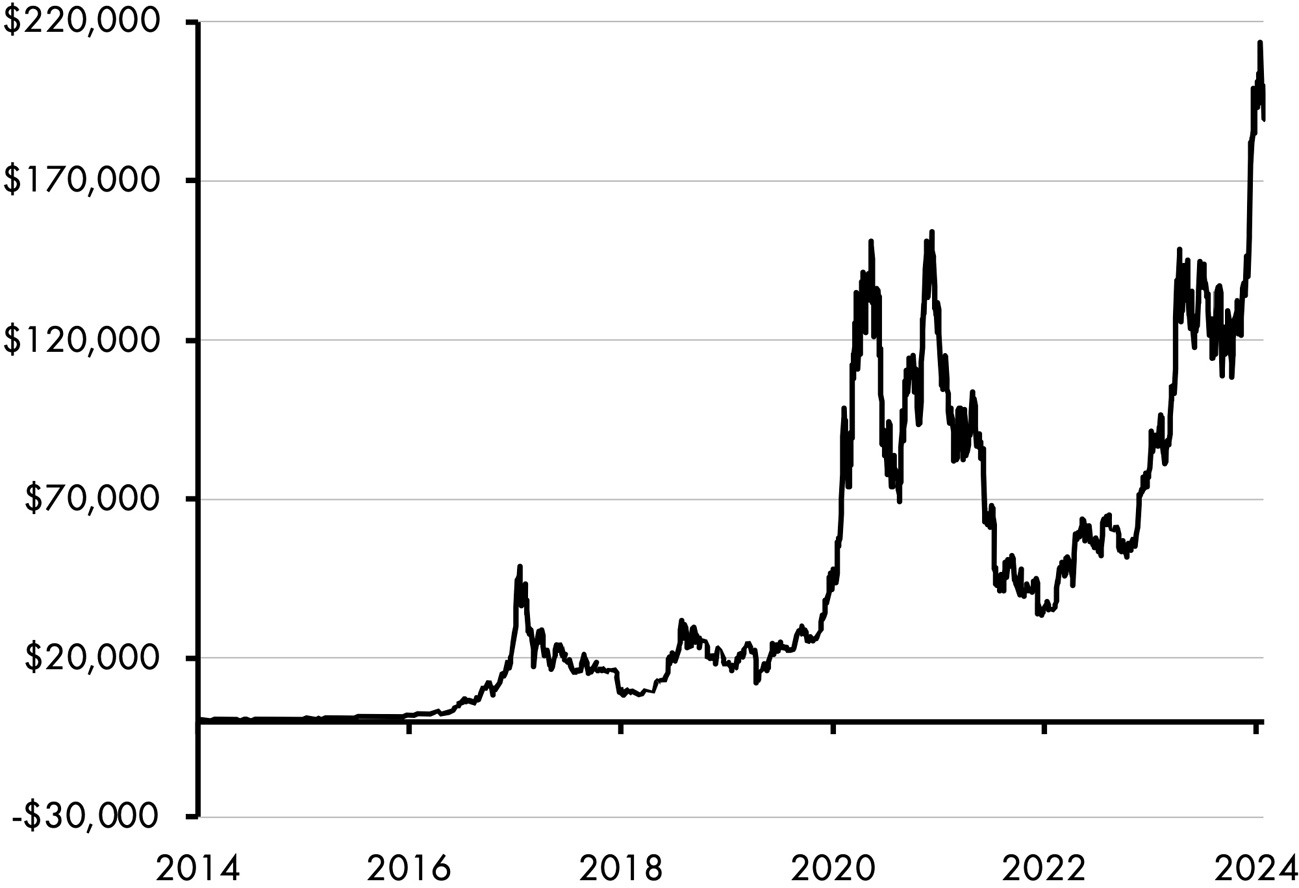
A common question I get is: “What are the use cases for Bitcoin?” On its face Bitcoin seems like an instrument that people mostly just speculate with. It’s not like trillions of dollars of commerce is being transacted in Bitcoin. At least we’re not there yet.
The use case that I’ve always found compelling is fiat currency insurance. For example, if you live in Zimbabwe or any authoritarian regime or country with a history of currency collapse, you might consider diversifying into other currencies or assets that protect you from domestic currency risk. You might not be able to own dollar-denominated hedges like US stocks because the intermediaries often have strict requirements. And you probably don’t even want to own gold because then you have to store the gold and figure out a way to sell it when the currency collapses (and everyone is chasing you around with a gun). Bitcoin gives these people access to an inflation hedge that anyone with a phone or internet connection can buy and sell.
It’s interesting that Bitcoin is popular in the US because I’d argue the dollar is one of the few fiat currencies that doesn’t need to be heavily hedged against currency collapse, but when you put yourself in the shoes of any foreign economy the story becomes much more compelling.
There are lots of theories as to why an instrument like Bitcoin would have any value, but I think it’s rather basic. It’s trustworthy as an immutable form of money and it’s garnered a large enough network effect that enough people deem it to be money. This was the theory of monetary value that economist Hal Varian put forth in 2004.43 He argued that money is used so long as it’s trustworthy and gains a network effect. This makes sense. After all, trust and a large network effect are what make money useful. And Bitcoin has achieved these two essential properties, thereby making it a viable currency alternative.
As I’ve already alluded to, I think of Bitcoin as fiat currency insurance. Insurance is inherently a satellite asset around a core of your financial plan. It’s not the central piece of a portfolio and it’s way too volatile to comprise a majority of someone’s assets, but using it as another form of insurance makes a lot of sense in my view.
Figure 21.2: Bitcoin drawdowns (%)
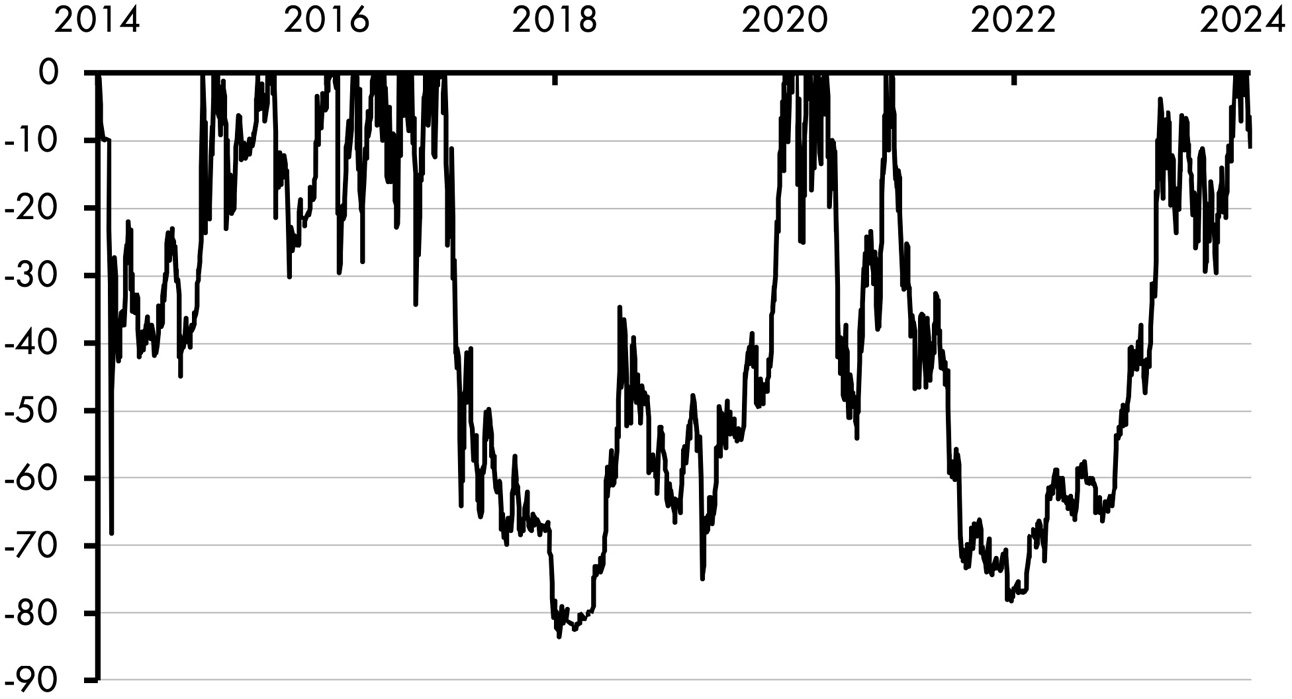
The volatility aspect is important because Bitcoin’s huge returns (and drawdowns) could result in a significant amount of portfolio skew as your allocations become unbalanced due to extreme moves. This is one reason to maintain a strict rebalancing strategy around how you utilize Bitcoin.
HEDGE FUND STRATEGIES
Low-cost indexing can be thought of as the Toyota Camry of the portfolio world. Index funds aren’t especially beautiful looking, but are low-cost, safe, and will efficiently get you from point A to point B. Hedge funds are your Ferraris. These are the strategies that look sexy, cost a lot, and can sometimes get you from point A to point B much faster. Other times they get you there in the same time but end up costing a lot more in the process. These are the strategies you probably don’t need, but might want.
“Hedge fund” is a broad term that covers several different types of strategies including:
- Long/short equity
- Short-biased
- Equity market neutral
- Merger arbitrage
- Distressed securities
- Global macro
- Managed futures
- Fund of funds
These strategies are typically difficult to access and as a rule hedge funds should only be employed when you can invest with a top tier fund with a strong track record. But if you’re looking for some publicly available funds that replicate some of these strategies you might consider doing more research on some of the following:
- First Trust Long/Short Equity ETF (ticker: FTLS)
- AQR Long-Short Equity Fund (ticker: QLEIX)
- Invenomic Fund (ticker: BIVIX)
- PIMCO StockPLUS Absolute Return Fund (ticker: PSPTX)
- Abbey Capital Multi-Asset Fund (ticker: MAFIX)
- AQR Diversifying Strategies Fund (ticker: QDSIX)
- Stone Ridge Diversified Alternatives (ticker: SRDAX)
- AQR Macro Opportunities Fund (ticker: QGMIX)
A newer firm called Unlimited Funds (unlimitedetfs.com) also offers a number of different hedge fund replicator strategies. Bob Elliott, the founder of the firm, is a former Bridgewater employee and very sharp guy.
RETURN STACKED ETFS AND PORTABLE ALPHA STRATEGIES
In the last few years, portable alpha strategies have made a big resurgence. These are strategies that utilize leverage to construct a beta core with an alpha satellite.
The basic theory is that you can build a beta index as your core holding and then add an alpha overlay using leverage to try to enhance the beta component. As long as the alpha overlay outperforms the cash borrowing rate then you’ll have “ported” some alpha on top of a beta position.
These funds are also commonly referred to as capital-efficient funds as they utilize the same basic thinking as someone who takes out a mortgage on their home. Consider a scenario where you have $1,000,000 in cash and are looking to buy a $1,000,000 home. If you expect real estate to generate 0% real returns over the next 30 years, but believe stocks will return 10% per year, allocating all your capital to the home may not be the most efficient use of funds. Instead, you could put 20% down ($200,000) and take out an $800,000 mortgage at a 5% interest rate. This allows you to keep $800,000 invested in the stock market, potentially earning 10% per year. By using leverage, you’re effectively substituting a 0% return on housing for the opportunity to earn a 10% return on investments while paying 5% interest, capturing a 5% annual spread on that $800,000 over time. You’re essentially stacking the return of stocks on top of the house by using leverage to purchase the home.
Of course, that sounds easier than it really is, but that’s the basic gist. Below is a list of funds that implement something similar to this that you might consider.
I would also suggest looking at the Return Stacked products from Corey Hoffstein of Newfound Research and Adam Butler, Rodrigo Gordillo, and Mike Philbrick of Resolve Asset Management. These are all very smart guys who are worth paying attention to.
Some other funds worth researching include:
- Pimco StocksPLUS Long Duration Fund (ticker: PSLDX)
- PIMCO StocksPLUS Small Fund (ticker: PSCSX)
- PIMCO StocksPLUS International Fund (ticker: PISIX)
- WisdomTree US Efficient Core Fund (ticker: NTSX)
- WisdomTree International Efficient Core (ticker: NTSI)
- WisdomTree Emerging Markets Efficient Core (ticker: NTSE)
- WisdomTree Efficient Gold Plus Equity (ticker: GDE)
- ReturnStacked Bonds and Trend (ticker: RSBT)
- ReturnStacked Stocks and Bonds (ticker: RSSB)
- ReturnStacked Stocks and Trend (ticker: RSST)
- ReturnStacked Stocks and Futures Yield (ticker: RSSY)
- Standpoint Multi-Asset Fud (ticker: BLNDX)
- DoubleLine Shiller Enhance CAPE (ticker: DSNEX)
VANGUARD LIFE STRATEGY FUNDS
Vanguard’s Life Strategy funds provide an all-in-one option for investors who want the leanest possible portfolio. They come in various risk profiles as well as income-oriented options. This includes:
- LifeStrategy Income Fund (ticker: VASIX)
- LifeStrategy Conservative Growth Fund (ticker: VSCGX)
- LifeStrategy Moderate Growth Fund (ticker: VSMGX)
- LifeStrategy Growth Fund (ticker: VASGX)
This is as straightforward as it gets. And while they might be great for a core component of a broader portfolio I do think these sorts of funds need complementary components, especially if you need liquidity. But in general, these are the sorts of funds that make investing about as simple as possible.44
OPTION-BASED INCOME STRATEGIES
Option-based strategies have also grown in popularity due to the turbulence of the markets in the last 20 years and especially the recent poor performance of pure fixed income strategies. These strategies typically have a core beta exposure with a satellite option system. The options are used like insurance to generate income and potentially protect or enhance the exposure of the underlying core position.
We should be super clear about these types of strategies – they are very specifically insurance-style strategies. These kinds of options were historically used to create greater predictability in the price of an underlying asset over a specific time period. During the Dutch tulip mania of the 17th century, traders often entered into informal forward contracts that included optional clauses, allowing one party to cancel the deal for a small fee. While not true options in the modern sense, these agreements functioned similarly providing a form of insurance against adverse price movements. Tulip growers might use them to lock in profits and protect against falling prices, while buyers used them to manage the risk of rising prices. Though speculative in nature, these early contracts reflected the same insurance-like risk-management principles behind today’s put and call options.
These strategies give you insurance-like certainty across a specific time horizon, but they aren’t a free lunch as the added certainty means added costs and lower expected returns. And that’s typically what we see in these income-based strategies or option hedging strategies. A few funds you may want to research include:
- CBOE S&P 500 BuyWrite Index (ticker: BXM)
- CBOE S&P 500 PutWrite Index (ticker: PUT)
- J.P. Morgan Equity Premium Income ETF (ticker: JEPI)
iShares also has a suite of ETFs called outcome ETFs. These are typically buy/write ETFs that buy the underlying asset and then write options to define the outcome of the fund or income over a specific time horizon.
Innovator ETFs has also created a similar line of funds called Buffer ETFs.
I don’t have a problem with options-based ETFs, but I do think people can construct high degrees of certainty around stocks and bonds without unnecessary bells and whistles. As I’ve said throughout this book, there’s nothing wrong with insurance, but you also don’t want to be over-insured. And you want to be especially careful of the funds in this space that promise eye-wateringly high returns.
VOLATILITY AND TAIL-RISK FUNDS
Morgan Housel once said that risk is what we can’t know. Nassim Taleb famously called these unknowable events “black swans” – rare occurrences that aren’t supposed to happen, but do. The challenge with black swan events is that, despite their rarity, they can have a disproportionately large impact on your finances.
It’s well known that stock bull markets are the norm. But as the saying goes, stocks take the stairs up and the elevator down. This extreme sort of event is the basis for black swan and tail-risk strategies. These strategies operate like insurance in that they’re typically buying far out-of-the-money options that will surge in price in the case of an anomalous black swan event. This gives the investor the potential to make huge insurance-like gains.
Some funds that protect against this are listed below. Keep in mind that these are more trading instruments than anything else. Volatility or options funds can have high embedded costs and many of them have futures contract decay risk resulting from constantly rolling the contracts. As a result, they can be at risk of very negative returns in the long run, or high relative costs that result in asset decay over time. They should be utilized like term insurance to cover you in a specific period of uncertainty where you believe some insurance makes sense.
- Cambria Tail Risk ETF (ticker: TAIL)
- Alpha Architect Tail Risk ETF (ticker: CAOS)
- Amplify BlackSwan Growth and Treasury Core ETF (ticker: SWAN)
- Barclays VIX ETN (ticker: VXX)
CONCLUSION
I hope this gives you a few more interesting ideas to explore. There are countless investment options out there, and I’ve only scratched the surface. New ETFs and strategies are being launched every year, often with increasingly creative twists. If you’ve come across a fund or approach that you think deserves a mention, feel free to send me a note – I’m always interested in learning what others are exploring.