The Portfolios
Chapter 3
T-Bill and Chill (Or Why Not 100% Cash?)
ONE of my favorite movie scenes of all time is when John Goodman berates Mark Wahlberg in The Gambler because he’s not saving any of the money he’s been winning. Goodman says:
You get two-and-half million dollars and any a**hole in the world knows what to do.
You get a house with a 25-year roof, an indestructible economy sh$tbox car and you put the rest into the system at 3–5% and you pay your taxes. That’s your base. Get me?
That’s your fortress of f***ing solitude. That puts you, for the rest of your life, at a level of ‘F*** You. . . Someone wants you to do something? F*** You. Boss pisses you off? F*** You.
Own your house. Have a couple of bucks in the bank. Don’t drink. That’s all I have to say to anybody.
Holy cow. If he had told people never to forget leg day he’d have given us all the advice anyone ever needs in life. I kid, but not about the leg day. Never. Skip. Leg. Day.
In all seriousness, the interesting part of this advice is putting the money “in the system” at 3–5%. He’s implicitly referring to cash and safe government bonds. He’s promoting what I like to call the “T-Bill and Chill” strategy, although I would avoid throwing around F-bombs because that is not very chill.
Of course, getting the $2.5 million is the hard part (and $2.5 million ain’t what it used to be), but putting the $2.5 million to work in the system is easier than you might think. And you don’t need $2.5 million to make your cash work better for you.
So, let’s dig into it.
***
I have a secret that Wall Street doesn’t want you to know – the fees on cash management are egregiously high, arguably the most egregious fees in finance. And most of you probably don’t notice them because they’re largely invisible.
“Cash” is one of the more misleading terms in finance. It’s dirty in much the same way that the word “money” is dirty in economics. It has so many different meanings to so many different people in so many different contexts.
For instance, when you hear the word “cash” you probably think about physical dollars. Ah, but you’d be wrong. That’s one form of cash. Deposits are cash equivalents. So are Treasury bills. So are Banker’s Acceptance Notes. So is Commercial Paper. So are Money Market Funds. There are lots of different instruments that are “cash equivalents” and while many of us think of them as convertible and similar, the reality is that the cash equivalents can be quite different.
We spend a lot of time in financial circles obsessing over the high fees of investment management and financial advice. But the biggest fees of them all are often the seemingly small fees you don’t see. For example, as I am writing this a three-month T-bill yields the equivalent of 4% per year. At the same time, the most prominent “high-yield” savings account (HYSA) in the USA offers 3.25%. This might sound like a good deal on your cash savings. But when you look under the hood it’s very likely that this financial firm is buying T-bills earning 4% and then giving clients a cut of that action at 3.25%. That 0.75% skim might sound modest, but it amounts to nearly a 19% reduction in your gross return – a massive implicit fee on a risk-free asset you could have purchased yourself.
Even worse, there are often commissions and worse tax treatment on this instrument. While the bank is likely getting favorable state tax treatment on the T-bill (bills are exempt from state and local taxes), you get the privilege of paying state and federal taxes on the savings account. This could be more favorable for foreign holders of US Treasury bills, as the US government will exempt taxes on T-bills for most foreigners. After all is said and done (or not said at all), you’re likely paying the equivalent of a 1%+ fee and giving up a full 25% of your gross return on an instrument that is risk-free. For the bank, that’s one of the best risk-adjusted returns they’ll earn. For you, it’s a seemingly invisible fee that is significantly more expensive than most other fees you’ll pay in finance (and yes, I know that Whole Life Insurance policies are a thing).
WHY DOES T-BILL AND CHILL WORK?
In 2017 Hendrik Bessembinder wrote a paper called “Do Stocks Outperform Treasury Bills?”13 He concluded:
Four out of every seven common stocks that have appeared in the CRSP database since 1926 have lifetime buy-and-hold returns less than one-month Treasuries. When stated in terms of lifetime dollar wealth creation, the best-performing 4% of listed companies explain the net gain for the entire US stock market since 1926, as other stocks collectively matched Treasury bills. These results highlight the important role of positive skewness in the distribution of individual stock returns, attributable both to skewness in monthly returns and to the effects of compounding. The results help to explain why poorly diversified active strategies most often underperform market averages.
Woah. We’ve already discussed how hard it is to pick stocks, but this really puts things in perspective. It doesn’t mean we shouldn’t own stocks, but it highlights that cash isn’t just a 0% nominal or negative real return-generating instrument. When used properly, cash is an important insurance-like instrument that gives you nominal principal stability, optionality, and even some inflation protection.
I especially like this conversation in the context of inflation and currency debasement. If you spend enough time debating inflation on the internet (not recommended) you’ll inevitably run into the idea that the US dollar has lost 90%+ of its value. And it’s true. If you had taken a single physical dollar in 1900, left it under your mattress, never earned any income, and never invested that dollar, your purchasing power would be 98% lower today. If, on the other hand, you’d invested that dollar in a portfolio of T-bills earning interest you’d have the equivalent of $1.36 in today’s dollars. You would have retained your purchasing power when compared to inflation.
So, T-bills give you some level of inflation protection, and you get a very high degree of principal stability. Not bad.
T-Bill and Chill is starting to sound pretty good, huh?
Let’s get into the details and talk about how you can build your own optimized cash management account.
BUILDING YOUR OWN T-BILL AND CHILL PORTFOLIO
There are many great options for cash that go beyond leaving money in the bank or getting lured in by the suboptimal returns advertised by certificates of deposit (CDs) and HYSAs. I am generally critical of “high-yield” savings accounts and CDs because of their hidden costs through lock ups, surrender fees, worse relative returns, and taxes, but nothing is worse than leaving large amounts of excess cash sitting in the bank earning 0%. While we all need a little cash on hand to pay bills and whatnot, it’s always smart to be hands-on with your cash. Especially excess cash in a brokerage account or retirement account.
Personally, I think a lot of investors get this backwards. While stocks are long-term assets, cash is an inherently short-term instrument. It needs to be managed more proactively because of this. Meanwhile, most of us talk about stocks as the asset we try to be more “active” with. In reality, stocks are the asset that should be mostly left alone while cash is the one that benefits from more active management.
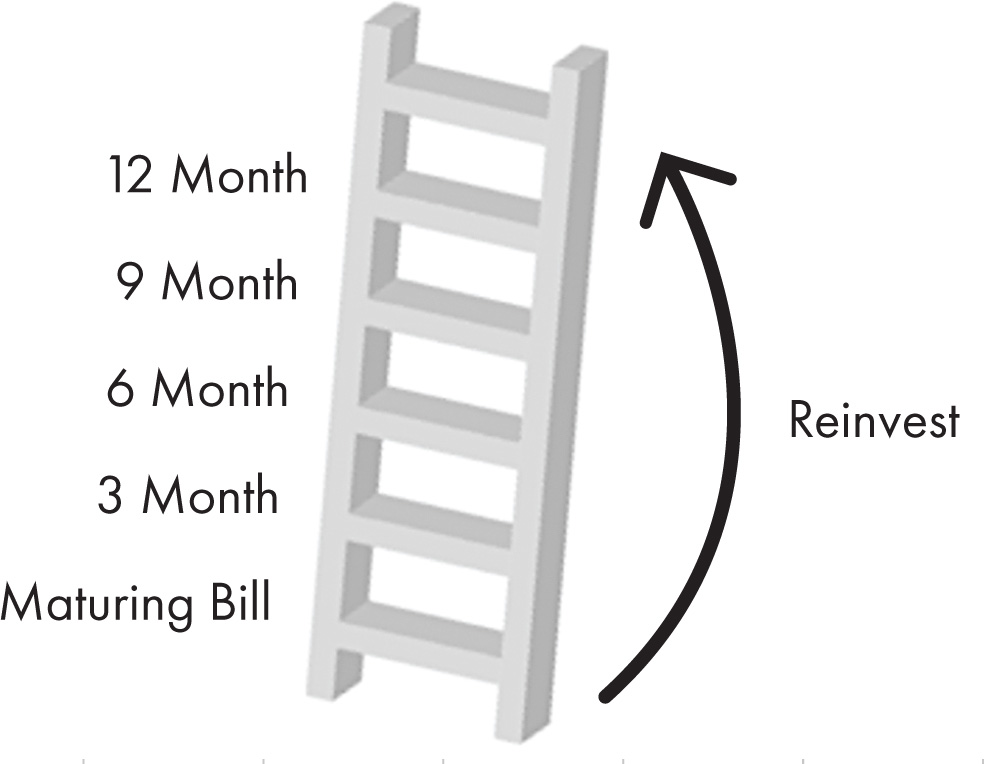
My personal preference for managing cash is to take a hands-on approach with Treasury Bills by building T-bill ladders. An individual T-bill can be purchased in one-, two-, three-, four-, six- or 12-month maturities at any brokerage firm in $1,000 increments. The “laddering” of it refers to the strategy of buying specific rungs sequentially across time to mimic a ladder. In other words, you might buy a three-, six- and nine-month T-bill and roll each new bill into a new nine-month bill as you “climb the ladder” and the bills mature every three months.
A T-bill is a little different from a standard bond in that you purchase it at a discount and it matures at par. For example, if you buy a three-month T-bill with a 5.4% annual yield and a face value of $100, you would pay $98.65 today (roughly one-quarter of the stated annual yield) and the T-bill’s value would gradually increase until it reached $100 at maturity in three months. Most money market mutual funds function the same way, but have less favorable tax treatment or higher fees.
RANDOM SIDE NOTE
One instrument that will come up on occasion in this book is a Total Bond Market fund, which is a common recommendation for a one-stop-shop for bond allocation. I find these funds troublesome at times because they’re what we call “constant maturity” funds. In the case of the actual Total Bond Market ETF, we’re talking about an eight-year instrument on average. This means that you own an income-generating instrument that is being used to give you near-term income and principal stability, but it cannot achieve the latter because it doesn’t ever mature.
The beauty of disaggregating your bond holdings (or holding something like individual T-bills) is that you have a more tangible principal stabilizer. You could build your own constant maturity Treasury ladder with an average maturity of eight years, but because you own each rung of the ladder in a disaggregated component, you have a tangibly liquid component in your short-term bills and notes. I’ve found that this creates a more behaviorally robust portfolio for investors who need principal certainty from their bonds/cash because it gives you the ability to predict, with near certainty, how much money you’ll have at certain points in the future.
If you purchase the individual T-bills in a brokerage account you can typically auto-roll them or roll them manually. You can build simple ladders by diversifying your T-bills out over different maturities.
For instance, if you had $100,000 in cash needs over the coming 12 months you might ladder this out over a four-rung ladder of $25,000 increments in T-bills of three-, six-, nine- and 12-months’ duration. When the first three months is up your three-month bill matures to cash, your six-month is now a three-month, your nine-month is now a six-month and your 12-month is now a nine-month bill. At this point you can either disburse cash as needed or roll the maturing rung into T-bills of the duration of your choice (in this case we’d buy a new 12-month bill to maintain our sequential rungs on the ladder). And then the same thing after six months, nine and 12 months, as depicted in Figure 3.1. It’s easier than it sounds and many brokerage firms will allow you to automate the rollover process.
Figure 3.1: How a bond ladder works
If that sounds too daunting or like more work than you’d prefer then there are plenty of good alternatives that are near equivalents, such as:
- SPDR 1-3 Month T-Bill ETF (ticker: BIL).
- Vanguard Government Money Market Fund (or similar low-cost government money market funds).
- iShares and Bullet Shares also offer ETFs with specific maturities and customizable bond ladders.
- Alpha Architect 1-3 Month Box ETF (ticker: BOXX).
The first two options are low-cost ways of owning T-bills through a fund. You don’t need to do anything except pay a small expense ratio.
The third option is an ETF-based way of owning something that has the same general features of the individual bonds. These are fine in my view and some people swear by them, but if you’re going to buy the ETF in a structured ladder, I don’t see why you wouldn’t just buy the individual bonds from a broker.
That last one is a little more complex: a synthetic T-bill ETF that builds a box spread using options to replicate T-bill returns. It’s a clever tax loophole that allows the investor to turn T-bill income (which is often taxed as ordinary income) into long-term capital gains. So, if you hold that fund for 12+ months you can avoid the distributions from a T-bill and instead incur realized gains as capital gains, which gives you an added tax benefit compared to actual T-bills. Again, maybe more complex than you want to deal with, but these are all fine options for optimizing your cash holdings.
T-BILL AND CHILL, PROS, CONS, AND LESSONS
The T-Bill and Chill strategy is a wonderful cash management strategy, but it ain’t all sunshine and rainbows. Let’s consider some of the cons:
- While you’ll likely be keeping up with inflation using this strategy, you will be lucky if you consistently beat inflation.
- In a low or zero interest rate environment like the one we experienced in 2010–2020, you will almost certainly lose purchasing power using this strategy.
- You still have significant currency risk using this strategy. T-bills are nominally risk-free, but any form of government-issued bonds or bills will get demolished in a hyperinflation.
What about the good news?
- You have a nominally safe and very liquid instrument that can be liquidated and transferred almost instantaneously to meet short-term spending needs.
- The taxes, fees, and income are very favorable compared to bank deposits, high-yield savings accounts, and CDs. This is especially magnified if you’re in a high-tax US state.
- You can structure a T-bill portfolio in a time-based ladder that gives you near certainty in managing your cash-flow needs over time.
T-BILL AND CHILL ANALYSIS
These cash equivalents are the definition of nominally risk-free instruments so there’s not a whole lot to analyze here. We’re just talking about cash equivalents after all and in the case of T-bills you’re looking at an instrument whose performance is roughly similar to the rate of inflation on average and has virtually zero volatility when structured properly.
SUITORS FOR THE T-BILL AND CHILL PORTFOLIO
The T-Bill and Chill Portfolio is best utilized for a portion of your portfolio that needs to remain highly liquid for withdrawals, emergency needs, etc. Since it will barely retain purchasing power over time, you’ll need some diversification elsewhere to boost your purchasing power protection.
So, this portfolio is best used for very short-term cash-flow needs or in cases where an investor wants to maintain a very behaviorally conservative portfolio for specific purposes.
FINAL THOUGHTS
Speaking of greater purchasing power protection – we need some diversification in these portfolios, huh? So, let’s talk about the most famous diversified portfolio of all time – the 60/40 stock/bond portfolio. Believe me, it’s a lot more interesting than you might think, so read on.