The Portfolios
Chapter 2
Why Not 100% Stocks?
OVER the course of your life, you will consistently encounter bull and bear markets. Bear markets are the price of admission to benefit from bull markets. Stocks need to go down at times in the short run to be able to sustainably go up in the long run. And while we often focus on the dangers of bear markets, bull markets can be equally perilous as they will test your patience and tempt you to alter your asset allocation.
As bull markets rage upward, you could be tempted to ask yourself: “Why diversify at all, why not move to 100% stocks?” Of course, when the bear market comes (and it always does eventually), the opposite question will be posed: “Why invest in stocks at all, why not remain mostly bonds and cash?” Don’t worry – we’ll answer that question in the next chapter.
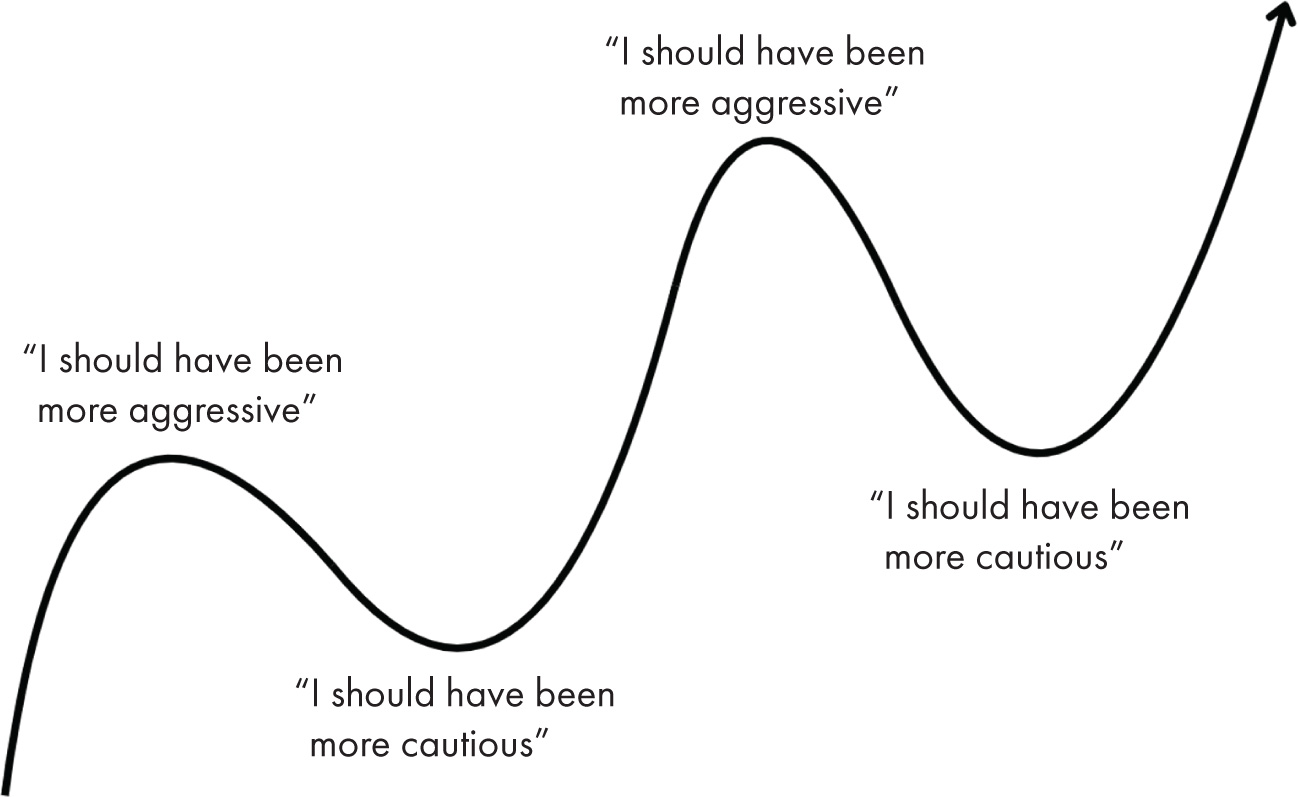
This sort of all-in and all-out mentality is commonplace across the market cycle, but remember that you’re a saver and not a gambler. You should never move all-in or all-out with your portfolio as that leaves you undiversified and subject to the biases of your own worst enemy (that’s right, you). This rollercoaster ride of emotions, as depicted in Figure 2.1, is something you will need to get used to. We all go through it.
Figure 2.1: The stock market emotion roller coaster
That said, it could be perfectly appropriate for certain segments of your portfolio to be very aggressive, even up to 100% stocks, not too dissimilar to the way Buffett manages Berkshire. This would be especially true in inherently long-term parts of your portfolio, for example, a 25-year-old allocating to a Roth IRA they won’t touch for 30+ years.
The 100% Stock Portfolio is an important strategy to touch on because it helps formulate the building blocks for many of the later portfolios we’ll discuss, and I also hope it gives you some perspective on what we’re trying to achieve when we allocate assets from a financial planning perspective.
Let’s get into it.
As we discussed earlier, corporations are best thought of as long-term entities. Buffett can be extremely patient with Berkshire’s portfolio because he has always understood that the stock market is, as Ben Graham famously said, a “voting machine in the short run and a weighing machine in the long run.”
That’s another way of saying that markets can be inefficient in the short run, but are more efficient in the long run. I always like to point out that the stock market is a system that preys on the behaviorally weak to the benefit of the behaviorally robust. The behaviorally robust understand that the stock market is an inherently long-term instrument because its underlying entities are long term by nature.
By the time a corporation qualifies to be included in one of the prominent indices, it has likely been around for many decades as it takes time to reach the multi-billion-dollar valuation required to qualify for listing. For example, as of 2025 the minimum requirement for being included in the S&P 500 is a market capitalization (total market value) of $20.5 billion. These are very large companies that have grown into behemoths over long periods of time.
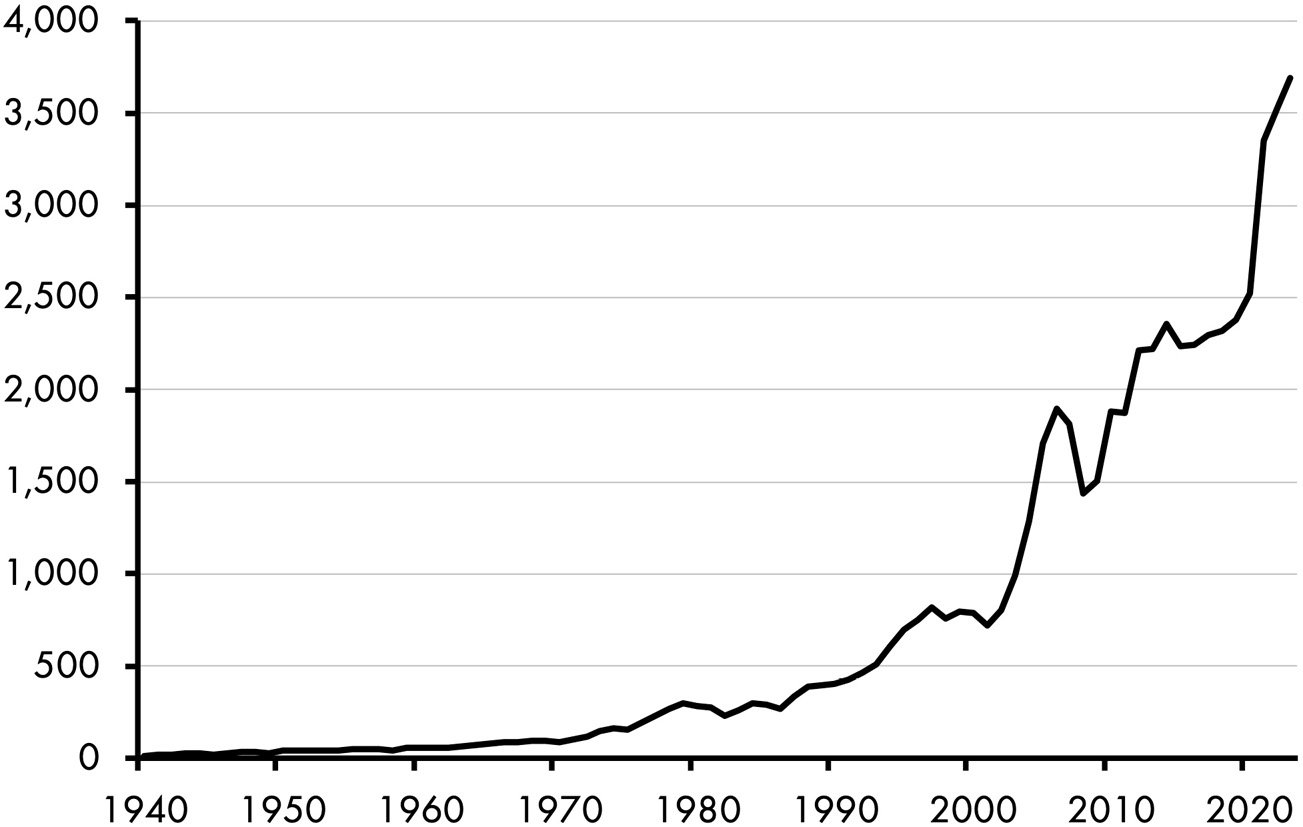
When you buy a diversified pool of these entities you are hitching your wagon to the long-term trend in corporate earnings. And what have corporate profits done in the long run? Well, they generally go up over the long term because capitalism, despite some of its faults, is very good at incentivizing people to innovate, produce, and maximize profits. Figure 2.2 shows the upward trend in pre-tax corporate profits from 1940 to 2025.
In a sense, when you buy stocks, you are betting on an increase in human production and innovation. That flows to corporations as profits and will be reflected in corporate stocks as higher market values.
Figure 2.2: Pre-tax corporate profits ($bn)
The stock market tends to be a good nominal and real return generator because corporations are inherent inflation hedgers. That is, corporations buy commodities at cost, build goods and services, and then sell them at a mark-up.
This is especially powerful when viewed through the lens of something like an index fund. For example, a FTSE All-World index fund is a diversified pool of over 4,000 of the best corporations in the world. These are mature, profit-generating companies that you can own a small slice of. And the diversified index structure is important because the ownership of something like an index fund is a systematic way of keeping your wagon perpetually hitched to the best corporations in the world.
This is because an index fund works by systematically rebalancing its portfolio, shedding so-called losers and replacing them with winners. For instance, if XYZ Corp falls to $1 billion in market capitalization, it may no longer qualify for inclusion within the index. The Index Committee will review alternatives and replace this entity with a newer firm that now meets the criteria. In this sense you are buying a systematic fund that maintains exposure to a dynamic set of the market’s strongest companies.
In some ways this is similar to momentum investing in that you’re consistently allocating to firms that meet minimum (and rising) standards over time. This isn’t technically the momentum factor strategy (which we’ll discuss more in Chapter 6) or the Trend Following strategy (which we’ll discuss in Chapter 15), but it applies a similar concept using underlying corporate fundamentals.
Further, when indexing strategies like this are done at scale they can benefit from extremely low costs. This is one of the true superpowers of index funds. Although there might be a lot of activity going on under the surface of the index fund, the scale at which they operate makes them very efficient.
But all this long-term efficiency comes at a short-term cost as the stock market can be extremely volatile in the short run. The stock market is a lot like a dramatic movie – certain tough scenes may feel tense or painful, but it typically has a happy ending in the long run.
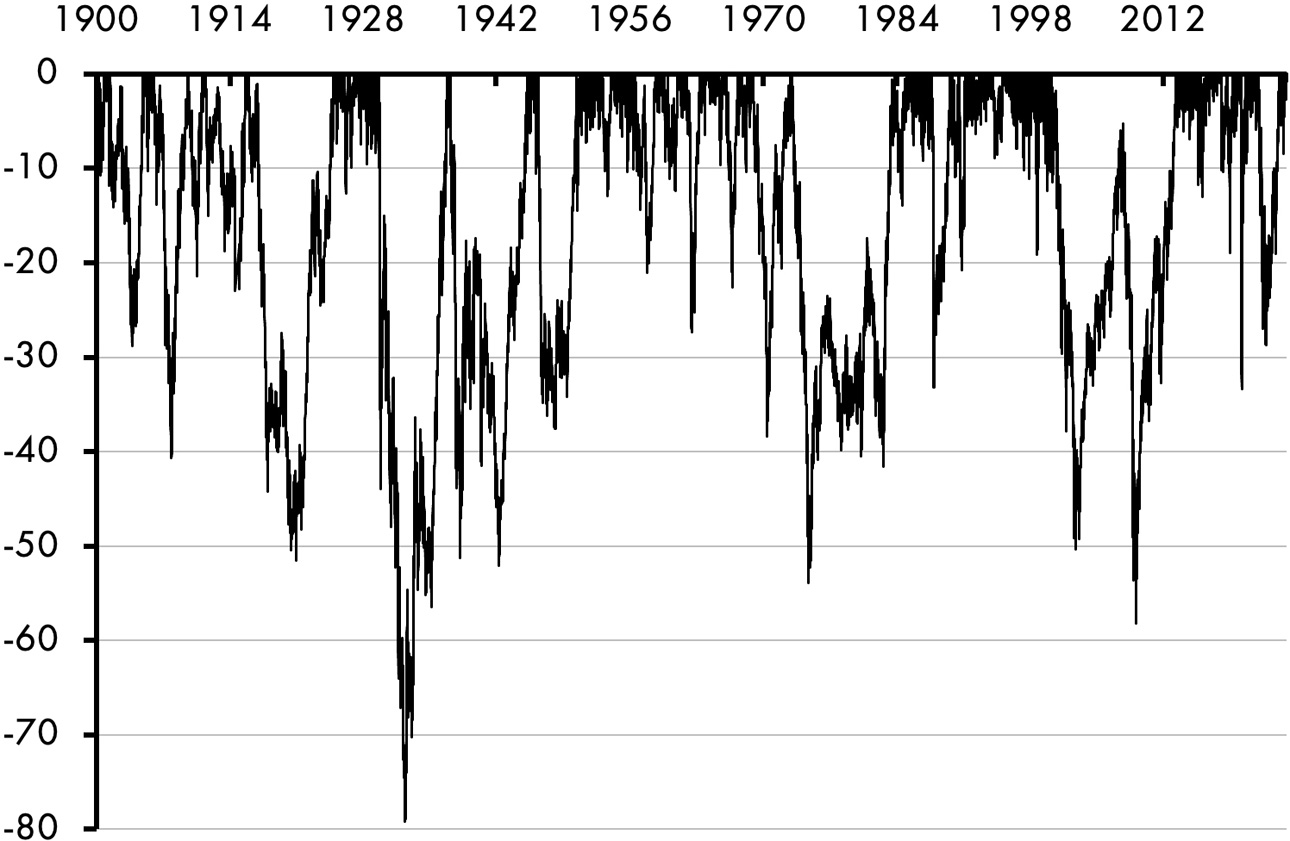
Figure 2.3 puts some of this short-term emotion in perspective. These drawdowns show the maximum loss from a previous high. As you can see, some of these drawdowns have been excruciatingly painful and it’s not uncommon to experience regular 20% or 30% downturns in stocks.
Figure 2.3: US stock market drawdowns (%)
In short, stocks “work” because they generally track corporate profits and earnings over time. And because these cash flows are uncertain, they will tend to earn a premium above the risk-free rate and inflation. This short-term uncertainty is reflected in greater short-term volatility that is rewarded by long-term appreciation.
BUILDING YOUR OWN 100% STOCK PORTFOLIO
Okay, so all that risk sounds good to you, you’re a patient person and you think a 100% Stock Portfolio might be a good fit for your portfolio, or a portion of your portfolio.
But what’s the best way to build that portfolio?
If you enjoy stock picking you need to choose a methodology for picking stocks. In the prior chapter I emphasized that most investors shouldn’t waste time picking stocks and, as Buffett stated, should stick to picking diversified, low-cost index funds. As we learned in Part 1, beating the market is hard and usually not worth the effort and added cost.
Okay, maybe I’ve convinced you not to pick stocks, but how do you pick your index funds? There are many ways to skin that cat.
The simplest portfolio to own is something like Vanguard Total World (ticker: VT) or MSCI All World Stock Index (ticker: ACWI). These are diversified, low-cost vehicles that give you access to thousands of stocks allocated on a global market cap basis.
Investing in global stocks, as opposed to only domestic stocks from your own country, can be advantageous for the following reasons:
- It boosts overall diversification.
- It reduces domestic economic and market risk.
- It reduces currency risk by diversifying into companies with foreign currencies.
Owning one fund might be suboptimal for reasons we’ll discuss throughout this book. So, you could choose to disaggregate the global stock market using the following three allocations:
- Vanguard Total US Stock Market ETF (ticker: VTI)
- Vanguard Total International Stock Index (ticker: VXUS)
- Vanguard Emerging Markets Stock Index (ticker: VWO)
You can then choose to allocate this in the same proportions as something like VT or ACWI and rebalance annually. If you just prefer to own domestic stocks then stick to owning funds that are similar to your home country’s total market index.
Easy peasy. No need to overthink all of this just yet. And don’t worry, we’re going to overthink all of this later with many strategies that are much more intricate versions of a 100% Stock Portfolio, but we’re just getting warmed up here.
Let’s dig into the data and learn more about what it really means to be 100% stocks.
100% STOCK PORTFOLIO ANALYSIS
The 100% Stock Portfolio is a maximally aggressive portfolio that will capture high real returns with high volatility. Since 1900, the US stock market has generated 6.65% real returns per year with numerous 30% downturns, average annual volatility of 17.70%, and an Ulcer Index of 21.84.
Figure 2.4: US stock market total real returns
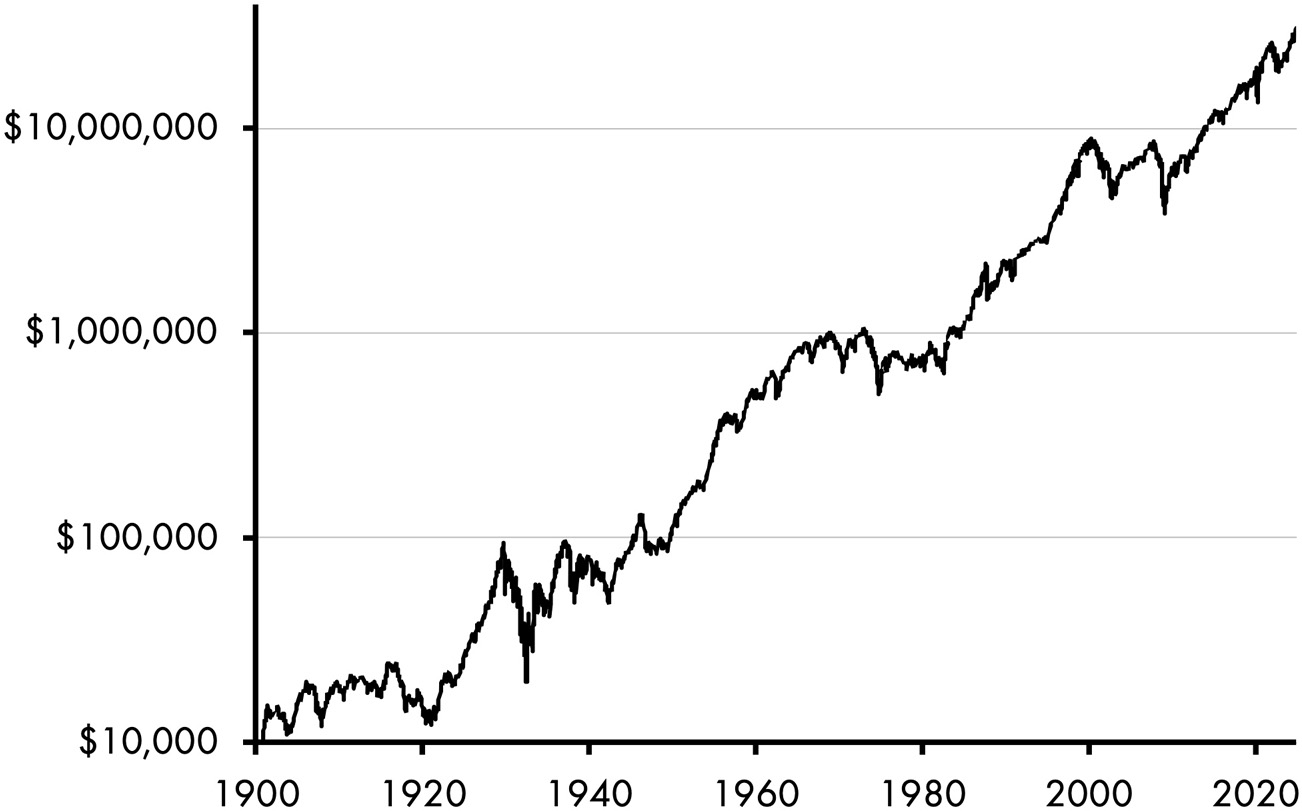
Table 2.1: Portfolio analysis (1900–2025)
|
US Stocks | |
|---|---|
Real Returns | 6.65% |
Volatility | 17.70% |
Sharpe Ratio | 0.44 |
Sortino Ratio | 0.62 |
Max Drawdown | −79.20% |
Max Drawdown (Post-1945) | −58.20% |
Ulcer Index | 21.84 |
Market Correlation | 1.00 |
With this portfolio you’ll have to get used to a high level of stress as the Ulcer Index of 21.84 is close to the most ulcer-inducing allocation you can experience. And while the Great Depression downturn of −79.2 is unlikely to be repeated in the future, we do know that real drawdowns of 50%+ are possible as it’s happened twice in the post-war era.
Let’s look more closely at the pros and cons here.
100% STOCK PORTFOLIO PROS, CONS, AND LESSONS
In 2023 Anarkulova, Cederburg, and O’Doherty published a paper that was highly critical of strategies that help glide path investors into retirement with hefty bond allocations (we will discuss these strategies in-depth in Chapters 18 and 19).11
The authors argued that investors should consider maintaining a constant 100% equity allocation diversified equally across 50% domestic stocks and 50% foreign stocks. The broader thinking is that stocks outperform diversifiers like bonds and alternatives by such large margins in the long run that investors should be able to stomach the inevitable short-term drawdowns that come with such a portfolio.
Cliff Asness of AQR did not like this paper and he pulls zero punches.12 In fact, my favorite thing about Cliff is that he sometimes (rightly) kicks people in the shins for making outrageous claims:
It should be obvious that higher expected return assets do generate higher realized returns. The fact that stocks beat bonds in the long run is not only not-earth-shattering, but what every finance 101 textbook teaches.
This is fundamental, but important, and you’ll notice that Asness specifically mentions the time horizon. The fact that something is likely to generate superior returns in the long run does not mean it’s guaranteed to always generate better returns. While the long-run returns of stocks are very likely to beat the long-run returns of bonds and alternatives, we really have no idea what stocks will do in the short term. We can’t even be 100% certain they’ll beat bonds in the long term, even though we have a high level of confidence that they will.
Here’s Cliff again, responding to the paper:
In particular, this. . . new paper makes one statement that is just an indefensible whopper. They state, ‘Given the sheer magnitude of US retirement savings, we estimate that Americans could realize trillions of dollars in welfare gains by adopting the all-equity strategy.’ This is very poor economic reasoning.
Cliff goes on to debunk the “cash on the sidelines” myth. That’s the persistent narrative that a large amount of uninvested cash is just waiting to pour into the market. The problem with this narrative is that all assets are always held by someone (including cash). So, when someone sells their cash to move into stocks, the person on the other side of the trade is selling stocks and moving into cash. There is no “sideline” here. The assets are always in play, always held by someone. It is mathematically impossible for 100% of US equity investors to own a 100% equity portfolio.
Cliff killed this paper, but I am a pretty good shin kicker as well so let me add some other critiques to consider.
The 100% Stock Portfolio ignores the fact that lower return–generating assets can be perfectly reasonable parts of a long-term financial plan. I would make this especially clear in the case of something like insurance. Insurance sometimes gets a bad reputation in finance, but insurance is a logical part of most portfolios. Berkshire Hathaway could not underwrite billions in insurance otherwise. That’s because the asset holder views insurance as a necessary part of their financial plan.
For example, a simple 20-year term life insurance policy is perfectly prudent financial planning for a household with dependents and one working parent. One theme you’ll notice in this book is that I think of many alternative asset classes as being similar to insurance and there’s nothing wrong with owning insurance in a portfolio, even if it’s a low or negative expected real return instrument.
We also need to be careful about assuming the past will look like the future. It’s no coincidence that papers like this tend to come out after large stock bull markets and especially after one of the most unique runs in US stock market history. The stock market can and does go through long and excruciating downturns that would make a 100% Stock Portfolio untenable.
It would be remiss of me, as a financial advisor to many retirees, not to highlight that a 100% Stock Portfolio is especially vulnerable to what we call sequence-of-return risk. This is the risk that you begin withdrawing from your portfolio during an unlucky stretch of poor returns early in retirement – which can permanently impair your nest egg even if long-term averages look fine. In other words, it’s not just your average return that matters; it’s the order in which those returns occur that can make or break your retirement plan.
For instance, imagine the 100% equity investor who retires in 2007. They then begin drawing down their portfolio to fund retirement needs and then, BAM, 2008 hits. This investor undergoes one of the most traumatic 50%+ downturns in stock market history. If they had a 4% withdrawal rate on a portfolio of $1,000,000 that falls to $500,000, this investor is instantly put to the ultimate behavioral test as their sequence-of-returns risk is through the roof. They are now drawing 8% of their portfolio per year, in order to maintain their previous level of spending, and they are exposed to a perilous financial future.
There are numerous other examples of stock market environments where prolonged or deep bear markets would have destroyed someone’s financial plans. And while this is not necessarily a significant risk, it is a devastating situation for the small percentage of people unlucky enough to encounter it. And given the ease of eliminating this risk (through simple asset class diversification) it is imprudent not to consider doing so.
All that said, it’s not all bad. While a 100% Stock Portfolio probably doesn’t make a lot of sense for your entire portfolio, there are many pros to a large equity allocation or even segments of your portfolio that are 100% stocks, including:
- Higher expected returns. As we’ve noted already, stocks should outperform most other assets classes in the long run because they give you the purest claim on corporate cash flows.
- Superior inflation hedging. Stocks are a wonderful long-term inflation hedge because their underlying corporations are inherent inflation hedgers.
- Reduction of single entity risk. When implemented in a diversified equity allocation you can significantly reduce exposure to single entity risk.
SUITORS FOR THE 100% STOCK PORTFOLIO
So, there it is. The 100% Stock Portfolio. What did you think? Is it right for you?
Still not sure?
Let me outline for whom or where this portfolio might be right.
- Ultra-aggressive investors with a high income. I like to think of your income as a bond. For example, if you have a salary of $100,000 per year you can think of that as a $1,000,000 bond that yields 10% per year. Your income is a de facto bond allocation that allows you to take more risk across other assets. As a result of this it might be perfectly fine for this investor to have a very aggressive stock allocation.
- Someone with a very long time horizon. If you can afford to have a very long time horizon (perhaps your age, income or unique circumstances allow for this), then you can afford to be very aggressive knowing that the stock market is likely to go up in the long run and that you can ignore any large downturns in the short term. As I will discuss in detail in Chapter 20, I like to think of stocks as being similar to a 20-year bond that will generate average annual 5–6% real returns if you hold them for multiple decades.
- Investors with a very high risk tolerance. This asset allocation will inevitably test your patience and your behavior. Given that it will consistently fall more than 20%+ you need to have a high tolerance for risk, uncertainty, and volatility.
- Investors who want to target a certain asset location. You can think of different accounts as different asset allocations with different time horizons. For example, if you are a 20-year-old with an income and a Traditional IRA, you will most likely first touch that money at some point in 40+ years. You can afford to think of that retirement account as a totally different animal and different time horizon inside your broader asset allocation. The 100% Stock Portfolio allocation could be perfectly appropriate if it’s located within that IRA account.
FINAL THOUGHTS
One hundred percent is a lot. It’s a lot of returns, a lot of risk, a lot of drawdowns, a lot of emotions. And what if the 100% Stock Portfolio is too much for you? Well, the polar opposite is 100% cash. And while we’re now at risk of swinging the pendulum too far in the opposite direction, your cash portfolio could end up being the most important part of your entire financial plan.
The 100% cash portfolio, while boring, is also a surprisingly confusing portfolio that’s oftentimes the most mismanaged part of a person’s financial plan. So, let’s look at this very boring and very important part of our portfolios in more detail.