The Portfolios
Chapter 19
Target Date Portfolios
IN the early 1990s, two advisors from Wells Fargo Investment Advisors (now Barclays Global Investors), Donald Luskin and Lawrence Tint, identified a problem with many retirement accounts – the investors didn’t pay much attention to them and as a result often ended up with overly aggressive portfolios during their uncertain retirement withdrawal years.
To respond to this dilemma, the advisors devised a methodology by which a retirement portfolio could automatically reduce its risk as the investor neared retirement. They called this the LifePath Portfolios and the strategy roughly followed the age-in-bonds rule. By following this automated strategy, an employee with a retirement plan could pick a single fund and contribute to a diversified portfolio of stocks and bonds knowing that the portfolio would be more aggressive during their accumulation years and become less aggressive as they neared retirement and entered their decumulation years.
While seemingly obvious today, the strategy was a game changer at the time and would go on to become one of the most popular retirement plan choices.
WHY TARGET DATE FUNDS WORK
Target Date Portfolios should be considered as another behavioral portfolio. They’re not designed to beat the market or optimize for alpha. They’re designed to help an investor build a simple and diversified portfolio that helps them stay the course and plan for retirement. Most importantly, a Target Date Portfolio doesn’t require a lot of upkeep, which makes it especially popular in retirement accounts and 401(k)s. The investor can set it and forget it and still know that they’re on track for retirement without having to consistently tinker with and monitor an allocation.
Most target date funds follow a phased approach to rebalancing that matches your career arc. Figure 19.1 shows what they typically look like.
Figure 19.1: Phased target date approach
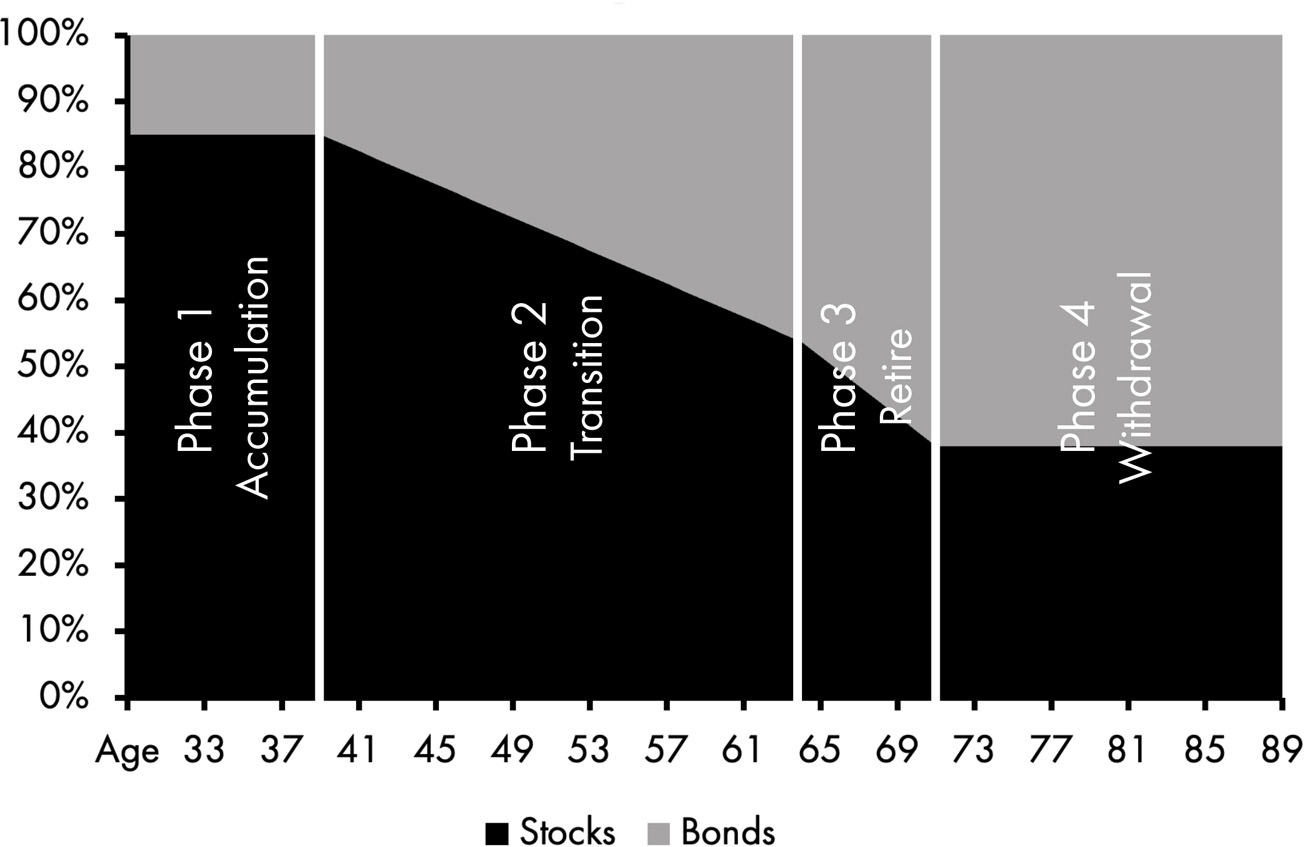
The key factor in a Target Date Portfolio is that it reduces sequence-of-returns risk by becoming more conservative as you near retirement. You choose a fund which matches your expected retirement year and the portfolio systematically becomes more risk-averse as you get closer to that date, and then typically becomes even more conservative as you navigate the early retirement years, until leveling off during the withdrawal phase.
Target date funds just make sense. They work because they take a diversified and low-cost portfolio and then systematically rebalance it so you can focus on what you do for a living and still know that your retirement plan is aligned with the likely changes in your risk tolerance based on age and retirement target.
BUILDING YOUR OWN TARGET DATE PORTFOLIO
There are two ways to build your own Target Date Portfolio. Option one is to consider target date funds from a low-cost fund family like Vanguard or Fidelity. They currently offer funds covering every five years from 2025–2070. You can simply select the fund that matches your retirement year and call it a day. No need to overthink it.
The other option is to build something more customized and rebalance it on your own. For instance, if you took the Boglehead Three-Fund Portfolio you would simply build out a plan using three funds and rebalance it over time to match the customized glide path you prefer. It might look something like this:
- Phase 1 (age 30–40): 85/15 stocks/bonds.
- Phase 2 (age 40–63): Increase bond allocation by 1.3% per year until you reach a 55/45 stock/bond allocation.
- Phase 3 (age 63–71): Accelerate bond allocation by 2.25% per year until you reach 37/63 stocks/bonds.
- Phase 4 (age 71+): Maintain 37/63 stock/bond allocation.
This can be done using any of the multi-asset portfolios we’ve discussed in this book.
TARGET DATE PORTFOLIO ANALYSIS
These aren’t the sexiest portfolios, but let’s run some figures anyhow.
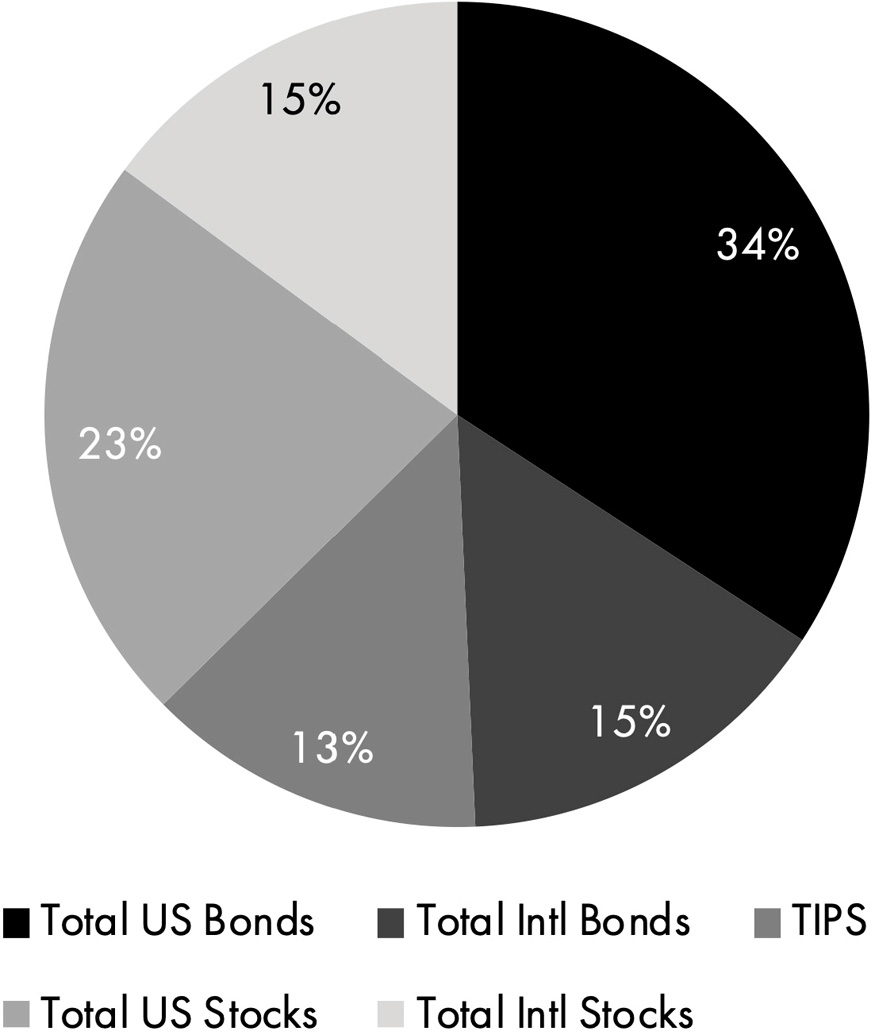
To see how this works in practice we can look at the actual Vanguard 2020 Target Date Fund which followed a path approximately similar to the above four phases and is currently helping retirees who retired in 2020 and now have a 37.4% stock allocation with a 62.6% allocation in bonds.
Figure 19.2: Vanguard 2020 Target Date Fund
When compared to a 60/40 Portfolio we see that the 2020 TDF underperforms by a bit (Figure 19.3), which is to be expected given that the fund has been underweight stocks leading into 2020.
Figure 19.3: Vanguard 2020 Target Date Fund performance
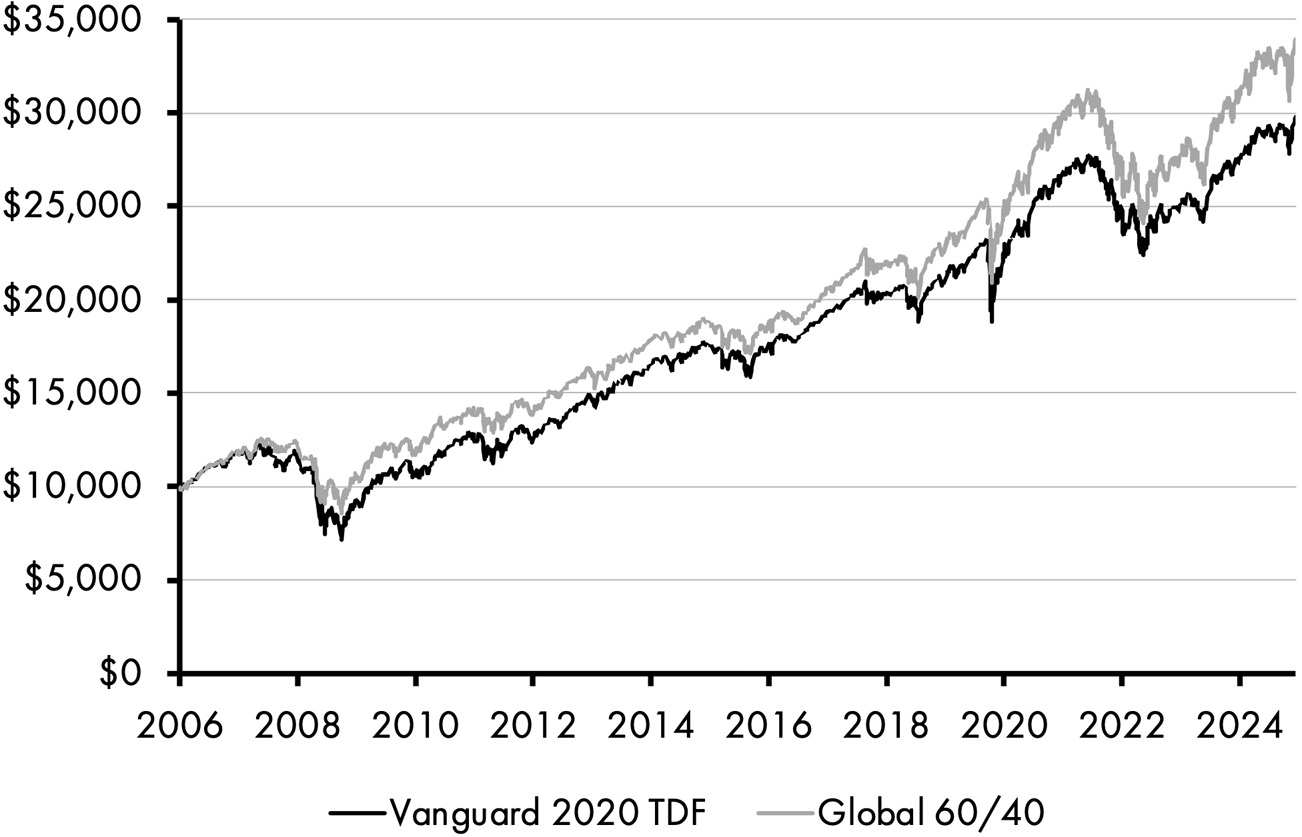
Interestingly, this fund also experienced a bit of sequence-of-returns risk, as its inception came close to the GFC. So, its more aggressive starting allocation hurt it upfront. But remember, this fund’s target retirement year was 12 years later so the fund still achieved its more long-term goal of growing nicely and then helping to provide a little better principal protection around the target retirement year in 2020.
As Figure 19.4 shows, the fund mitigated drawdowns during the Covid market crash because it had systematically reduced its stock allocation as compared to its 2008 allocation.
Figure 19.4: Vanguard 2020 Target Date Fund drawdowns (%)
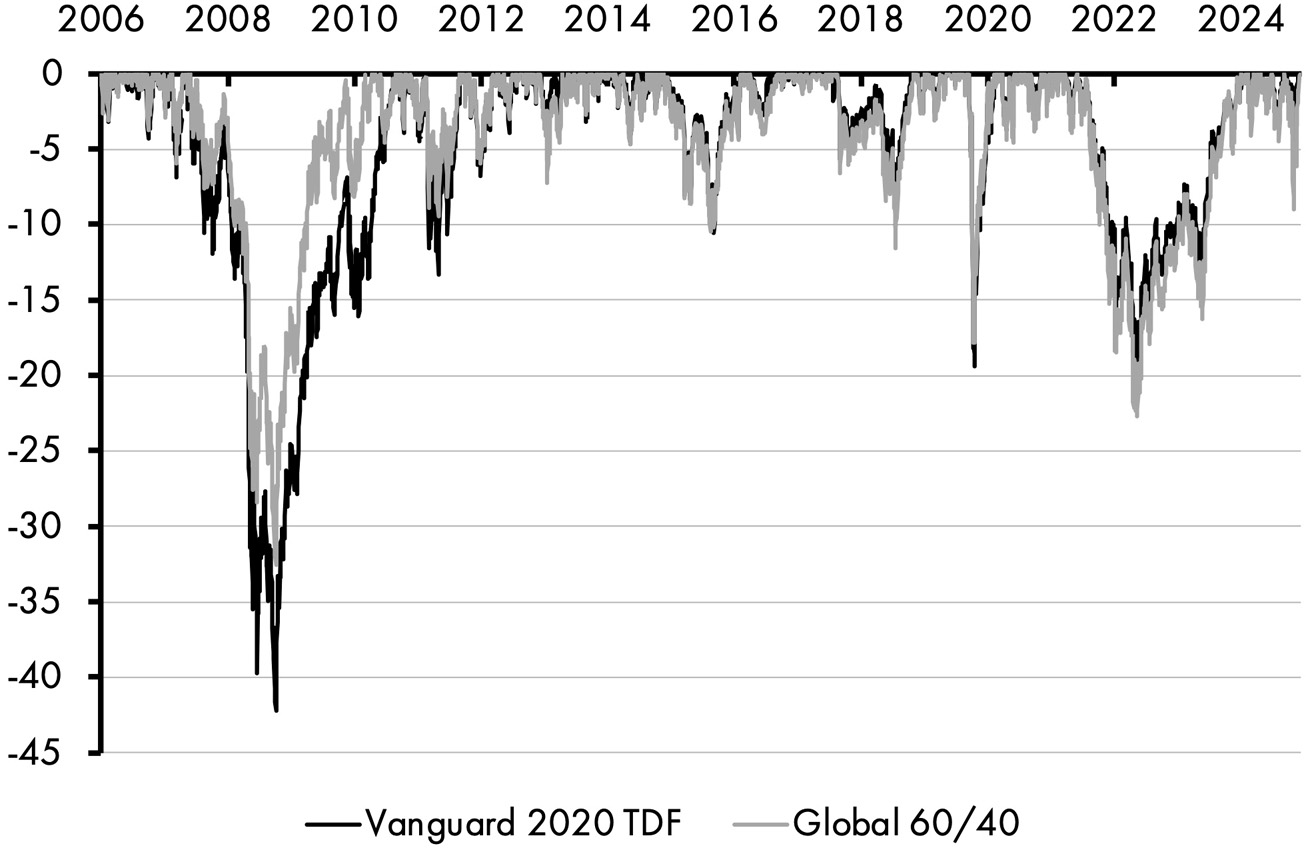
Overall, these funds do what we’d expect them to do as they’re more aggressive at initiation and become less aggressive as they approach their target.
TARGET DATE PORTFOLIO PROS AND CONS
C’mon. You know how this works by now. Bad news first:
- Target Date Portfolios will generally become cautious in retirement and then remain that way. As we discussed in the bond tent chapter, this might not be optimal because your allocation doesn’t need to remain cautious throughout your entire retirement. In fact, as we noted in the bond tent strategy, TDFs might be doing something that imperfectly aligns with your behavior and retirement goals by too closely following the age-in-bonds rule.
- The strategies are often homogeneous so your stocks and bonds are all in the same diversified mix of assets. As a result, if you withdraw funds you are essentially selling a bit of everything in the portfolio instead of just selling the liquid cash component you need. This is one reason to consider the option where we disaggregate it into something like the Three-Fund Portfolio.
- Target date funds came under a lot of criticism in 2008 due to sequence-of-returns risk. Many TDFs will have a stock allocation of up to 40–50% at retirement age. If you just so happen to be on the verge of a 2008-type environment when you’re entering retirement then a TDF with that allocation might prove to be a less effective behavioral hedge than you’d hoped. Therefore, it’s worth considering the TDF allocation in the context of everything else you have going on to make sure you’re not being too aggressive headed into retirement.
- Most TDFs will have a 15–30% bond allocation in the early years of the fund. There’s a reasonable criticism that this isn’t optimal for the investor who’s in their accumulation years because this bond allocation isn’t providing them with reliable principal stability and isn’t large enough to sufficiently hedge the stock volatility, so it operates as a pure return-drag relative to a more aggressive option.
- Some TDFs have relatively high fees and should be avoided. These are incredibly simple portfolios and should always be implemented using a low-cost fund wrapper.
And now the good news:
- TDFs are simple, low-cost and diversified. They require virtually no upkeep, and the investor barely has to lift a finger to manage it.
- TDFs are excellent behavioral hedges. Although we can nitpick the age-in-bonds rule or the sequence-of-returns risk, these portfolios do a fine job of establishing a target date and then managing the risk into that date.
SUITORS FOR TARGET DATE PORTFOLIOS
These portfolios are great in 401(k)s and other retirement accounts. They’re not ideal for people who want to be more hands-on with an account, or people who are already in retirement. So, if you’re someone in your 30s, 40s or 50s looking for a very easy solution for a retirement fund then these are great options. You probably can’t go wrong with something like this in a 401(k) plan.
FINAL THOUGHTS
I’m a big fan of time-based investing strategies that help you obtain greater clarity of your assets across specific time horizons. And while target date funds do a nice job of achieving this, I’ve developed my own methodology for trying to improve upon this approach.
Yes, that’s right. My current favorite portfolio is up next. I love it and I hope you will too.