The Portfolios
Chapter 18
Retirement Bond Tent Strategy
AHH, retirement. That period in life where you finally get to kick back and stop worrying about everything. Right? RIGHT? Not necessarily.
As someone who has advised hundreds of retirees over the course of my career, I’ve found that retirement is often the most difficult psychological financial period you’ll ever encounter.
It’s not that retirement is a big hurdle itself. It’s easy to stop working so you can focus on things you enjoy. But it’s a huge transition for many people because you go from having had a purpose your whole life while growing your nest egg to suddenly transitioning to finding a different purpose while watching your nest egg potentially shrink as you live off it. At the same time, you have to grapple with the fact that your income is now shrinking and that cash flow you had before can no longer be relied on to fund your expenses. This can be a big psychological hurdle for many people to overcome.
I mentioned earlier that I like to think of your job and your income as a part of your bond portfolio. If you make $100,000 per year you can think of this as though you have the equivalent of a $1,000,000 bond allocation that pays you 10% per year. You have an asset (your job) and it pays you a fixed income every year. This is why it can make a lot of sense to be very aggressive when you’re young and working. You effectively have a large fixed-income allocation already so you can afford to take more equity market risk.
When you retire, that synthetic bond allocation either disappears or it shrinks significantly. All of a sudden your relative equity allocation increases. And this is where the psychological hurdles and sequence-of-returns risk can become magnified.
What’s an investor to do?
One strategy to consider is a Retirement Bond Tent. Let’s dive into it.
WHY RETIREMENT BOND TENT STRATEGIES WORK
Michael Kitces wrote a research piece in 2016 discussing a concept called a “bond tent.”42 It took a very different view on retirement asset allocation when compared to traditional financial planning approaches. In the traditional model, your bond allocation roughly follows your age (see Figure 18.1).
This makes sense on its face. As you get older you should reduce your stock market exposure and increase your bond exposure because you’re running out of time to navigate the excess volatility of the stock market. You add more bonds to throttle the stock market risk and therefore create more near-term certainty in your financial planning.
Figure 18.1: The age-in-bonds rule
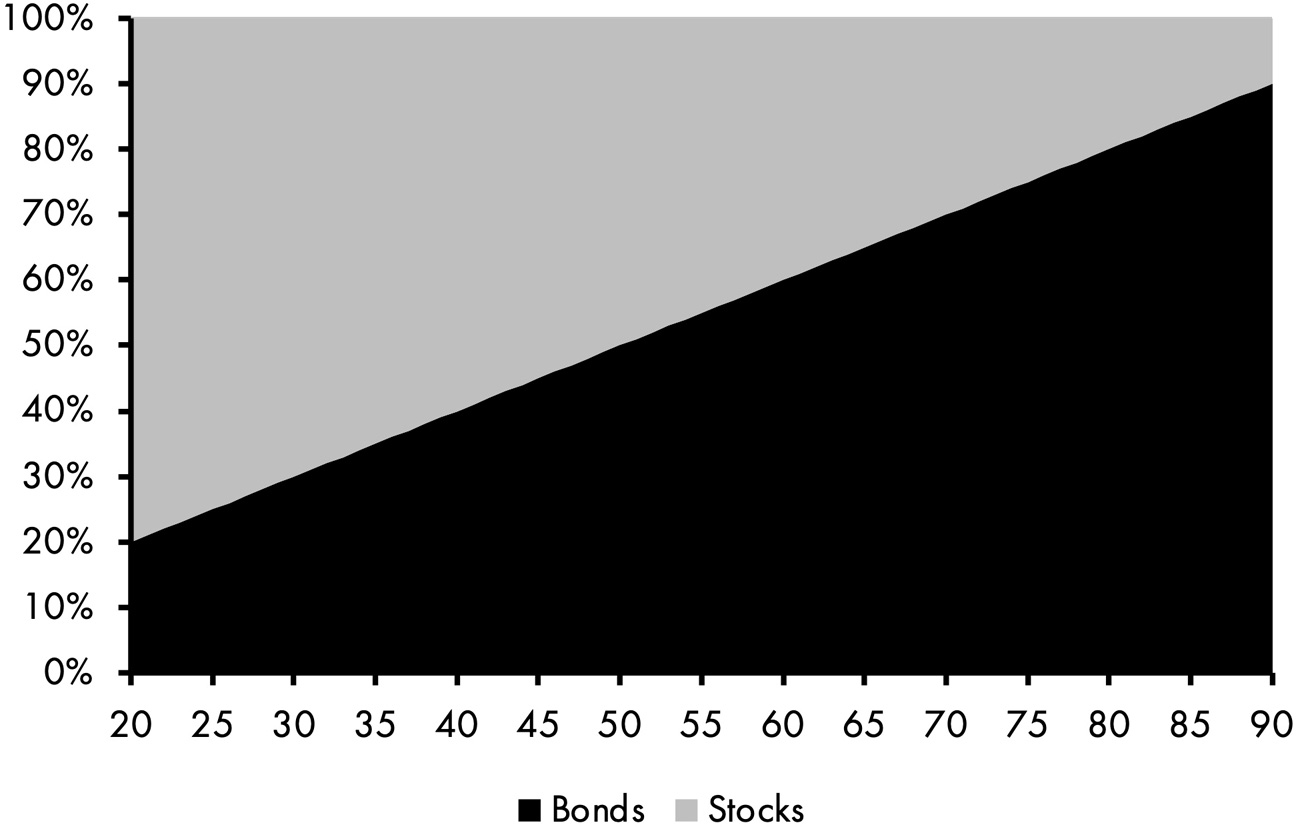
The problem with this concept around retirement is that life isn’t one smooth glide path into retirement. It’s generally a very abrupt start/stop type of sequence. For example, if you retire on January 1 of the year you turn 65, your wages abruptly shrink or disappear. If you think of your job as that bond allocation, you suddenly have a huge disparity in your stock/bond allocation. I don’t think most investors consciously think of it this way, but they intuitively feel it this way. That creates a huge amount of uncertainty for many investors. Especially if your retirement income sources are not significant.
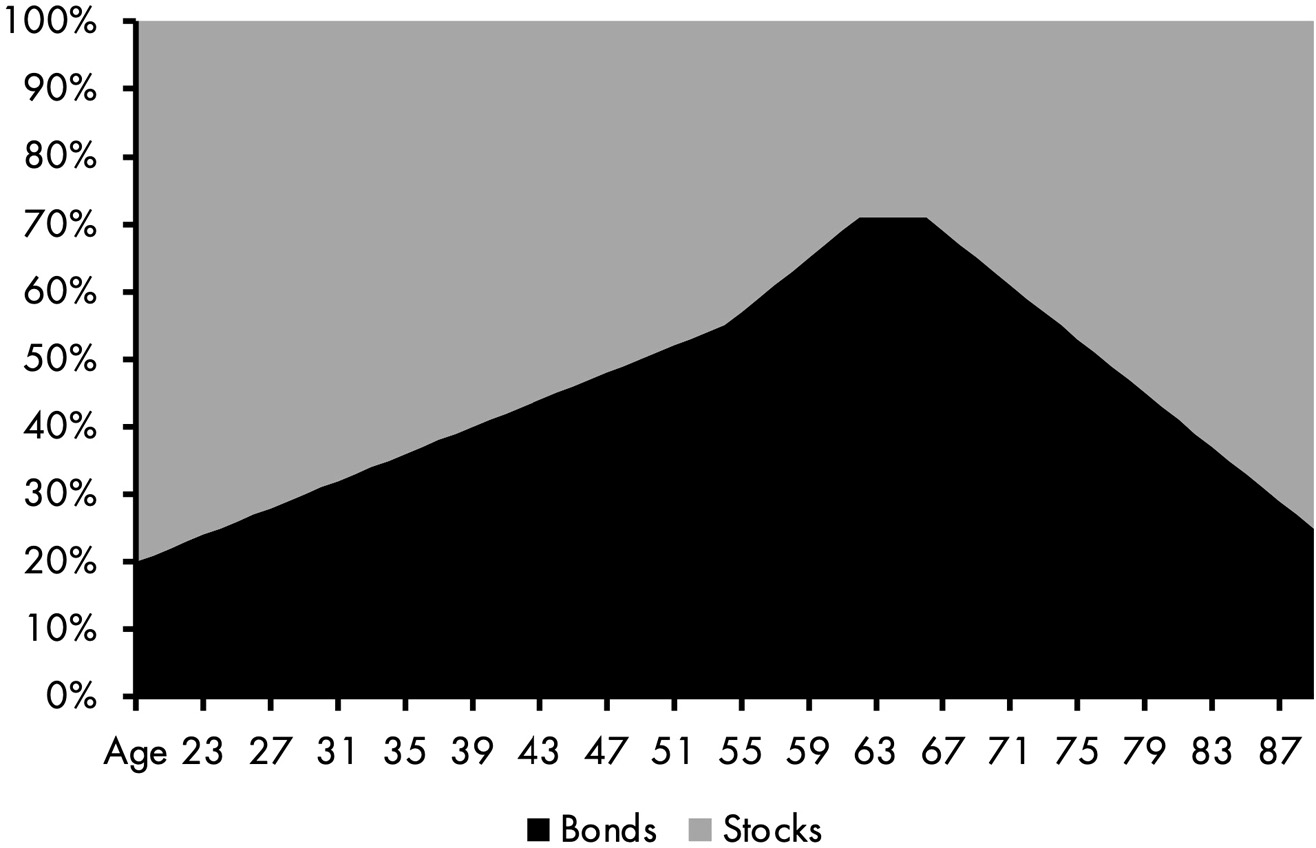
Kitces’ solution to this problem is to build a “bond tent” where, in the years leading up to retirement and in early retirement, you boost your bond allocation more than what the age-in-bonds rule would say. The bond tent is designed to create more income and stability around your retirement transition so you can more comfortably navigate those unpredictable years around retirement. Then as you get older you reduce the size of the tent and your relative equity allocation should begin to increase. Figure 18.2 shows what this looks like.
Figure 18.2: The Kitces bond tent
Most people think the riskiest part of your retirement years will be the point where you’re very old and potentially running out of money. But the biggest risk usually comes around retirement age when your sequence-of-returns risk is largest.
For example, if an investor retires at 65 with a portfolio of $1,000,000 that is growing at 7% per year with a 60/40 stock/bond allocation, they can comfortably withdraw $50,000 per year (adjusted for inflation). But what if they retire just as a severe bear market hits and their portfolio declines 10% annually for the first three years? This investor is suddenly looking at a portfolio value that is around $594,000. If they continue withdrawing $50,000 annually, they’re now taking out 8.4% of their portfolio each year and their financial plan is much more likely to fail. This investor may have to go back to work, take more risk, alter their living standards, or win the lottery.
Worse, what about the psychological turmoil? And what if this investor makes the worst mistake of all by reducing their stock exposure during the bear market, as so many investors often do? This is why sequence-of-returns risk is so important to understand. As Morgan Housel says, tails drive everything around us, and this is the ultimate retirement tail risk.
Yes, this is an oversimplified and extreme example, but it’s a scenario that can and does play out in real life. And it’s very easily avoidable by insulating yourself around those precarious early retirement years.
In short, the Retirement Bond Tent works because it’s designed to build a protective envelope around the period of retirement that is most difficult to navigate.
BUILDING YOUR OWN RETIREMENT BOND TENT STRATEGY
The Retirement Bond Tent is highly customizable and depends heavily on personal circumstances.
In general, you can construct a Retirement Bond Tent quite simply. Let’s use a hypothetical 20-year-old college graduate who follows the age-in-bonds rule up until they’re 55:
- Years 20–55: Increase bond allocation in accordance with the age-in-bonds rule.
- Years 55–62: Escalate the rate of bond reallocation by 2% per year so that you reach about 70–71% by the age of 62.
- Years 62–67: Maintain the tent at 71% bonds.
- Years 71+: Reduce your bond allocation by 2%+ per year as you withdraw funds and allow the higher expected returns to accrue in your stock market allocation.
An alternative option is to maintain any other strategy you like until you near your retirement years. For instance, if you’re an aggressive investor with a high income perhaps you maintain a 100% stock allocation from 20–55. At this point you initiate the above stages by making all retirement plan contributions to the bond allocation only. Over a 10-year period, your only asset allocation goal is to get that bond allocation to a point where it’s meeting your retirement income needs. If necessary, this could require selling some stocks and reinvesting the cash in bonds.
Implementation of the bond tent is highly dependent on personal circumstances so consider the actual asset allocation process in the context of your own needs. As we’ve discussed in earlier chapters, this sort of strategy would mesh well with our Flying Ladder Portfolio or any strategy that has a heavy bond emphasis with strategically structured bond ladders or fixed income components.
RETIREMENT BOND TENT STRATEGY ANALYSIS
Analyzing the Retirement Bond Tent strategy against a benchmark or index is challenging because the allocations shift based on the investor’s age. This means you can’t easily tie the portfolio’s composition to specific time periods in the market, making direct comparisons difficult if not impossible. And in any event, this is very much not a “beat the market” portfolio as it is specifically structured as a behavioral portfolio and planning tool. You don’t need to worry about how the broader market is performing when this strategy makes its moves, because the allocation is specifically designed to shield you from short-term volatility and the psychological mistakes it often provokes during the worst possible moments.
RETIREMENT BOND TENT STRATEGY PROS AND CONS
You know the drill:
- The first bit of bad news is that the bond tent doesn’t provide broad exposure to alternative assets. If you require greater diversification then you need to either reduce your stock allocation or consider incorporating high-quality bond alternatives. One solution here is to consider an “insurance tent.” I’ve mentioned that instruments like cash, gold, and managed futures have attributes like insurance. If you wanted a twist on the “bond” tent concept you might consider adding an insurance tent to bolster the bond tent.
- The bond tent requires a decent bit of upkeep. Your stocks are likely to outperform your bonds over time and if you’re living off the income in the bond portfolio then you’ll constantly need to monitor the bond allocations to avoid the stock allocation from growing ever larger. You need to be a bit hands-on.
- All that rebalancing requires flexibility, so if you can implement this strategy in non-taxable accounts then that’s smart. Otherwise, the added activity will incur higher taxes and fees.
And what about the pros?
- This is an eminently sensible portfolio for anyone entering retirement who is losing significant income.
- I really like how the equity piece is allowed to grow later in life because, depending on your portfolio size and withdrawal rate, the odds of running out of money are low and the time horizon for the portfolio is therefore getting, strangely, longer. That’s because the portfolio is likely becoming a multi-generational portfolio, so the beneficiary’s asset allocation and risk profile suddenly comes into play.
- This is a great behavioral portfolio as it helps solve a real-world problem for investors transitioning into retirement.
SUITORS FOR RETIREMENT BOND TENT STRATEGIES
If you’re entering retirement or in early retirement you should absolutely consider this sort of strategy. I’ve been using the bond tent concept in client accounts for a long time and have personally witnessed its benefits. For anyone who has any behavioral uncertainty as they near retirement this is a very good option to consider.
FINAL THOUGHTS
This strategy covers a more personalized period of someone’s life as they get closer to retirement. And that’s part of why your perfect portfolio has to be adaptive to some degree – your life is going to change and your portfolio will need to adjust with it. A bond tent can be a great way to build more security as you near an uncertain part of your life.
Speaking of adaptive retirement-based portfolios, let’s talk about some of the most popular time-based portfolios around. Target Date Portfolios have become a popular option in most retirement plans, so let’s look at whether they might be perfect for you.