*Investors’ return expectations are pivotal in stock markets, but the reasoning
behind these expectations is not well understood. This article explores economic agents’ mental models of what drives returns. We survey the general population, retail investors, financial professionals, and academic experts to investigate how
they forecast and explain future returns in scenarios with stale news about future company earnings. We find that investors strongly disagree in their forecasts and reasoning. Most academic experts view markets as efficient. By contrast, most
households express a perspective we call “expected earnings reasoning”: they directly equate higher expected earnings with higher expected returns. Professionals are split between market efficiency, mispricing, and expected earnings reasoning.
In detailed experiments, we dissect why households adopt expected earnings reasoning. We show that it arises from inattention to how stock price changes affect investor costs—that is, how much investors must pay to acquire a claim to fu-
ture cash flows—because the typical format and context of investment problems obscure these cost implications. Our results help connect a series of previously doc-
umented anomalies in expectation and trading data and highlight the importance of selective attention and context in shaping reasoning and belief formation. JEL codes: D83, D84, G11, G12, G41, G51, G53.
© The Author(s) 2026. Published by Oxford University Press on behalf of President and Fellows of Harvard College. This is an Open Access article distributed under the terms of the Creative Commons Attribution License (https://creativecommons.org/licenses/by/4.0/), which permits unrestricted reuse, distribution, and reproduction in any medium, provided the original work is properly cited. The Quarterly Journal of Economics (2026), 2925–2978. https://doi.org/10.1093/qje/qjag039. Advance Access publication on July 25, 2026.
I. INTRODUCTION
Stock markets revolve around return expectations. These expectations shape investment decisions, disagreement about future returns generates trading, and anomalies in these expectations can explain critical market-level phenomena such as excess volatility and bubbles ( Barberis et al. 2015 , 2018 ; Giglio et al. 2021a ; Adam and Nagel 2023 ). Investors’ mental models—their perspectives on what drives returns—likely play an essential role in the formation of these expectations. However, conventional data on stock prices or trading decisions and even data on subjective expectations remain silent on agents’ reasoning and understanding. Even though agents’ return expectations are pivotal in stock markets, the mental models they use to form these expectations are not well understood.
In this article, we empirically study the mental models agents use to form stock return expectations. We focus on how agents infer future returns from “stale” news about future company earnings. Such news affects what we will call the “investor benefits” of owning a stock (its expected future cash flows) and the “investor costs” of acquiring the stock (its current price). This setting allows us to distinguish three broad perspectives. A model of efficient markets predicts that benefits and costs move in tandem as prices incorporate new information. A model with temporary mispricing holds that prices fail to adjust appropriately to changes in benefits because markets under- or overreact to news. We also consider a third, simpler approach: models shaped by selective attention to either the benefit or cost implications of the news for investors. Because changes in the benefits of owning a stock are the most salient feature of earnings news, agents may selectively focus on these benefits and equate higher future earnings with higher future returns, ignoring changes in the costs of investing. We call this perspective expected earnings reasoning (EER).
To study mental models of the stock market, we adopt a tailored survey-based approach that combines rich expectation data with qualitative text data on agents’ reasoning. We field our survey with a diverse group of economic agents: households from the U.S. and German general populations, U.S. and German retail investors, U.S. financial advisors, fund managers employed at large German asset management companies, and international academic experts. In addition, we run a series of experiments with households to investigate the roots of households’ mental models and likely implications for belief formation and decision making. In total, we collect data from more than 29,000 households and investors.
Our empirical methodology is comparable across samples. We present participants with news scenarios that are relevant to the future earnings stream of a specific company (e.g., Nike). Participants read two alternative scenarios, one describing a relatively neutral and expected event (e.g., “Nike maintains supplier partnership”), the other describing either good or bad unexpected news (e.g., “Nike secures cost-saving partnership”). Crucially, the pieces of news are four weeks old. Depending on which mental model participants use, they should reason very differently about how this “stale” news affects future returns. Participants predict in which of the two scenarios the expected future stock return of the company would be higher. Then they explain the reasoning underlying their return forecast in a qualitative open-ended question. We primarily rely on hypothetical news scenarios, which lets us hold information sets constant across respondents and simplifies the collection of text data on their reasoning. We demonstrate the robustness of our approach to relying on real news items. We present our results in four steps.
i. Inference from Stale News. We investigate whether respondents predict that stale earnings news still affects companies’ future stock returns. Few academic experts do so, with about 72% forecasting no change in future returns in response to stale news. This stands in stark contrast to general population respondents, retail investors, and financial professionals, the majority of whom predict higher returns over the next 12 months in response to fourweek-old positive news about future earnings (and lower returns for negative news). For example, around 70% of the U.S. general population, 78% of U.S. retail investors, and 51% of fund managers make such “news-congruent” return forecasts. (p.2928)ii. Mental Models. We explore which mental models respondents use to form return forecasts and analyze respondents’ openended explanations of their return forecasts. The qualitative text data provide direct insight into participants’ thoughts, and the open-ended format ensures that respondents express what is top of mind without being primed with any specific mechanism or argument.
Reasoning in line with market efficiency is dominant among academic experts. For example, a typical academic expert argues that “[t]he effect on future profits and dividends should already be reflected in the current price.” By contrast, respondents from the general population, retail investors, and financial advisors predominantly adopt expected earnings reasoning. They justify their return forecasts by referring to changes in companies’ earnings, citing factors such as profit margins, sales volume, or production costs. For example, a typical retail investor argues that returns are higher because “the company can continue to grow profits, increasing the value of the stock.” Households and financial advisors thus directly link differences in expected future company earnings to differences in expected future returns, while remaining silent about changes in the cost to investors of buying the stock over the previous four weeks.
Among fund managers, we find significant heterogeneity in mental models. Some fund managers reason in a manner consistent with market efficiency, others argue that temporary mispricing arises from under- or overreaction, and still others exhibit expected earnings reasoning. Mental models thus vary considerably both across investor groups and within the influential group of fund managers.
We confirm the prevalence of expected earnings reasoning (EER) among households in a series of additional experiments. We rule out that EER reflects low engagement with the survey, implicit beliefs in mispricing, or implicit risk-based reasoning.
iii. Selective Attention and Problem Representation. Why do so many households link the investor benefits of the news (higher expected earnings) directly to expected returns, while disregarding the investor costs (the prices they must pay today)? Having ruled out risk-based asset pricing and temporary mispricing as mental models underlying households’ return forecasts, we present evidence on the role of selective attention. Recent theories argue that attention is drawn to the most salient features of (p.2929)a problem, which in turn shapes how individuals represent the problem and reason ( Bordalo et al. 2026a , 2026b ). Changes in the benefits of owning a stock are the most salient feature of earnings news. By contrast, price adjustments and their implications are less visible and may escape households’ attention. To test this idea, we explore when and how households start reasoning about the prices they pay for the stock.
We first test whether households can infer the price response that should have occurred in the four weeks since the news broke. In an experiment in which we directly ask households about past market and price responses, almost all anticipate greater demand from other traders at the old price and predict that the stock price has increased over the past four weeks. When prompted, households understand the direction of the market response to good earnings news. (However, this realization alone has no significant effect on return predictions, nor does it alter the explanations respondents provide for those predictions. Households do not put the pieces together.)
We conduct an experiment in which we make the price response an explicit and salient feature of the problem description. This intervention moderately reduces the share of households who expect higher returns in the good-news scenario by 12 percentage points, but 70% of households continue to make news-congruent return forecasts. The open-ended explanations reveal that many participants start reasoning about prices once price changes are made salient. However, they often view higher prices as a positive signal of value and quality—one that echoes and reinforces changes in expected earnings rather than offsetting them. Only few households reason about prices as investor costs—that is, they recognize a higher price as requiring them to pay more for a given share of the firm.
Why do many households not think of higher stock prices as higher purchase costs even when prices are salient? We argue that the standard context and format of investment problems obscure the implications of price changes for investor costs. Stock investment decisions are typically framed in terms of investing a given amount of money. When prices rise, investors still consider investing the same amount. The change in cost is hidden in the lower number of shares purchased. To test this explanation, we study two experimental interventions that, in addition to providing price information, make the cost implications of higher prices salient. In one intervention, we explicitly list how the price in- (p.2930)crease changes the number of shares that can be purchased. In the other intervention, we frame the decision in terms of buying a given number of shares, which must be bought at a higher cost in the good-news scenario. Neither intervention provides new economically relevant information beyond what participants should be able to infer on their own. Nonetheless, both interventions significantly reduce the share of news-congruent return forecasts (by 21 percentage points and 12 percentage points, respectively) and strongly increase the tendency to adopt a prices-as-costs view (by 32 percentage points and 16 percentage points, respectively) relative to a condition that adds only price information to the standard scenarios. In the condition that explicitly lists the change in the number of stocks one can afford, fewer than half of the respondents (49%) expect higher returns following stale good news—the lowest share observed among households in our data.
These findings suggest that households adopt EER because changes in expected earnings are easy to parse, whereas corresponding changes in investor costs escape attention in the context and format of standard investment problems. For many individuals, the bottleneck lies not in noticing price changes but in attending to them as investor costs. More broadly, our evidence supports the view that attention is selective and drawn to salient features, so that context shapes the reasoning that agents adopt ( Bordalo et al. 2026a , 2026b ).
In additional experiments, we implement alternative variations of the context. For example, we show that highlighting shifts in risk shapes reasoning and forecasts through selective attention to negative implications for investor benefits, such as the possibility of bad earnings realizations. We also show that beyond context, familiarity with different perspectives matters for households’ forecasting, consistent with Bordalo et al. (2026b) . In particular, memories of past price episodes and knowledge of the principle of arbitrage shift households’ reasoning about prices and return predictions.
iv. Consequences of Expected Earnings Reasoning. In the final step of our analysis, we draw on additional evidence to explore the implications of EER for real-world decision making and belief formation. First, we find that EER influences households’ investment decisions in an incentivized investment experiment. Second, when retail investors explain their actual currently planned trades, EER frequently emerges as an explicit motive for trad- (p.2931)ing. Third, retail investors request information on a company’s expected business outlook much more often than information on volatility, exposure to the economy (beta), misvaluation, or recent returns. Fourth, EER shapes households’ perceptions of stock market participation costs. Finally, we integrate our standard survey module into an established panel survey on household expectations and show that EER predicts households’ tendencies to form procyclical ( Giglio et al. 2021a ; Amromin and Sharpe 2014 ; Beutel and Weber forthcoming ) and extrapolative ( VissingJorgensen 2003 ; Greenwood and Shleifer 2014 ) return expectations, suggesting that EER contributes to previously known belief anomalies.
Taken together, our results highlight that disagreement in return expectations is rooted in heterogeneous mental models. Expected earnings reasoning—the tendency to directly equate future earnings with future returns—is common, particularly among households, because the implications of investment news for investor costs escape attention in the standard context and format of investment problems. Understanding investors’ reasoning can help us make sense of previously documented anomalies in expectations and trading behavior and market-level outcomes. We discuss these implications below.
v. Implications and Related Literature. Expectations are central in financial markets and have attracted a large empirical literature ( Adam and Nagel 2023 ). These studies have used observational survey data ( Adam, Marcet, and Beutel 2017 ; Bordalo et al. 2019 ; Giglio et al. 2021a , 2021b ; Bordalo et al. 2024 , 2025 ; Delao and Myers 2021 ) or experiments ( Haaland, Roth, and Wohlfart 2023 ; Chinco, Hartzmark, and Sussman 2022 ; Laudenbach et al. 2026 ; Fuster and Zafar 2023 ; Gorodnichenko and Yin 2025 ; Beutel and Weber forthcoming ) to understand how expectations are formed and how they affect individual- and market-level outcomes. We contribute to this literature by providing direct evidence on economic agents’ reasoning—the mental models they use to form return expectations. We show that these models do not necessarily align with prevailing economic theories, which makes it necessary to study mental models empirically “in the wild.” In particular, households and many financial professionals directly equate future company earnings with expected future stock returns, neglecting the implications of changes in stock prices for investor costs.
Expected earnings reasoning helps us understand and connect a series of previously documented anomalies in expectation and trading data, so one key contribution of our article is to identify common cognitive processes behind these phenomena— heterogeneous mental models, selective attention, and the role of context and memory. For example, we argue that EER provides a plausible foundation and is empirically linked to the procyclical and extrapolative nature of return expectations ( VissingJorgensen 2003 ; Amromin and Sharpe 2014 ; Greenwood and Shleifer 2014 ; Giglio et al. 2021a ; Da, Huang, and Jin 2021 ; Beutel and Weber forthcoming ). EER could also contribute to the tendency to trade on stale news ( Tetlock 2011 ) or overtrading ( Odean 1999 ; Barber and Odean 2000 ). If one believes that expected future earnings indicate higher future returns, successful stock investment requires adjusting the portfolio in response to earnings news and identifying companies that are expected to achieve higher earnings. This could contribute to (i) high perceived stock market participation costs ( Gomes, Haliassos, and Ramadorai 2021 ; Duraj et al. 2025 ) and (ii) a preference for active investment strategies conditional on participation ( Haaland and Næss 2023 ). Mental models also help understand how agents interpret new information in information provision experiments ( Beutel and Weber 2025 ). Mental models thus likely have significant downstream consequences for beliefs and behavior.
The fact that expected earnings reasoning is so widespread suggests that it could also be relevant for market-level outcomes. Our results thus strongly support theoretical work that integrates nonstandard belief formation mechanisms into macrofinance models to understand asset-pricing consequences ( Adam and Nagel 2023 ). For example, the extrapolation of returns that EER could produce can lead to momentum and price reversals ( De Long et al. 1990 ; Cutler, Poterba, and Summers 1991 ; Barberis et al. 2015 ; Jin and Sui 2022 ), while disagreement about the correct model can generate high trading volume ( Hong and Stein 2007 ; Barberis et al. 2018 ). Our finding that households often overlook the implications of stock price changes for investor costs also relates to the literature on imperfect inference from equilibrium prices ( Hong and Stein 1999 ; Adam, Marcet, and Beutel 2017 ; Eyster, Rabin, and Vayanos 2019 ; Bastianello and Fontanier 2025 , forthcoming ; Schmidt-Engelbertz and Vasudevan 2025 ; Cohen 2025 ). Another intriguing implication of this mechanism is that it links earnings expectations to return expectations and can thus (p.2933)also link the extrapolation of fundamentals ( Barberis, Shleifer, and Vishny 1998 ; Hirshleifer, Li, and Yu 2015 ; Bordalo et al. 2024 ; Bordalo, Gennaioli, and Shleifer 2022a ) to return extrapolation.
We also contribute to recent work on attention, mental models and reasoning ( Schwartzstein 2014 ; Hanna, Mullainathan, and Schwartzstein 2014 ; Gabaix 2019 ; Enke 2020 ; Schwartzstein and Sunderam 2021 ; Bordalo, Gennaioli, and Shleifer 2022b ; Graeber 2023 ; Gagnon-Bartsch, Rabin, and Schwartzstein 2023 ; Bordalo et al. 2026a ; Barron and Fries 2025 ; Charles and Kendall 2025 ; Esponda, Vespa, and Yuksel 2024 ; Han, Huffman, and Liu 2025 ; Bohren et al. 2025 ). Our evidence suggests that agents attend to salient features of the context, which in turn triggers the use of particular mental representations. In line with our findings, Bastianello, Décaire, and Guenzel (2025a) document selective attention in equity analysts’ mental models. Our findings support recent theoretical work ( Bordalo et al. 2026a , 2026b ) and align with recent evidence on the role of memory, context, and associations in shaping reasoning and beliefs ( Enke, Schwerter, and Zimmermann 2024 ; Taubinsky et al. 2025 ; Jiang et al. 2025 ; Bordalo et al. 2026c ; Link et al. forthcoming ; Gennaioli et al. 2025 ; Charles 2025 ). Previous evidence also suggests that individuals often struggle to comprehend indirect and contingent consequences ( Greenwood and Hanson 2015 ; Dal Bó, Dal Bó, and Eyster 2018 ; Eyster 2019 ; Niederle and Vespa 2023 )—here, the market’s pricing response. Our mechanism experiments suggest that changes in problem presentation and the associated changes in attention can powerfully change how individuals think about indirect consequences. Our evidence emphasizes the importance of studying mental representations of the world, echoing Hirshleifer (2020) , who argues that understanding mental models in financial market contexts is a critical research goal.
Indeed, a growing empirical literature explores economic thinking in various contexts, such as macroeconomic shocks and policies ( Coibion, Gorodnichenko, and Kumar 2018 ; Andre et al. 2022 , forthcoming ; Coibion, Gorodnichenko, and Weber 2022 ; Coibion et al. 2023 ), taxation ( Stantcheva 2021 ), and trade ( Stantcheva 2023 ). In finance, Chinco, Hartzmark, and Sussman (2022) document that only a few investors consider an asset’s correlation with consumption growth when making investment decisions; Stroebel and Wurgler (2021) and Bauer et al. (2026) study how investors reason about climate risks; Bastianello, Décaire, and Guenzel (2025b) and Ben-David and Chinco (2024) analyze (p.2934)the valuation methods in equity analyst reports; Duraj et al. (2025) conduct qualitative interviews with households on stock market participation; Schnorpfeil, Weber, and Hackethal (2025) explore how retail investors’ beliefs about inflation affect trading decisions; Choi and Robertson (2020) , Bender et al. (2022) , and Liu et al. (2022) study investment motives of retail investors; and Choi (2022) reviews the investment advice given in popular books. Our study contributes to this stream of work by directly studying and comparing investors’ mental models of the stock market.
II. EMPIRICAL STRATEGY
II.A. Three Mental Model Types
Our goal is to understand how agents reason about returns on stock markets. We use the term “mental model” to describe the distinct perspectives agents can take when thinking about returns. A mental model takes a stance on how and why different economic factors—such as expected earnings, risk, or the magnitude of mispricing—relate to asset prices and returns. This view aligns with recent theoretical work on (misspecified) models, sometimes also referred to as “mental representations,” “narratives,” or “categories” (e.g., Spiegler 2016 ; Schwartzstein and Sunderam 2021 ; Bohren and Hauser 2025 ; Bordalo et al. 2026b ).
The term “mental model” emphasizes the subjective nature of reasoning and highlights that differing perceptions, rather than objective economic reality alone, shape expectations. Mental models can include incomplete or even incoherent perspectives on returns, but they differ from purely habitual or rule-ofthumb investment behavior that is devoid of economic reasoning (“model-free” in the language of Barberis and Jin 2026 ). Importantly, agents’ reasoning is not necessarily fixed or stable. Instead, agents may focus on different economic factors depending on which features attract their attention, consistent with recent evidence on the role of selective attention (e.g., Bordalo, Gennaioli, and Shleifer 2022b ; Li and Camerer 2022 ; Bordalo et al. 2026a ; Conlon 2026 ).
To fix ideas, contrast two scenarios in a simple thought experiment, which will serve as a guiding framework for much of the analysis in this paper.
News about a large exchange-traded company broke four weeks ago. Scenario 1: Neutral news. The company’s expected earnings do not change. Scenario 2: Good news. The company is expected to make noticeably higher earnings in the future. Hence, investors can expect a higher future dividend stream. An investor invests $1,000 into the company’s stock today, four weeks after the news was released. How does the expected return on the investment differ between the two scenarios over the next 12 months?
Stale cash-flow news affects what we call the “investor benefits” of owning a stock (its future cash flows) and the “investor costs” of acquiring the stock (its current price). The thought experiment offers a useful lens through which to contrast three perspectives on stock markets: efficient markets, temporary mispricing, and simpler models shaped by selective attention to either the benefit or the cost implications of the news.
The first notion of efficient markets holds that asset prices fully reflect all publicly available information ( Fama 1970 ). News about future expected earnings is quickly priced in, otherwise an arbitrage opportunity would arise, which cannot exist in equilibrium. Instead, the expected return arises as a compensation for the risk properties of the stock—the risk premium—plus the riskfree rate. As long as the stock’s risk profile remains unchanged, stale cash-flow news does not matter, and the expected future return is identical across the two scenarios. The expected “investor benefits” of owning the stock (future cash-flows) and the “investor costs” of acquiring it (the current price) move in tandem and offset each other. Agents who apply market efficiency reasoning therefore predict that expected future earnings are irrelevant for expected future returns—unless they think the risk profile of the stock differs across scenarios.
By contrast, the second notion of temporary mispricing allows market prices to deviate from efficient pricing. Changes in the “investor benefits” and “investor costs” of owning a stock do not always coincide. The reasons can be manifold. For example, if traders are inattentive and arbitrage is limited, the market underreacts to good cash-flow news, prices move only slowly to the efficient price as the news spreads, the stock can be bought at an attractive price, and returns are temporarily higher ( Jegadeesh and Titman 1993 ). By contrast, if traders become initially too optimistic after hearing the good news, the market overreacts, (p.2936)prices overshoot, and later reverse toward the efficient price ( De Bondt and Thaler 1985 ). Expected returns can be higher or lower depending on the timing of market entry and the return reversal. Mispricing can also result from the behavior of fully rational agents if there are market frictions. Although there are many specific models for why temporary mispricing can occur after earnings news arrives, they all share the idea that in addition to the risk-free rate and the risk premium, under- or overreaction shape expected returns.
As is standard for academic models of returns, both perspectives recognize the role of the “investor benefits” (future cash flows) and the “investor costs” (current price) of acquiring a stock. However, we are also interested in the reasoning of nonexperts and therefore allow for a third, simpler approach: models characterized by selective attention to either benefits or costs. Indeed, research suggests that human reasoning is often shaped by selective attention to salient features—those that stand out and attract attention (e.g., Li and Camerer 2022 ; Bordalo, Gennaioli, and Shleifer 2022b ; Bordalo et al. 2026a ; Conlon 2026 ). In the context of our thought experiment, the change in corporate earnings is the most salient feature. The price adjustments that likely occurred over the past four weeks, although predictable, are not equally visible.
It is therefore plausible that some agents focus selectively on the earnings implications. We refer to this reasoning pattern as expected earnings reasoning (EER) . Agents who follow EER consider only changes in cash flows and directly equate changes in company earnings with changes in expected returns, without any references to changes in risk or mispricing. Intuitively, they perceive the question “When can the stock investment be expected to succeed?” as equivalent to “When can the company be expected to succeed?”
Our broad classification of mental models is not exhaustive, but it captures the two prominent classes of models in economics and finance and a third, simpler form of reasoning, which is, as we will find, quite common in practice. These models have very different implications for how return expectations are formed. They will often yield different predictions for an asset’s future expected returns, but even when they yield similar predictions, the underlying rationales differ fundamentally. This motivates us to study the empirical prevalence of these models.
Throughout the analysis, we do not take a stance on which way of reasoning about the stock market is correct. Our academic expert survey consults a large number of distinguished financial economists, many of whom have contributed to the academic debate on this issue. We are not in a superior position to judge and leave it to readers to draw their own conclusions.1
II.B. Survey Design
Because the three model types treat stale news so differently, this setting is ideal for studying which mental models agents use. Our empirical strategy relies on this insight, translates the thought experiment into concrete terms, and implements it in tailored surveys with a diverse set of economic agents.
1. Scenarios. In the survey, each respondent is asked to think about a pair of hypothetical scenarios: a scenario with neutral stale news and a scenario describing either positive or negative stale public news for the future earnings stream of a company. We describe the news as four weeks old.2 We repeat this information multiple times, including in all subsequent prediction questions, and even ask for it in a comprehension quiz to ensure that the information is salient. We highlight that the news is public and received attention. Our main scenarios describe news about Nike, the multinational athletic footwear and apparel corporation. In the condition with neutral versus good news, the scenarios read as follows:
Scenario 1: Nike maintains supplier partnership. Four weeks ago, on [...], Nike Inc. announced the continuation of its partnership (p.2938)with major polyester supplier Toray Industries Inc., in a move aimed at retaining its current supply chain. The continuation of the partnership is expected to maintain the company’s current cost structure. Industry experts were not surprised by the announcement, as continuity in supplier relationships is a common practice in the industry. Scenario 2: Nike secures cost-saving partnership. Four weeks ago, on [...], Nike Inc. announced a new strategic partnership with leading recycled polyester supplier Unifi Inc., aimed at reducing raw material costs by 20%. The deal is expected to have a significant impact on Nike’s bottom line, making its products more price-competitive. Industry experts were pleasantly surprised by the news and dubbed it an “unexpected success” for the company. They projected the move to significantly enhance Nike’s market position in the sports apparel industry. In both scenarios, the announcement was made four weeks ago and received a lot of attention from stock market traders.
An analogous survey condition contrasts neutral with bad news. There, Nike announced a significant disruption of its supply chain. Industry experts were negatively surprised by the news and projected that this significantly weakens Nike’s market position. Respondents are randomized into one condition.
We deliberately use a real-world company and realistic business news and present them in a journalistic style to render the situation concrete, tangible, and naturalistic. Not all respondents are equally able to access or articulate an abstract mental representation of the stock market, but their underlying views and understanding become visible in concrete examples. Moreover, focusing on an individual stock rather than the aggregate market allows abstracting from changes in the risk-free rate or risk aversion.
The hypothetical nature of the scenarios has three key advantages. First, it gives us full control over all the details of the news events. Second, it allows us to ensure comparable information sets across participants, which is crucial given the diverse background knowledge of our heterogeneous respondent groups. Third, it lets us present each respondent with both a neutral and an alternative positive/negative news scenario, which means we can directly elicit our object of interest: the perceived difference in expected returns across scenarios. This approach controls for heterogeneity in the level of return expectations across individu- (p.2939)als and samples and facilitates the open-ended elicitation of how people reason about the effect of stale news on future returns.
This approach also has potential drawbacks: reasoning could be specific to the details of the scenarios, the news could feel less credible than real news, we cannot incentivize forecasts, and presenting two scenarios side by side could make respondents overly sensitive to their differences. These issues could be particularly relevant for respondents from the general population, who are the least familiar with the general principles that govern stock markets. To address these concerns, we replicate the results in eight additional conditions with alternative scenarios in our surveys with the general population (discussed in Section III ). We demonstrate the robustness of our main result in an additional between-subject study with households that relies on real news items and incentivized return forecasts (discussed in Online Appendix D.1.1 ).
2. Measuring Expectations and Reasoning. After respondents have read the scenarios and passed a comprehension quiz, they are asked to imagine investing $1,000 in the company’s stock on the day of the survey, four weeks after the news was released. They are asked to predict whether the expected return over the next 12 months will be higher in the first scenario, similar in both scenarios, or higher in the second scenario.3 We focus on directional predictions (higher/similar/lower) to ensure that the question remains meaningful and answerable for groups with lower levels of financial knowledge. On the subsequent page, respondents explain their return prediction in their own words. Online Appendix F.1 presents the instructions for our key survey questions. The complete instructions, including additional questions on expectations, respondents’ economic background, and financial literacy, are available online at https:// osf.io/ b83gf .
Our survey module lets us investigate mental models by documenting how respondents infer future returns from stale news and how they reason in the open-ended data, and we can integrate (p.2940)our module into additional experiments that shed more light on people’s reasoning.
II.C. Samples
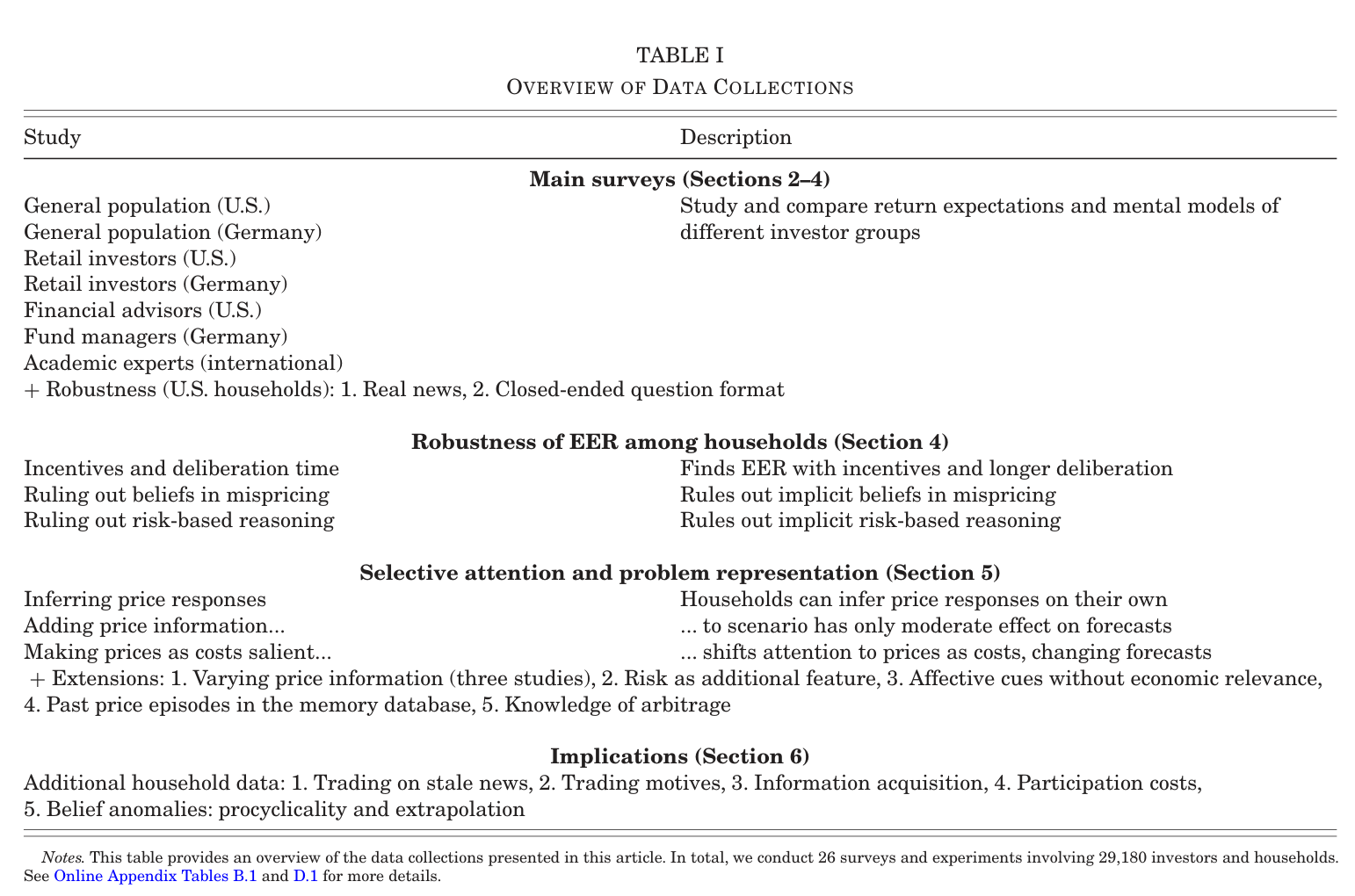
The final requirement for our empirical strategy is access to data from different types of economic agents. We therefore launch multiple surveys. Table I summarizes all data collections presented in the article, including the additional experiments presented later.
1. General Population (United States, n = 2,434). We conducted our U.S. general population survey in June and July 2023 in collaboration with the survey company Dynata. Our sample of 2,434 households closely aligns with the general U.S. population in terms of gender, age, region, and income ( Online Appendix Table B.2 ). As is common in online surveys, our sample overrepresents college-educated individuals (sample: 47%, population: 33%); 58% of our respondents report owning stocks.
2. General Population (Germany, n = 3,852).
We included a condensed version of our survey in the June 2023 wave of the Bundesbank Online Panel (BOP-HH), an established panel survey on household expectations ( Beckmann and Schmidt 2020 ); 3,852 households with diverse background characteristics complete our module ( Online Appendix Table B.2 ). Due to restrictions from the Bundesbank, we rely on fictitious company names but hold all other aspects of the scenarios constant. The German sample allows us to replicate our results in a different cultural context and to relate households’ mental models to their real-world expectations.
3. Retail Investors (United States, n = 408). To survey households who invest a substantial share of their wealth in stocks, we recruited 408 U.S. retail investors via the survey platform Prolific in August 2023. 81% of the investors have a college degree, and 91% report an income of $100,000 or more. The median respondent holds financial assets worth $225,000, has 47% of their financial wealth invested in stocks or stock mutual funds, and conducts two equity trades per quarter ( Online Appendix Table B.2 ).
4. Retail Investors (Germany, n = 299). In November and December 2023, we recruited 299 retail investors who hold a portfolio at a large German online bank. The sample has a relatively high fraction of male respondents (88%), and the average age is 49 years. Respondents report a median financial wealth of €137,500, with 51% invested in equity, and conduct two equity trades per quarter. For comparability, we use the same fictitious company names as in the German general population survey.4
5. Financial Advisors (United States, n = 406). In June 2023, we surveyed a sample of 406 financial professionals who advise or trade for households. We collaborated with CloudResearch, a provider specializing in surveys with hard-to-reach populations, following Chinco, Hartzmark, and Sussman (2022) . Summary statistics are displayed in Online Appendix Table B.2 . 50% of the respondents report that providing financial advice is part of their professional activities. They advise a median number of 22 clients and have on average 10 years of experience in providing financial advice. The remaining respondents indicate trading or financial analysis among their key roles. For simplicity, we refer to this sample as our “financial advisors” sample. It reflects the base segments of the financial industry.
6. Fund Managers (Germany, n = 105). To survey financial professionals trading substantial amounts in the stock market, we collaborated with two large German asset management companies. For both, the total assets under management are in the hundreds of billions of euros. The companies agreed to distribute a shortened version of our survey among their fund management teams, which 105 respondents answered in the time between November 2023 and March 2024. We were only able to include a handful of background questions. The fund managers in our sample report an average experience of 16.2 years in their professional role. This sample reflects a population whose decisions have significant market-level implications.
7. Academic Experts (International, n = 116). In June 2023, we invited academic economists to participate in a short version of the survey. We invited experts who have published articles with (p.2943)the JEL code “G: Financial Economics” in a set of leading finance journals or the top five economics journals between 2015 and 2019. A total of 116 experts participated in our survey ( Online Appendix Table B.3 ). 40% of the experts are based in the United States, and 96% are male. On average, they completed their PhD 18.6 years before the survey. They have on average 1.7 publications in the top five economics journals and 4.2 publications in the top three finance journals. Their average Google Scholar h-index is 20.98, and their average citation count amounts to 6,594 (as of August 2023). Thus, our expert sample consists of highly experienced researchers in financial economics with significant academic impact. Their responses provide us with an academic benchmark for the forecasts elicited in our survey.
As we described already, the surveys sometimes differ between samples due to logistical constraints. Online Appendix Table B.1 provides an overview of these differences, but wherever relevant, we highlight them in table or figure notes, footnotes, or the main text.
III. INFERENCE FROM STALE NEWS TO FUTURE RETURNS
This section describes the first step of our analysis: we investigate how respondents predict stale news about future earnings to affect future returns.
Figure I compares the expected differences in returns over the next 12 months between the bad/good news and the neutral scenario across our different samples. We focus on the main version of our survey module, which features news about Nike. Among academic experts, a large majority predict returns to be similar in the good/bad news and the neutral scenarios (67% for the good news and 76% for the bad news condition). Most experts do not predict stale news to matter for future returns.
This strongly contrasts with the patterns in the other samples. Majorities of financial professionals, retail investors, and general population respondents forecast higher returns following four-week-old good news about future earnings and lower returns following four-week-old bad news. The tendency to make such “news-congruent” predictions is most pronounced among retail investors, with 75% and 81% of U.S. retail investors (74% and 75% of German retail investors) making news-congruent forecasts in the good and bad news conditions, respectively. The fractions are also large among fund managers (58% and 45%), financial advi-
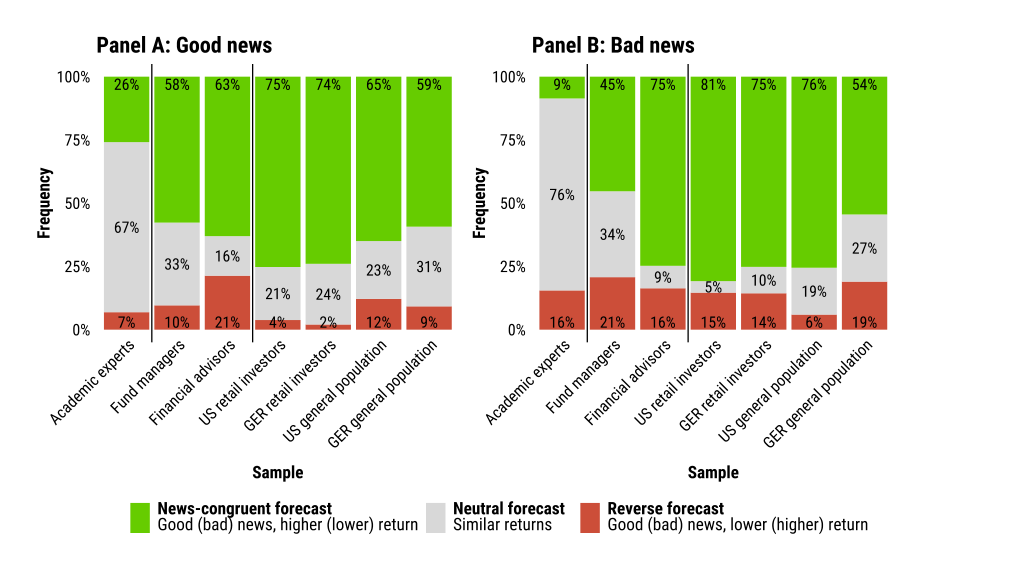
FIGURE I
Return Forecasts Across Samples
This figure shows the distributions of predictions about the difference in the expected stock return over the next 12 months between the Nike good news and the neutral scenario (Panel A) and between the Nike bad news and the neutral scenario (Panel B) in our samples of academic experts, financial professionals, retail investors, and the general population. In the surveys with German retail investors, the German general population, and some of the fund managers, the scenarios use the fictitious company name SportsApparel but are otherwise identical to the Nike scenarios.
sors (63% and 75%), and in the U.S. (65% and 76%) and the German general population (59% and 54%).5
The return differences expected by nonexperts are quantitatively meaningful and persistent. We illustrate this using additional expectation data from the longer household and financial advisor surveys, which also elicit respondents’ quantitative return expectations under both scenarios. For instance, U.S. retail
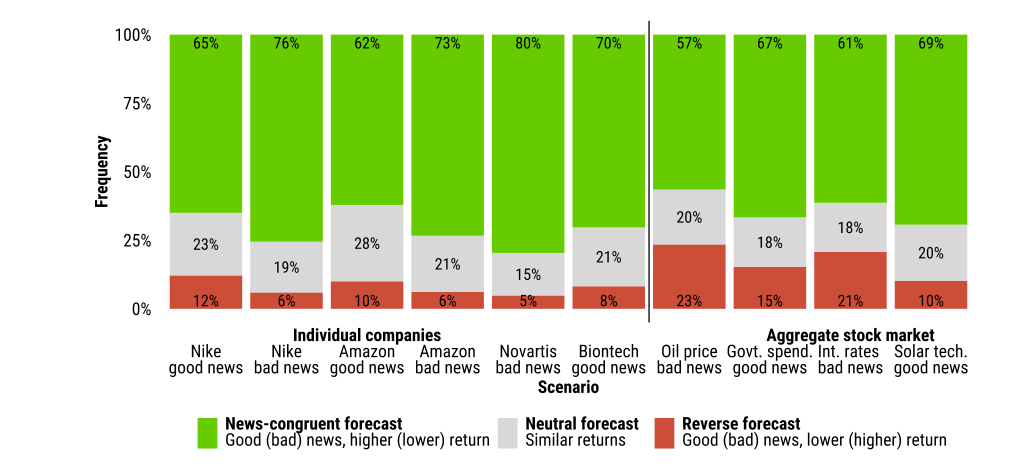
FIGURE II
Directional Return Forecasts Across Scenarios
This figure shows the distributions of directional predictions about the difference in the expected stock return over the next 12 months between a good/bad news and a neutral scenario. The six bars on the left focus on firm-level news and company stocks, and the four bars on the right focus on aggregate news and the U.S. stock market. The samples consist of respondents from the U.S. general population.
investors on average anticipate a 3.7 percentage point higher 12-months-ahead return after four-week-old good news and a 7.3 percentage point lower return for bad news ( Online Appendix Figure D.2 ). Many nonexperts continue to make news-congruent forecasts for returns one (56% to 65%), two (44% to 46%), three (30% to 40%), or four years (29% to 40%) in the future ( Online Appendix Figure D.1 ).
Figure II shows that this tendency extends to various other scenario conditions that we included in the U.S. general population survey to explore the robustness of our results. Most respondents infer higher future returns from past good news (or lower returns from past bad news) in scenarios that feature a successful expansion of Amazon in Africa, Amazon’s surprising withdrawal from South America, Novartis’s harmful loss of a patent suit, or a breakthrough in the development of a new cancer drug by German pharmaceutical company Biontech.6 Households’ tendency to equate higher company earnings with higher stock returns carries over to the aggregate stock market. In four scenarios fea- (p.2946)turing macroeconomic news, majorities of respondents expect returns of the U.S. stock market to be lower after four-week-old bad news, namely, the announcement of an oil price or interest rate increase. Conversely, they predict the stock market to yield predictably higher returns following stale good news, namely, a government spending program or a breakthrough in solar technology.
Taken together, our first main result is the following:
RESULT 1. Most households, retail investors, and financial professionals consider stale positive or negative news regarding future company earnings to be predictive of correspondingly higher or lower future stock returns. A large majority of academic experts do not consider such news to be predictive of future returns.
The strong differences in return expectations between academic experts and other investors suggest very different reasoning about how returns arise in markets. Although experts’ predictions are consistent with the view that stock markets are mostly efficient, households and professionals could, for example, reason through the lens of temporary mispricing or apply expected earnings reasoning. We distinguish between these different lines of reasoning in the next section.
IV. MENTAL MODELS
We explore which mental models underlie investors’ return expectations. We analyze reasoning across investor groups ( Section IV.A ) and present complementary experimental evidence to further characterize households’ reasoning ( Section IV.B ).
IV.A. Market Efficiency, Mispricing, or Expected Earnings
Reasoning
After respondents have predicted the return difference between the two scenarios, they explain their prediction in an opentext field. The open-ended explanations offer insight into respondents’ reasoning when respondents are not primed on any potential line of thought.
1. Example Responses. Even a quick glance at the qualitative data reveals that academic experts, on the one hand, and respondents from the general population, retail investors, and financial advisors, on the other hand, reason very differently about the (p.2947)effect of stale news. Experts often invoke the idea of market efficiency, as illustrated by the following response:
“The effect on future profits and dividends should already be reflected in the current price.”
Many experts additionally explain that differences in exposure to systematic risks should be the only source of differences in expected returns:
“In efficient markets, the information should be fully incorporated into the stock price four weeks after the announcement. Thus, going forward Nike will earn its expected return which is the same in both scenarios (as beta did not change due to the announcement).”
By contrast, respondents from the general population tend to invoke differences in company earnings to justify their return forecasts. They directly link stale changes in expected earnings to changes in expected returns:
“[...] In scenario 2, a disruption in their supply chain would lead to difficulty in maintaining production and therefore income and therefore profits.”
“By changing the supplier Nike is saving money which would mean greater returns for them and greater returns for me.”
Retail investors and financial advisors tend to follow similar lines of reasoning as households in the general population sample, as exemplified by the following responses:
“Because Nike will continue a positive relationship with its partner and therefore the company can continue to grow profits, increasing the value of the stock.”
“Cost savings of 20% will increase the bottom line of Nike, and therefore increase EPS for the company. I expect my $1,000 investment to also increase as a result.”
2. Coding Scheme. We devise a coding scheme to systematically categorize the responses. First, we identify arguments consistent with efficient markets and standard risk-based asset pricing. These include references to (i) market efficiency, (ii) changes in uncertainty, and (iii) changes in exposure to risk factors.
Second, we identify arguments consistent with mispricing. These include references to temporary stock price (iv) overreaction or (v) underreaction. Since laypeople may describe mispricing (p.2948)in different terms than experts, we classify responses that use lay terms—for example, advocate for “buying the dip”—as instances of mispricing reasoning.
Third, we identify arguments consistent with expected earnings reasoning, that is, selective attention to the earnings implications of the news. These include responses that refer only to (vi) changes in expected earnings or (vii) changes in traders’ sentiment, excitement, or overall outlook for the company. The first code directly captures selective attention to expected earnings, where respondents equate higher expected earnings with higher expected returns. The second code usually applies in similar cases, but respondents also refer to greater excitement for the stock among traders (without invoking sentiment-driven mispricing). Both categories selectively focus on the “investor benefit” side of the cash-flow news, remaining silent on its implications for the “investor cost” side—that is, the stock’s current price.7
Responses that cannot clearly be assigned to one category are assigned to a residual category. Trained human coders assign each response to a unique code.8 Any reference to market efficiency or mispricing (codes (i)–(v)) takes precedence over cases of selective attention to earnings or investor outlook (codes (vi) and (vii)). We also considered including an analogous code for selective attention to the current stock price but found virtually no evidence of such reasoning—an issue we return to in Section V . The coding scheme and procedure are explained in more detail in Online Appendix C .
3. Results. Figure III displays the distribution of open-ended responses in our main Nike scenarios, categorized with our coding scheme. We can categorize 93% of the responses from the academic expert sample using our coding scheme, compared with 87% among fund managers, 68% among financial advisors, and 69%
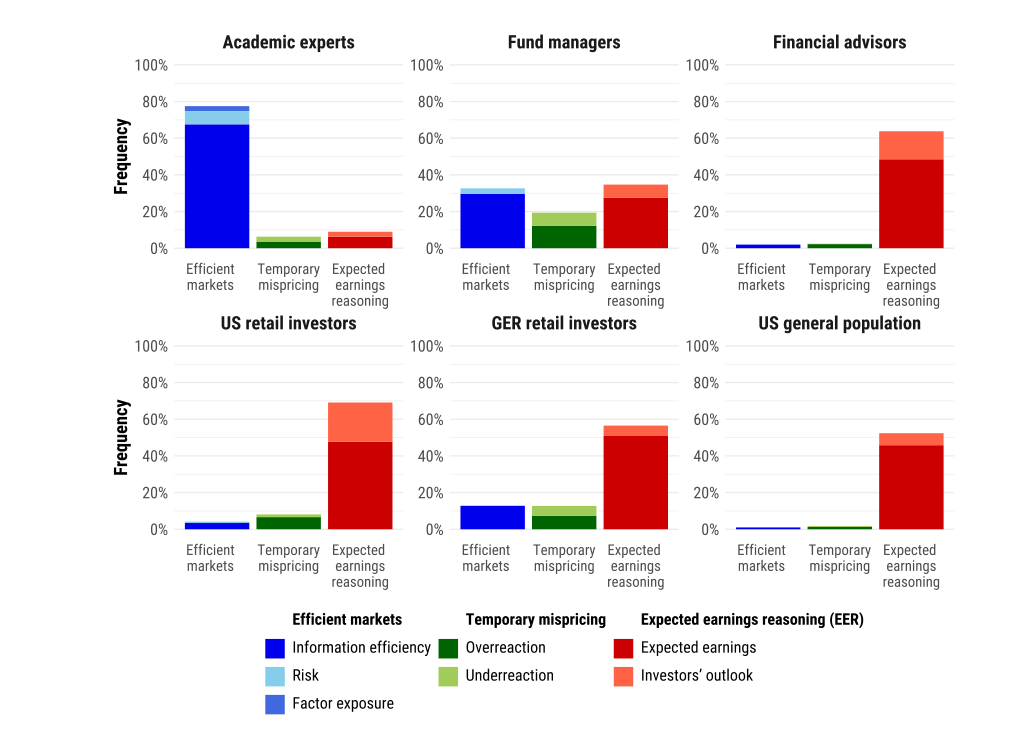
FIGURE III
Reasoning Underlying Return Forecasts Across Samples
This figure displays the distributions of reasoning underlying respondents’ return forecasts as expressed in the open-ended question and categorized using our coding scheme. We pool results across the Nike good news and the Nike bad news survey conditions. In the survey with German retail investors and for part of the fund managers, the scenarios use the fictitious company name SportsApparel but are otherwise identical to the Nike scenarios. The German general population survey does not include an open-ended question on reasoning due to space constraints.
among households. The smaller fractions in the nonexpert samples reflect that nonexpert responses are often less precise and harder to classify. We instructed the coders to be conservative and to err on the side of avoiding misclassification.
Among academic experts, 77% argue in line with efficient markets and standard risk-based asset pricing. Merely 6% attribute their return forecast to temporary over- or underreaction of stock prices, and only 9% talk exclusively about expected earnings.
In stark contrast, 52% of U.S. general population respondents make arguments consistent with EER. Arguments in line with market efficiency or temporary mispricing are almost absent in (p.2950)this sample. The fact that respondents do not mention changes in risk factor exposure when making return forecasts is striking, given the central role of risk factors in contemporary asset-pricing models. We find the same dominance of EER among U.S. and German retail investors (69% and 57%, respectively) and among financial advisors (64%), whereas arguments referring to market efficiency or temporary mispricing are almost absent. In these samples, more financially literate respondents tend to be, if anything, more likely to express EER ( Online Appendix Table B.5 ). This suggests that reasoning in terms of more sophisticated market efficiency or mispricing models reflects a facet of financial knowledge that is not captured by common financial literacy measures ( Lusardi and Mitchell 2014 ). For U.S. households, we find that EER is prevalent across all firm-specific scenarios and the aggregate stock market scenarios, where most respondents refer to expected future economic growth and company earnings ( Online Appendix Figure A.1 ).
The views of fund managers vary widely. About 33% invoke market efficiency; references to temporary mispricing are also common, at 19%. Notably, 35% directly link differences in expected earnings to differences in expected returns, suggesting that selective attention to expected earnings can occur even among experienced professional traders. We cannot rule out that some fund managers do not fully articulate their reasoning (an issue we address experimentally for households in Section IV.B ). But many professional investors justify their return forecasts solely by pointing to changes in expected earnings. For example, fund managers argue that returns are higher after four-week-old good news because “cutting costs will benefit the enterprise value,” “raise margins and profits,” which “will have positive implications on CF generation and therefore on valuation,” or “lower production cost should lead to higher earnings on company side and as such increase total return of the investment.”
Respondents’ open-ended explanations strongly predict their return forecasts in all our samples ( Online Appendix Table B.6 ), and differences in reasoning can account for differences in return forecasts across samples ( Online Appendix Table B.7 ).
Taken together, our second main result can be summarized as follows.
RESULT 2. Mental models are heterogeneous across investor groups but also in the important group of fund managers. Gen- (p.2951)eral population respondents, retail investors, financial advisors, and even a share of fund managers apply expected earnings reasoning when forming stock return expectations. By contrast, academic experts’ forecasts are mostly based on reasoning aligned with market efficiency.
Our open-ended question does not restrict responses to predefined options and lets participants express their thoughts freely, unconstrained by the researcher ( Ferrario and Stantcheva 2022 ; Andre et al. forthcoming ; Haaland et al. 2025 ). However, one natural limitation of open-text data is that it captures only the reasoning respondents choose to articulate. Although respondents are likely to report what is top of mind, some may find it difficult to articulate their reasoning clearly—particularly in the household samples. To address this concern, we complement the open-text data with three additional approaches. First, we examine how return expectations co-move with respondents’ expectations about other variables. Online Appendix D.2.1 shows that among academic experts, return expectations are predicted only by risk expectations. By contrast, the return expectations of households, retail investors, and financial advisors co-move most strongly with their earnings expectations—consistent with the open-text data. For fund managers, both earnings expectations and expected risk factor exposure are positively related to return forecasts, consistent with the heterogeneity in models that the text data revealed among fund managers. Second, we confirm that households predominantly engage in EER using a closed-ended question in which participants can select which perspective best describes their own reasoning ( Online Appendix D.2.2 ). Third, we conduct a series of robustness experiments among households, to which we turn next.
IV.B. Robustness of Expected Earnings Reasoning Among
Households
A central finding of our analysis is that most households engage in EER when thinking about the effect of stale earnings news on future returns. Among households, we can conduct additional experiments to further characterize their reasoning. This allows us to demonstrate that the prevalence of EER does not reflect (i) low effort when responding to the survey, (ii) implicit beliefs in mispricing, or (iii) implicit risk-based reasoning.
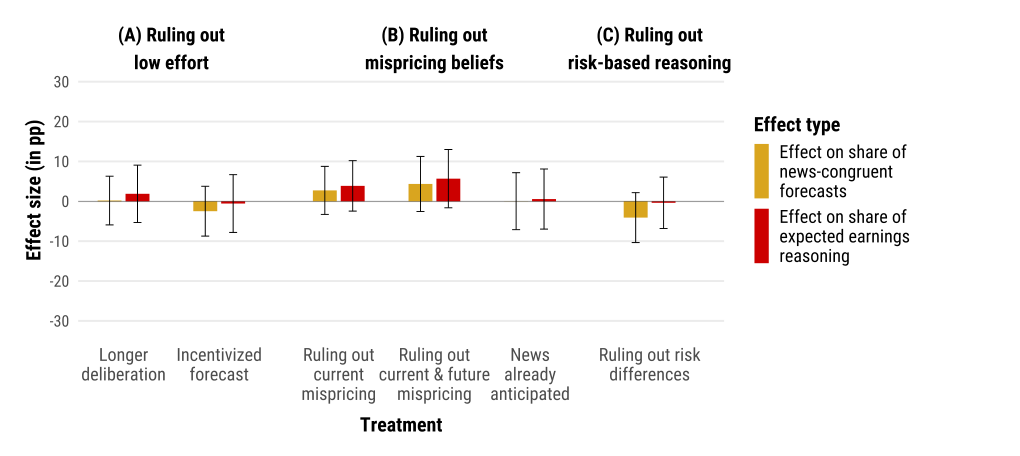
FIGURE IV
Robustness of Households’ Expected Earnings Reasoning
This figure summarizes the key results of the experiments from Section IV.B . For each treatment, the yellow bar (left; color version available online) presents the treatment effect on the share of news-congruent return forecasts, compared with that experiment’s control group. The red bars (right) represent treatment effects on the share of expected earnings reasoning expressed in the open-ended question relative to the respective control group. Whiskers indicate 95% confidence intervals.
1. EER Does Not Reflect Low Effort. Our first experiment ( n = 885; details in Online Appendix D.2.3 ) examines whether inducing participants to think harder changes their reasoning. One treatment condition requires participants to spend at least two minutes on the prediction page, while another offers a sizable bonus (£5) for forecasts that match the majority forecast in our academic expert survey. Despite dramatically increasing response times, neither intervention has a significant effect on participants’ forecasts or reasoning compared with a standard control condition (see Figure IV , Panel A). This result is consistent with our main data, where news-congruent forecasts and expected earnings reasoning are, if anything, more common among respondents with higher levels of engagement ( Online Appendix Figure A.2 ).
2. EER Does Not Stem from an Implicit Belief in Mispricing. Although we rarely observe explicit mispricing reasoning in households’ explanations, it remains possible that households implicitly apply a mispricing model but struggle to articulate it clearly. To investigate this possibility, we conduct three interventions designed to detect previously unarticulated beliefs in mispricing.
All experiments build on the Nike good news scenario. Participants randomized into the control group face the standard scenarios. By contrast, in the first experiment ( n = 789, Online Appendix D.2.4 ), participants in the treatment group receive the following additional instructions on the prediction screen and confirm that they have read the information:
Please assume that the stock price of Nike has changed over the last four weeks since the announcements. The stock price responded to what the announcements revealed about Nike’s future business prospects. Please assume that the current stock price fully and correctly reflects Nike’s future business prospects in both scenarios.
The second experiment ( n = 906, Online Appendix D.2.5 ) copies this approach, but the treatment condition also rules out mispricing “at any future point in time.” Finally, a third treatment condition seeks to rule out mispricing without requiring that respondents understand what “prices fully and correctly reflect the future business outlook” means. Most theories of mispricing predict that expected (and therefore redundant) news should not trigger mispricing. Building on this idea, the third intervention highlights to treated participants that “[i]ndustry experts and stock market traders were not surprised because they had known about the partnership for a long time. Widely circulated industry reports had left no doubt that the new partnership was coming.”
If households’ news-congruent forecasts and expected earnings reasoning are actually driven by a hidden belief in mispricing, then ruling out mispricing or highlighting that the news had long been anticipated should strongly reduce the fraction of newscongruent forecasts and expected earnings reasoning. However, none of the three treatments has a noticeable effect on households’ forecasts and explanations. If anything, we observe a slight increase in news-congruent forecasts and expected earnings reasoning. Figure IV , Panel B, summarizes the results.
3. EER Does Not Stem from Implicit Risk-Based Reasoning. An analogous experimental manipulation rules out that EER reflects nonarticulated risk-based reasoning ( n = 794, Online Appendix D.2.4 ). In the treatment condition, respondents are explicitly instructed to assume that there are no differences in investment-relevant uncertainty across the two scenarios. We clarify that this means (i) equal stock return volatility and (ii) identical protection against adverse aggregate developments, (p.2954)such as the risk that the overall economy performs poorly. If riskbased reasoning is driving news-congruent forecasts, return predictions and explanations should differ sharply between the treatment and control conditions. Yet we do not observe such differences ( Figure IV , Panel C).
4. Conclusion. We conclude that EER is not only prevalent among households but also quite resistant: it survives longer deliberation, remains unchanged even when respondents are asked to assume that there is no mispricing, and cannot be explained by differences in risk across scenarios. Why, then, do households predominantly adopt expected earnings reasoning?
V. SELECTIVE ATTENTION AND PROBLEM REPRESENTATION
This section explores the origins of expected earnings reasoning among households—the tendency to emphasize the potential “investor benefits” of investing under each scenario (the company’s expected earnings and the associated future cash flows) but rarely discuss the “investor costs” (the prices paid today for a claim to these future cash flows). Attention to changes in benefits is natural because these changes are a salient and relevant feature of earnings-related news. By contrast, the price adjustments that occurred over the past four weeks, though predictable, are not equally visible. Indeed, recent theories argue that selective attention is drawn to salient features of the context, which shapes how individuals represent and approach a problem ( Bordalo et al. 2026a , 2026b ). To test this idea, this section explores when and how households start reasoning about the prices they pay for the stock. Our key finding is that EER is prevalent not because households are generally incapable of recognizing that higher prices imply higher investor costs. Rather, those cost implications simply escape attention in the context and format of standard investment problems.
V.A. Households Can Infer Past Price Responses
First, we test whether households can infer the price response that should have occurred over the past four weeks since the news broke.
1. Design. We run an experiment in which we explicitly ask households which trading and price responses occurred over the past four weeks (Prolific, 1,183 U.S. households, June 2023, details in Online Appendix D.3.1 ). The design builds on the Nike good news scenario, and participants are randomly assigned to one of three conditions. Control group participants complete the standard scenarios. By contrast, we ask participants in the trading reaction condition, just before they make their return forecast, how they think other traders reacted to the announcement over the past four weeks (others were more eager to hold the stock, no change, less eager to hold the stock). Participants in the price reaction condition respond to the same question and are also asked how other traders’ reactions affected Nike’s stock price over the past four weeks (it increased, did not affect, or decreased the price).
2. Results. 88% of respondents who receive the question on trading reactions predict a higher eagerness of other traders to buy the stock at the old price. Similarly, 88% of respondents who receive the question on price changes predict that the price has increased over the past four weeks. When prompted, households understand the direction of the market response to good earnings news over the past four weeks. (However, as we show in Online Appendix D.3.1 , this realization alone has no significant effect on return predictions, nor does it change households’ explanations of these predictions. Households do not yet put the pieces together.)
V.B. Making Prices a Salient Feature of the Scenario
A natural next step is to extend the scenarios so that they not only highlight earnings-relevant news but also report how prices have responded to that news over the previous four weeks. We make the price response—which, in principle, households could infer themselves—an explicit and salient feature of the problem description. How do households’ return forecasts and explanations change when past price movements and current purchase prices become salient in the scenario?
1. Design. We conduct the experiment with Prolific UK with 1,032 households in January 2026 ( Online Appendix D.3.3 ).9 The (p.2956)control condition replicates our main survey. By contrast, the price information condition explicitly presents past price responses and current stock prices alongside the earnings news:
Scenario 1: Nike maintains supplier partnership, stock price unchanged at $62.50/share Four weeks ago, on [...], Nike Inc. announced the continuation of its partnership [...] The price of Nike stock did not change in response to the announcement. Today, four weeks after the announcement, Nike stocks still cost $62.50 per share. Scenario 2: Nike secures cost-saving partnership, stock price rises to $71.40/share Four weeks ago, on [...], Nike Inc. announced a new strategic partnership [...] Over the past four weeks, Nike stock has become more expensive. The announcement generated interest among stock traders, who were now willing to pay a higher price for the stock. This increased demand drove up the stock price, leaving Nike shares trading at a 14% more expensive price compared to pre-announcement levels. Today, four weeks after the announcement, Nike stocks cost $71.40 per share. (Bracketed text indicates wording identical to the main survey and is omitted here for brevity.)
As before, we elicit return forecasts and explanations.
2. Coding Attention to Features. To detect which features of the scenarios enter households’ return forecasts, we develop a tailored coding scheme for households’ explanations, which we use throughout Section V . Unlike the coding scheme in Section IV , which assigns respondents to mutually exclusive model categories and where more “elaborate” models take precedence over EER, here we capture which specific economic features a respondent mentions; specifically, we include codes for the following four features.
One code captures references to the benefits of investing, including future cash flows, company earnings, or excitement among traders about the stock. These responses recognize the changes in expected earnings across the two scenarios.
The three remaining codes capture references to the current stock price or to price changes since the announcement. Crucially, we will soon see that prices can enter households’ reasoning in two different ways. First, respondents can refer to current prices as investor costs, recognizing that a higher price implies paying more for a given share of the firm (prices as investor costs). Such higher costs reduce expected returns, so this line of reasoning could in principle offset an expectation of higher future cash flows. Second, however, respondents may view a high price as a feature that signals a favorable outlook. High prices often reflect market expectations of high future earnings, and they could be viewed as an indicator of further price increases. Respondents could attend to prices as a signal of the stock’s value, quality, and promise, with higher prices indicating a “better” stock (prices as signal of value). This line of reasoning would reinforce expectations of higher earnings rather than dampening their effect on expected returns. We treat “prices as investor costs” and “prices as signal of value” as two distinct features of the problem respondents can attend to.10
We assign price references that do not clearly fall into either category to a residual category (prices: other).
Each response can receive multiple codes. We code the data using few-shot prompting with the large language model GPT-5.2 in February 2026. The coding procedure is described in further detail in Online Appendix C .11
3. Results. Figure V shows that even explicit information about past price changes has only a moderate effect on households’ return forecasts. Directly providing price information reduces the share of respondents who expect higher returns in the good-news scenario by 12 percentage points ( p < .001), but 70% of respondents continue to make news-congruent return forecasts. The share of neutral forecasts increases from 12% to 21% ( p <
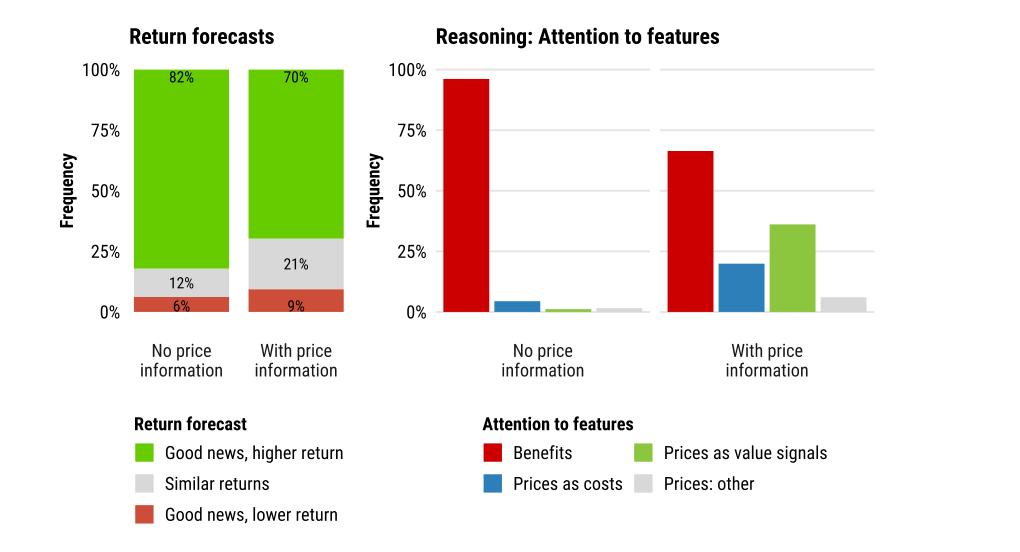
FIGURE V
Return Forecasts and Reasoning When Prices Are a Salient Feature
This figure summarizes the key results of the experiment that makes price information salient ( Section V.B ). The left panel shows the distributions of directional predictions about the difference in the expected stock return between the good news and the neutral scenarios, separately for the control and price-information conditions. The right panel presents the distribution of features mentioned in respondents’ open-text explanations.
.001), and the share of lower-return forecasts increases slightly from 6% to 9% ( p = 0.053).
By contrast, respondents’ reasoning shifts strongly when price information is directly available. In the control condition, almost all households (96%) refer to the investor benefits of the good news, and hardly any household refers to current stock prices (7%, aggregated across all price-related codes).12 This changes in the price-information condition. The share of respondents who invoke the investor benefits of the good-news scenario falls by about 30 percentage points ( p < .001) to a (still sizable) 66%. Conversely, the share making any reference to current prices increases from
7% to 60% ( p < .001)—many respondents start reasoning about current stock prices when those prices are a salient feature of the problem. Yet the tendency to reason about prices as an investment cost increases by only about 15 percentage points ( p < .001), even though the scenario descriptions use terms such as “expensive” and “cost.” Instead, respondents’ explanations reveal that a competing feature is at work: many view a higher stock price as a positive signal of the stock’s quality. This reasoning pattern is 35 percentage points more common when price information is available ( p < .001).
Which feature of prices households attend to is therefore critical. Work in psychology argues that cues that are easy to parse as “good” or “bad” can exert a strong influence on reasoning when attention is selective ( Schwarz 2012 ; Slovic et al. 2007 ; see also Taubinsky et al. 2025 ; Bordalo et al. 2026c , in economics). While higher expected future earnings are straightforward to read as “good” for returns, high prices are ambiguous. They reflect a high cost of investment—which is “bad”—but they also often signal that markets expect strong future earnings and may therefore be perceived as “good” for investment. Only the “costs” representation invites a comparison between investor benefits (higher expected earnings) and investor costs (higher price today). By contrast, under a “value” representation, higher prices can echo and reinforce the effects of higher expected earnings rather than offsetting them.
V.C. Changing Problem Presentation to Make Prices as Investor
Costs Salient
The ambiguity in how people represent prices raises a central question: why do households often not view stock prices as investment costs?
Recent theories highlight that the presentation of a problem can shape individuals’ reasoning by directing attention to particular features ( Bordalo et al. 2026a , 2026b ). The key issue, then, may lie in how investment decisions are typically framed. The typical stock investment decision is framed in terms of investing a given amount of money. The number of shares one receives is not salient. On the one hand, this focus is reasonable: what ultimately matters is the expected return, not the nominal count of shares purchased. On the other hand, after a price change, the change in the number of shares received for a fixed dollar amount is the clear- (p.2960)est indicator that prices are the cost of acquiring a claim to future cash flows. While the change in expected earnings is easy to parse, this change in investor costs may escape people’s attention.
1. Design. We explore this possibility in two additional conditions ( n = 977), implemented in parallel with the priceinformation experiment in Section V.B . The treatment condition from that experiment now serves as the new baseline. Recall that this baseline condition contrasts stale good and neutral earnings news while providing information about the corresponding price response to each announcement. As in all previous experiments, respondents are asked to imagine investing $1,000 in Nike stocks on the day of the survey, four weeks after the announcement was made in the two scenarios, and selling the stock 12 months later.
Two new treatment conditions make the implication of higher prices for investor costs salient by changing the presentation of the problem. The number of shares condition explicitly lists how many shares the investor receives for a fixed $1,000 investment:
Imagine that you invest $1,000 in Nike stocks today, four weeks after the announcement was made in the two scenarios . Imagine that you sell these stocks in twelve months from now. This means Scenario 1: You pay $1,000 and receive 16 stock shares. Scenario 2: You pay $1,000 and receive 14 stock shares. You receive two fewer shares for the same money.
The purchase cost condition reverses the logic: it directly asks the respondents to imagine that they buy a given number of shares and highlights the change in costs:
Imagine that you purchase 16 Nike stocks today, four weeks after the announcement was made in the two scenarios . Imagine that you sell these stocks in twelve months from now. This means Scenario 1: You pay $1,000 for 16 stock shares. Scenario 2: You pay $1,142 for 16 stock shares. You pay $142 more for the same number of shares.
The treatment conditions highlight that the increase in the stock price means that one can afford fewer shares or must pay more for a given number of shares. Both conditions deviate in an important way from how stock investment decisions are typically viewed in the real world: they make the implications of price changes for investor costs salient and encourage viewing prices as costs. Neither condition provides new economically relevant infor-
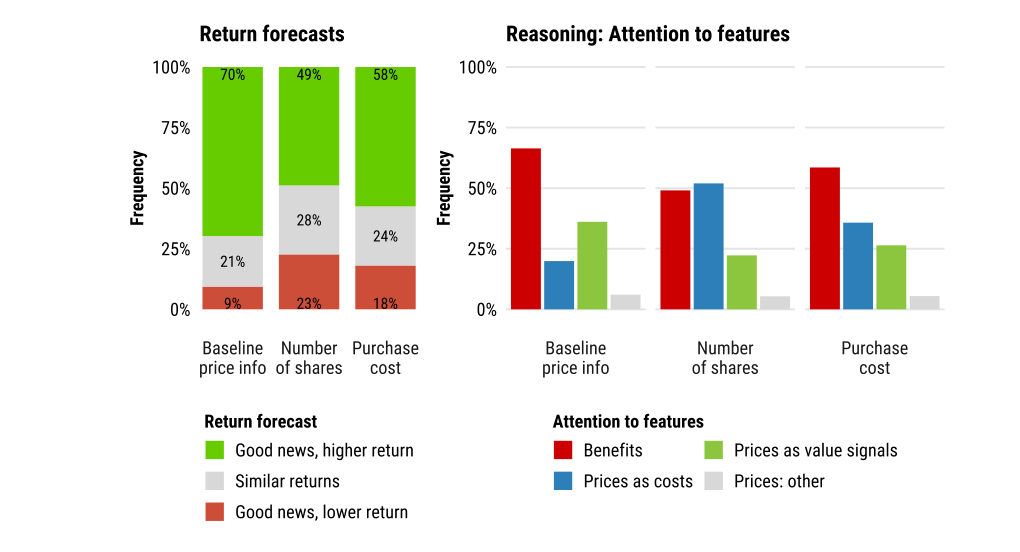
FIGURE VI
Return Forecasts and Reasoning When Prices as Investor Costs Are Salient
This figure summarizes the key results of the experiment that changes the problem presentation to make prices as investor costs salient ( Section V.C ). The left panel shows the distributions of directional predictions about the difference in the expected stock return between the good news and the neutral scenarios separately for the three experimental conditions. The right panel presents the distribution of features mentioned in respondents’ open-text explanations.
mation beyond what respondents should be able to infer on their own, and there is a clear benchmark: conditional on the current stock price, the percent return one can expect from an investment does not vary with how many shares one buys, nor with the total amount invested.
2. Results. The presentation of the problem has a large effect on return expectations beyond the effect of price information. Figure VI shows that with price information alone, 70% of respondents make news-congruent return forecasts for a fixed $1,000 investment. In the purchase-cost condition, where households instead consider buying a fixed number of shares, respondents are 12 percentage points ( p < .001) less likely to expect higher returns. The effect is even larger in the number-of-shares condition, which explicitly lists how many shares they can purchase for a fixed sum of $1,000. Relative to the baseline condition, 21 percentage points ( p < .001) fewer respondents expect higher returns in the good news scenario. As a result, fewer than half of respondents
(49%) expect returns to be higher after stale good news—the lowest share observed among households in our data.
This shift in return predictions is mirrored in respondents’ reasoning. Relative to the baseline condition (which already includes price information), respondents in the purchase-cost condition are 8 percentage points ( p = .010) less likely to discuss the expected investor benefits of the good-news scenario and 10 percentage points ( p < .001) less likely to mention prices as a quality signal. Instead, they are 16 percentage points ( p < .001) more likely to invoke the higher stock price as an investment cost. The pattern is even stronger in the number-of-shares condition, where 17 percentage points ( p < .001) fewer respondents refer to expected benefits and 14 percentage points ( p < .001) fewer mention prices as a value signal, and 32 percentage points ( p < .001) more refer to prices as investor costs.
An interesting pattern is that households often switch from news-congruent to contrarian forecasts once the implications of higher prices for investor costs become salient. As shown in Online Appendix Table B.8 , this shift can be explained by changes in selective attention to different features. Respondents who frame prices as costs without mentioning the corresponding change in the investment’s benefits are significantly more likely to make contrarian forecasts. Instead of focusing selectively on the implications of the news for investor benefits, they now focus selectively on its cost implications. By contrast, households who mention both benefits and costs to investors more frequently predict returns to be similar across scenarios. Controlling for these shifts in reasoning accounts for most of the differences in return forecasts between problem presentation conditions. Intuitively, selective attention to different features of the problem can push forecasts in either direction, depending on which feature dominates.
Taken together, presenting the problem such that it becomes clear that a given investment buys a smaller share of the company after a price increase—or, equivalently, that one pays more for the same number of shares—changes how households think about prices. In particular, households’ reasoning is shifted from a prices-as-value to a prices-as-costs view. This framing produces the smallest share of news-congruent forecasts observed in our data. For many households, the bottleneck does not seem to lie in noticing price changes but in attending to them as investor costs.
A potential concern is demand effects. For example, reading that one can afford fewer shares may lead respondents to guess (p.2963)that we expect them to predict lower returns. In one important respect, demand effects would even strengthen a key takeaway from our evidence: news-congruent forecasts are common, and shifting attention toward investor costs requires a strong salience manipulation. We still think demand effects are unlikely to drive the results. First, demand effects are typically found to be small in comparable survey settings ( de Quidt, Haushofer, and Roth 2018 ; Haaland, Roth, and Wohlfart 2023 ). Second, the scenarios make many features salient at once—for example, the earnings news, its timing, market attention, and purchase costs—so the hypothesis we test is extremely difficult for respondents to guess.
The purchase-cost and number-of-shares framing we adopt is uncommon in practice. Our results suggest that while reasoning is context-dependent, stock investment decisions tend to prompt selective attention to the investor benefit side. More generally, our findings support the idea that economically irrelevant features of the context can trigger different mental representations of the same problem and, in turn, change reasoning and expectations ( Bordalo et al. 2026a , 2026b ).
Our third main result is the following:
RESULT 3. Households adopt EER because changes in expected earnings are easy to parse, while the corresponding changes in investor costs often escape attention in the context and format of standard investment problems.
V.D. Extensions
We extend the discussion in three ways to provide further nuance. We explore the role of context in greater depth in a series of context manipulations. We show that beyond context, households’ familiarity with different perspectives on the stock market matters. And we discuss the potential role of affective reasoning. For brevity, we summarize these findings at a high level and report details in the Online Appendix .
1. Additional Context Variations.
i. Varying the Price Information. We examine whether the precise nature of the price information matters. First, we replicate the findings of the price-information experiment presented in Section V.B when we provide only qualitative information about a price increase after good news (or a decrease after bad (p.2964)news) rather than a precise numerical change ( n = 1,015, Online Appendix D.3.4 ). Second, when we provide quantitative price information, extreme price responses (30% change) modestly reduce the share of news-congruent forecasts and slightly increase references to prices as investor costs relative to smaller price responses (10% change), although the effect appears small given the large difference in price changes ( n = 1,008, Online Appendix D.3.4 ). Third, emphasizing that Nike’s shares became more expensive because traders were overly impulsive leads to fewer newscongruent forecasts and more reasoning about prices as investor costs than framing the same price change as a considerate response to the earnings news ( n = 972, Online Appendix D.3.4 ). (p.2964)ii. Risk as an Additional Scenario Feature. Although risk is central to standard asset-pricing theories, our results so far indicate that households’ return forecasts in our scenarios do not follow standard risk-based logic. To better understand how households reason about risk, we run an experiment ( n = 905; Online Appendix D.3.5 ) with one control and two treatment conditions. In one treatment condition, the good news (the expected 20% reduction in production costs) is framed as a safe bet that will reduce the overall volatility of the firm’s performance. In the other, the same news is framed as a risky bet that will make the company’s total earnings harder to predict.
We find that the high-risk framing reduces the share of higher-return forecasts by 17 percentage points ( p < .001) relative to the control group, at odds with the logic of standard riskbased asset pricing. In the high-risk condition, many respondents justify lower-return forecasts following positive earnings news either by directly citing higher risk or by focusing on the adverse state of the world in which the negative earnings realization materializes. By contrast, respondents rarely mention the positive implications of higher risk for investor costs: lower prices. We find symmetric results for the low-risk condition. The evidence from this experiment is consistent with selective attention: higher risk is perceived as “bad for returns” because of a focus on the negative implications for investor benefits (cash-flow risk and the possibility of bad earnings realizations) and a neglect of the positive, cost-side implications (lower prices).
iii. Affective Cues Without Economic Relevance. Work on affective reasoning in psychology and economics suggests that cues (p.2965)that are easy to parse as “good” or “bad” can exert a strong influence on households’ reasoning ( Slovic et al. 2007 ; Schwarz 2012 ; Taubinsky et al. 2025 ; Bordalo et al. 2026c ). Our evidence suggests that higher earnings are readily perceived as “good,” higher risk as “bad,” and prices as either “good” or “bad,” depending on whether they enter reasoning as a signal of value or as investment costs. A final experiment ( n = 601; Online Appendix D.3.6 ) tests whether we can shift households’ reasoning by changing merely the affective valence of the scenario without altering its economic substance.
Alongside the standard control condition, we introduce a condition in which good earnings news is framed in a way that “feels bad.” Specifically, the cost-saving switch to a new supplier is described as coming at a substantial social cost: increased automation replaces much of the manual workforce, leaving many textile workers and their families facing severe economic hardship, though the serious social and economic costs on affected workers are unlikely to be traced back to Nike.
We find that this manipulation substantially shifts respondents’ affective evaluations while leaving earnings expectations unchanged. What happens to return forecasts? We find that they are very similar across conditions: the share of respondents expecting higher returns in the good-news scenario is only 4 percentage points lower when the positive earnings news implies heavy social costs ( p = .195). We take this as evidence that people’s thinking about the stock market—although prone to selective attention—is not driven by pure emotion but remains grounded in economic reasoning.
2. Familiarity. Theories of memory and selective attention predict that not only the context but also familiarity with different perspectives shapes individuals’ reasoning, beliefs, and decisions (e.g., Bordalo et al. 2023 , 2026b ; Wachter and Kahana 2024 ). Intuitively, the more familiar households are with the role of a feature, the more likely this feature will come to mind. We illustrate two examples of this broader principle and examine whether memories of past price episodes or knowledge of the principle of arbitrage can change respondents’ reasoning about prices and forecasts.
i. Past Price Episodes in the Memory Database. We test for the role of memory of past price episodes in a simple intervention
( n = 3,009, Online Appendix D.3.7 ). In a baseline wave, treated respondents are instructed to summarize news stories about real historical negative earnings news for companies. In all cases, the negative earnings news triggered an initial collapse in stock prices, but the resulting low purchase costs allowed for higher subsequent returns. Control group respondents read and write about the same events, but the events are presented to them without any reference to stock prices. In an outcome wave conducted one or two days later, respondents face our standard Nike scenarios (the bad news case), predict future returns, and explain their forecast in open text.13
The goal of the treatment is to induce greater familiarity with the return implications of purchase costs. It effectively adds instances of such cases to households’ memory database. Does this shift return forecasts and explanations? We find that it does. The treatment significantly increases the share of respondents who make contrarian return forecasts and adopt a prices-as-costs view in their reasoning. Memories of past price episodes can change how households reason about prices and shift households’ return forecasts. The effect on forecasts likely operates at least in part through the observed changes in households’ reasoning. In addition, the change in the memory database may have a direct effect on return forecasts if households rely on learned empirical patterns without explicitly reasoning about prices.
ii. Knowledge of Arbitrage. Arbitrage is a key principle of modern finance. A view of prices as investment costs is central to the idea of arbitrage. To test whether knowledge of this principle matters for how households reason about prices, our final mechanism experiment explains to respondents how expected future earnings are incorporated into prices in financial markets through arbitrage (n = 947, Online Appendix D.3.8 ). Treated respondents are more likely to account for prices as investment costs in their reasoning, and they are more likely to predict no difference in returns across scenarios. The effect on forecasts likely operates at least in part through the observed changes in house- (p.2967)holds’ reasoning—although there could be an additional direct effect that does not operate through reasoning about prices.14
3. Discussion of Affective Reasoning. Our preferred interpretation is that EER reflects selective attention to salient features: changes in investor benefits are a salient feature of earnings news, whereas changes in investor costs are not. Although this interpretation is guided by recent theoretical work ( Bordalo et al. 2026b ), a related mechanism could be at play: households may follow a broad tendency to map favorably valenced firm-level news onto higher expected returns—affective reasoning. Indeed, a growing literature suggests that emotions and affective cues can shape people’s economic expectations ( Taubinsky et al. 2025 ; Bordalo et al. 2026c ). Several of our findings are consistent with this. The baseline result that most households make news-congruent forecasts ( Section III ) is what an affect-to-outcome mapping would predict, since the news is both affectively positive and has positive implications for future earnings. The problem-presentation frames of Section V.C (“fewer shares for the same money”) and the high-risk cue of Section V.D are both negatively valenced, so the contrarian shifts they produce are consistent with an affective channel as well.
The “affective cues without economic relevance” experiment narrows this alternative mechanism. It holds earnings information fixed but varies global affective evaluation by adding orthogonal affective content (the social harm to textile workers) and finds return forecasts essentially unchanged. This rules out affective reasoning that operates through a global affective assessment but affective reasoning through the economically relevant variables themselves could still be at play. This perspective raises the question which features “feel good” and which ones “feel bad” for returns—a question that seems related to respondents’ understanding of financial markets and the features they believe to be beneficial or detrimental to returns in the mental models they use. We cannot further tease apart these related mechanisms here, but we view exploring the role of affective reasoning as a promising direction for future research.
4. Conclusion. Together, these results extend our earlier conclusions in three ways. First, context systematically shapes economic reasoning. Second, across the wide range of contexts we examine, EER remains prevalent. Third, besides context, familiarity with specific perspectives influences what comes to mind. Differences in familiarity also offer a compelling explanation for the markedly different reasoning we observe among academic economists and fund managers.
VI. IMPLICATIONS
The main objective of this article has been to describe and better understand investors’ mental models of the stock market, particularly the reasoning of households. In a final step, we discuss the potential implications of our findings for our understanding of trading behavior, belief anomalies, asset pricing, and economic reasoning more generally. We draw on additional evidence and related literature, although for brevity, we keep the discussion short and relegate a more detailed analysis to Online Appendix D . The key idea is that because investors’ understanding of the stock market informs their expectations and behavior, mental models help connect a series of previously documented anomalies in expectations and trading data.
VI.A. EER and Retail Investors’ Trading Behavior
Retail investors are prone to trade on outdated information ( Tetlock 2011 ), which can be an important source of overtrading ( Barber and Odean 2000 ; Odean 1999 ). Selective attention to the implications of outdated information for investor benefits— and the failure to consider current prices as an investment cost— provides a natural explanation.
We provide evidence for this link in additional surveys. First, in an incentivized investment task, U.S. households invest more in a stock after reading several-months-old, positive, real-world news about the company ( Online Appendix D.1.1 ). However, this is no longer the case after an intervention that reduces households’ tendency to engage in EER ( Online Appendix D.4.1 ). Second, we survey U.S. retail investors on their currently planned stock trades and ask them to explain their trading motives. Respondents frequently cite companies’ expected earnings outlook. They often target companies like Apple, Amazon, or Tesla because (p.2969)of their dominant market position, innovation, and high expected future earnings. Third, when adjusting their overall stock market exposure, investors commonly point to factors that shape future earnings and cash flows, such as overall economic growth ( Online Appendix D.4.2 ). Fourth, we ask U.S. retail investors which information they would seek before making a trading decision. They request information on a company’s expected business outlook much more often than information on volatility, exposure to the economy (beta), misvaluation, or recent returns ( Online Appendix D.4.3 ).
VI.B. EER and Stock Market Participation
The prevalence and robustness of EER among households suggests that it may also influence whether households are willing to invest in the stock market at all. EER suggests that researching and tracking company earnings is crucial for successful stock investments. On the one hand, this could point to seemingly promising trading strategies—such as investing in companies with good earnings news—that could make participation appear attractive. On the other hand, the perceived need to track earnings and identify such companies may increase the perceived participation costs for laypeople and could ultimately deter some households from investing in stocks altogether ( Haliassos and Bertaut 1995 ). Indeed, this is one of the main reasons many households in the qualitative interviews of Duraj et al. (2025) conclude that investing in stocks requires substantial effort. In our own data, many households report that successful stock investment demands spending “a lot of time” monitoring business news, and an experiment shows that these perceived participation costs decrease when EER becomes less pronounced ( Online Appendix D.4.1 ). Conditional on participation, EER may help explain the appeal of active investment strategies ( Haaland and Næss 2023 ): if successful investment hinges on tracking earnings news, this could make people reluctant to invest in passive funds, while expertise in analyzing and interpreting earnings information is perceived to pay off.
VI.C. EER and Belief Anomalies
Two important and well-documented anomalies in stock return expectations are procyclicality and extrapolation. Both can be related to EER. Procyclicality means that households’ return expectations co-move positively with expectations about overall economic growth ( Giglio et al. 2021a ; Beutel and Weber forthcoming ) (p.2970)and are highest during economic booms and lowest during recessions ( Amromin and Sharpe 2014 )—contrary to standard assetpricing logic. EER—selective attention to the earnings implications of higher growth—naturally generates procyclical expectations: during economic booms, investors anticipate higher earnings and therefore higher stock returns. The second anomaly, extrapolation, means that many agents extrapolate past stock returns into the future ( Vissing-Jorgensen 2003 ; Greenwood and Shleifer 2014 ; Da, Huang, and Jin 2021 ). Again, EER can contribute to this pattern. High past returns often reflect good news about future earnings, leading people who selectively focus on earnings to become more optimistic about future returns. This produces a positive co-movement between past realized returns and expectations about future returns.
We can empirically test for a link between expected earnings reasoning and these belief anomalies using the expectation panel data from the German Bundesbank Online Panel ( Online Appendix D.4.4 ). We match households’ forecasts from our module with panel data on their real-world expectations about aggregate stock returns and economic growth. On average, households expect higher stock returns when anticipating stronger economic growth (procyclicality) or following periods of higher realized returns (extrapolation). Crucially, both procyclicality and extrapolation are significantly more pronounced among respondents who exhibit expected earnings reasoning.
VI.D. Asset Pricing
In markets with limits to arbitrage, many of these patterns in beliefs and decisions can have aggregate implications. For example, the extrapolation of returns that EER may produce can lead to overreaction, momentum, and price reversals ( De Long et al. 1990 ; Cutler, Poterba, and Summers 1991 ; Barberis et al. 2015 ; Jin and Sui 2022 ). The presence of agents who do not pay sufficient attention to the price and investor cost implications of investment news can have similar effects ( Glaeser and Nathanson 2017 ; Eyster, Rabin, and Vayanos 2019 ; Bastianello and Fontanier forthcoming ; Adam and Nagel 2023 ; Cohen 2025 ). Disagreement about the correct model—as documented among fund managers— can generate high trading volume ( Hong and Stein 2007 ; Barberis et al. 2018 ). The context dependence of reasoning could generate feedback loops, in which significant events cue specific ways of (p.2971)thinking about the market, which in turn influence market outcomes ( Wachter and Kahana 2024 ; Jiang et al. 2025 ; Bordalo et al. 2026b ). In general, asset-pricing implications depend on the joint distribution of mental models and investable resources, the marginal investor, and limits to arbitrage. In light of our findings, incorporating selective attention, expected earnings reasoning, and disagreement in mental models into asset-pricing theory appears to be a promising avenue for future theoretical work. Our results can also be viewed as providing mechanism evidence in support of reduced-form approaches adopted in the literature (e.g., X-CAPM, Barberis et al. 2015 ).
VI.E. Economic Reasoning and Selective Attention
A plausible interpretation of our findings is selective attention: the way agents approach a problem and reason depends on the salient features of the context. These findings support recent theoretical work ( Bordalo et al. 2026a , 2026b ), and we believe selective attention, context, and familiarity could influence economic reasoning in many other domains. For example, in many settings, economic problems are difficult because they involve multiple moving parts. Selective attention implies that individuals will often struggle to integrate total effects and instead focus on partial ones. A key question for economic research is which effects the context makes salient. One example is the salience of direct effects and the relative obscurity of indirect price implications, which are frequently neglected (e.g., Greenwood and Hanson 2015 ; Shue, Townsend, and Wang 2024 ; Kaufmann, Andre, and Köszegi 2024 ). Another example is that high asset prices can be attended to not only as a cost but also as a signal of value, which may help explain why households extrapolate past house price growth into the future ( Glaeser and Nathanson 2017 ; Armona, Fuster, and Zafar 2019 ). Future work could explore the context dependence of mental representations in other domains, such as consumption and saving decisions, labor market behavior, or education choices. A related open question is the role of affective reasoning—how attention and affect jointly shape economic belief formation and decision making across contexts ( Taubinsky et al. 2025 ; Bordalo et al. 2026c ).
VII. CONCLUSION
Financial markets are governed by return expectations. In this article, we develop a tailored empirical approach to shed light on the mental models underlying agents’ return expectations. We combine rich expectation data with qualitative text measures of reasoning from seven different groups of economic agents represented by more than 29,000 respondents across 26 separate surveys and experiments. Our key takeaways are that mental models of the stock market are heterogeneous, that expected earnings reasoning is common among households—often because the implications of investment news for investor costs escape attention—and that economic reasoning is shaped by selective attention to salient features of the context.
DATA AVAILABILITY
The data and code underlying this article is available in Andre, Schirmer, and Wohlfart (2026) , in the Harvard Dataverse, https:// doi.org/ 10.7910/ DVN/ BNFSAO .
SUPPLEMENTARY MATERIAL
An Online Appendix for this article can be found at The Quarterly Journal of Economics online.
LEIBNIZ INSTITUTE FOR FINANCIAL RESEARCH SAFE AND GOETHE UNIVERSITY FRANKFURT, GERMANY UNIVERSITY OF BONN, GERMANY UNIVERSITY OF COLOGNE, GERMANY
REFERENCES
Adam, Klaus , Albert Marcet, and Johannes Beutel, “Stock Price Booms and Expected Capital Gains,” American Economic Review , 107 (2017), 2352–2408. https:// doi.org/ 10.1257/ aer.20140205 . Adam, Klaus , and Stefan Nagel, “Expectations Data in Asset Pricing,” in Handbook of Economic Expectations , Rüdiger Bachmann, Giorgio Topa, and Wilbert van der Klaauw, eds. (Amsterdam: Elsevier, 2023), 477–506. https:// doi.org/ 10 .1016/B978- 0- 12- 822927- 9.00024- 0 . Amromin, Gene , and Steven A. Sharpe, “From the Horse’s Mouth: Economic Conditions and Investor Expectations of Risk and Return,” Management Science , 60 (2014), 845–866. https:// doi.org/ 10.1287/ mnsc.2013.1806 . Andre, Peter , Ingar Haaland, Christopher Roth, Mirko Wiederholt, and Johannes Wohlfart, “Narratives about the Macroeconomy,” Review of Economic Studies , forthcoming. https:// doi.org/ 10.1093/ restud/rdag014 .
Andre, Peter , Carlo Pizzinelli, Christopher Roth, and Johannes Wohlfart, “Subjective Models of the Macroeconomy: Evidence from Experts and Representative Samples,” Review of Economic Studies , 89 (2022), 2958–2991. https: // doi.org/ 10.1093/ restud/rdac008 . Andre, Peter , Philipp Schirmer, and Johannes Wohlfart, “Replication Data for: ‘Mental Models of the Stock Market’,” 2026, Harvard Dataverse . https://do i.org/ 10.7910/ DVN/ BNFSAO . Armona, Luis , Andreas Fuster, and Basit Zafar, “Home Price Expectations and Behavior: Evidence from a Randomized Information Experiment,” Review of Economic Studies , 86 (2019), 1371–1410. https:// doi.org/ 10.1093/ restud/rdy03 8 . Barber, Brad M., and Terrance Odean, “Trading Is Hazardous to Your Wealth: The Common Stock Investment Performance of Individual Investors,” Journal of Finance , 55 (2000), 773–806. https:// doi.org/ 10.1111/ 0022-1082.00226 . Barberis, Nicholas , and Lawrence Jin, “Model-Free and Model-Based Learning as Joint Drivers of Investor Behavior,” Working Paper, 2026. Barberis, Nicholas , Robin Greenwood, Lawrence Jin, and Andrei Shleifer, “XCAPM: An Extrapolative Capital Asset Pricing Model,” Journal of Financial Economics , 115 (2015), 1–24. https:// doi.org/ 10.1016/ j.jfineco.2014.08.007 . ———, “Extrapolation and Bubbles,” Journal of Financial Economics , 129 (2018), 203–227. https:// doi.org/ 10.1016/ j.jfineco.2018.04.007 . Barberis, Nicholas , Andrei Shleifer, and Robert Vishny, “A Model of Investor Sentiment,” Journal of Financial Economics , 49 (1998), 307–343. https://doi.org/ 10.1016/S0304- 405X(98)00027- 0 . Barron, Kai , and Tilman Fries, “Narrative Persuasion,” Working Paper, 2025. Bastianello, Francesca , Paul Décaire, and Marius Guenzel, “Mental Models and Financial Forecasts,” Jacobs Levy Equity Management Center for Quantitative Financial Research Paper, University of Pennsylvania, 2025a. ———, “Valuation Models,” Working Paper, 2025b. Bastianello, Francesca , and Paul Fontanier, “Expectations and Learning from Prices,” Review of Economic Studies , 92 (2025), 1341–1374. https:// doi.org/ 10 .1093/restud/rdae059 . ———, “Partial Equilibrium Thinking, Extrapolation, and Bubbles,” Review of Financial Studies , forthcoming. https:// doi.org/ 10.1093/ rfs/ hhag053 . Bauer, Rob , Paul Smeets, Katrin Gödker, and Florian Zimmermann, “Mental Models in Financial Markets: How Do Experts Reason about the Pricing of Climate Risk?” Working Paper, 2026. Beckmann, Elisabeth , and Tobias Schmidt, “Bundesbank Online Pilot Survey on Consumer Expectations,” Technical Paper, Bundesbank, Frankfurt, 2020. Ben-David, Itzhak , and Alex Chinco, “Expected EPS × Trailing P/E,” NBER Working Paper no. 32942 , 2024. https:// doi.org/ 10.3386/ w32942 . Bender, Svetlana , James J. Choi, Danielle Dyson, and Adriana Z. Robertson, “Millionaires Speak: What Drives Their Personal Investment Decisions?” Journal of Financial Economics , 146 (2022), 305–330. https:// doi.org/ 10.1016/ j.jfineco. 2021.09.016 . Beutel, Johannes , and Michael Weber, “Beliefs and Portfolios: Causal Evidence,” Review of Financial Studies , forthcoming. https:// doi.org/ 10.1093/ rfs/ hhag01 1 . Bohren, Aslinn J., Josh Hascher, Alex Imas, Michael Ungeheuer, and Martin Weber, “Mental Models of Information: The Role of Attention and Memory,” Becker Friedman Institute for Economics Working Paper No. 2024-19 , 2025. https://dx.doi.org/10.2139/ssrn.4731525 . Bohren, Aislinn J., and Daniel N. Hauser, “Misspecified Models in Learning and Games,” Annual Review of Economics , 17 (2025), 427–451. https:// doi.org/ 10 .1146/annurev- economics- 091324- 032415 . Bordalo, Pedro , John J. Conlon, Nicola Gennaioli, Spencer Y. Kwon, and Andrei Shleifer, “Memory and Probability,” Quarterly Journal of Economics , 138 (2023), 265–311. https:// doi.org/ 10.1093/ qje/ qjac031 .
———, “How People Use Statistics,” Review of Economic Studies , 93 (2026a), 250– 285. https:// doi.org/ 10.1093/ restud/rdaf022 . Bordalo, Pedro , Nicola Gennaioli, Rafael La Porta, and Andrei Shleifer, “Diagnostic Expectations and Stock Returns,” Journal of Finance , 74 (2019), 2839–2874. https:// doi.org/ 10.1111/ jofi.12833 . ———, “Belief Overreaction and Stock Market Puzzles,” Journal of Political Economy , 132 (2024), 1450–1484. https:// doi.org/ 10.1086/ 727713 . ———, “Finance without Exotic Risk,” Journal of Financial Economics , 173 (2025), 104145. https:// doi.org/ 10.1016/ j.jfineco.2025.104145 . Bordalo, Pedro , Nicola Gennaioli, Giacomo Lanzani, and Andrei Shleifer, “A Cognitive Theory of Reasoning and Choice,” Quarterly Journal of Economics , 141 (2026b), 1921–1963. https:// doi.org/ 10.1093/ qje/ qjag023 . Bordalo, Pedro , Nicola Gennaioli, Florencio Lopez de Silanes, Simon G. Schröder, Andrei Shleifer, and Maarten van Rooij “The Psychology of Macroeconomic Expectations,” Working Paper no. 35214, National Bureau of Economic Research, Cambridge, MA, 2026c. https:// doi.org/ 10.3386/ w35214 . Bordalo, Pedro , Nicola Gennaioli, and Andrei Shleifer, “Overreaction and Diagnostic Expectations in Macroeconomics,” Journal of Economic Perspectives , 36 (2022a), 223–244. https:// doi.org/ 10.1257/ jep.36.3.223 . ———, “Salience,” Annual Review of Economics , 14 (2022b), 521–544. https://doi. org/ 10.1146/ annurev- economics- 051520- 011616 . Charles, Constantin , “Memory Moves Markets,” Review of Financial Studies , 38 (2025), 1641–1686. https:// doi.org/ 10.1093/ rfs/ hhae086 . Charles, Constantin , and Chad W. Kendall, “Causal Narratives,” Working Paper, 2025. Chinco, Alex , Samuel M. Hartzmark, and Abigail B. Sussman, “A New Test of Risk Factor Relevance,” Journal of Finance , 77 (2022), 2183–2238. https://doi.org/ 10.1111/jofi.13135 . Choi, James J., “Popular Personal Financial Advice versus the Professors,” Journal of Economic Perspectives , 36 (2022), 167–192. https:// doi.org/ 10.1257/ jep.36.4 .167 . Choi, James J., and Adriana Z. Robertson, “What Matters to Individual Investors? Evidence from the Horse’s Mouth,” Journal of Finance , 75 (2020), 1965–2020. https:// doi.org/ 10.1111/ jofi.12895 . Cohen, Shani , “What You Can’t See: Contingent Thinking Failures in Dynamic Markets,” Working Paper, 2025. Coibion, Olivier , Dimitris Georgarakos, Yuriy Gorodnichenko, and Michael Weber, “Forward Guidance and Household Expectations,” Journal of the European Economic Association , 21 (2023), 2131–2171. https:// doi.org/ 10.1093/ jeea/jva d003 . Coibion, Olivier , Yuriy Gorodnichenko, and Saten Kumar, “How Do Firms Form Their Expectations? New Survey Evidence,” American Economic Review , 108 (2018), 2671–2713. https:// doi.org/ 10.1257/ aer.20151299 . Coibion, Olivier , Yuriy Gorodnichenko, and Michael Weber, “Monetary Policy Communications and Their Effects on Household Inflation Expectations,” Journal of Political Economy , 130 (2022), 1537–1584. https:// doi.org/ 10.1086/ 718982 . Conlon, John J., “Inattention, Information Provision, and (Failures of) Revealed Preference,” Working Paper, 2026. Cutler, David M., James M. Poterba, and Lawrence H. Summers, “Speculative Dynamics,” Review of Economic Studies , 58 (1991), 529–546. https:// doi.org/ 10.2 307/2298010 . Da, Zhi , Xing Huang, and Lawrence J. Jin, “Extrapolative Beliefs in the CrossSection: What Can We Learn from the Crowds?,” Journal of Financial Economics , 140 (2021), 175–196. https:// doi.org/ 10.1016/ j.jfineco.2020.10.003 . Dal Bó, Ernesto , Pedro Dal Bó, and Erik Eyster, “The Demand for Bad Policy When Voters Underappreciate Equilibrium Effects,” Review of Economic Studies , 85 (2018), 964–998. https:// doi.org/ 10.1093/ restud/rdx031 .
De Bondt, Werner F. M., and Richard Thaler, “Does the Stock Market Overreact?,” Journal of Finance , 40 (1985), 793–805. https:// doi.org/ 10.1111/ j.1540-6261. 1985.tb05004.x . Delao, Ricardo , and Sean Myers, “Subjective Cash Flow and Discount Rate Expectations,” Journal of Finance , 76 (2021), 1339–1387. https:// doi.org/ 10.1111/ jo fi.13016 . De Long, J. Bradford , Andrei Shleifer, Lawrence H. Summers, and Robert J. Waldmann, “Positive Feedback Investment Strategies and Destabilizing Rational Speculation,” Journal of Finance , 45 (1990), 379–395. https:// doi.org/ 10.1111/ j.1540-6261.1990.tb03695.x . de Quidt, Jonathan , Johannes Haushofer, and Christopher Roth, “Measuring and Bounding Experimenter Demand,” American Economic Review , 108 (2018), 3266–3302. https:// doi.org/ 10.1257/ aer.20171330 . Duraj, Kamila , Daniela Grunow, Michael Haliassos, Christine Laudenbach, and Stephan Siegel, “Rethinking the Stock Market Participation Puzzle: A Qualitative Approach,” SAFE Working Paper No. 441, Leibniz Institute for Financial Research SAFE, 2025. Enke, Benjamin , “What You See Is All There Is,” Quarterly Journal of Economics , 135 (2020), 1363–1398. https:// doi.org/ 10.1093/ qje/ qjaa012 . Enke, Benjamin , Frederik Schwerter, and Florian Zimmermann, “Associative Memory, Beliefs and Market Interactions,” Journal of Financial Economics , 157 (2024), 103853. https:// doi.org/ 10.1016/ j.jfineco.2024.103853 . Esponda, Ignacio , Emanuel Vespa, and Sevgi Yuksel, “Mental Models and Learning: The Case of Base-Rate Neglect,” American Economic Review , 114 (2024), 752–782. https:// doi.org/ 10.1257/ aer.20201004 . Eyster, Erik , “Errors in Strategic Reasoning,” in Handbook of Behavioral Economics: Applications and Foundations 1 , vol. 2, B. Douglas Bernheim, Stefano DellaVigna, and David Laibson, eds. (Amsterdam: Elsevier, 2019), 187–259. https:// doi.org/ 10.1016/ bs.hesbe.2018.11.003 .
Eyster, Erik , Matthew Rabin, and Dimitri Vayanos, “Financial Markets Where Traders Neglect the Informational Content of Prices,” Journal of Finance , 74 (2019), 371–399. https:// doi.org/ 10.1111/ jofi.12729 . Fama, Eugene F., “Efficient Capital Markets: A Review of Theory and Empirical Work,” Journal of Finance , 25 (1970), 383–417. https:// doi.org/ 10.2307/ 232548 6 . Ferrario, Beatrice , and Stefanie Stantcheva, “Eliciting People’s First-Order Concerns: Text Analysis of Open-Ended Survey Questions,” American Economic Association: Papers & Proceedings , 112 (2022), 163–169. https:// doi.org/ 10.1 257/pandp.20221071 . Fink, Josef , “A Review of the Post-Earnings-Announcement Drift,” Journal of Behavioral and Experimental Finance , 29 (2021), 100446. https:// doi.org/ 10.101 6/j.jbef.2020.100446 . Freyberger, Joachim , Andreas Neuhierl, and Michael Weber, “Dissecting Characteristics Nonparametrically,” Review of Financial Studies , 33 (2020), 2326– 2377. https:// doi.org/ 10.1093/ rfs/ hhz123 . Fuster, Andreas , and Basit Zafar, “Survey Experiments on Economic Expectations,” in Handbook of Economic Expectations , Rüdiger Bachmann, Giorgio Topa, and Wilbert van der Klaauw, eds. (Amsterdam: Elsevier, 2023), 107– 130. https:// doi.org/ 10.1016/ B978- 0- 12- 822927- 9.00010- 0 . Gabaix, Xavier , “Behavioral Inattention,” in Handbook of Behavioral Economics: Applications and Foundations 1 , vol. 2. B. Douglas Bernheim, Stefano DellaVigna, and David Laibson, eds. (Amsterdam: North-Holland, 2019), 261–343. https:// doi.org/ 10.1016/ bs.hesbe.2018.11.001 . Gagnon-Bartsch, Tristan , Matthew Rabin, and Joshua Schwartzstein, “Channeled Attention and Stable Errors,” Working Paper, Harvard Business School, 2023.
Gennaioli, Nicola , Marta Leva, Raphael Schoenle, and Andrei Shleifer, “How Inflation Expectations De-anchor: The Role of Selective Memory Cues,” Working Paper, 2025. Giglio, Stefano , Matteo Maggiori, Johannes Stroebel, and Stephen Utkus, “Five Facts about Beliefs and Portfolios,” American Economic Review , 111 (2021a), 1481–1522. https:// doi.org/ 10.1257/ aer.20200243 . ———, “The Joint Dynamics of Investor Beliefs and Trading During the COVID19 Crash,” Proceedings of the National Academy of Sciences , 118 (2021b), e2010316118, https:// doi.org/ 10.1073/ pnas.2010316118 . Glaeser, Edward L., and Charles G. Nathanson, “An Extrapolative Model of House Price Dynamics,” Journal of Financial Economics , 126 (2017), 147–170. https: // doi.org/ 10.1016/ j.jfineco.2017.06.012 . Gomes, Francisco , Michael Haliassos, and Tarun Ramadorai, “Household Finance,” Journal of Economic Literature , 59 (2021), 919–1000. https://doi.org/ 10.1257/jel.20201461 . Gorodnichenko, Yuriy , and Xiao Yin, “Higher-Order Beliefs and Risky Asset Holdings,” Working Paper, 2025. Graeber, Thomas , “Inattentive Inference,” Journal of the European Economic Association , 21 (2023), 560–592. https:// doi.org/ 10.1093/ jeea/jvac052 . Greenwood, Robin , and Samuel G. Hanson, “Waves in Ship Prices and Investment,” Quarterly Journal of Economics , 130 (2015), 55–109. https:// doi.org/ 10.1093/ qje/qju035 . Greenwood, Robin , and Andrei Shleifer, “Expectations of Returns and Expected Returns,” Review of Financial Studies , 27 (2014), 714–746. https:// doi.org/ 10 .1093/ rfs/ hht082 . Gu, Shihao , Bryan Kelly, and Dacheng Xiu, “Empirical Asset Pricing via Machine Learning,” Review of Financial Studies , 33 (2020), 2223–2273. https://doi.org/ 10.1093/ rfs/ hhaa009 . Haaland, Ingar , and Næss Ole-Andreas Elvik, “Misperceived Returns to Active Investing,” CESifo Working Paper No. 10257, 2023. Haaland, Ingar , Christopher Roth, Stefanie Stantcheva, and Johannes Wohlfart, “Understanding Economic Behavior Using Open-Ended Survey Data,” Journal of Economic Literature , 63 (2025), 1244–1280. https:// doi.org/ 10.1257/ jel. 20251780 . Haaland, Ingar , Christopher Roth, and Johannes Wohlfart, “Designing Information Provision Experiments,” Journal of Economic Literature , 61 (2023), 3–40. https:// doi.org/ 10.1257/ jel.20211658 . Haliassos, Michael , and Carol C. Bertaut, “Why Do So Few Hold Stocks?” Economic Journal , 105 (1995), 1110–1129. https:// doi.org/ 10.2307/ 2235407 . Han, Yi , David Huffman, and Yiming Liu, “Minds, Models and Markets: How Managerial Cognition Affects Pricing Strategies,” Working Paper, 2025. Hanna, Rema , Sendhil Mullainathan, and Joshua Schwartzstein, “Learning through Noticing: Theory and Evidence from a Field Experiment,” Quarterly Journal of Economics , 129 (2014), 1311–1353. https:// doi.org/ 10.1093/ qje/ qju0 15 . Hirshleifer, David , “Presidential Address: Social Transmission Bias in Economics and Finance,” Journal of Finance , 75 (2020), 1779–1831. https:// doi.org/ 10.1 111/jofi.12906 . Hirshleifer, David , Jun Li, and Jianfeng Yu, “Asset Pricing in Production Economies with Extrapolative Expectations,” Journal of Monetary Economics , 76 (2015), 87–106. https:// doi.org/ 10.1016/ j.jmoneco.2015.08.006 . Hong, Harrison , and Jeremy C. Stein, “A Unified Theory of Underreaction, Momentum Trading, and Overreaction in Asset Markets,” Journal of Finance , 54 (1999), 2143–2184. https:// doi.org/ 10.1111/ 0022-1082.00184 . ———, “Disagreement and the Stock Market,” Journal of Economic Perspectives , 21 (2007), 109–128. https:// doi.org/ 10.1257/ jep.21.2.109.
Jegadeesh, Narasimhan , and Sheridan Titman, “Returns to Buying Winners and Selling Losers: Implications for Stock Market Efficiency,” Journal of Finance , 48 (1993), 65–91. https:// doi.org/ 10.1111/ j.1540-6261.1993.tb04702.x . Jiang, Zhengyang , Hongqi Liu, Cameron Peng, and Hongjun Yan, “Investor Memory and Biased Beliefs: Evidence from the Field,” Quarterly Journal of Economics , 140 (2025), 2749–2804. https:// doi.org/ 10.1093/ qje/ qjaf035 . Jin, Lawrence J., and Pengfei Sui, “Asset Pricing with Return Extrapolation,” Journal of Financial Economics , 145 (2022), 273–295. https:// doi.org/ 10.1016/ j.jfin eco.2021.10.009 . Kaufmann, Marc , Peter Andre, and Botond Köszegi, “Understanding Markets with Socially Responsible Consumers,” Quarterly Journal of Economics , 139 (2024), 1989–2035. https:// doi.org/ 10.1093/ qje/ qjae009 . Laudenbach, Christine , Annika Weber, Rüdiger Weber, and Johannes Wohlfart, “Beliefs about the Stock Market and Investment Choices: Evidence from a Survey and a Field Experiment,” Review of Financial Studies , 39 (2026), 1654– 1699. https:// doi.org/ 10.1093/ rfs/ hhae063 . Li, Xiaomin , and Colin F. Camerer, “Predictable Effects of Visual Salience in Experimental Decisions and Games,” Quarterly Journal of Economics , 137 (2022), 1849–1900. https:// doi.org/ 10.1093/ qje/ qjac025 . Link, Sebastian , Andreas Peichl, Oliver Pfäuti, Christopher Roth, and Johannes Wohlfart, “Attention to the Macroeconomy,” Quarterly Journal of Economics , forthcoming. https:// doi.org/ 10.1093/ qje/ qjag047 . Liu, Hongqi , Cameron Peng, Wei A. Xiong, and Wei Xiong, “Taming the Bias Zoo,” Journal of Financial Economics , 143 (2022), 716–741. https:// doi.org/ 10.1016/ j.jfineco.2021.06.001 . Lusardi, Annamaria , and Olivia S. Mitchell, “The Economic Importance of Financial Literacy: Theory and Evidence,” Journal of Economic Literature , 52 (2014), 5–44. https:// doi.org/ 10.1257/ jel.52.1.5 . Martineau, Charles , “Rest in Peace Post–Earnings Announcement Drift,” Critical Finance Review , 11 (2022), 613–646. https:// doi.org/ 10.1561/ 104.00000122 . Medhat, Mamdouh , and Maik Schmeling, “Short-Term Momentum,” Review of Financial Studies , 35 (2022), 1480–1526. https:// doi.org/ 10.1093/ rfs/ hhab055 . Niederle, Muriel , and Emanuel Vespa, “Cognitive Limitations: Failures of Contingent Thinking,” Annual Review of Economics , 15 (2023), 307–328. https: // doi.org/ 10.1146/ annurev- economics- 091622- 124733 . Odean, Terrance , “Do Investors Trade Too Much?” American Economic Review , 89 (1999), 1279–1298. https:// doi.org/ 10.1257/ aer.89.5.1279 . Schmidt-Engelbertz, Paul , and Kaushik Vasudevan, “Speculating on Higher-Order Beliefs,” Review of Financial Studies , 38 (2025), 2434–2466. https:// doi.org/ 10 .1093/ rfs/ hhaf019 . Schnorpfeil, Philip , Michael Weber, and Andreas Hackethal, “Inflation and Trading,” Journal of Financial Economics , 173 (2025), 104166. https:// doi.org/ 10.1 016/j.jfineco.2025.104166 . Schwartzstein, Joshua , “Selective Attention and Learning,” Journal of the European Economic Association , 12 (2014), 1423–1452. https:// doi.org/ 10.1111/ je ea.12104 . Schwartzstein, Joshua , and Adi Sunderam, “Using Models to Persuade,” American Economic Review , 111 (2021), 276–323. https:// doi.org/ 10.1257/ aer.20191074 . Schwarz, Norbert , “Feelings-as-Information Theory,” Handbook of Theories of Social Psychology , 1 (2012), 289–308. https:// doi.org/ 10.4135/ 9781446249215.n1 5 . Shue, Kelly , Richard Townsend, and Chen Wang, “Categorical Thinking about Interest Rates,” Working Paper, 2024. Slovic, Paul , Melissa L. Finucane, Ellen Peters, and Donald G. MacGregor, “The Affect Heuristic,” European Journal of Operational Research , 177 (2007), 1333– 1352. https:// doi.org/ 10.1016/ j.ejor.2005.04.006 ,
Spiegler, Ran , “Bayesian Networks and Boundedly Rational Expectations,” Quarterly Journal of Economics , 131 (2016), 1243–1290. https:// doi.org/ 10.1093/ qj e/qjw011 . Stantcheva, Stefanie , “Understanding Tax Policy: How Do People Reason?” Quarterly Journal of Economics , 136 (2021), 2309–2369. https:// doi.org/ 10.1093/ qj e/qjab033 . ———, “Understanding of Trade,” NBER Working Paper 30040, 2023. https://doi. org/ 10.3386/ w30040 . Stroebel, Johannes , and Jeffrey Wurgler, “What Do You Think about Climate Finance?” Journal of Financial Economics , 142 (2021), 487–498. https://doi.org/ 10.1016/j.jfineco.2021.08.004 . Taubinsky, Dmitry , Luigi Butera, Matteo Saccarola, and Chen Lian, “Beliefs about the Economy Are Excessively Sensitive to Household-Level Shocks: Evidence from Linked Survey and Administrative Data,” Quarterly Journal of Economics , 141 (2026), 2803–2873. https:// doi.org/ 10.1093/ qje/ qjag032 . Tetlock, Paul C., “All the News That’s Fit to Reprint: Do Investors React to Stale Information?” Review of Financial Studies , 24 (2011), 1481–1512. https://doi. org/ 10.1093/ rfs/ hhq141 . Vissing-Jorgensen, Annette , “Perspectives on Behavioral Finance: Does ‘Irrationality’ Disappear with Wealth? Evidence from Expectations and Actions,” NBER Macroeconomics Annual , 18 (2003), 139–194. https:// doi.org/ 10.1086/ ma.18.3585252 . Wachter, Jessica A., and Michael Jacob Kahana, “A Retrieved-Context Theory of Financial Decisions,” Quarterly Journal of Economics , 139 (2024), 1095–1147. https:// doi.org/ 10.1093/ qje/ qjad050 .
© The Author(s) 2026. Published by Oxford University Press on behalf of President and Fellows of Harvard College. This is an Open Access article distributed under the terms of the Creative Commons Attribution License ( https:// creativecommons.org/ licenses/by/ 4.0/ ), which permits unrestricted reuse, distribution, and reproduction in any medium, provided the original work is properly cited.
Notes
- *We are grateful to the editor (Andrei Shleifer) and four anonymous reviewers for their comments, which improved the article significantly. We thank Nicholas Barberis, Kai Barron, Francesca Bastianello, Luigi Butera, Felix Chopra, Nicola Gennaioli, Thomas Graeber, Ingar Haaland, Sam Hanson, Sam Hartzmark, Luca Henkel, David Hirshleifer, Lawrence Jin, Spencer Kwon, Christine Laudenbach, Ulrike Malmendier, Luca Michels, Cameron Peng, Chris Roth, Joshua Schwartzstein, Andrei Shleifer, Tobias Sichert, Peter Norman Sørensen, Johannes Stroebel, Adi Sunderam, Maximilian Voigt, Rüdiger Weber, Mirko Wiederholt, Florian Zimmermann, and participants at various conferences and seminars for helpful feedback. Egshiglen Batbayar, Erik Covarrubias, Julius Gross, Theresa Hübsch, Ben Hüls, Lukas Hutter, Kanita Isakovic, Georgios Louvaris, Vincent Selz, Emma Thevißen, and Brenda Torres Blomer provided excellent research assistance. Support by the Deutsche Forschungsgemeinschaft (DFG, German Research Foundation) through CRC TR 224 (Project A01) is gratefully acknowledged. Financial support from CEBI and the Danish National Research Foundation, grant DNRF134, is gratefully acknowledged. We also thank the Economic Policy Research Network (EPRN), ECONtribute, briq, the Joachim Herz Foundation, and SAFE for financial support. Wohlfart was funded by the Deutsche Forschungsgemeinschaft (German Research Foundation) under Germany’s Excellence Strategy– EXC 2126/2-390838866. We received ethics approval from the German Association for Experimental Economic Research (XUzKfPvU). All data collections were preregistered at the AEA RCT Registry (AEARCTR-0011505); see Online Appendix E for further details.返回正文
- 1Of course, expected earnings reasoning is incomplete and inconsistent with economic theory, but even those who use it could make plausible return forecasts for the wrong reasons. However, we note that several recent studies suggest that earnings news does not predict future stock returns over the horizons we consider ( Freyberger, Neuhierl, and Weber 2020 ; Gu, Kelly, and Xiu 2020 ) and that phenomena such as the post–earnings announcement drift have disappeared over the past decades for large, liquid stocks of the type considered in our scenarios ( Fink 2021 ; Martineau 2022 ).返回正文
- 2The news is described as four weeks old because we want to abstract from very short-run mispricing (e.g., Medhat and Schmeling 2022 ). In theory, efficient markets respond immediately, but we do not want to take a stance on what counts as “immediate” in the real world. Hence, we adopt a conservative approach: if respondents predict that the public news is still not fully reflected in prices four weeks later, they certainly do not reason in terms of market efficiency.返回正文
- 3Respondents are told that “similar” indicates a return difference of at most 0.5 percentage points. At the start of the survey, all respondents receive a nontechnical definition of stock returns to ensure a common understanding. We clarify that the return of a stock comprises both price changes—that is, capital gains/losses— and dividend payments.返回正文
- 4Due to the bank’s data protection policies, we cannot link survey responses to administrative data on clients’ investment and trading decisions.返回正文
- 5We think that the lower fraction of news-congruent forecasts in the German general population sample mainly reflects higher response noise. The BOPHH survey is a taxing survey with many technical questions, and we could not include a comprehension quiz in our short BOP module. Consistent with this, in our U.S. sample, more attentive households make more news-congruent forecasts (see Section IV.B.1 ). We also examine how the return forecasts of nonexperts vary with their background characteristics (see Online Appendix Table B.4 ). Most important, higher financial literacy—as measured with the commonly used Big 3 questions ( Lusardi and Mitchell 2014 )—is associated with a stronger tendency to make news-congruent forecasts ( Online Appendix Figure A.2 ).返回正文
- 6We find similar patterns in the corresponding scenarios in the German general population survey, which use fictitious company names. These results are omitted for brevity but are available on request.返回正文
- 7Category (vii) is sometimes more difficult to distinguish from mispricing reasoning. However, because responses in this category are relatively rare, including or excluding them does not materially affect our conclusions.返回正文
- 8In our baseline surveys, each response is independently coded by two reviewers. Whenever a conflict occurs, a third coder revisits the case and makes a final decision. Our interrater reliability falls within the typical range observed in economics research ( Haaland et al. 2025 ): when one reviewer assigns a specific code, there is a 71% chance that the other coder does so as well. The vast majority of disagreements (23% of all responses) stem from reviewers disagreeing about whether a response should be assigned to the residual category. Reviewers disagree by assigning different nonresidual codes in less than 6% of all responses.返回正文
- 9We moved from Prolific U.S. to Prolific U.K. for this 2026 data collection. After the many large previous data collections, we had effectively exhausted the U.S. subject pool and therefore sought a fresh set of participants. The control condition replicates our key findings in a U.K. sample: a large share of forecasts are news-congruent, and households refer almost exclusively to expected earnings in their explanations.返回正文
- 10Equivalently, one could describe the price as a single feature that respondents may interpret differently or link to returns in different ways. We adopt the feature-based formulation for parsimony and because it integrates naturally with the rest of our coding scheme. None of our takeaways depend on this choice.返回正文
- 11Previous text data, mostly collected and coded in 2023 and 2024, was coded by trained human coders. With the rapid development of large language models, automated coding has become a viable alternative by 2026, and we adopt it here because of its scalability. As is standard practice, we validate the machine-based coding by showing close alignment with human coding for a sample of responses in Online Appendix C .返回正文
- 12Not all of these cases would qualify as EER in the coding scheme of Section IV , which explains why we detected lower shares of EER there. In Section IV , classification depended not only on the features respondents mentioned but also on whether their overall reasoning fit a specific model category. More “elaborate” models always took precedence over expected-earnings reasoning, and we coded conservatively. As a result, many household responses remained unclassified, and many references to expected earnings were not counted.返回正文
- 13To mitigate concerns about demand effects, we fully obfuscate the connection between the baseline and the outcome wave. We use a different survey layout and launch the survey under the name of a different university ( de Quidt, Haushofer, and Roth 2018 ; Haaland, Roth, and Wohlfart 2023 ).返回正文
- 14To address potential concerns about experimenter demand effects, we conduct a follow-up survey one to three days later, in which demand effects should be mitigated ( de Quidt, Haushofer, and Roth 2018 ). We replicate our findings.返回正文