I. WHY THE SINGAPORE MODEL...................................................................005
A. BACKGROUND FOR TRANSPLANTATION..................................................................005
B. CONTRACTING-OUT: ARGUMENTS AND PITFALLS................................................012
C. BLUEPRINT PURPOSED..................................................................................................016
II. INTRODUCTION AND FORMATION OF A SINGAPORE MODEL.......021
A. RATIONALE FOR THE SINGAPORE MODEL...............................................................022
B. TRIAL OF THE SINGAPORE MODEL.............................................................................027
C. PATHS OF THE SINGAPORE MODEL............................................................................032
III. DEVIATION FROM THE SINGAPORE MODEL.....................................041
A. FRAMEWORK OF THE SINGAPORE MODEL IN CHINA...........................................042
B. DYNAMICS OF THE SINGAPORE MODEL: A FURTHER MUTATION......................045
IV. CONCLUSION.................................................................................................058
*State-Owned-Enterprises (SOEs) in China traditionally have represented and dominated the country’s “socialist” economic system, and for these reasons have attracted much attention from the general public. At the beginning of communist China in the early 1950s, the country largely copied Stalin’s particular SOE model, consisting of a “unit” matrix system. To reflect cultural differences and economic developments, over the next several decades China then tweaked this model, a process we may call Sinolization. After decades of trial and error adjustments and exhausting almost all possible institutional fine tuning, however, China’s SOE model still required major reform. Following a strategy characterized by top-down, bureaucratic management and the least resistance from multiple political levels, China’s political leaders finally in the 1990s turned to the Singapore model of public corporations.
In DENG Xiaoping’s era of “opening up and reform” and under his “economic reforms first” policy, the country’s strategy of turning massive existing SOEs into private-like, independent legal persons in pursuit of profit, as well as leveraging the capital market’s financing power to bail out and support them, matched well with the reformers’ desire to improve efficiency, rescue insolvent organizations, and maintain the existing levels of political institutions. The corporatization of existing SOEs and securitization of existing state-owned-assets were crucial steps to rescue distressed SOEs and could be done without further governmental restrictions. In the capital markets, state ownership could be mixed with and made efficient by limited private ownership; in this way the Singapore model also corresponded to the notion of “incremental economic growth,” which since the 1980s had been in vogue.
During the last two decades of transformation, including both corporatization and securitization, immense capital accumulations have made China’s SOEs look like gigantic economic powers, sometimes ranking even among the world’s top enterprises in Fortune magazine surveys. Most SOE revenue actually derives from their monopolistic market positions, at the cost of private sector business and with the result of socially inefficient public goods and services. In the eyes of SOE regulators and managers this result may seem like a success, but in the eyes of ordinary people the enterprises look like “robber barons.”1 Even though the black letter law regards SOEs as equal legal actors, in reality, their close connections to the central and local governments, powerful bargaining positions, and ability to hold the balance of power in specific economic communities, combined with the ineffectiveness of formalistic legal rules and enforcement, still provide them from most perspectives with de facto advantages over private business operators.
The transformation of SOEs was dominated and led by government bureaucrats and therefore in my view have been largely captured by them. Without restrictions on the “principal” (the government) at the constitutional level and by increasing only regulations on the “agent” (the SOE corporations themselves) in civil legal institutions, the state-owned-asset (SOA) legal apparatus has deviated from the reform’s original purpose and alienated itself from the Singapore model.
The current SOE regulatory approach, which has been established mainly by the SASAC (the State-owned Assets Supervision and Administration Commission) and labeled “SOA management legal institutions,” now represents a two-fold paradox. First, from an economic perspective, the SOEs now are considered as a cost of the free market in China, rather than a complementary component. Originally, corporatized SOEs were supposed to use market mechanisms to improve their efficiency, like fish swimming at sea; the opposite result, however, has occurred. Not including how Chinese capital market SOEs stocks have replaced many private market opportunities, even in the ordinary commercial market, the SOEs have begun to monopolize almost all profitable opportunities.
2 Second, from a political and constitutional perspective, the SOE transformation has resulted in the SOEs’ clearly trumpeting enterprise profits over public ownership concerns. They have reaped the cream of the society’s economic system, and sometimes now have their own interest in the country, like how in the past a king or queen’s individual property might conflict with general public concerns. Under Stalin’s model, the SOE system was justified by the promotion of the public good, and its property was labeled as the whole people’s property. The introduction, transplantation, and departure from the Singapore model, however, has created a divergence between the SOE system of profitability and the public’s interest.
3 China’s constitutional law already promulgates the public nature of SOEs. Consistent with this lead, the “Enterprise State-Owned-Asset Act (ESOAA)” also identifies the government task to “promote the centralization of state-owned capital to the important industries and key fields that have bearings on the national economic lifeline and state security, optimize the layout and structure of the state-owned economy, promote the reform and development of state-owned enterprises, improve the overall quality of the state-owned economy, and strengthen the control force and influence of the state-owned economy.” But in the process of transformation and through the legal enforcement of SASAC, “value maintenance and increment of SOA” triumphed over the SOE’s original public purpose, resulting in the whole system mutating from the Singapore model into a crown property system.
Why and how has this mutation occurred? This paper describes the divergence in the context of various historical developments. Focusing mostly on the last three decades, it considers the transition of the Chinese SOE system, reviews the institutional designers’ intention and their purposed measures, and reveals the problems vexing the current system. First, a bird’s eye view of the establishment of SOEs serves both to introduce the CCP (Chinese Communist Party)’s habitual thinking of learning and to demonstrate the difficulties inherent in China’s unique political-economic-social matrix. Second, I’ll focus on the major switch that occurred from 1992 to 1994: the formation of a theoretical foundation based on the Singapore model. The process, methods, and paths of the SOE system transition, from State-Owned-Enterprise to State-Owned-Capital management system will be described from a legal perspective. Third, the current system’s defects will be examined as they have gradually appeared over the last few years. After reviewing these obstacles, the departure of SOE reform from the Singapore model will be provided. Through this evolutionary examination, I’ll explain from a legal theoretical perspective why this mutation happened and provide some preliminary and conjectural solutions for the next step in SOE reform.
I. WHY THE SINGAPORE MODEL
Marketization is a common thread to understand the last three decades of Chinese economic reform, and ideologically is often considered as to “foster and develop a socialist market.”4 With respect to SOE reform, the initial purpose was to use markets, both mechanisms and capital markets, as an economic incentive to solve problems of inefficiency and determine social production needs. Indeed, the purpose was to be realized through an institutional transition based on Singapore’s experience, conflicting with DENG Xiaoping’s trial and error strategy as well as the wisdom gained from practical experience.
A. BACKGROUND FOR TRANSPLANTATION
In China, the tradition of government-run business goes back almost 3,000 years,
5 ever since the Guanzi Administration in the Qi State (around 6th century A.C.),
6 and the range of business operations has fluctuated only slightly since this time.
7 Today’s typical practice of operating businesses differs from ancient China’s in only two respects. The first is that the ancient practice focused primarily on monopolized salt and iron sales, transportation, and military provisions instead of the modern focus on public goods and services. The other is that income gained in ancient times served as compensation for the fiscal gap needs of the public administration, while the modern practice normally has been to distribute dividends to national citizens. In both the West and East, a third tradition exists as the Crown’s property, which also sometimes takes the form of a “public corporation” or “factory,” serving the king or emperor’s private needs and thus considered their personal property. The distinction between state public ownership and the king’s private ownership can be traced back to the Zhou Dynasty (established around 8th century A.C.) in China, even earlier than Guanzi’s reform.
8 Modern joint stock companies across the world can also be traced back to England’s Crown corporations, their franchises coming from the King or Queen’s privileges.
9 With the rise of people’s sovereignty and democratization in the modern state and political system, Crown corporations became public corporations serving the common good instead of the highest ruler’s private interests.
The long-standing traditional practice in China gives SOEs a cultural legitimacy; people are inclined to accept that the state can be an owner and manager of a profitable enterprise or factory. Without any ideological obstacles or constitutional challenges, even the Kuomintang (KMT)’s administration kept many SOEs after the 1911 revolution;
10 and, of course, there was no exception for the CCP. Actually, both the KMT and CCP learned and tried national capitalism from Lenin’s Soviet Union, which can also be traced back to France. These kinds of tradition combined together to provide legitimacy in Chinese political leaders’ minds and a common ideology. For example, Dr. SUN YatSen’s book on the Republic of China’s future promised to use SOEs to provide social goods,
11 and MAO Zedong’s earlier articles, when he was very young, fiercely criticized monopoly “robber barons” in American’s golden age, arguing SOEs could be a solution to social divergence and the struggle between the capital and labor classes.
Fragmentary experiences with SOEs could be found in the 1930’s at Jinggangshan (MAO Zedong and ZHU De’s revolutionary base) and Eyuwan (ZHANG Guotao’s revolutionary base), but the official SOE system in the Chinese communist community was established in Yan’an only around 1945. The initial system now is called the “three by three economic institution,” and included SOEs, state procurement from private business owners, and market based production and circulation of commodities, each part constituting one third.
The practice of a mixed economy was replaced by a planned economy, and the enterprise system was gradually converted into an SOE model in the 1950s, spreading from Northeast China to all over the country. CHEN Yun, a top Soviet Union style economist-leader during MAO’s era, was appointed as the chief officer in charge of the economy in China’s Northeast after WWII. He started by copying Stalin’s SOE system after the CCP took over Japan’s enterprises from the Soviet Union Red Army. After 1949, MAO’s strategy was that a newly founded China should “lean to one side” in international relationships, which meant the New China should join the Easternbloc states and follow the Soviet Union’s socialist path.
14 Therefore, adopting and transforming the existing SOEs as well as confiscated private corporations and newly established factories in aid of the Soviet Union to Stalin’s model of SOEs constituted a major task of the political, economic, and social movement—called “socialist transformation” (specifically, reformation of industry and commerce)—after the “liberation,”15 when the CCP seized the mainland China.
From 1958, China replicated Stalin’s SOE dominated centrally planned economy almost exactly, bring about a great burst of industrial production, accompanied however with complications embedded in the planned economy.
16 The unbalanced industrial structure, shortage of daily social provisions, bureaucracy and fiefdom, and huge gap between social needs and supply, were all transplanted to China as a byproduct of Stalin’s planned economy.
Slight differences from the Soviet Union’s style still could be found; sometimes those deviations were called “Chinese features” or even deemed Chinese innovations, according to the CCP’s habitual perspective, a uniquely China path. First, the Chinesestyle vertical power relationships and the corresponding dynamics between the central and local governments, as a unitary sovereignty (rather than the Soviet Union’s federal system), formed a vertical movement for SOE management and an overall national ownership system.
18 As subsidiary productive or circulative economic units of specific administrative ministries in different industry lines, the SOEs could not be owned by local governments. The central government had discretion over which level of government should be responsible for particular SOE production and circulation. Considering the difference between the central and local governments in China, especially in the planned economy, they held different levels of power, including the magnitude or sphere of using or distributing enterprise resources. Local governments, however, were pressed with meeting people’s daily needs, and local officers faced additional competition from their peers, especially with respect to officer promotion. SOEs under local management thus usually could get additional freedoms and out-ofplan resources. Under central government management and control, SOEs normally were constrained and regulated more than they would have been under the local administrations, and they had no incentives for increasing production. The vertical power allocation caused a vicious cycle: SOEs belonging to the central government tended to stagnate, lacked incentives, and were inefficient, while the local SOEs were over-active and out-of-control, and tended to create a state of chaos in the eyes of central government planners. A well-known Chinese SOE planned economy feature called “catastrophe in power devolution and chaos in taking it back(一放就死,一统就乱)” emerged as a result of the local competitions.
19 From 1958 to 1978, the central government would devolve the administrative level of SOEs, transferring powers of management and supervision to low level governments, which normally were accompanied with revenue collection during economic depressions and the exact opposite in boom times.
Secondly, unlike the high urbanization ratio and heavily industrial economic structure in the Soviet Union, China had a much more rural population and could not afford the huge cost of rapid urbanization. MAO indeed tried, and several times in the process of learning from the Soviet Union specifically encouraged rural villagers, to organize “commune populair(人民公社)” as a copy of the Kolkhoz (collective farm), a symbol of a high stage and organizational form of socialism. The process of cooperativization, overlapping with the “great leap forward(大跃进)” and “three years natural calamity,” unfortunately resulted in the most severe social and economic famine in the history of communist China, the number of people who starved to death still a mystery. The negative consequence of such interwoven policies and events had a decisive effect on the path of governance for communist China, as well as the replacement of political leaders, change of development strategies, and planting of the seeds of the Cultural Revolution. The political meaning of this Sinolization of Marxism’s turning point is not this paper’s aim, but from an economic perspective, the rural areas transformation to SOE style farms thus came to a standstill. The failure in the rural area’s socialist transformation resulted in a dual economic structure in China, which continues to the present day. Private transactions, through rural bazaars, continued even in the very leftist times, such as the Cultural Revolution. Private ownership could not be eliminated from the socialist institutions; only the spheres would change variously in different policy phases. Extant rural needs determined China could not take the strategy of placing a total priority on heavy industry in economic development. Smaller enterprises created and managed by rural villages and generally owned collectively, consisted of complementary parts of the Chinese economy, while SOEs dominated the whole nation in scale and scope. The ever-present small rural industry, also accompanied with not-so-public ownership and private sector needs, relied heavily on the SOEs, as the resources needed for such rural production were distributed through the SOEs. A parasitic relationship thus formed between big SOEs and small rural enterprises and private small business operators; the SOEs obtained funds and resources through central plans and by increasing productive ability were promoted, while small rural industries and business also benefited from the growth. The parasitic relations and upwarddownward movement of management of SOEs brought a multiplied effect and enlarged the economic circles between catastrophe and chaos. Another effect called the “bloodtransfusion dependence” deviated from this symbiotic embrace between SOEs and small non-public owned enterprises, lasting till now; it refers to SOEs obtaining loans from banks (which were also SOEs normally), fiscal grant-in-aid, or allotments from the government, which also boosted the private sector. In a deflation time, SOEs could not get money from either banks or the government, thus ending the blood transfusion, depressing SOE output and the correspondingly leveraged small non-public owned industry and commerce.
The situation became worse in the 1980s, for from 1984 a hard-line policy of “changing allotments to loans” was announced. Under this policy, the government stopped directly distributing funds to SOEs and instead pushed the SOEs to get loans from banks. The initial purpose of this policy was unloading the government’s heavy fiscal burden, using banks as a supervisor for performance and the use of money, and mostly important, cutting off the ratio of planned economy in general. This policy altered the relationship of the banks and enterprises, giving SOEs an unequal bargaining position relative to banks. The policy of “changing allotment to loan,” however, was just an ad-hoc measure for the government; it did not alter the SOEs institutional infrastructure. The effect of blood transfusion dependence after that time became a regular disease throughout the 1980s, as banks loaning money to SOEs first borrowed the money from the central bank. Economic growth now became dependent on expansionary monetary policy, which brought a Chinese style of economic development, both through inflation and export orientated production.
Third, internal governance mechanisms under consideration swung between economic efficiency and politically effective control, and represented a main theme inside SOE management. On the one side, called “the manager or chief officer sole accountability mechanism(厂长经理责任制),” as a copycat of a one-director-incharge governance first introduced from Northeast China and transplanted from the Soviet Union (initially purposed by Lenin who was enlighten by Ford’s productionline management system which concentrated the command and control of a business), embraced more efficiency and economic considerations. On the other side, “the first in command under leadership of party committee(党委领导下的厂长经理负责制)” subordinated director or manager power in a collective decision-making mechanism to more political considerations.
22 Over decades, the policy involving internal governance for decision-making mechanisms in SOEs was a trade-off between economic efficiency and political considerations; in fact, concentrated power helped managers to say no to indirect leaders’ commands or requests for out-of-plan provisions, like donations to the poor, unnecessary employment, and local public goods undertakings, which would decrease planned productivity and result in a more favorable performance for the central government. Decisions required going through a party committee, in which local governments or other interested groups normally had representatives, and SOEs would consider non-productive tasks. When the whole economy suffered a depression, the central government was inclined to emphasize the sole responsibility of managers, and vice versa.
After the 1978 economic reforms, the core idea of DENG Xiaoping’s administration was to decentralize power and share the profits with contributing persons or units(放 权让利). These declaratory words were to be understood in a comprehensive way in Chinese. The public management contracting mechanism(承包制)was exemplified by the SOE manager taking sole responsibility for performance (based on profit targets) and sharing residual profits with the government. Of course, the devolution of powers to local governments with differing policies or laws and even political experiments in some special zones was another meaning of the core ideas of DENG’s reform strategy. With the temporary success of the management contracting mechanism in the early 1980s and the astonishing performances of productivity for SOEs, the one-director-incharge command system from then on prevailed over the collective decision making mechanism, eventually impeding corporate governance, especially board decisions.
Fourth, SOE internal operational incentives, also called personnel management, involved labor regulation or protection and were committed to equality for decades before DENG’s reform. Under-urbanization added tremendous job placement pressure on the SOEs’ development and the socialist ideology also required equal opportunities and treatment among workers. The expansion rate of SOEs and cities could not match each other, and thus salary scales had to be regulated. Over and over harsh bargains took place between SOE’s leaders and government officers, the former wanting elevated payments for workers as a measure for internal incentives, and the latter desiring to keep a certain level of equal treatment among different enterprises, industries, and areas.
This oft-repeated contest created a unique Chinese style labor and salary system, and even today continues to exert influence in SOEs.
23 One feature was workers in SOEs being labeled either regimental or contractual. The regimental ones were protected by regulated rules as well as recorded and managed by the Ministry of Personnel and its branches, while the contractual persons’ rights were defined and protected by labor contracts. The dual structure has continued up to the present, and resulted in a unique law called “The Labor Contract Act.”24 The salary system has, in consideration of equality and regional differences, built over a very complex structure since the planned economy. The regular payments a worker receives were composed of three parts. The first was salary, which even today is still kept at a very low level. The second consisted of all kinds of subsidies for special local needs, such as haircuts, heat, cooling, housing, and other in-kind payments. The third was an invisible subsidy, such as social insurance, citizenship’s special treatment for public garden tours, and distributed in-kind daily necessities, and in the case of some units with deep pockets, provisions for daily meals, even free baths. The latter two kinds could be deemed as a compensation for the low level of payments, and also to distinguish treatment against the backdrop of the iron rule of equal payments.
Among the above-mentioned features, some changed in the era of “reform and opening-up” while others did not, and all were combined with general weaknesses and flaws in the planned economy.
25 The many problems of SOEs, including planning foreseeability, skewed measurements, regional and departmental divide and lack of coordination, incentive incompatibility, and worker laziness under equalitarianism, were targets of reformers and later institutional designers.
The Chinese model’s alternations, however, obtained legitimacy for the CCP. The continuous exploration of a Chinese path for Marxism often served as a propaganda slogan, and after years of reiteration became internalized: an identity of the CCP.
26 The philosophy was even written into the Constitution’s preamble, “Both the victory in China’s New-Democratic Revolution and the successes in its socialist cause have been achieved by the Chinese people of all nationalities, under the leadership of the Communist Party of China and the guidance of Marxism-Leninism and MAO Zedong Thought, by upholding truth, correcting errors and surmounting numerous difficulties and hardships.” In the process of learning from the Soviet Union, and accompanied by the close and often tense swings in the relationship, any advanced experience must be through a Chinese alternation fitting the country’s special circumstances. The deviations from the Soviet Union’s SOE system and planned economy mentioned above were deemed important lessons for top decision-makers. The philosophical doctrine of Marxism, “truth comes from practice(实践出真知),” and an ancient Chinese idea underlying MAO’s philosophy, “that man can conquer nature(人定胜天),” gave unprecedented confidence to the CCP. Since the party leaders were open-minded and willing to learn from the experience of any country, they were capable of adapting and revising the plan.
B. CONTRACTING-OUT: ARGUMENTS AND PITFALLS
Contracting-out was a main mechanism in Chinese SOE reform during the 1980s. It actually arose from an experimental accident in another area: the successful experience of rural reform first tried by a Heze City SOE in Shandong Province in the early 1980s,
27 and in reform efforts in rural areas beginning with Fengyang City in Anhui Province where the local village and farmers signed a contract in which following the harvest and after payment of taxes and public duties the farmers could kept any reserves. Letting farmers and workers keep the reserve was also consistent with DENG’s reform strategy of profit-sharing.
28 Thus local officers allowed some SOEs to develop a new path with no obstacles from political ideology and only minor confusion under equalitarianism, which was also being swept away by DENG’s “allowing some people to get rich first” proposal. The biggest advantage for contracting-out was the minimal political cost. Another advantage of this practice was shortening information transmission lines and low planning costs as well as simple and clear measures which could be set up by local governments instead of the central planning committee.
29 For the Chinese government, contracting-out was a least-cost strategy, even without other parts undertaking reform.
Generally, two rounds of the contracting-out mechanism were deployed, one was from 1984 to 1988 and the other from 1988 to 1992 (after the first round had succeeded).
30 The contracting-out mechanism had many forms, kinds and contents. As for forms, one kind of contract was signed by the government and top managers for fulfilling a certain level of performance, as a derived extension, while the other one was called “all workers contracting mechanism(全员承包),” in which all levels of workers signed contracts with the manager and undertook particular assignments. With respect to contents, in consideration of a legal contract, transactions between the government and managers fell into managerial performance, enterprise rental, and trusteeship, in which there was a slight difference among the magnitude of the manager’s rights. After decades of equal and limited distribution or payments, “a flat society of wealth,” almost no one had enough money to pay the government advanced rent or guaranteed deposits, thereby tightly constraining any economic reform. The majority of managerial performance contracts thus consisted of public contracting-out, whereas rental and trusteeship only existed where another enterprise or corporation served as the renter or trustee, and even then only a few examples existed.
This mechanism was subject to disadvantages and fundamental flaws, especially as other conditions did not change. Managerial contracts detailed a certain level of performance, and once the manager’s performance reached the consented measurement, the manager and government could share the agreed ratio of profits. However, first, in the time of enforcement, no parties could be held responsible for their commitments. Managers did not have enough property or money (some people even made jokes emphasizing they were communists, which meant they were not supposed to have property, they were loyal only to the party, and had no qualifications required for running a for-profit business) to guarantee their performance, and without an open job market, they could not be fired. When a manager broke a promise, the government could not ask for compensation or even punish the manager. If the government desired to make a manager accountable, considering the network decision-making process and limited power in reality, demotion or transfer were the normal choices. On the other side, a consented profit-sharing ratio or amount was normally based on the past performance of SOEs in the planned economy, which had under-estimated productivity, provided easy money, or overestimated payments for managers. Too much profit flowing to private hands, especially to people who were also public officers, put great pressure on the government in approving agreed distribution in the contract liquidation phase. Collective decision-making for government and the short-terms of government officers decreased the difficulties and lowed the costs of breaking contractual promises. Therefore, both parties could not hold their promise, which later institutional economists referred to as the “incredible commitment problem.”
Second, the “signaling problem” disrupted the contracting-out practice. A successful contract design depended on proper measurement for performance, while proper measurement involved enterprise profits and a well-developed market. Unfortunately, China did not enjoy such features—market elements let alone capital markets—at that time. With the adoption of the SOEs’ internal incentive reforms, gradually advanced economic reforms and especially price controls emerged through deregulation as a dual-track price system. The prices in the overall system were divided into planned and unplanned. SOE productivity in a planned economy could get quotations of resources needed from government officers; however, if productivity exceeded the plan, the needed resource had to be bought at free-trade prices. This dual input of prices created calculation and measurement problems for profits and performance. Input signals lost fidelity, further blocking the functioning of the incentive mechanism. Political resistance also arose as the dual track price system was thought to breed corruption and nepotism, and requests for fair opportunities even directly induced the 1989 protests. Through marketization and devolution of powers to enterprises, the government wanted to turn the SOEs into real market subjects, responsible for both profit and loss, “letting SOEs swim freely in the sea of the market.” But without a well functioning and developed market, the government achieved only a diversified planned system.
32 Without a real functioning signaling system, contracting out was actually a replicated micro-planned measurement system.
Third, government and enterprise interests conflicted, causing political reform to be suspended behind economic reform, for governments still in reality “owned” the SOEs. Holding the SOEs responsible for profits and losses and treating them like market subjects required the SOEs to be independent from the governments, especially for political purposes, tasks or contributions. Most SOEs served as the main contributors of local taxes and fiscal resources, and normally were requested by local governments to undertake some provisions of public goods, services or contributions so the governments could improve some infrastructure or other political ambition. As a good example, “apportion(摊派)” became a hot area in the first round of the contractingout mechanism. The central government in 1988 purposed a new law to clearly define the powers and rights between both sides of a contract. It gave the SOE 13 rights, including anti-apportionment rights.
34 This legal solution called “rights specification in administrative direction(行政细分法)” was a total failure for the words could not be put into enforcement absent judicial review for administrative behavior in China.
35 In reality, no SOE managers would dare to challenge the authority that appointed them. At the same time, the non independence of the SOEs drew great attention and was considered as “no separation between administration and enterprise(政企分开),” which had been viewed as a pertinacious illness and was later labeled a top priority for the next level of reform.
Finally, although no one realized it then, a Chinese way of understanding the nature of enterprise and entrepreneur activity placed restrictions on the extension of the contracting-out scheme. Successful enterprise growth is a process of combining capital and entrepreneurship, which requires a full spectrum of markets, especially manager and capital markets. In the early stage of the 1980s, only non-fundamental and nonkey industry markets were established; land, energy, transportation, communications, and even labor markets were still regulated (all necessary for independent enterprise competition). Managers were government officers familiar with bureaucratic operations rather than businessmen who had risen through the market’s selective mechanism. Measurements were just productive benchmarks confined to providing additional existing products or services, rather than considering that outputs should be innovative products, services, or matching various kinds of market-oriented needs. In summary, even without information or incredible commitment problems, contracting-out SOEs were just enlarged or more efficient productive units in the planned economy way.
Reflecting the contracting-out strategies’ past success, however, harsh arguments for continuity or abolishment for contracting-out became the top concern of officers and scholars. Concerning how the next step of economic reform should be conducted, economists generally fell into two schools. The majority conservative school could be labeled as “market first”; their core idea was the SOEs’ poor performance was due to the lack of proper market signals. Once the markets functioned well, the SOEs could obtain proper signals from the markets and operate as real enterprises. A few scholars, labeled as “enterprise first” and later as the famous property rights school, insisted that the SOEs should be transformed as “real enterprises” rather than productive units, and instead prescribed a share-holding system(股份制).
36 The core idea of the share-holding system initially was to use the capital market as a “survival of the fittest” mechanism, shutting, stopping, merging, and retooling uncompetitive SOEs, and later with the support of institutional economics to find hardline bosses to cure the government’s “soft heart” (also characterized as a soft budget) towards the protection and rescue of dying SOEs.
In legal circles—I’d rather say circles than community, for law was still an undeveloped area and profession at that time—although most legal scholars focused on criminal law or private affairs, legal strategies for SOE reform could be categorized as pro-state-ownership and pro-independent-enterprise, which could be explained in Hansmann and Kraakman’s state’s ownership oriented model and manager-oriented model classification way.
37 Unfortunately, legal solutions were drowned out by economic ones.
Inner party political struggle signaled a divergence of political routes, and after DENG’s “tour down to the South” in 1992, further SOE reform returned to the center of the political stage. Due to the development of the private sector, enterprises without shareholders popularly named “red caps,” in which capital came from various sources but mainly from private persons’ in-kind contributions rather than shares, were deemed as sub-public subjects. A “red cap” enterprise, as a de facto private enterprise (but in law a collective one), could not distribute its accumulated profits as dividends. This point was noticed by institutional reformers. Contrary to Marxism’s doctrine of antiexploitation, obtaining returns from investment in the form of share capital now gained political legitimacy after DENG’s “ignorance over the crux of what is socialism and what is capitalism.” The share-holding system in the private sector now was acceptable for officers but still doubtful whether it could be applicable to SOEs. Indeed, SOEs were completely owned by the state, any attempt to sell shares to private persons would lead to accusations of privatizing state property. Building a capital market needed more time, courage and theoretical preparation.
C. BLUEPRINT PURPOSED
After DENG Xiaoping once again emphasized the legitimacy for economic reform under the leadership of the CCP, redirecting JIANG Zemin’s political route, implementers were required to take action to escalate the opening up policy to a higher level. DENG, however, did not mention hardly any specific formulas or schemes, and indeed DENG’s hard-line for further reform in political ideology was a great leap forward. No constitutional alterations were allowed, and any further rural area reforms were too costly to implement. The only applicable areas for further adjustments were the administrative branch, SOEs, and the private and foreign investment sectors. The easiest option was additional deregulation for the private and foreign investment sectors, including opening-up restricted markets to foreigners, which was immediately adopted by the central government. The share-holding system was basic to the capital markets, which now were justified as a living organ of the Socialist-market economy. SOE reform was the next measure and administrative branch reform after that.
Beginning in 1992 and lasting for a few years, the direction of SOE reform was unclear, a point underscored by the next reform stage’s programmatic documents, “The Central Committee of China Communist Party’s Resolution Concerning Some Issues of Establishing a Socialist-Market Economic System” (hereinafter as the “Socialist-market Document”), which was published on December 17, 1993. The “modern enterprise system” was introduced through official documents, but the contents merely mentioned “clearly defining property rights, specifying rights and accountability, separating administrative functions from enterprise management, and scientific management.” It did, however, schedule several specific corporatization routes, including going-public, sales, and reorganization, and also alerted that “corporatization should not just make a name change, nor simply accumulate funds, but instead focus on the transformation of the management mechanism,” “public-held corporations can be only a few,” and “no formalism, no herd mentality.” Such concerns became the exact reality, and a few years later when the Singapore model was adopted, these prohibitive doctrines were violated in the process of SOE reform.
After emphasizing the continued domination of state ownership and enforcement of the contracting-out mechanism, the Socialist-market Document purposed to strengthen supervision and management for SOAs, and preserve and increase the value of SOAs. The State-owned Assets Supervision and Administration Bureau (SASAB), which was founded as a branch of the Ministry of Finance in 1988 and later upgraded as Commission in 2002 (SASAC), began to play a larger role in the coming economic reform. The SASAC first emerged as a response to losses among state-owned assets, but did almost nothing for SOEs actually owned by other agencies and the local governments. After SOE reform became a focus of the whole society, the SASAC, with support from scholarly research, purposed many detailed plans for establishing the current SOA system.
38 The SASAC played an important role in the process of adaptation of the Singapore model of SOE reform.
The beginning of SOE reform evidenced it was a purely top-down reform, which differed from the former path. The Socialist-market Document included almost all of the ideas coming out at that time, and although comprehensive but actually ambiguous, sometimes even paradoxical, it needed to be completed with specific schemes or practices through trial and error. The same phenomenon appeared in “Decision of the Central Committee of the Communist Party of China on Some Major Issues Concerning Comprehensive Deepening the Reform” (hereinafter as “Deepening Reform Document”) published March 14, 2014. It is easy to understand that SOE change should be a systematic work, making institutional design more important than the existing trial and error way of practical wisdom.
From 1992, many ideas, schemes, or route maps, taking different countries’ experiences as models, were purposed, argued and debated in all kinds of settings, including the media and scholarly journals. All different kinds of SOE governance, with which any corporate scholar would be familiar, such as the Continental law style’s public corporation, collective-owned companies, co-determination, cooperatives, mangeroriented governance, Yugoslavia's social enterprise, British style of privatization, and the Singapore model, suddenly were examined on all the respective stages. In the process of idea competition, some initial conditions, doctrines and ideologically restricted areas limited the number of choices. The final resolution was reached in the early 1990s through a great academic scholar debate, local government innovation and trials, and some institutional entrepreneurs’ theoretical contributions.
The first constraint was clarified by the Socialist-market Document as well as contained in the Constitution and other oft-repeated political ideology: state ownership as a major feature of socialism should remain the dominant feature in the whole nation’s economy, with a ratio perhaps being decreased, but the presence qualitatively the same. Based on Eastern Europe and the USSR (Union of Soviet Socialist Republics)’s unsuccessful rapid privatization at the time, using vouchers as a temporary substitute currency and selling shares of SOEs to every citizen was the first choice to be ruled-out; incidentally, directly distributing shares of the whole people’s ownership of the SOEs to the people was also excluded.
39 In fact, every plan that induced suspicions of direct privatization was considered a violation of socialist ideology (and even after almost two decades is still a strong accusation today).
40 The public-private divide of state and market, which meant copying from the civil law countries’ practice, letting the SOEs exit profitable businesses and serve as only public goods or services providers, was partly accepted by reformers. That newly founded SOEs should concentrate on public goods and key industries was a commonly held opinion, but hardship lied in the existing SOEs acting across a spectrum of industries, most of them were path dependent for profits. If those profitable SOEs adopted an exit strategy, their shares must go through a selling-out process that would involve partial privatization. Although afterwards most of the small and medium SOEs were sold quickly and systematically, no one figured out how to do it at the time. The public-private divide doctrine and that the state should not compete for profits with the people, a soft constitutional rule since ancient dynastic times, were both compromised by the existing reality.
So long as the SOEs should be continued to pursue profits, the ad-hoc strategy gained theoretical legitimacy and had a ripple effect. Although no one liked the SOEs’ bureaucratic way of business in market transactions and their inefficiency and clumsiness were subject to widespread criticism, abandoning profitable SOEs at that time rarely arose in the people’s arguments and debates.
41 While at then most SOEs were financially deficient and dysfunctional, most ideas, schemes and plans still sought a way to rescue them.
42 This kind of paradoxical feeling lasted a very long time (and is even popular yet today). The SOE complex among people was not due to fear of the CCP’s punishment, indeed it was substantiated by almost no studies or even awareness in the earlier 1990s great debates.
43 Some officers believed that the whole people owning the respective assets was a call to past glory and dreams, but anxiety over unfair distributions or corruption perhaps provided a more reasonable explanation. For all three decades that the State hand had been directly involved in and run businesses, corruption, tunneling, shrinking, sharking, misfeasance, malfeasance, nepotism, and collusive or conspicuous wrongdoing—basically any misconduct you can imagine—had been found in the government’s direct or indirect business operations, and as a reaction, anti-corruption was a main theme and common expectation.
44 The SOE complex could be deemed an extension of the anti-corruption complex, and it also restricted applicable choices in reality, which at first killed managerialism as a solution, though many economists strongly criticized too much government paternalism and over-control as undercutting SOE entrepreneurship. Of course, the argument also touched upon famous theories of “separation of ownership and control” purposed by Berle and Means in the 1930s; unfortunately, out-of-options’ managerialism could not draw attention to this issue. In the later years, some populist scholars made good use of the complex and successfully prevented certain kinds of transactions, for example, the Management Buy-Out (MBO).
Based on a realistic view that SOEs already engaged in comprehensive businesses and privatization would induce a high social cost, it was early and widely accepted by most reformers that state ownership in SOEs pursuing profits was an unshakable doctrine. Ownership was the key word for discussion of SOE reform. Also eliminated was the British style “golden share,” which meant the owner should willingly give up its investment return and control over assets. Some pioneering scholars did purpose a similar solution for the government to keep only a claim for residuals and give up control over the SOEs whether directly through command or indirectly through share capital, “letting state ownership be obligatory,” but this option was swamped by solutions more favorable to the state.
With its quick collapse and trapped in an unfavorable situation in the 1990s, the Soviet Union was deemed a failure in both politics and business and thus not a resource or even as a lesson; China seldom made a close and detailed examination and review of the Soviet Union. Conservatives, or pro-labor scholars, purposed to adopt the Iberian model, “social enterprises,” an autonomy decision-making model in the mid-20th century’s Yugoslavia;
47 however, it fell victim to the same objection as the British Golden Share for state ownership controlled by private people. It was also criticized by some empirical studies on Yugoslavia, autonomous workers were prone to limit newcomers from the job market in order to maintain their insider interests.
48 Obviously, facing huge unemployment in China, political leaders could not accept the potential danger of shrinking the job market.
As for the employment ownership model, sometimes commingled with the cooperative concept, it had passed through a Sinolization process and long existed in a Chinese form, and thus would not meet any ideological problems. Only capital contribution problems would block the transformation of existing collective-owned enterprises, since policy makers thought mostly about how actual contributions for a long time had come from the state through fiscal subsidies, allotments, and other kinds of favorable treatment. For such collective-ownerships, including both rural and urban ones, transformation for cooperatives or corporations was allowed only after currently held property was defined clearly as contributory resources.
49 New cooperatives would be encouraged, but in reality this form did not work well due to its flawed governance, and enthusiasm lasted only a very short time as the real purpose of reform was not for the form but for the transformation. A unique concept of combining cooperatives together with a property, share or contribution based capital system—called sharecooperative enterprise—served as a channel for small and medium collective-ownership enterprise but resulted in a huge social cost.
Most existing and tested models of corporatization were ruled out as an option for the very next step of SOE reform, the Singapore model was practically the only one left that could meet (i) the needs of the state as an owner having total control over the enterprise, (ii) keep the legal status as a private legal person and categorize it as profitable market subject, (iii) gain revenue in the form of dividends, and (iv) from a theoretical perspective possibly increase the value of property held by the whole people.
II. INTRODUCTION AND FORMATION OF A SINGAPORE MODEL
Introducing the Singapore model into SOE transformation was a gradual process. Some scholars, the SASAC, and economic policy makers, especially Prime Minister ZHU Rongji, played crucial roles in the design and realization of this new institution. It was politically unacceptable, however, to announce the influence of a specific country’s experience, the CCP always insisted on exploring the Chinese way scientifically, based on the whole human society’s so-called “crystallized essence of advanced experience and knowledge.” The Singapore model’s adoption therefore had to be in the form of a theoretical explanation and expressed in a Chinese way. In official documents, the current SOE system was never recognized as a branch or outlet of the Singapore model, but instead as the result of China’s trial and error and bold exploration. Nevertheless, it was easy to identify, the Singapore model was the closest and occurred prior to the SOE’s management system. The SASAC also experienced a process of learning specifically from Singapore, and both parties established mutual cooperation, with even Temasek obtaining the privilege to enter some key areas in China. The institutional transplantation could be evidenced by the output of the transformed system and learning process, even if no one recognized it consciously.
A. RATIONALE FOR THE SINGAPORE MODEL
The first systematic expression of the Singapore model was by WU Jinglian and some of his students and colleagues, like ZHANG Chunlin. They were almost the first generation of believers and preachers for a new institutional economics. When Ronald Coase became a Nobel laureate, his theory was introduced into China and amidst a new round of economic reform together had an effect. WU used to be classified as a marketpriority scholar and he successfully combined capital markets with property theory to create a systematic explanation for SOE reform. After providing a route map as practical guidance, he received approval from the policy makers. Another economist, Li Yining was a pioneer for purposing a share-holding system as a way out of the SOEs, especially from a theoretical perspective, but WU actually played a guidance role by providing detailed directions and steps. WU and his students also served as consultants for policy makers, sometimes directly acting as high government officers.
A book named “Large and Medium Enterprise Reform: To Build a Modern Enterprise System” written by WU and his students and colleagues,
52 was believed to be the first detailed route map for SOE reform after the CCP’s decision was announced as mentioned above. Combined with a series of studies, their theory mixed institutional economics and practical transformation plans for operation, described various institutional efficiencies of different arrangements of property rights regimes, and enlightened many followers—it actually could even be labeled as a school. After reciting the private, collective, and public ownership institutional dynamics, and concluding as a famous new institutional economics doctrine, it stated the most efficient arrangement should be to clearly define property rights and thereby overcome information costs, collective coordinative impossibilities, and the tragedy of commons, which also were principles of the SOE’s transformative arrangements.
According to WU’s school, the rationale and core idea of the de facto Singapore model for China were as follows. Using property rights to describe share arrangements and corporate governance matched the Socialist-market Document and became a dominant explanation; it dominated in both political and administrative black letter rules and academic research. State ownership thus was deemed as common or “public ownership,” which meant that in name it was owned by all the people and in reality by no one, a symptom lately labeled as a nihility of owners.
53 But the capital market could help SOEs to find real bosses, for the share-holding system identified specific shareholders as rights and proper duty bearers. Shares were accompanied with the law’s defined and executable rights system, which meant SOE corporatization could solve the principal’s problem. According to new institutional economics, the principal was the best mechanism for solving agency problems, and thus also for SOEs. In today’s corporate theory, we may think the value of property rights perspective for a corporate nature mainly lies in phase of importance of merger, acquisition or takeover in order to promote corporate performance. But at that time, the property rights perspective for understanding the nature of corporations gained a dominant position in academic circles, and mostly was venerated by property rights perspective’s prestige in corporate theories studies, which represented an advanced international interpretation of the existence and nature of a corporation.
The capital market’s efficiency served as a theoretical foundation for the WU school’s reform plan, and combining the property right’s perspective of a corporation, the free market of change could provide many advantages over the Soviet Union style’s SOE system.
54 The capital market’s construction had to be through capitalization and securitization, the first step was to form corporations and issue shares.
In the WU school’s imaginary theoretical solution, through corporatizing SOEs, a share market would emerge and solidify. State-owned-equity should be freely exchanged with other shares issued by private sector corporations, a mixed capital market thus serving as an effective vehicle for supervision and management. The shares system would provide a benchmark, or measurement, as an index system for the rise and decline of share prices in a competitive capital market, which would make it easy for the state to identify manager performance triumphing over contract designs. Information costs would be much lower, and substitutes for incompetent managers would be easily identified in the near future’s professional or manager market. Shareholder eyes would focus on the return of investment, and market value of corporations through price reflection would provide a strong force for corporate performance, keeping out the government’s soft heart for coddling inefficient officers. The last and most important efficiency coming from a well-developed capital market was the professionalization of managers, as the share price could easily identify real experts in management. Moreover, corporate independence of legal status as a legal person, and diversified shares acting as a “great wall” for government direct intervention, would provide a perfectly balanced answer for the central government’s most pressing issue, separating administrative power and enterprise businesses with the state keeping indirect control over assets and return on investments.
Graph 1: The State’s Separate Roles and Markets
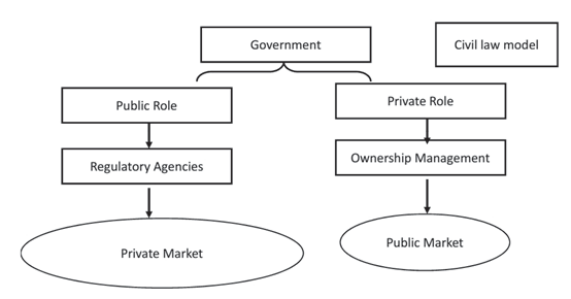
A transformation route map, especially for gigantic existing SOEs, was also produced. It included that industrial regulation ministerial departments and agencies could de divided into several levels. First, the transformation of existing administrative branches involved in the direct control and command over SOEs should be based on the “separation of the economic regulatory function from the direct command and control over business(经企分离).” Administrative functions were categorized as regulatory, which meant ministerial affairs would be applicable to all kinds of enterprises, and economic, which meant managerial affairs would just be focused on subsidiary SOE or industrial lines management. The latter ministries, bureaus, departments or agencies should be stripped off as divested or carved out from the original agencies to industrial general or controlling corporations, and deprived of existing administrative powers. The state should not run any businesses through a command and control way except a few key industries, normally considered as public goods, and the rules should be amended to systematically build up a modern administrative governance in a rule-by-law way.
Other than separating direct management from the administrative branch, the SASAC should take responsibility for all SOA management. Many scholars insisted that the SASAC needed to be reoriented to be responsible to the National People’s Congress (NPC), which was supposed to be the right body to act as owner for all of the people.
56 This argument was just wishful thinking; in reality, the CCP did not want to undertake any reform strategy that would loosen control,
57 even a simple separation of powers was ruled out, and in fact it was thought that an unprofessional congress would be a “rubber stamp” and unable to perform a proper surveillance duty. Arguments also focused on who was the ultimate owner of SOAs.
58 Many different regimes had been purposed, such as the whole people in equal shares or the local governments, and the result was a vague political compromise: namely, the state, fundamentally because of the CCP’s longstanding, hardcore political doctrine of centralization.
59 Therefore, only two principles were left, one was for the SASAC to act as an agency to manage SOAs in a professional way, while the other was that for all SOAs to have only one owner, the state. No local government could own a SOA by itself, at least in terms of the whole spectrum of property rights.
60 The SASAC’s task was set up as a regulator for making rules and performing surveillance for having, using, and keeping SOAs in all levels of government branches and agencies, and assuming, exercising, and supervising SOAs as a private owner.
61 The supposed ways share rights would vest in transformed SOEs was promulgated in the 1993 Corporate Act as shareholder status, voting rights, collection of revenue, and appointment of managers. As a regulator and representative for execution of ownership, the SASAC still had dual roles in SOA administration, which later on caused many problems. Indeed, some policy-makers proposed to turn the SASAC into a Temasek style holding corporation, but the obstacle was such a big corporation could not be established in a reluctant way.
As for the existing gigantic corporations, and those corporations transformed originally from administrative bureaus or departments, they were the main sources of the top-level holding corporations. Some former industry guilds might serve as extensions of government management or agents of administrative bureaus, and those guilds could be reorganized or conglomerated as holding corporations. National banks could also be shareholders of top level holding corporations through debt-for-equity swaps.
62 The last source of top-level holding corporations, national banks, was eventually criticized by other scholars, for it meant China would replicate the contingent bank intervention corporate governance system of Germany or Japan.
63 Meanwhile, China’s financial sector was highly protected by the central government, and the fact that the SOEs’ bad performance might induce high debt default risks meant that they must be isolated from the safe bank assets.
64 At the same time, with the influence of financial experts and officers, the “Commercial Banks Law,” which was promulgated in 1993, adopted the United States’ separation of investment and commercial banking, in line with the principles established by the Glass-Steagall Act model. As a result, no investment banks were allowed in for a very long time.
65 The adopted American experience was credited to Chinese financial economists and scholars, who were always less influenced by theoretical economists, which also meant their decisions were more practical and at that time less influenced by new institutional economics.
Once the top-level controlling corporations like Temasek were founded with stock issues, such controlling corporations were free to set up new subsidiaries, carve out assets, reorganize old subsidiaries, as well as subscribe, buy, or sell other corporations’ issued shares, whether as a majority or minority block holder. Therefore, the top controlling corporations and their vast subsidiaries consisted of a matrix of public share markets. The top controlling corporations thus served as mothers of state-owned shares, supposedly acting like professional capital market investors and shareholders. The top controlling corporations, professional investment banks, institutional investors newly founded by states, and gigantic corporate groups could overlap, hold, and make free transaction of medium or minor size corporatized SOEs’ shares in a mixed share markets. A public share market was established after the current SOEs transformed into corporations, and fulfilled those efficiencies discussed above. As a complement, small and medium SOEs—collective-owned enterprises—could be sold, contracted out, or entrusted to the private sector, and thus a private shares market emerged, and all those needed to go through a process of corporatization. Therefore, a rough route map, from corporatization to securitization, through capital markets transactions, with the property rights school’s firm belief about improvement of efficiency for corporate governance, was thus purposed.
Graph 2: Design of the Singapore Model
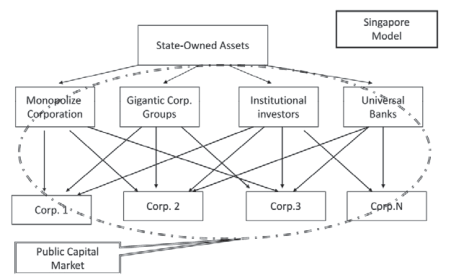
With a fashionable theoretical foundation, an existing successful model that could be transplanted, and the benefits of keeping control and having claims over future returns, the WU school’s property rights scheme provided a perfect route map for confused officers, without violating any existing doctrine. The SASAC also obtained benefits from this route map, and it adopted the property rights explanation and made many efforts to lobby the people and top leaders. Although specific times cannot be verified, from 1994 to 1998, WU’s strategy gradually was accepted as an official solution for transformation.
B. TRIAL OF THE SINGAPORE MODEL
Given the conditions and doctrinal requirements, the Singapore model was almost the only acceptable solution for the rulers of China, but it still had to pass through a trial and error process and be helped by some path-breaking entrepreneurship by bold reformers. Although Wu’s scheme and the SASAC’s interpretations about the SOA system gradually gained popularity, and some experimental trials for stock shares systems and securities exchanges already existed in the 1980s for some local governments, especially in Shanghai, Shandong, and Shenzhen,
66 existing SOEs in the form of factories, shops and cooperatives still faced many practical obstacles or potential political risks in their transformation into private corporations.
In the early 1990s, many SOEs’ were close to or actually insolvent, or in the very least had serious deficit problems, and this situation indeed was driving the need for SOE transformation.
67 As a policy-maker focused on effectiveness, the CCP, like any political party with a realistic vision, would not take an ad-hoc strategy to change its direction unless it felt the urge of a real threat or force. The SOEs’ dire financial situation was combined with a state treasury unable to actively “cut burdens” in the planned process of shareholder reorganization. Such burdens often included discharging instead of relocating incompetent managers as well as firing redundant workers and unnecessary officers. Most important, the SOEs’ poor financial status normally revealed an ugly balance sheet; in fact, enterprise capital normally would be identified as zero or negative, offset by huge debt in the accounting standards. The SOEs remained safe only because of almost unlimited support from creditor banks which were also owned by the central government. According to official studies and reports or figures published in newspapers and journals, the three types of financial status of SOEs were equally divided into stillearning, breaking-even, and insolvent. Most scholars, however, believed in unpublished government reports showing that insolvent SOEs exceeded 70% of the total. At any rate, this financial situation made the transformation difficult.
The ideological challenge was the political risk of being accused of privatization (in that specific time it meant transferring publically owned property into private hands instead of the international comprehensive meaning, which was against political ideology) and loss of assets or value of the whole people’s property. Since the Socialistmarket Document had already announced the selling, renting, and transferring of small or medium SOEs and collective ownership enterprises (COEs), ideological dissenters mainly focused on unfair transactions, which meant that contract considerations did not follow quid pro quo. Considering the poor financial condition of the existing SOEs, attackers could easily draw significant negative attention from uninformed people that a factory being sold for an insignificant amount was in charge of massive tangible assets. Public opinion manipulated through the CCP’s propaganda machine was used to create a glorious feeling about big SOE achievements and cover the poor financial conditions, and now of course generated an antidote for the decreased value from unfamiliar accounting standards. This kind of resistance has continued throughout SOE transformation even until today.
Selling small and medium SOEs and COEs sparked several questions: (1) which kind of SOEs or COEs should be sold first, profitable ones or nearly insolvent ones? This question often referenced the famous saying, “letting the beautiful girl marry first(靓女 先嫁).”68 Governments wanted to sell profitable ones which meant they would not have any obligations to subsidize buyers, either through long-term tax cuts or exemptions while they also could even get future revenues through employment and tax collecting. On the other hand, buyers wanted to purchase insolvent ones, even paying little money in advance and intending to make an exchange for future favorable tax treatment. But in line with public opinion, the “letting the beautiful girl to marry first” strategy just evidenced the government was not intending to save the SOEs but to use them for a fiscal return. Faced with this public pressure, the government then first tried to sell the nearly insolvent ones on the sole condition the buyer would maintain current employment and with a promise to provide tax cuts or exemptions. Later such arrangements heavily burdened the governments, which suffered a loss of apportion-able resources and continued to be obligated to support the transformed enterprises. (2) Who should be the buyers: outsiders or insiders of the respective enterprise? The enterprise leaders were used to equal status as “comrades” with the workers, and the transformation would change their relationship, which caused uncomfortable social feelings. At the beginning, the government seldom sold SOEs or COEs to insiders, usually opting for a private or foreign enterprise, and therefore the buyers market was limited. Later, the government tried to sell all shares equally to all workers, which was also an acceptable scheme. When whole property rights were purchased by insiders, however, it resulted in the same people who were used to crying for help from the government frustrating the purpose for improving efficiency. In the early 2000s, most local governments adopted the strategy of selling SOE and COE shares mostly to insider managers as a kind of majority shareholder, and devoting a small fraction of shares to the other workers to make them minority stakeholders.
69 Therefore, many social grudges and collective actions such as demonstrations, continuous complaints to government or superior governments, and even physical conflicts between managers and the original workers emerged as a regular social phenomenon. (3) How to solve the problem that the transferring of ownership and efficiency requirements led to unemployment, as a separate social security system did not exist? At first, governments set up employment as a condition for purchasing SOEs and COEs. As long as the new owner would keep most of the workers, the state sellers would provide as many convenient terms as possible. The condition raised the acquisition costs of buyers and reduced the potential buyers market, as well as exhausting reform officers dealing with detailed arrangements for employment and the corresponding owner incentives.
At the central government level, several challenges also could be identified, including: (1) administrative branches became used to managing SOEs directly through commands, instructions, and informal ways, even through personal relationships between officers, as SOEs originally had been considered a government sub-unit or subsidiary factory. The new transformation needed a changed regulatory style in the way of rule by law, but neither habitual decision-making nor express black letter rules were ready for the existing administrative branch. Much new legislation, especially administrative legislation, needed to be promulgated, and detailed new divisions inside the administrative branch were to be set, adjusted, and reallocated following the principle of separation of administration and regulation. The greatest difficulty might lie in the vested interests of the originally supervising administrative agencies and a Chinese political cultural often called the “fiefdom system,” which would lead to massive private bargaining between officers and much internal conflict.
70 (2) Unemployment was another difficult constraint for the central government in the next step of reform and may have led to some differences with local governments. Traditionally, central SOEs drew the whole country’s elites and provided a systematic and higher level of treatment than the normal welfare system for workers, which meant higher costs for the central government to provide social security, insurance, or reemployment for laid-off workers. In particular, central SOE managers, whether in the top or middle levels, were identified as officers like bureaucrats. The transformation from an administrative sub-branch to an independent corporation would cause managers to lose their privileges as officers, or lower their expectation of possibility for getting promotion to higher positions in an administrative branch. (3) The poor budget of the central government’s treasury determined that transforming administrative agencies could not get financial support to self-reorganize as ultimate holding corporations (UHCs). This brought a temporary dilemma, either UHCs were vulnerable to their supposed subsidy corporations due to their nearly unavailable capital financing capability, or UHCs would pick up administrative power again to command in an old fashion, leveraging their superior close relationship to the transformed regulatory agency. In later practice, the central government did input significant capital funds for UHCs as well as provide special privileges as compensation after the central government improved its financial situation.
For small and medium enterprises, the first trial happened in Zhucheng, a small city in Shandong Province.
71 The original situation changed based on a leading case by a daring top officer (party secretary of the city’s committee), who used a compensation scheme for laid-off workers as a substitute for reemploying or retaining them. His strategy drew substantial arguments in political circles, but was however gradually accepted as a model and spread to the whole country. Unfortunately, his political destiny was heavily constrained by his boldness, for the reform was complicated by serious unemployment and lack of social insurance for forced early retirees or jobless people. In today’s viewpoint, his reform was the wrong strategy for he used a private enterprise’s way to reorganize a public enterprise, but at that time his success was easily observed while the social costs only turned up later. His quick success and boldness inspired other officers and his experience spread very quickly around the country.
Prime Minister ZHU Rongji at the time was a main promoter of the Singapore model. His administration established the main framework for the current SOA system, and the WU school became his brain trust for transformation. He publicly made a promise to save SOEs from their dire financial situation in three years, and permitted his subordinates to use any kind of measures to corporatize and privatize to make up deficits. His administration spared no efforts to support the newly founded national securities market, and the central government obtained monetary revenue from selling non-controlling shares of central SOEs and explosive share premiums in SOEs going public. The national treasury was thus filled through all kinds of deregulation and privatization, and therefore the central government became capable of inputting capital into central SOE corporations. ZHU’s construction of infrastructure for the new Chinese socialist market, including the Singapore model of a mandatory pension system and a social securities system (in a very narrow sense, it left many serious problems such as the medical care system), at least outwardly provided a possible way out of the predicament for his subordinates to privatize small and medium SOEs and COEs. And in 1998, in order to avoid the Southeast Asia financial crisis, he centralized the local financial and debt market, which heavily restrained the next steps in China’s economic development. To maintain control of tunneling and siphoning SOAs, he reinforced administrative scrutiny and intervention in SOA transactions, naively believing in the reputation of international auditing agencies to change Chinese corporate governance to rely on auditing.
In the central SOEs’ reform, the Chinese Aviation Industry Corporation (CAIC) was chosen to be the first trial. CAIC was accustomed to playing multiple roles, which was also typical of the former SOE model. It enacted policies for and regulated the aviation industry and also served as a parent corporation owning vast aviation and related operations, including universities, hospitals, nursing homes, and subsidiary factories. In short, it ran all kinds of profitable businesses but now needed to hand over its regulatory tasks to the National Development and Reform Commission (NDRC) and change itself from a top-down command chain to a controlling shareholder of corporations. Due to a complex history of central government missteps, the Chinese aviation industry was deemed a failure in the eyes of the state and people. No large passenger plane made by CAIC flew over Chinese territory, and it manufactured buses to compete with the automobile industry. Therefore, it was a natural choice to ask CAIC to give up its power. With a successful example, the central government started a comprehensive reform for transformation.
The SASAC’s self-interested pursuit of authority and power gave an impetus to the systematization of SOA management institutions, and it initially gained special support from the legal community. In its founding phase, the SASAC was supposed to be just an agency responsible for the registration and statistics of SOA, and not necessarily responsible for enterprise assets. A very important shortcoming of the SASAC was lack of industrial management knowledge and professional elites, which meant it could not take over control of SOEs directly. Yet, the SASAC took a very clever gradual approach, and merely emphasized the need for loss-prevention of SOAs, which was a politically correct proposition easily accepted by common people and political leaders. In hindsight, it is easy to see how the SASAC became an omnipotent shareholder through the execution of this strategy.
Although many realistic obstacles and doubts, questions, and even dissent existed in people’s minds, the dying SOEs indeed required urgent change. In the later transformation process, the Singapore model was the least costly strategy for the government if not for the whole society. It’s now commonly accepted that the ZHU administration achieved this break-thorough reform at a break-neck pace.
C. PATHS OF THE SINGAPORE MODEL
Various kinds of transformation strategies were adopted by governments, and had already been through several phases. The detailed operations of transformation of corporatization that occurred from 1995 to 2004 have already been described by many observers, recorders and scholars,
72 and I will not repeat them here. This section merely provides a general explanation of the system’s structure and key steps and dynamics as well as the selected paths’ side effects or social/institutional costs.
Graph 3: A Sketch of the Paths of Transformation
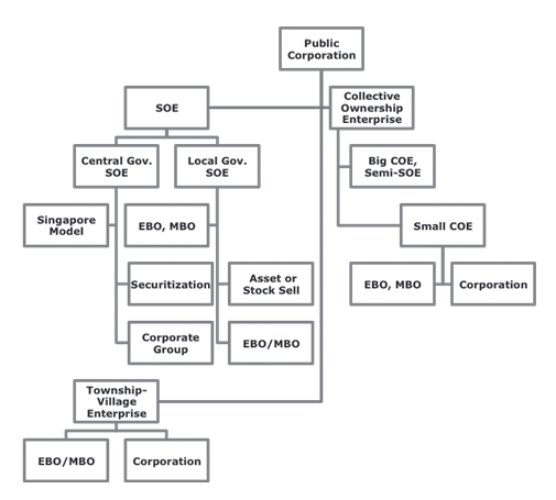
1. Selling Assets or Property
Selling assets or SOE property to private persons or other enterprises, which emerged first and also was considered as the way of least resistance, mostly happened in the early 1990s. Due to industrial policy and investment preferences in the planned economy, SOEs had better equipment, machines, factory buildings, and capability for heavy industry production. The land rights were not as valuable as today, and the local governments had plenty of land reserves. Over the last three decades, the changing values of productive elements, rise of land rights and fall of material capital, and switch in allocation of advanced technology from the public sector to the private sector, all demonstrated a subtle even ironic influence in China’s development model. From a social efficiency perspective, leaving the machines, equipment and technology and especially production lines unused constitute wasted, and thus “liquidizing remnant assets” was a convincing reason for the transformation.
As already mentioned above, the buyers market for SOE assets was limited. Few private parties could afford to pay adequate consideration, and banks seldom provided debt support for such acquisitions, as the banks were also weighed down by the SOEs’ bad financial condition. In the early 1990s, China was still a flat society with relatively equal wealth distribution, though a divide between the rich and the poor had already begun. At the same time, foreigners faced many market restrictions, as China continued to consider the costs and benefits of joining the WTO. Therefore, local governments, with a view to saving their SOEs or COEs, opted to sell some potentially successful SOEs and Village Township Enterprises (VTEs). During the process, attractive buyers could obtain almost every kind of favorable treatment, simply for taking over the bad financial situation of the SOEs or COEs and agreeing to retain as many staff and workers as possible.
Selling assets or property was not to obtain revenue from the deal, but to make good use of material capital, maintain steady employment, and decrease the governments’ fiscal burden. Keeping or cutting job positions were key issues in both the sellers and buyers bargaining positions. Buyers in a good position could ask for a big price discount to maintain the original workforce, resulting in the local government using state owned property to sustain employment. Some asset or property selling cases were quite successful through a change of manager or owner, and some not. In the eyes of the central government, however, transferring ownership from one failed SOE to another profitable SOE would burden the latter with a compressed horizontal integration, and possibly turn a good SOE into a bad one. The hardest problem was that assets or property sales were one-off transactions, no one would be responsible for a wrong selection or bad bargain, if the transformed SOE went for worse. If the buyers were not a public subject, but instead a private person, the deal in fact only cost the buyer very little for obtaining control over public property or assets, which violated the principle of fair and true value for employment and was not an official element of transformation. Indeed, some extreme cases involved buyers once obtaining an asset or property then in a very quick time reselling it to another buyer to arbitrage the price spread. With the rise of accusations surrounding privatization, the SASAC, representing the will of the central government, called a halt to many transactions and implemented strict regulations for directly selling property or assets to prevent local officers from colluding with buyers.
The SASAC possessed two regulatory tools, one was compulsory competitive tendering (CCT), the other one was asset evaluation.
74 No deal could be made for less than the asset’s intrinsic value, and all deals needed to go through a public bidding or competitive tendering process. The winds now started to change, a good choice for transformation in eyes of the central government began to mean worthiness of assets or property, which caused a reduction in the national treasury. I believe this was a key point coming from games between the central government and local government in the whole process of transformation, for their positions varied: all SOAs belonged to the central government, while local governments were mired in a heavy fiscal burden. Once the central government tried very hard to prevent losses, the game changed and the reform of SOEs shifted directions.
2. Reorganization and Joint Ventures
The number and capability of buyers were limited in the very beginning, and direct asset selling was not necessarily applicable. Alternative choices included partial selling, mixed ownership, joint operation, and introducing partners. First, existing SOEs or COEs needed to identify asset owners and their financial situation, turning asset management into share valuation. Then new entrants and local governments negotiated the deal and signed the contract. Under the common practice, new entrants normally would act as managers and fund providers, and the local government usually kept a considerable block of shares as a passive shareholder. Through incorporation and SPO (Second Public Offering)-like capital-raising behavior, SOEs and COEs in dire financial situations could get money needed for improvements, and no public ownership was transferred at least in name. The strategy harmed neither the quantity of ownership nor entitlement of property; on the contrary, new comers would provide funds for SOE corporations. The absence of a need for surveillance and no rules for regulation have lasted until today.
But at that time two questions were laid in front of reformers, the first one was that no government would have enough funds or new sources of money to provide for SOEs and COEs, especially when the old shareholders’ majority shares already were offset by the SOEs’ high debt. The second one still was how to retain the original labor force and not create a new burden on employment. Governments could not just transfer their holding blocks to new entrants, for it would have reduced an existing SOE’s block as they did not have new capital investment as a balance to new shareholders’ contributions. Therefore, to invite new investors as partners or joint operators, governments needed to spin off good assets or divest bad assets from SOEs to make them attractive. The divestiture of non-performing assets and contributory assets into different pools, separately held by already nearly bankrupt SOEs and by newly founded, spin-off or carved-out subsidiary corporations, allowed for new entities with healthy balance sheets. This prevalent strategy of course relied on the legal fiction of independence of market subjects. From the end of the 1990s, this reorganization scheme became quite popular with many Chinese style words, such as “capital operations” and “capital replacement.”75
For local SOEs and COEs, the transformation took various forms, strategies, and schemes at different times, but for central SOEs, reorganization served as a main strategy for bailing them out. Combined with going public and new input from the central government, central SOEs were easily and quickly pulled out of insolvency and became active in all kinds of new expansions of investment. China Mobile was a typical example, set up as a new corporation through a series of outbound investments. It brought a shell company in Hong Kong, renamed it China Mobile HK, and then issued stocks on the SEHK (the Securities Exchange of Hong Kong). On the mainland, China Mobile divested its assets into many subsidiary corporations and gradually transferred those corporations to China Mobile HK, the latter exactly following Hong Kong’s corporate rules and corporate governance. Most of the central SOEs took this kind of strategy for transformation.
The banking system was no exception for this reorganization strategy, albeit perhaps more complex. With market access to the banking system subject to high regulation, only four gigantic bank groups existed for a very long time, and they were owned by the central government. Since 1984, all levels of government had stopped making additional investment as SOE shareholders and all SOEs had to borrow money from banks. The SOEs’ poor financial situation meant that their financing was mainly confined to borrowing from banks, which caused their debt-to-equity ratio to skyrocket. Most SOE debt to banks became bad, which jeopardized the banks own capital positions and brought potential systematic risks to the whole financial system. In ZHU’s administration, four bank groups were approved to set up asset management funds; they were organized as four specialized corporations to undertake bad assets and pursue debt claims through legal methods. The central government later in 2003 incorporated Central Huijin Investment Ltd. (CHIC) as the ultimate shareholder for the SOE banks. CHIC injected billions of funds to reinforce the core capital for SOE banks based on their need for capital, which was unimaginable at the time of the beginning of the transformation.
Since the central government owned the four SOE bank groups, and those banks were the biggest creditors to almost all of the SOEs, if local SOEs could escape banks claims over local SOE defaults, the local governments could much more easily attract new investors for the local SOEs. Due to the party-state system, which had no separation of power between any levels or branches of government, the local government exercised direct and de facto control over all of the trial courts, and developed a new strategy that we now refer to as “fake bankruptcy” to escape central SOE bank claims over local SOEs assets. Local SOEs would appeal for bankruptcy due to their insolvent financial situation, which of course was decided directly by the local governments but in the guise of a local court’s judgment. Local courts under the command of the local government would begin a liquidation process without strictly following bankruptcy procedures, many cases not even performing a notification of the creditors. Passing through a legal death for an existing enterprise, local governments would reclaim residual assets and reinvest them into newly founded corporations that were normally partnered with others.
76 Another popular way of escaping central SOE bank debt claims was that the local government as a shareholder would directly allocate good assets to new corporations incorporated as joint ventures with new partners. This practice resulted in another skirmish between the central and local governments. The supreme court could use judicial interpretations as an underlying legislation to regulate local courts, which should be responsible to the central government. Facing this method of escaping SOE bank debt collection or claims, the supreme court set up a new rule called “the debt follows the assets,” which meant creditors could make claims on transferred assets or property of SOEs or governments investing into new entities without the consent of the creditors. The mandatory rule was unique, with someone even calling it the “Chinese version of fraudulent conveyance law,” even if it was similar only in appearance.
3. EBO
Asset selling required valuable assets or property, and reorganization required an outsider as a capital provider, meaning existing SOEs would be worthy of value increments from a going-concern perspective. Most SOEs still were trapped in a bad financial situation, and a majority of them even needed to switch to another industrial line as their past monopolistic advantages disappeared in the deregulation era. With no outside buyers or capital providers, neither bankruptcy nor pure asset liquidations was an option for governments; a new path was needed to cure the paralysis of SOEs or COEs for lack of funds or capital. Thus an unique Chinese type of enterprise, the share based cooperative enterprise (SBCE, 股份合作制), emerged and was even accompanied with a slogan “tapping potentialities internally(内部挖潜).” It elevated social security and insurance concerns to a key point in the whole process of transformation, planted the seeds for the very next coming of “safeguarding rights(维权),” and evoked a chain reaction for later reform.
At the beginning, the SBCE as a method for transformation was used mainly in local SOEs and COEs, and carried out in two rounds. The first round was all workers would pay for capital accumulation and receive shares in various kinds as a return, which was quite similar to an employee buy-out (EBO) with slight Chinese revisions. The second round involved a majority of shares being brought by managers on the basis of the first round, which was typical of a MBO. The SBCE was a very ambiguous concept at the time, and first emerged as an ownership system of cooperatives with its members’ rights measured by contribution for capital, requiring that current internal workers make contributions to enterprises. In return, they enjoyed a simulated dividend of any residual revenue, but not necessarily structured as a standard form of shares, either in a collectively held way or an individually held way. The first kind of “share” in the so-called “share based cooperatives system” (SBCS) could be easily understood as an updated version of a public contracting system, just like a variation as in contractingin. 77 The content of “share” varied according to the contracts signed by the SOEs and workers, and normally included the right to claim a dividend, inherit or internally transfer entitlements, and jointly vote, but normally also contained many restrictions on external transfers. Voting rights were not comprehensive and not necessarily attractive because the collectively held shares were not enough for a majority, and the workers were already entitled to vote in the workers and staff congress system, copied from the Dutch experience as an enterprise commission. Non-transferable internal SBCS shares were also called “internal employee shares,” and some successful trials accompanied with great incentive effects resulted in it quickly spreading over the country. These trials, effectively equity offerings, emerged as a refinancing mechanism, and the SOEs or COEs thereby could obtain real money needed for production, without any loss of control or challenge to political ideology. Therefore, some local governments set up a new strategy for mandatorily requiring SBCS in SOEs that were worthless to outside investors, to force workers to make capital contributions to SOEs and COEs on condition of preserving their job positions.
A slightly different kind of important SBCS share called “employee stocks” resulted in a few unexpected consequences. With the official introduction of corporations as an enterprise form and stock as the ownership’s legal institution, employee stocks had gained a transferable bundle of rights so that they could be deemed as common stock at a cheap price, which also could be understood as compensation for workers for the longstanding underpayment during the planned economy times. The central government, however, would not let employees own a majority of the SOEs or COEs’ issued stocks, and set the upper limit at 15% for all employee stocks in the whole package of issued stocks, held either collectively or individually. After corporatization, some SOEs and COEs went for public offerings, and insider employee stock gained a huge premium, drawing many complaints and actual feelings of envy among the public. Going public employee stocks enhanced the separation of the divided securities markets, and the Chinese SEC, the SARC (Securities Administration and Regulation Commission), spent a few years to clear up the existence of employee stocks as a kind. Some SOEs and COEs that did not go public still had collective ownership through a committee of workers holding shares, which induced many unfair problems between common stockholders and employee stockholders.
Issuing the third kind of employee stocks was a de facto privatization, while the former two did not. The former two were similar to issuing stocks to new investors and increasing the capital without changing the state-owned assets, the third one meant that the local government would sell SOEs and COEs to worker insiders, which was exactly an employee buy out. In this kind of method for transformation, shares were set up no differently from a common stock issue in a capital market, and insider employees and staff needed to pay a considerable amount of money to buy assets from the governments. Thus, SBCS was a transitional measure, and SOEs and COEs became a SBCE as a first predecessor of common corporations.
The SBCE was an unique kind of concept in the Chinese transformation, and because it was illogical it persisted only for a short time. The word “cooperative” impressed normal people as another version of COEs, but in the reality, “share” turned out to be the real purpose of the whole transformation process.
4. MBO
From approximately 1998 to 2001 in different areas, EMO was a dominant strategy for the first round of corporatization of Chinese SOEs and COEs. In the second round of privatization from 2002 to 2005, local governments were more inclined to use MBOs as a main strategy to transform SOEs and COEs into “standard corporations.” The difference between EMOs and MBOs was whether a buy-out plan for identified state-owned assets included differential treatment for high officers and ordinary workers, for an EMO (in the third meaning) generally was accompanied by equal blocks for all insiders, while a MBO was purposely designed to allow high officers to have the biggest block and be a future majority shareholder.
The MBO was first introduced into China for undefined property right’s “red cap” enterprises at the end of the 1990s, and became a popular method for privatization in the first decade of the new century. Two reasons provided institutional advantages for unequal distribution of buying opportunities for SOAs at that time. The first one was an official explanation by local governments in consideration of future corporate governance: a majority shareholder with disperse minority shareholders was considered a better allocation of share benefits for corporate governance.
78 The idea of one majority shareholder being better than a group of equal shareholders was unproven, and we still do not know why local governments believed in this option and few people challenged it. The best guess of such a hard line might come from either a structure enlightened from the monopolistic competition model in microeconomics
79 or the political dynamics following the communist party’s practice of democratic centralization. A whale-minnow share allocation was favored by the government for efficiency but despised by civil lawyers because of the oppression of minorities and the majority block-holder’s selfdealing eroded the common interest. While local governments advanced wave upon wave to form a majority shareholder in transforming corporations, lawmakers continued to add as many corporate rules as possible to protect minority shareholders. A possible dark-side explanation for the local governments’ choice was that it was much more acceptable to the general public, the majority shareholder normally was the top leader of an existing SOE or COE, and thus capable of rent-seeking or lobbying for policy making.
80 The second one was the interference of bank lending, which provided possible payments to the government in exchange for control. After several years of great efforts to peel off bad assets and input new capital, a revived and heavily protected banking sector became profitable. Banks now operated in a market-orientated way pursuing safe lending practices, and MBOs became a target because they had assets to mortgage.
81 That banks were enthusiastic in providing funds to MBO managers was contrary to their prior strict surveillance of the same person’s personal behaviors in SOEs. Enhanced creditors rights in law, execution for mortgaged assets, and expansion of credit under active fiscal and monetary policy could not be a sufficient reason, and this situation also made people suspicious of collusion among corrupt officers, managers, and now governmentcontrolled bankers.
The complexity of feelings surrounding SOEs, dark allegations of corruption, and unequal distribution for buy-out chances inspired strong public opposition, led by some famous opinion leaders, against MBOs.
82 This situation also lead to President XI Jinping’s current worries. The SASAC tried but failed to defer the approval of transactions in several cases, for the SOA system did not contemplate this problem at the very beginning.
5. Going Public
Going public for the purposes of privatization was a common international experience, especially in the UK, and it was a real “share system” way to form a capital market. As a trial in 1988, Shanghai first used going public as a strategy for SOE reform. Eight small and medium SOEs became the very first group of publically listed SOEs, now called “the old eight.” The old eight issued fully circulating stocks with no divisions in kind, and then faced continuous hostile takeover attempts over the years. But after 1992, new rules and institutions for the Singapore model were set up to categorize stocks as state-owned stocks, state-owned legal person held stocks, circulated stocks, and restricted circulated stocks, including promoter held stocks, employee stocks, and management stocks. The different kinds of stock evidenced various SOE reform strategies to keep state control over SOEs and maintain a public ownership dominant position as well as raise money from the public and serve transformation.
Going public as a transformation strategy was used mostly with central SOEs and comparatively local SOEs in relatively good financial situations. The process also evidenced a Chinese regulatory style, which had been transformed from the planned economy’s administrative way of direct command and control with new accountability for institutional change. Newly established regulatory agencies like the SARC tried very hard to promote the emergence and development of markets. As with other government bureaus, they were forced to transform their behaviors in a rule-by-law way. But following DENG Xiaoping’s policy of economic reform first without political reform, those administrative bureaus possessed administrative legislative power to set up new rules, without any public accountability system and under only a very loose political way of leadership responsibility.
84 Bureaus thus had a very broad discretion to regulate and leaders were required to be responsible for a “bad result,” which normally meant loss of control and the markets in chaos. Without a judicial check and balance, the newly established agencies were inclined to go back to their most familiar way of legal enforcement and put strict discipline on market access to prevent chaos in their regulated industry. The state needed to keep control over SOEs, while SARC needed to keep the stock market running at a high level. They thus used the old tradition of a quota system to set up public issuing quantities, beyond the rules they pronounced, so as to maintain these purposes. The result was after 20 years of this practice, most of the enterprises entitled to pubic offerings were SOEs, and public shares owned directly or indirectly by government accounted for over 60% of the whole capital market. The stock market was supposed to be a well developed market for private actors, and the public shares were just complementary parts like fishes swimming in the ocean of a private securities market; however it turned out to be a public shares market, which should be a credit for the SARC’s regulation.
Even though it closely followed the international experience of such transformations, we can identify the existing political, social and legal system dynamics that turned the related going public strategy into a Chinese one. The Chinese capital market was comprised of the following main characteristics: separation of market through division of shares, SOA shares occupied the biggest block, and under the SOE’s style of corporate governance cutting off the link between stock market signals and managers performance for SOE’s revenue coming from monopolistic privilege.
Another important feature that needs pointing out is that governments using the capital markets as a method for saving SOEs perhaps resulted in the most frequent affiliated transactions in the world. Everyone hated self-dealing and the SARC promulgated rigid restrictions to prevent self-dealing by majority shareholders. However, the SOEs going public were normally carved out of a parent company’s subsidiary corporations and represented the group’s best assets and, as a favor or return, also involved transferring some interests back to the sisters corporations still in trouble.
III. DEVIATION FROM THE SINGAPORE MODEL
From productive units undertaking all kinds of social services in a planned economy, the Chinese model of SOEs emerged as a corporatized, share-based mixed ownership, for-profit enterprises. The SOE corporations were registered as common corporations, and their governance, business operations, and even product distribution existed under the “private” legal adjustments of mainly corporate law. Under the current legal system, no clearer definition of an SOE exists, while SOA consists only of an administrative institution executing state owned equity rights, including the identification, transaction, and selection of managers as well as the collection of dividends. Although SOEs typically enjoy some privileges in the way of legal adjustments like immunity from the anti-trust law, they no longer have an official expression or legal concept. Form SOE to SOA, actually I do think it should be called the state owned equity system, according to the ESOAA, after almost a decade of transformation, a Chinese version of the Singapore model of SOEs has been established. As mentioned above, the Singapore model of SOEs satisfied the need for legal, private, for-profit corporations, business operations within competitive markets, and professional asset management without any actual loss of state ownership. This kind of design for the SOE system, like a economist said, was “drawing a black line on a white horse to have a zebra.”85 From the law’s perspective, the Chinese version of the Singapore model was actually a laissez-faire style private law plus a crown property’s public administrative law model.
A. FRAMEWORK OF THE SINGAPORE MODEL IN CHINA
The current Chinese SOE version of the Singapore model, including structure, function and organization, have already been described by many studies, so I will just provide a legal description here. Several legal institutions form the bedrock of the SOE system.
The first component of the current SOE system, and the most important legal concept, was state ownership. State ownership, due to its public nature, as a crystallization of the communist revolution in political ideology, means that the asset belongs to the whole people and cannot be privatized by any individual person. The CCP’s legitimacy indeed was tied to economic growth, and the SOE system could be traced back to the Soviet Union’s economic system. The SOE was not considered as a complementary part of the market, but as a substitute of the market, as an advanced productive force. State ownership was no different from private property rights with respect to the legal nature or the content of rights, just ownership. Therefore, state ownership entered into the market and made a deal that private persons should follow the rule of quid pro quo.
86 This kind of proposition was called state ownership realized through the civil law. State ownership could be divided into three categories based on usage and considerations: administrative property for fulfilling the needs of government, natural resource property in franchise rights granted to users, and profitable assets input into enterprises. The SOEs were the last presentation of state ownership, and occupants, users, and operators were entrusted by the state as owners to fulfill an obligation of fidelity and increase the property’s value.
This kind of idea mirrored an understanding for corporations, which were not considered as a cooperative mechanism for all participants or stakeholders, but rather as an extensive arm for property owners’ rights. Execution of the corporation meant enlarging the scale or territory of the owner’s domain or increasing the value of the shareholders’ interest. This kind of idea was obviously evidenced in the SOA evaluation standards to maintain and increase the value of existing SOAs. State ownership is understood from the perspective of rem, and all interest derived, like dividends, were fruits. Socialism did not need the market; productivity and not monetary interest was its concern. Control and domination for rem rather than revenue as return were the essence of ownership. In fact, this image of property management was quite contradictory to valuation-based operation in a well-functioning market, and had been very popular in the civil law. Agents or trustees of state ownership, which meant officers of the SASAC as representatives of the whole people and officers inside the SOE corporations, were to undertake the task as a private agent with a fiduciary duty to maintain asset value and increase state ownership.
The second component is the state-owned asset management system regulated and managed by SASAC. SASAC was supposed to be isolated from industrial regulation, serving as a firewall for government direct intervention in economic regulation and industrial policies, which was deemed an evil for government agencies using their power to protect and extort SOEs. A policy of no separation between administration and business affairs would foster nepotism, corruption, and unequal treatment between different ownership systems.
89 Since ownership belonged to the whole people, no privatization was allowed. SOA management must build up a new regulatory system including identification and registration of state owned assets (normally in rem), verification and scrutiny for share value for asset contributions to corporations, and checks and ratification for fidelity of exchange value of state owned share transactions. The idea of state ownership determined the boundaries and spheres of the SASAC’s jurisdiction. From the theoretical perspective of institutional designers and interpreters, the SASAC was supposed to function as a pure shareholder without any further administrative or regulatory power. The SASAC’s role and duty, however, had to be realized in an administrative way. It is conceivable that the desire for separation of administrative power from economic regulation was embedded within the absence of a higher level of division of powers, the lack of checks and balances in constitutional arrangement, and the unaccountability of powerful executors.
The third one is private law, especially a profitable private enterprise legal institution for realization of state ownership through a corporate form, under a continental legal system understanding for law. Through corporatization, a collective of owners could watch over each other, and form a supervisory mechanism and put some restrictions on officers. In the long chain of principal-agent relationships of state ownership, the SASAC performed a supervisory duty for shareholders rights execution, and SOE corporations’ high officers acted as market-oriented professional managers. The vertical principal-agent relationship thus could be separated from horizontal market transactions and business competition. As long as the SOE corporation’s operation followed the exact corporate law and other private legal institutions, state owned assets value maintenance and enhancement would be a natural outcome of the corporate form as market competitors, the only additional concerns therefore focused on the entry and exit of state owned equity. Through registration and identification of SOE property, the incorporation process would turn state-owned assets or property into accounting valuation based shares. If state-owned equity needed to be transferred to other corporations, the transaction should get approval from the SASAC based on market valuation through a public bidding process and an auditing procedure, which would ensure the price and deal being fair for state interests. From a corporate law perspective, using separation of assets and equity as a capitalization process, the SASAC could concentrate its attention on management by values instead of intervention into detailed and specific micro-management of SOE corporations.
The underlying proposition of this design overestimated the efficiency and effectiveness of corporate law. In an ideal world, any loss caused by malfeasance or misfeasance of managers could be called to account in fiduciary duty or internal accountability in administration, which would not interweave with horizontal transactions or corporate behaviors. The SASAC was responsible for equity as an administrator, and managers were responsible as professional trustees under corporate law regulations. This, of course, is a fond delusion, the result would definitely be the opposite of the institutional designers or interpreters’ wish.
Using corporate law as a remedy for poor control of the SOEs under the strict protection of national interest ideology, the state and reformers did not prepare for loss of any control power. The ideology turned some special rules into private corporate law, and seriously damaged common corporate governance. The first version of the corporate act was promulgated in 1993, and served solely for the reform and transformation of SOEs, and many irrational and unreasonable mechanisms, like shareholder meetings as an ultimate power center of corporate governance to ensure the dominant position of state ownership, enhanced legal capital institutions, sole legal representatives, and heavily relying on internal remedies, were written into the corporate act and applicable to all. The phenomenon was called “one became ill and all took the pills.”
The fourth component of this system is a need for a well-developed intermediary market, including lawyers, accountants, asset appraisers, and auditors. This market was needed to serve as an information and professional knowledge provider for a valuesbased management including rewards and punishments, and especially for decisionmakers. With the fast expansion of intermediary industries, information fidelity became a serious problem beginning in Primer Minister ZHU’s time. Collusion between intermediates made the SASAC expand its power to regulate the information providers industry through a market access control. Scattered intermediary market entry control was all over every industry, every regulator set up its own rules under its jurisdiction.
The fifth one is the capital markets. In the imaginary route map for copying the Singapore model, parent-controlling corporations, intermediary kinds of professional investors, and gigantic corporate groups could exchange shares to improve corporate governance. But mergers, acquisitions, and takeovers, especially hostile takeovers, rarely happened due to separation of the securities markets and blocks by the SARC’s regulatory rules. At the beginning and after some preliminary regulatory failure, the SARC adopted a U.S. style Williams Act’s mechanism for takeover disclosure, and then later added a British City Code’s style “piercing through” rule requiring equal treatment for all shares. The combination of transatlantic regulation, plus rigid legal capital requirements actually eliminated any possible opportunity for battle of control. It was believed that double regulation for takeover was trying to ensure the control of state ownership and the so-called “steady society.”
Graph 4: Categories of Chinese SOE and SOA
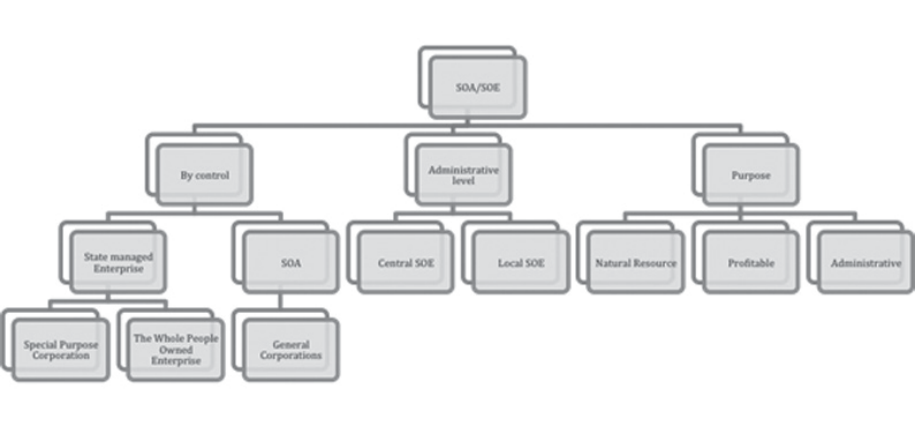
B. DYNAMICS OF THE SINGAPORE MODEL: A FURTHER MUTATION
The SOE transformation was generally designed prior to actual practice, in contrast to the successful experience of DENG’s “feels the stones to cross the river” strategy, although in reality the process still involved many trials and still required practice to determine workable schemes. In the SOEs’ transformation process, many competing forces fought with each other, and the results of reform deviated from the initial blue print’s purpose. Once the transformation was almost completed, such dynamics resulted in unexpected outcomes that magnified the design’s defects. Around the middle of the first decade in the new century, the Singapore model’s transformation was nearly finalized and received an official confirmation as promulgation of the ESOAA. Reality, however, always posed unexpected dilemmas. After the establishment of the Singapore model, the well-functioning system in theory met harsh dynamic social movements in reality, revealing loopholes or flaws in the system design as embedded in the Chinese context of legal institutions.
1. Managerial Rights Battles
The separation of administration from business management had been set up as one of the top priorities of reform, at least in the eyes of mainstream independent opinion. This goal required the SOE’s superior unit in charge(上级主管单位)as an administrative agency to give up power and reallocate specific command to the SASAC. In the Singapore model, state ownership was not necessarily a concept, and its realization would not rely directly on an administrative organ as a state’s interest realization mechanism. With standard corporate governance, all powers were vested in the corporate board, which also determined the roles of directors, paid attention to system design, monitoring, and capital management, and did not necessarily require specific industry knowledge. In the Chinese model, however, using the concept of state ownership to design corporate governance rules meant that all powers should be allocated to shareholders, and therefore ultimately majority blockholders, and the board thus was deemed as only an executive commission of the shareholder meetings. Managers were usually appointed by major shareholders directly, and the board still played a traditional role as strategic management,
90 which required that directors and managers have experience and knowledge of the corporation’s industry and business. The SASAC did not have this kind of elite manager in such broad industries, and actually was incapable of executing shareholder rights through appointing directors and managers, especially for closely held corporations which normally hid behind publically held corporations. The separation of administration from business management did not consider the real need for voting to decide major decisions inside the corporation. And in general, who should be representatives for major business decisions? Therefore, even though the SASAC in theory represented state ownership and had authority over all kinds of share rights, in reality it still needed industrial regulation agencies to recommend chief officers, and ultimate share controlling corporations to execute shares rights in the SOE corporations. To change this awkward situation, the SASAC began many rounds of head hunting and tried to build up a specialists pool, but until now it has not performed this function well. This paradox comes from: (i) corporate governance requires a shareholder meeting as an ultimate organ for corporations; (ii) the SASAC should not act as a full shareholder especially for voting and making vital decisions; and (iii) the proposition of separating administration from business and regulation was totally an illusion and paranoia, for SASAC still used a regulatory way to manage the top level SOE corporations and put many administrative rules on corporation’s actions.
The first symptom was exemplified by the SOE banks and securities corporations. In 2003, a newly founded ultimate controlling corporation in banking, Central Huijin Investment Company Limited (Huijin), announced that it would send out “share rights directors.” Prior to then, a SOE bank corporation theoretically should be under the jurisdiction of the SASAC. The concept was odd as it was not supposed to make a difference with employee directors, which was a mandatory requirement for state solely owned corporations, though in reality not a single SOE corporation had one employee director. Therefore, when Huijin purposed the concept, which meant it would supplant the SASAC as a SOA representative in the banking industry, with it superior political bargaining power and a reasonable excuse, it effectively took away the SASAC’s supposed power over SOE banks. The move resulted in the clear ESOAA rule, banking was considered out of the sphere of SASAC jurisdiction, and Huijin became famous for it nickname as the “banking SASAC.” The very first case showed that the principle of separation of administration from regulation and business could not be sustained.
Recently, it was reported that the Ministry of Finance (MOF) intended to set up “Huijin II,” called the “State Owned Capital Management Corporation,” to take over the SASAC’s SOA representative for central SOE corporations.
91 The MOF officially attacked the current SASAC-lead SOA system, resenting the complex and comprehensive regulation, “from managing people, managing matters, to managing assets,” which did not conform to the basic principle of separation of administration and enterprise direct management. Using Huijin as a successful example, the MOF accused the SASAC of blending the SOE’s administration into its own affairs, and not doing a good job of being a representative of the state as shareholder. The SASAC fought back against the MOF, trying to go back to the planned economy style, and insisted on its managerial model should not copy Temasek exactly, which also violated the separation of administration and enterprise direct management, for those purposeed Temasek style capital management corporations were under the direct command and control of the government.
92 It was interesting that both sides emphasized the principle of separation of administration and enterprise direct management, and both sides actually showed a very strong intention to copy the Temasek model to organize several ultimate holding corporations.
93 In my estimation, the real question is that it was just a struggle for agency power, and maybe, for revenue collections as the SASAC did not have any motivation to turn over the collected dividends from SOE corporations to the national treasury, the MOF.
The battle over the control of SOE corporations in the name of shareholder rights realization also happened in the SEC and the SASAC over securities corporations. Securities corporations passed through an arduous change process directed by the SEC, and diversified ownership was step-by-step merged into the hands of SOE securities corporations, which were based on the need for collective actions to implement the SARC’s industrial policy in a tacit way. In Prime Minister Wen Jiabao’s administration, Wen purposed that all securities corporations should be placed under the SARC’s management both for industry regulation and SOA management. Although the idea was not realized, it was an example of the SASAC’s inability to specifically manage key industries.
Many SOE corporations were actually controlled by former industry regulators either through nomination of leading officers or by coordination at the government level. A major SOE corporation’s leading officers’ appointments had to be approved at certain levels of the CCP’s organizational department according to the SOE corporation’s administrative level, and top leaders of local governments often had real authority to decide candidates.
Through indirectly appointing high officers in the SOE corporations, former superior units in charge indeed regained de facto control over the SOEs. The SASAC was not reconciled to the loss of power over SOEs, and was afraid its equity value would be shrunk by managers appointed by another bureau. As a remedial measure for ensuring the symmetrical value of equity and assets in the SOE daily operations, the SASAC set up a “general legal counsel” position inside the SOEs. Under the SASAC’s direct control, the appointees were required to be listed as high officers and allowed to perform a check and audit function of the SOEs’ daily work (though they had no legitimate basis in corporate law). The SARC similarly inserted a higher officer directly reporting to it into all of the securities corporations.
Battles over de facto control of the SOEs is ongoing, as verified by the loophole of managerial rights in the bundle of shareholder rights. The proposition of separation of administration from regulation and business, moreover, was also just a naive route of the map drawer’s own wishful thinking. Battles for representatives, director appointments, dividends collection, and re-distribution all evidence the self-expansion of administrative powers, against the background of lack of accountability and constitutional constraint. If government regulation is still involved with its direct business running, however, the SOE model would go back to it starting point despite the huge social costs in the transformation to the Singapore model.
2. Failure for Efficiency-oriented Management Improvement
Backing the SASAC, Huijin won the battle over control of SOE banks, but still used a model of corporate governance similar to the SASAC’s mutated Singapore version. Faced with the coming challenge of the WTO treaty opening up the financial markets, the government worried Chinese SOE banks could not compete with foreign banks in management. From 2005, ZHOU Xiaochuan purposed a concept called “strategic investors,” introducing internationally experienced banks like Bank of America, Goldman Sachs, Allianz, American Express, Asian Development Bank, Citigroup, Credit Suisse First Boston, Deutsche Bank, and J. P. Morgan, as a new participant and non-controlling shareholder in Chinese SOE banks. Those investors were required to make contributions to the SOE banks’ capital, and in exchange get a certain ratio of the bank’s shares at a bargain price. But the real purpose of introducing foreign investors as a partner to the monopolized SOE banks was to introduce “advanced management experiences” into the Chinese SOE banks. The experienced, professional and international partners were supposed to provide their internal management knowledge, strategies, and experience to the less knowledgeable SOE banks and thereby improve the latter’s corporate governance performance.
In the case of the China Construction Bank (CCB) and Bank of America (BOA) deal, for example, BOA obtained 30% of CCB’s shares and thus became a strategic investor. The two parties set up a close relationship in daily business, and built up many mechanisms for attracting depositors and consumers, like Sino-American small amount personal fund transferring. Before BOA became involved with CCB, CCB did not have a full member board and followed a traditional way of appointing top leaders directly. After the two parties became partners, Huijin immediately sent out directors selected from retired former high officers to fill vacant positions on the board, and opened up just 50 middle level manager positions for BOA, aiming to learn some specific “advanced management experience.” No doubt this move would be contrary to BOA’s expectation of getting into the Chinese banking services market. After years of failed investment purposes, BOA gave up and stopped waiting for a power switch. After CCB went public, BOA sold its shares at a high premium. ZHOU was then attacked for the loss of SOAs (due to introducing strategic investors) and for not opening the gates to the domestic private sector, while in the industrial SOE enterprises MBOs were halted by the SASAC due to public opinion against privatization.
The desire to maintain control over the SOEs and SOAs and improve SOE efficiency and competitiveness through only limited management control are contradictory, and bank reform evidences the internal conflicts of the Chinese-style Singapore model.
3. Equality of Shareholders
As a combined and revised version of the Ch’ing Dynasty business law and Taiwan company law, Chinese corporate law maintains a nineteenth century theoretical foundation.
94 A corporation was deemed similar to a partnership enjoying independent legal person treatment.
95 At the same time, legal capital exemplified an earlier regulatory type of corporate law and still was accepted as an iron doctrine by most legal scholars, judges, and practitioners. A shareholder had to make certain kinds of capital contributions to obtain an equivalent value of shares in every round of capital raising, while a series of regulatory rules maintained that share par value was a justified intrinsic value. Moreover, “one share one vote” and “equal rights for equal shares” were scrupulously abided by both corporate law and security law. Legal capital served as a bottom floor for corporations, and determined the shareholder’s rights as a benchmark. Under these rigid restrictions, China did not need, and indeed did not develop, a complex and flexible equality of shareholders.
The situation was challenged by the entry of SOE corporations into public capital markets. The SARC regulations for going public were not only intended to protect investors through information disclosure and prevention of insider transactions just like its worldwide peers did, but also were tasked with promoting the development of the capital markets. The SARC was required to control market access in consideration of industrial policy under the current legal regime dominated by an administrative style. Qualifying or obtaining approval from the SARC for an IPO (Initial Public Offering)required close scrutiny over matters like corporate governance, financial condition, business history, shareholder structure, asset fidelity and legitimacy, business profitability, future dividends policy, and whether the business coincided with industrial policy. In ZHU Rongji’s administration, the public capital market played the role of the SOEs’ financial savior, and high scrutiny ensured most corporations going public were SOEs. The number of corporations, scale of IPOs, and even distribution for every province were planned by the NDRC, and resulted in a huge gap between supply and demand, and therefore high mass speculation. Demand far in excess of supply raised stock prices, and no one cared about the quality of stock or naturally, the performance of the SOE corporations, severing any link between stock price and performance of corporate governance.
The SOE corporations went public to raise capital from the mass of public investors, but control over corporations still needed to be retained by the state, directly or indirectly. State owned shares were classified as promoter’s shares. Many SOE corporations’ promoters also included some other public agencies or corporations, their holding of stocks referred to as state owned legal person held shares. To maintain the majority shareholder status and protection of SOAs, state owned shares were forbidden to circulate, and state owned legal persons holding shares were limited to exchanges with its public agencies or corporation peers. After going public, individual and institutional investors bought newly issued shares, namely circulative shares, at a very high premium compared to the promoter.
Therefore, a strange situation appeared: according to the black letter law, all shares were identical and entitled to equal treatment both in voting and dividend distributions, but in reality shares were divided into three kinds and sometimes a fourth type, staff shares. Cracks within the institutional dynamics emerged. Fully circulative shares, which were bought by investors at a high premium after an SOE’s IPO, contributed more to the corporate capital, while state owned stocks or state owned legal person held stocks normally just made contributions for corporate capital at par value. The corporate capital was coming mainly from contributions of full circulative stocks, therefore, public investors holding such stocks would feel voting rights allocation and distribution proportions were unfair. In a famous case in 2004 involving the “China Merchant Bank Convertible Bond,”96 public investors through trust fund managers complained that the majority shareholders, which were eight SOE corporations as incorporators, paid just one Yuan (RMB) for one share, while public investors paid ten times that amount as capital contributions for one share. Although different prices at various times were the most common occurrence in the capital market, such complaints revealed an unfair feeling over the huge gap in voting rights allocation between the two kind of shareholders. The SARC immediately announced a notorious regulation, class voting, which required any fundamental transaction or corporate change must obtain a plurality approval in each kind of shares. This time the pendulum swung to the other side, in the China Merchant Bank share structure, public full circulative shares composed only 30% of all shares, therefore, dissenters representing only 16% of the total share capital would be able to block a deal. The class voting rule could not justify itself, for the SARC did not provide the same treatment to foreign investors in the B share market.
In some earlier cases, the opposite outcome happened as state-owned stocks encountered discrimination, especially in relation to some local SOE corporations. Those corporations made dividend policies according to the shareholder’s contribution rather than shares since in a speculative market circulative shares made a larger contribution to the corporation. The distribution of dividends according to contribution, moreover, was much fairer in many people’s minds for in the transformation of a SOE in a bad financial condition, the SOE promoters’ capital contribution consisted mostly of land, equipment and buildings devalued by high debt prior to IPO. Compared to the new investors’ monetary contributions, those assets were unrealizable for cash. Some corporations took a strategy in dividend distribution favoring circulative shareholders considering their capital contribution, and then the SASAC promulgated many rules for forbidding this kind of corporate distribution policy.
97 Those cases represented an opposite example of the so-called equality of shareholders, and the SASAC called it discrimination against state owned stocks.
In order to solve the problem of separately classed stocks, the central government and SARC from 2005 to 2006 undertook a non-tradable reform. State-owned stocks and state-owned legal person held stocks were supposed to be non-tradable, the former was de jure forbidden and the latter was de facto blocked due to complex procedures and a massive scale that eliminated any potential buyers. The reform aimed to remove legal obstacles for tradable shares and to create a fully circulative stock market, though non-tradable shareholders bribed public shareholders. After the reform, in some cases tradable blocks of share were unloaded to the stock market, triggering a price avalanche and causing the SARC to go back for a new kind of split market and force any block transaction above 1% to be traded in a block transaction system. Through ups and downs under constantly changing rules, a unified capital market finally was established, which would benefit the equality of shareholders, but at current it mostly exists only on paper.
New unequal shareholder treatment problems occurred in the cross-listings of gigantic SOE corporations. Sino-petroleum (China National Petroleum Corporation, CNPC) cross listed in mainland China and Hong Kong, through a voting trust certificate, raising 2.9 billion dollars in the U.S. and in 2012 distributing 11.9 billion dollars to American investors.
98 As a comparison, Sino-petroleum in the Chinese A stocks market issued a dividend that was less than 1.5 Yuan for every ten shares. This unequal dividend policy incited a great wave of public criticism, considering the company’s SOE nature and monopolistic privilege domestically.
Equality in China is a serious problem from every perspective, not only among shareholders. The question has not attained a consensus among corporate scholars, let alone been answered by legislative and judicial action. The problem revealed a legal capital regulatory dependency, which was used to maintain fairness between shareholders and serve as a tool for measuring the SOA’s value. If par value did not need to match the intrinsic value of the SOE corporations, the SASAC would not have a tool to evaluate SOAs and maintain its current managerial system’s work. Its step-by-step approach became a vicious cycle, and the SASAC needed to watch over both the value of shares and the corporation, and therefore needed to enhance legal capital regulation.
Graph 5: Dynamics of the Failure of Capital Market
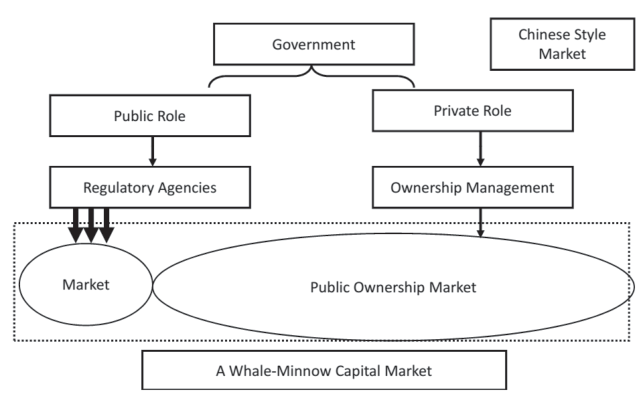
4. Franchised Industry
High market entry provided SOE corporations with huge advantages in capital accumulation, and most of their business belonged to monopolistic industry lines which facilitated a constant and steady income stream. With their deep pockets, these corporations started investing in the most profitable business sectors, which at first consisted of the real estate market. In a real estate bubble, these SOE corporations often leveraged their advantageous political and economic power to obtain local landuse rights, resulting in some of them even being referred to as “land kings” ( 地
王, the highest bidder for land use rights). This process pushed real estate prices higher, which ordinary people found intolerable. Their monopolistic positions in particular sectors, which frequently resulted in poor services for the people, combined with their competition in the private sector for profitable business opportunities eventually exacted a heavy toll on the people’s daily life and drew a massive objection from the people.
Responding to public opinion, meanwhile, and as a precaution for a potential burst of the real estate bubble, the SASAC in 2006 set up the “main business line” rule for all central SOE corporations.
99 The SASAC started a one-by-one confirmation process to determine every central SOE’s main businesses, and the assets of non-core businesses were then required to be sold, restructured, or freely reallocated to other SOE corporations, with the franchise of main business certificated and approved by the SASAC.
The SASAC’s regulation, however, was just an ad hoc measure for this systemic problem. Many paradoxical questions arose. First, based on the Singapore model the SOE corporations with deep pockets were supposed to be greedy and profitable, and the SASAC’s restrictions on outside business investments violated the nature of SOEs as a private enterprise and caused a series of chain reactions. Second, all of the respective SOE corporations were also publically held corporations, so an administrative order to require those corporations to give up profitable business opportunities, even diversify existing assets, ignored that those kinds of decisions should be passed through corporate shareholder meetings and might be deemed as an abuse of controlling positions in the corporate act, although this kind of behavior happened frequently. Third, the SASAC violated not only the corporate law, but also the ESOAA’s rule that its task was to manage the equity of SOE corporations rather than their assets. Those remedial measures for main businesses in reallocation or mandatory sales, however, were actually a deep intervention in internal corporate affairs. It was an ironic solution after decades of hard efforts to separate administration from regulation or business, and maintain the independent legal status of SOEs.
The central SOEs’ retreat from real estate was just the beginning, and other similar problems followed close upon one another. It was a systemic problem rather than a contingent event, for the initial purpose to adopt a revised Singapore model was to save the bad financial situation of the SOEs, and its designers did not expect one day through unfair public offerings that the SOEs would turn into robber barons.
5. Konzern and Financial Empire
Another SOE corporation gold rush happened after the real estate rush, with the current updated version being SOE corporations investing in the finance, banking, and securities industry. With gradual deregulation in banking, finance, and private equity by the China Banking Regulatory Commission (CBRC) and central banks (the People’s Bank of China, PBC), and industrial production being trapped in depression, banking as a monopolistic business with various spreads reaped huge profits. The possibility came from SOE banks going public to raise capital for rebalancing their debt to equity ratio. Since bank shares now had become tradable, and the industry was attractive enough for revenue, SOE corporations started to invest in shareholdings in all kinds of finance, banking, insurance, and private trust corporations. It has been reported that 87 of a total of 117 central SOE corporations had already entered the finance industry through share holdings.
Notwithstanding that the SASAC’s main business rule had been promulgated, a combination of industry and finance did not fall into the sphere of regulation. Most importantly, the SASAC had shown two minds—both positive and cautious attitudes concerning a combination of industry and finance were delivered simultaneously.
102 Just like the main business problem, the current situation fell beyond the initial design of the Chinese version of the Singapore model, and no theoretical support offered a clear attitude towards the new questions. Although the rationality and legitimacy of combining industry and finance was still in question, under the current market, the SOEs through turning themselves into konzerns could definitely reap the cream of Chinese economic development and obtain the most valuable business opportunities.
6. Asymmetric Competition and Abuse of Monopolistic Power
Because the government largely ignored general equality, unfair competition plagued China’s markets, and even with the promulgation of the anti-monopoly law, competition questions still were a serious problem. Without a clear definition of public goods, most Chinese SOEs were designed simply to operate “key strategic industries.” Because of the nature of their legitimate business, the SOEs were immune from the antitrust law, although different dissenting explanations may have been formed from the ambiguous Article 7 of the Anti-monopoly Law. With their de facto bargaining power as gigantic corporations with both tremendous capital resources and high administrative influence, the SOEs competitive (or anti-competitive) behavior was rarely challenged.
The SOEs, however, still were positioned as profitable organizations, and competitiveness was also a design of the Chinese version of the Singapore model. Without actual financial constraints and instant revenue requirements like a natural person as shareholder, the SOEs’ competition in China has two obvious features. Between SOE corporations, especially in an industry with network effects, like telecommunications where competition has focused on scale of network rather than instant investment return, cut-throat competition has happened regularly. China Telecommunications, China Unicom, and China Mobile are set up to compete with each other, and their conduct in some areas goes far beyond fair business competition. In 2003, the local subsidiaries of China Mobile and China Unicom fought with each other so far as to “use scissors” to cut off the rival party’s communication lines. The Supreme People’s Court even organized a forum for all parties involved in public communications in Chengdu, to announce that using scissors to damage public communication lines and purposely block interconnection between networks would be punished as a felony.
Competing among SOEs and other corporations, privileged SOEs often leveraged their immunity from the anti-monopoly law to blackmail, boycott, or otherwise economically threaten others to fulfill their expansion purposes. It was reported that Sino-petroleum, to expand its industrial line to natural gas and thereby realize its ambition of building an energy empire, in Western areas used the threat of cutting off the gas supply to buy out local gas stations.
104 This case was just the tip of the iceberg, and most such competition has been covered over by the gigantic corporations massive ability to control public opinion and leverage the national information control and filtering system. The cutthroat competitive behavior of SOEs was an unexpected result of the Chinese version of the Singapore model, and is only worsening.
7. Duty of Common Calling in Public Service
The public service’s common calling story may be the height of paradox in the Chinese version of the Singapore model. Having adopted a continental legal system, and as a reaction to heavy administrative regulations, laissez-faire now has become a dominant, politically correct ideology among legal scholars, lawyers, economists, and even some judges and officers. No clear concept and legal institution of a common calling duty has existed in Chinese legal culture. Unlike in Western countries, Chinese law did not require public goods providers to perform specific corporate duties, such as care about various stakeholders’ interests, price fairly, ensure a higher standard of product quality, cooperate with both upstream and downstream business partners, and even open its platform as a common carrier for its rivals.
105 In the planned economy times, such duties were not specified in rules, for the SOEs were considered as braches of government. In the market economy times, however, the SOEs turned into market competitors, and thus needed to be regulated like a private corporation. The SOEs’ dual role made an impression on the regulators; they could both be good civil corporations and pursue profits. The only thing that needed to be promulgated into black letter law was to build up a legal system of price regulation, and therefore, public goods providers’ common calling duties were neglected by lawmakers.
When the SOEs became market participants in pursuit of profits, they inevitably faced many situations where some stakeholders’ interests would be sacrificed. The SOE corporations competed even more fiercely than normal corporations, for some of them enjoyed monopolistic privileges or real market power by way of their gigantic assets or almost unlimited financial capability due to government paternalism.
106 The SOEs’ irresponsibility caused a strong backlash from the public, and the CSR (Corporate Social Responsibility) in 2005 thus promulgated a corporate law to remedy the situation. In corporate law, a mandatory duty of the CSR for all corporations was inserted as a black letter rule, giving rise to much controversy among corporate law scholars. The dynamics in reality reflected the institutional loophole just using Price Law as a foundation for distinguishing the public and private duties of an enterprise. It evidenced a clumsy public affairs regulatory legal system, and in particular a narrow vision and understanding among intellectuals in their knowledge provisions.
After the SASAC placed some restrictions on their profitable businesses and the NDRC continued to set up a limited space for pricing, most existing SOE corporations faced a dilemma: price regulation from the NDRC on public services limited their profitability, which had been the Singapore model’s main purpose to measure their performance, and business regulation from the SASAC forbade them from other profitable investments. The result was those public service corporations being set up as profitable enterprise could not meet the ESOAA’s requirement of “maintenance and appreciation of values for SOA.”
The SASAC’s attitude towards this dilemma has oscillated. A vice chairman, Shao Ning, publically purposed a new classification for SOEs, one was “public-benefit SOE” and the other was “competitive SOE.” SOEs with public-benefit elements concern public welfare and tend to be a monopoly, with their products and services regulated, and thus they should not be measured by the current criterions of profitability. Anyone learned in some basic economics or law would realize that this classification was supposed to be a classical division between public goods and private goods, but Shao did not cite any words from “advanced experience” and made up a new concept in a very Chinese bureaucratic expressive way. The SASAC immediately released an official announcement to deny Shao’s words, clarify that the concept of a “SOE with public welfare elements” differed from a “public-benefit SOE,” and the latter was a journalistic misreading. What the SASAC intended to express was that no monopolistic SOEs existed and all SOEs should pursue profits.
107 The SASAC’s slapping its own face only evidenced an internal contradiction over the SOE’s supposed role. After two decades of struggling for a private-like corporation transformation, things now have swung to the other side, and turned around in a circle to the original position.
After the current administration announced SOE reform would move towards a “mixed ownership system,” the SASAC was provided with a chance to fix the problem and allowed to take a trial and error reform strategy to find some good examples without first strictly following the existing black letter rule. Intending to solve the dilemma of public service corporations, the SASAC and its branch offices at the local level were urged to promote a so-called “categorized management,” which mirrored SHAO Ning’s proposal, as a solution.
108 Sophisticated categorizing divided the SOE corporations into four types: (i) pure public-benefit SOEs, including the military, cereals, and salt industries, aimed at establishing as a public service; (ii) pure competitive SOEs, including automobile manufacture and the electronics industry in pursuit of profits; (iii) mainly public-benefit and supplementary competitive SOEs, like the petroleum and telecommunication industries; (iv) mainly competitive and supplementary public-benefit SOEs, without mentioning any specific industries yet. The SASAC, ironically, however, seems to have lost jurisdiction over public service regulation, and is back to its original position, after three decades of experimenting with a Chinese style SOA system.
IV. CONCLUSION
SOEs indeed are a positivistic human invention and no doubt embedded in a larger social context, and also perhaps inevitably involve too many stakeholders. With China’s bold process of transformation causing huge social costs and economic suffering by countless people, some of the country’s leftists have even claimed that one or two generations have sacrificed themselves for the transformation, and the SOE’s indigenous evolution in China has now gone in an unanticipated and dark direction. The reason for the departure away from the initial motivation or purpose, if we conduct a general survey without examining detailed choices and compare the final result with the Singapore model, rests in the government as principal without any restrictions on or accountability of it. By adjusting the duties of only the agent, China’s SOE system could not solve its principal-agent dilemma.
In theory the government represents the whole people in owning SOAs, but in an era of “economic reforms first,” its power and accountability have not been (and perhaps could not be) constrained legally. We may easily identify that all of the abovementioned institutional dynamic problems lie on the “principle” side of the equation. These institutional dynamic problems can be categorized from three perspectives. First, bureaucrats have used the SOEs to pursue power and face no real accountability for their abuse or expansion of such power. They fight against each other and prevail based on their bargaining position in the state council, rather than following set market practices or legal rules. In this vein, they often exert great effort to exclude any other possible power sharing partners and thereby maintain tight control over the SOE corporations. In short, the management rights battle trophy has been won through the political power of various ministry leaders, and this contest is both on-going and may determine the next step of the so-called “mixed ownership” reform. The failure in the name of SOA protection to introduce a strategic investor is one example of the bureaucrats acting in their self-interests and increasing their power.
Second, through their countless ties to bureaucrats, the SOE corporations act as robber barons and generally overwhelm their competitors and otherwise plunder the country’s best economic opportunities. Without any real financial constraints, SOE corporations, for example, can easily be the highest bidder for prized real estate or first movers in the finance and securities industries. They monopolize profitable business opportunities either directly by entering into the industry or indirectly by holding majority share positions in important players.
Third, the imbalance in the rights and duties of the private-like SOE corporations has resulted in the controlling shareholder often taking advantage of the other stakeholders. This problem is acute in China’s civil law and formalistic legal tradition (which often takes long to change) as well as the country’s current laissez faire economic ideology. Minority shareholders, employees, non-SOE creditors, and management have constantly faced serious, rigid, and unreasonable regulations from the SASAC, all in the name of SOA protection. Indeed, when the SASAC treats everyday people like SOA thieves, they are gradually placing themselves in opposition to the people, and thereby giving rise to a crown property model. By insisting on the sanctity of SOA, generations of bureaucrats imply they have a noble task and political legitimacy. At the same time, however, they forget that in socialist China the state should be governed and owned by the majority of people.
In moving from state property to crown property, the SOE transformation diverged from its original purpose and has been captured by the bureaucrats themselves. This divergence has been constant and widespread; when I refer to SOE alienation from the Singapore model, however, after reviewing the whole process, we may identify several levels of meaning to this word. The first level of divergence is that in the Chinese version, the components of the Singapore model have almost all been changed or even swung to the opposite position. Transferring almost all powers to the SASAC and separating administration from regulation and business now is challenged by the experience of many industrial regulatory agencies, including even the SSAC’s former overseer, the MOF. The aim of building up independent private corporations and profitability as a core idea for the SOEs was denied by the SASAC itself in the process of executing state ownership. Most ironically, prior to the share system, SOEs were accused of undertaking too many social services, and now are required to make more contributions for corporate social responsibility. The only change is that SOEs have escaped their dire financial situations and now have deep pockets. Since whether SOEs should undertake social services depends only on their financial status, why bother to change their role and internal governance?
The second level of divergence is the reversed positions of the private and public sectors. Chinese economic reform began in an incremental style, with the private sector emerging with deregulation. Selling off small and medium SOEs and COEs, or reorganizing large SOEs by going public, generated capital contributions from the private sector and saved the SOEs from insolvency. Now, SOEs with deep pockets are swallowing up private sector players, at least the most profitable business opportunities or industries. Public feelings about the SOEs have always been complex, but in the beginning few people purposed to give up SOEs, while now most people support doing so.
The third level of divergence is the shift in the meaning of SOEs from public ownership of the whole people to private property of the state. Why should a state set up a system of SOEs that dominates the whole economy and is directly run by various levels of government? The entire public sector is supposed to serve the public interest, not the state’s private interests. Maintenance and appreciation of value for SOAs gradually has become the sole purpose and task of the SASAC; and therefore, the whole people’s property has fallen into the government’s self-interested hands. Any modern state, including the socialist countries, and its people’s relations have been interpreted in a social contract way, but with this operation, the SOA has been turned into Crown property.
What kind of institutional system will come out of the recent political decision’s “mixed ownership” in the next stage of SOE or SOA management reform remains controversial, but most probably it will be just a patch to continue the current Singapore model, considering the following constraints: (i) the concept of mixed ownership reveals an underlying understanding of corporations in a property rights way, (ii) the ordinary people still associate SOEs with past and present national glory, and (iii) the reform will be conducted mainly by the bureaucrats themselves. The Sinolization as an evolutionary process and deviation from the initial Singapore blueprint may provide some hints— just like an ancient Chinese philosophical saying: history tells us the future. Through comparing the blueprint and midway result from a historical perspective, we can identify that some doctrines like taboos cannot be shaken. The hegemonic state power, for example, is unlikely to distribute stocks to individual hands or give up profitable enterprises and thereby decrease its own influence.
After the early 1990s’ great debates over China’s SOA problem, the Singapore model gradually gained traction with the country’s top leaders. Although the SASAC still did not recognize its administrative system as a facsimile of the Temasek model, for no one ultimate controlling corporation took full responsibility for a state owned capital market management, the SASAC was set up to represent and manage the whole people’s property, both as a shareholder and a regulatory body. The SASAC regularly has used the doctrine of separation of administration from business management to gain control over SOE corporations from other agencies (other administrative branches could take responsibility for regulation but not be involved in the SOE’s management). At the same time, however, the SASAC could not justify its position as manager of SOAs and could not directly make business decisions as a shareholder in a specific contingency to attend a corporate shareholder meeting. Therefore a conflict has emerged between the doctrine of separation of administration and business management, and the doctrine of avoiding nihility of shareholders in a specific SOE corporation. That is why people emphasize China’s current SOE system is a copy of Singapore, although the SASAC denies it. If all shareholders’ rights transfer to the Huijin style’s Chinese Temasek to fulfill shareholder rights, what will be the SASAC’s sphere of influence?
When I asserted that China’s current SOE system copies the Singapore model, the reasons were based on China’s learning history and the similarity of the two systems’ main characteristics, including a lack of distinction between public and business corporate legal institutions, the state owned enterprise’s pursuit of profits, and neither any specific limitation nor legitimate privilege on a public corporation’s capability. From a legal perspective, the current Chinese SOE system can be clearly distinguished from the civil law countries’ “public legal person” institution, although China normally claims to be following a German legal tradition.
To seek a sustainable future for the Chinese SOE system as well as fulfill the SOEs’ social efficiency and public duties, the state must realize that it needs a well-functioning constitutional infrastructure and then delegate or even give up its power in property rights of stocks of corporations. The departure from the SOA’s public nature constitutes a departure of the government from the people’s interests, and if continued will result in the SOEs resembling Hobbes’ metaphorical leviathan.
Notes
- *Associate Professor, Peking University Law School. The author would like to thank Curtis Milhaupt, Benjamin Leibman, and all participants of 2014 Columbia workshop on State Capitalism for helpful comments, Joseph Pratt for his patient corrections and polishing work, and YU Guangjun for her correction on citations in this paper. A short and refined version will be published in Professor Curtis Milhaupt and Benjamin Leibman (ed.), Regulating the Visible Hand? The Institutional Implications of Chinese State Capitalism, Oxford University Press, 2015. ©返回正文
- 1For public opinion about SOEs, especially central SOEs, see, e.g., ZHOU Xuesong, “Central SOEs Getting Monopolistic Colossal Profits Evidences Regulatory Failure,” China Economic Times, November 14, 2011(周雪松:“央企牟取垄断暴利 凸显监管不力”,《中国经济时报》2011 年11 月14 日). See also SU Peike, “Reflections about Central SOEs Colossal Profits,” China Economic Times, September 28, 2010(苏培科:“反思央企垄断暴利”,《中国经济时报》2010 年9 月28 日).返回正文
- 2From 2004 to 2011, banking, oil and tobacco were the most profitable industries in China with a return on assets exceeding 20-50%; even now the rate of return on net assets still exceeds 20%. See GUO Tianyong, “The Arguments about Bank Industry’s Colossal Profits,” March 26, 2012(郭田勇:“中国银行业‘暴利’之争”,2012 年3 月26 日), available at http://www.ftchinese.com/story/001043808, lasted visited April 4, 2015.返回正文
- 3DENG Feng, “The Nature and Transaction Consideration of State-Owned-Assets,” Science of Law, No. 3, 2006, pp. 118- 120(邓峰:“国有资产的定性及其转让对价”,《法律科学》2006 年第3 期,第118-120 页).返回正文
- 4See e.g., State Council, Certain Opinions about Further Promoting Capital Market Health Development, No. 17 [2014], May 9, 2014(国务院:《关于进一步促进资本市场健康发展的若干意见》,国发[2014]17 号).返回正文
- 5See WU Xiaobo, Momentous 2000 Years, CITIC Publishing, 2012(吴晓波:《浩荡两千年》,中信出版社2012 年版).返回正文
- 6See XIONG Yingwu, “Historical Explorations for SOE,” Seeking Truth, No. 5, 1996, pp. 32-36(熊映梧:“国企的历 史考察”,《求是学刊》1996 年第5 期,第32-36 页).返回正文
- 7See HOU Jiaju, History of Fiscal and Finance Institution in China, Linking Publishing, 1989, pp. 156-173(侯家驹:《中国 财金制度史论》,联经出版事业股份有限公司1989 年版,第155-173 页).返回正文
- 8Ibid, pp. 71-75.返回正文
- 9See M. Schmitthoff, “The Origin of the Joint-stock Company,” University of Toronto Law Journal, Vol. 3, 1939-1940, pp. 74-96. See also Ron Harris, Industrializing English Law: Entrepreneurship and Business Organization, Cambridge University Press, 2000, pp. 1720-1814.返回正文
- 10See Morris L. Bian, The Making of the State Enterprise System in Modern China: The Dynamics of Institutional Change, Harvard University Press, 2005.返回正文
- 11See SUN Yat-Sen, The Triple Demism of SUN Yat-Sen, trans. by Pasquale d'Elia, AMS Press, Inc., 1974.返回正文
- 12See MAO Zedong, “Founding Manifesto,” The Shian Kian Weekly Review, July 14, 1919(毛泽东:“创刊宣言”,《湘 江评论》1919 年7 月14 日).返回正文
- 13See XU Zhide & LI Linghe, History of Management Development for Public Ownership Enterprise in China, Shanghai Academy of Social Science Publishing, 1996(徐之德、李令河:《中国公有制企业管理发展史》,上海社会科学院出版 社1996 年版).返回正文
- 14See NIU Jun, “The Origins of the Sino-Soviet Alliance,” in Odd Arne Westad (ed.), Brothers in Arms: the Rise and Fall of the Sino-Soviet Alliance, Stanford University Press, 1998.返回正文
- 15See CHEN Yongjun, “Why Did China Choose Planned Economy in the 1950s?,” Researches in Chinese Economic History, No.3, 2004, pp. 56-64(陈甬军:“中国为什么在50 年代选择了计划经济体制?”,《中国经济史研究》2004 年第3 期,第56-64 页).返回正文
- 16See generally, Maurice Meisner, MAO’s China and After: A History of the People’s Republic (3 rd edn), Free Press, 1999.返回正文
- 17See KONG Hanbing, “How the Soviet Union Model was Enhanced in China,” Russia Studies, No. 4, 2002, pp. 78-79(孔 寒冰:“苏联模式是如何在中国被强化的”,《俄罗斯研究》2002 年第4 期,第78-79 页).返回正文
- 18Ibid.返回正文
- 19See generally, DONG Fureng, et. al. eds., Centralized and Decentralized Powers, Economic Science Press, 1996(董辅礽等: 《集权与分权》,经济科学出版社1996 年版).返回正文
- 20See DONG Fureng, et.al., “China SOE Reform: Incentives, Environment, Behaviors and the Next Step Choice,” Social Science Front, No. 2, 1993, pp. 44-45(董辅礽等,“中国国有企业改革:激励、环境、行为与进一步改革的抉择”,《社 会科学战线》1993 年第2 期,第44-45 页).返回正文
- 21See HUANG Ming, “The Origin and Progressive Easement of Debt Crisis Between Bank-Enterprises in China,” Management World, No. 6, 1997, pp. 104-115(黄明:“我国银企债务危机产生的根源及其渐进纾解法”,《管理世界》 1997 年第6 期,第104-115 页).返回正文
- 22See KONG, “Soviet Union Model,” Supra note 17, p. 79.返回正文
- 23See HU Ruyin, “Incentive Mechanism and Labor Supply of SOEs,” Academic Monthly, No. 3, 1992, pp. 64-69(胡汝银: “国有企业的激励机制与劳动供给行为”,《学术月刊》1992 年第3 期,第64-69 页).返回正文
- 24See LU Nan, “Evolution of Labor Contract System in 30 Years since Reform and Opening-up,” Social Sciences of Beijing, No. 5, 2008, pp. 10-12(吕楠:“改革开放30 年中国劳动合同制的演变”,《北京社会科学》2008 年第5 期,第10-12 页).返回正文
- 25See generally Charles E. Lindblom, Politics and Markets: The World’s Political Economic Systems, Yale University Press, 1977.返回正文
- 26See e.g., ZOU Dongtao, China: 30 Years of Reform and Opening-up: 1978-2008, Social Sciences Academic Press, 2009(邹 东涛:《中国道路与中国模式》,社会科学文献出版社2009 年版).返回正文
- 27See SHI Jichun & DENG Feng, “Rediscovering Value of Economic Accountability Mechanism for SOE Reform,” Forum of Political Science and law, No. 2, 1999, p. 13(史际春、邓峰:“论经济责任制对国企改革价值的再发现”,《政 法论坛》1999 年第2 期,第13 页).返回正文
- 28See Path of China: Report on Reform and Development of China, China Financial and Economical Publishing House, 1995, p. 81(《中国的道路:中国改革与发展报告(1978-1994)》,中国财政经济出版社1995 年版,第81 页).返回正文
- 29See World Bank, World Development Report: From Plan to Market, Oxford University Press, 1996, p. 22.返回正文
- 30See e.g., DU Haiyan, “Comparative Analysis for Two Round Contracting-out of Industrial Enterprises Across the Whole Country,” Reform, No. 5, 1992, pp. 98-102(杜海燕:“全国工业企业两轮承包比较分析”,《改革》1992 年第 5 期,第98-102 页).返回正文
- 31See MA Jiujie & DENG Feng, Reform Strategies for the Enterprise System, Jilin People’s Publishing House, 1995(马九杰、 邓峰:《企业制度改革方略》,吉林人民出版社1995 年版).返回正文
- 32See LIN Yifu, et. al., Complete Information and SOE Reform, Shanghai Joint Publishing and Shanghai People’s Publishing House, 1997, pp. 16, 89(林毅夫等:《充分信息与国有企业改革》,上海三联书店、上海人民出版社1997 年版,第 16、89 页).返回正文
- 33See eg. ZHANG Jun, Modern Property Right Economics, Shanghai Joint Publishing and Shanghai People’s Publishing House, 1991(张军:《现代产权经济学》,上海三联书店、上海人民出版社1991 年版).返回正文
- 34State Council, Regulation on the Transformation of Operational Mechanism of the Industrial Enterprises Owned by the Whole People, Order No.103, July 23, 1992(国务院:《全民所有制工业企业转换经营机制条例》,国务院令第103 号).返回正文
- 35Ibid.返回正文
- 36See LI Yining, “Ownership System Reform and Share Enterprise Management,” China Reform, No.12, 1986 pp. 25-28(厉 以宁:“所有制改革和股份企业的管理”,《中国经济体制改革》1986 年第12 期,第25-28 页).返回正文
- 37See Henry Hansmann & Reinier Kraakman, “The End of History for Corporate Law,” Georgetown Law Journal, No. 89, 2001, pp. 439-468.返回正文
- 38See e.g., SASAB (ed.), Property Right Management of State-Owned-Asset, Economic Science Press, 1994(国家国有资产管 理局编:《国有资产产权管理》,经济科学出版社1994 年版).返回正文
- 39Almost all research on Eastern Europe and the USSR’s transformation was negative. See e.g., KONG Tianping, “Eastern Europe Economic Reform: Model Selection and Institutional Transition,” Russia and Eastern Europe Studies, No. 5, 1991, pp. 21-26(孔田平:“东欧经济改革:模式选择与体制转轨”,《苏联东欧问题》1991 年第5 期,第21-26 页). See also LI Lin, “Reasons of Economic Grim Situation in Eastern Europe,” World Economics and Politics, No. 4, 1992, pp. 23-24 (李琳:“东欧经济形势严峻的原因”,《世界经济与政治》1992 年第4 期,第23-24 页). Only few studies take a neutral position for shock therapy, see ZHU Xingqiao, “Analysis of Effect of Shock Therapy,” The Journal of World Economy, No. 7, 1992, pp. 69-74(朱行巧:“‘休克疗法’的成效辨析”,《世界经济》1992 年第7 期,第69-74 页).返回正文
- 40See e.g. NIU Junmin & HAN Bingcheng, “Economic System Reform Must Adhere to the Orientation of Socialism: On Impracticability of Economic Privatization in China,” Social Science, No. 6, 1989, pp. 6-11(牛俊民、韩秉成:“经济 体制改革必须坚持社会主义方向——论经济私有化在中国行不通”,《社会科学》1989 年第6 期,第6-11 页). For group opinions against privatization, see also “Persisting in, Improving, and Developing Socialism Public Ownership: Record of Conference held in Peking University for State Managed Large and Medium Enterprise Ownership Reform Theories,” Economics Science, No.12, 1989, pp. 78-79(“坚持、改善和发展社会主义公有制——北京大学‘关于国营大中型企业所 有制改革理论研讨会’记实”,《经济科学》1989 年第12 期,第78-79 页).返回正文
- 41See e.g. WANG Liming, Research On State Ownership, Renmin University of China Press, 1991(王利明:《国家所有权 研究》,人民大学出版社1991 年版). See also, SHI Jichun, On SOE Law, China Legal Publishing House, 1998(史际春: 《国有企业法论》,中国法制出版社1998 年版).返回正文
- 42See e.g., ZHANG Kunlun, “Recognition for Reasons of Embattled SOE,” Economic Theory and Business Management, No.1, 1996, pp. 16-19(张昆仑:“国有企业处境维艰原因的再认识”, 《经济理论与经济管理》1996年第1期,第16-19页).返回正文
- 43Even for outside observers, see e.g. Joseph. E. Stiglitz, Whither Socialism, The MIT Press, 1994. As I know, only the World Bank clearly encouraged China to adopt the strategy of real privatization. See World Bank, China: Between Plan and Market, World Bank, 1990. See also World Bank, China: Reform and the Role of the Plan in the 1990s, World Bank, 1992.返回正文
- 44Many have commented on this topic. See e.g., SU Xiaohe, Black Book of Chinese Entrepreneurs, Chongqing Press, 2010(苏 小和:《中国企业家黑皮书》,重庆出版社2010 年版).返回正文
- 45See FENG Ju & HUO Zhongyan, “Larry Lang Says All MBOs Should be Stopped Until China Realizes the Rule of Law,” National Business Daily, April 18, 2005(冯桔、霍中彦:“郎咸平:中国在法制化未完善前一切MBO 都该停止”, 《每日经济新闻》2005 年4 月18 日).返回正文
- 46See ZHANG Weiying, “SOE Reform in Perspective of Modern Industrial Organization Theory,” Reform, No.1, 1995, pp. 30-33(张维迎:“从现代企业理论看国有企业改革”,《改革》1995 年第1 期,第30-33 页)。See also ZHANG Weiying, “Transforming SOA to Creditor Rights: An Effective Way for Separation of Administration From Enterprises,” Outlook Weekly, No.18, 1995, p. 19(张维迎:“将国有资产变为债权—解决政企不分的有效途径”,《瞭望》 1995 年第18 期,第19 页).返回正文
- 47A translated book received numerous citations and much attention, see David P. Ellerman, The Democratic Firm, The World Bank, published in Chinese as: The Democratic Corporation, Xinhua Publishing House, 1997(《民主的公司制》,新华出版 社1997 年版)。返回正文
- 48See LU Hongwei & HU Yongming, “Comparison and Selection of Models for Socialist Enterprises,” China Industrial Economics, No.2, 1987, pp. 57-62(陆宏明、胡永明:“社会主义企业模式的比较与选择”,《中国工业经济研究》1987 年第2 期,第57-62 页). See also LI Xingsheng, “A Theoretical Analysis of Expansion of Consumption and Contraction of Accumulation in Yugoslavian Autonomous Enterprises,” Foreign Economics and Management, No 5, 1988, pp. 10-13(李幸 生:“南斯拉夫自治企业中消费膨胀与积累萎缩的理论剖析”,《外国经济与管理》1988 年第5 期,第10-13 页). See also ZHANG Jun, “Property Right Structure, Ownership System, and Socialist Enterprise Institution: a Hypothesis of Institutional Innovation,” Economic Research Journal, No. 8, 1989, pp. 3-11(张军:“产权结构、所有制和社会主义企业 制度——关于制度创新的一个假说”,《经济研究》1989 年第8 期,第3-11 页).返回正文
- 49See CHEN Liangbiao, “Theory and Practice of Share Cooperatives of Township and Village Collective Ownership Enterprise,” Study and Exploration, No.4, 1987, pp. 91-92(陈良彪:“乡镇集体企业股份合作制的理论和实践”,《学 习与探索》1987 年第4 期,第91-92 页).返回正文
- 50Even prior to the transformation, many problems emerged. See CHEN Wei, “Confusion about Share Cooperatives,” Enterprise Management, No. 2, 1989, pp. 8-9(陈卫:“股份制的困惑”,《企业管理》1989 年第2 期,第8-9 页).返回正文
- 51For the most important report, see Investigatory Group for Visiting Singapore of Economic Development Research Center of the State Council, “Macro-Economic Management and Efficiency of SOA in Singapore,” Reform, No.4, 1992, pp. 143-148(国务院发展研究中心赴新考察团:“新加坡的宏观经济管理和国有企业的效率”,《改革》1992 年第4 期, 第143-148 页). See also REN Yuan, “Singapore Government’s Management for SOE,” Review of Economic Research, No.2, 1992, pp. 20-23(任远:“新加坡政府对国有企业的管理”,《经济研究参考》1992 年第2 期,第20-23 页).返回正文
- 52See WU Jinglian, et. al., Large and Medium SOE Reform: To Build a Modern Enterprise System, Tianjin People’s Press, 1993(吴 敬琏等:《大中型国有企业改革:建立现代企业制度》,天津人民出版社1993 年版).返回正文
- 53Ibid., p. 71.返回正文
- 54., pp. 240-244.返回正文
- 55Ibid., p. 254.返回正文
- 56See e.g. JIANG Yiwei & TANG Fengyi, “On Value Management of SOA,” Economic Research Journal, No.2, 1991, pp. 3-8(蒋一苇、唐丰义:“论国有资产的价值化管理”,《经济研究》1991 年第2 期,第3-8 页). See also ZHANG Jixiang et. al., “Framework for Institutional Transformation of Chinese SOA Management in 1990s,” Management World, No.3, 1991, pp. 67-81(张冀湘、李春满、柴武常、孙宇明:“九十年代我国国有资产管理体制改革的基本构想”,《管 理世界》1991 年第3 期,第67-81 页).返回正文
- 57See HE Zhenyi, “Exploring the Purpose of Management System of SOA,” Public Finance Research, No. 11, 1988, pp. 35-39(何振一:“国有资产管理体制改革目标的探索”,《财政研究》1988 年第11 期,第35-39 页).返回正文
- 58See DU Feijin, “System of Economic Law and Socialism Commodity Economy (Part II),” Legal Science, No. 6, 1988, pp. 14-16(杜飞进:“经济法的体系与社会主义商品经济(下)”,《法学》1988 年第6 期,第14-16 页).返回正文
- 59See JIANG & TANG , “Value Management of SOA,” supra note 56, pp. 3-8.返回正文
- 60See SHI, “SOE Law,” supra note 42; DU, supra note 58.返回正文
- 61See WANG Liming, “State as a Private Law Subject,” Chinese Journal of Law, No.1, 1991, pp. 59-66(王利明:“论国 家作为民事主体”,《法学研究》1991 年第1 期,第59-66 页).返回正文
- 62WU, “SOE Reform,” supra note 52, pp. 260-265.返回正文
- 63See Aoki Masahiko & QIAN Yingyi (ed.), Corporate Governance Structure in Transitional Economies, China Economic Press, 1995(青木昌彦、钱颖一主编:《转轨经济中的公司治理结构》,中国经济出版社1995 年版).返回正文
- 64See MA & DENG, supra note 31.返回正文
- 65See LIU Peng, “A Survey of Speeding the Reform of the Financial Institution,” Chinese Cadres Tribune, No. 14, 1993, pp. 10-13(刘鹏:“加快金融体制改革研讨会综述”,《党校论坛》1993 年第14 期,第10-13 页).返回正文
- 66See SUN Xiaoliang, “Share System Practice in China,” Management World, No.5, 1992, pp. 66-72(孙效良:“股份制 在中国的实践”,《管理世界》1992 年第5 期,第66-72 页).返回正文
- 67See ZHOU Xiaochuan & YIN Wenquan, “Various Paths for Economic Institutional Reform,” Reform, No.2, 1993, pp. 13-23(周小川、银温泉:“经济体制改革的不同道路”,《改革》1993 年第2 期,第13-23 页).返回正文
- 68See LI Yining, “Enterprise Reform and Transactions of Property Rights,” Qiye Huoli, No.12, 1996, pp. 4-7 (厉以宁:“企 业改革与产权交易”,《企业活力》1996 年第12 期,第4-7 页).返回正文
- 69See e.g., LAI Yongfeng & YAN Zhigang, “Share Cooperatives Went for the End, Nanchang is Pushing Management Buy-out,” Economic Monthly, No.7, 2002, pp. 58-59(赖永峰、颜志刚:“股份合作制走到尽头 南昌力推经营层控股”,《经 济月刊》2002 年第7 期,第58-59 页). See also ZHANG Lanjun & ZHANG Ruiye, “Some Thoughts about Manager Buy-out in a Share Cooperative,” Shandong Social Science, No. 4, 1998, pp. 91-93(张兰君、张瑞业:“对股份合作制企业 经营者控股问题的几点认识”,《山东社会科学》1998 年第4 期,第91-93 页).返回正文
- 70See Max Boisot & John Child, “From Fiefs to Clans and Network Capitalism: Explaining China’s Emerging Economic Order,” Administrative Science Quarterly, Vol. 41, 1996, pp. 600-628.返回正文
- 71See HUANG Shaoan and HUANG Lijun, “Review of Zhucheng Experience,” Reform, No. 2, 1998, pp. 38-47(黄少安、 黄立君:“‘诸城现象’再析”,《改革》1998 年第2 期,第38-47 页).返回正文
- 72See eg., Stoyan Tenev and ZHANG Chunlin with Loup Brefort, Corporate Governance and Enterprise Reform in China: Building the Institutions of Modern Markets, World Bank and the International Finance Corporations, 2002.返回正文
- 73See e.g., DING Ningning, “Regulating SOE’s Property Right Transaction Activities,” Reform, No.5, 1995, pp. 22-29(丁 宁宁:“规范国有企业产权交易活动”,《改革》1995 年第5 期,第22-29 页).返回正文
- 74See e.g., SHEN Zhaozhang, “Loss of State Assets: Not an Ignorable Problem in the Reform of SOEs,” Public Finance Research, No. 4, 1995, pp. 53-55(沈肇章:“国有资产流失:国有企业产权改革中不容忽视的问题”,《财政研究》 1995 年第4 期,第53-55 页). See also FAN Gang, “On the Current Reform of SOE’s Property Rights Relationships,” Reform, No.1, 1995, pp. 17-23(樊纲:“论当前国有企业产权关系的改革”,《改革》1995 年第1 期,第17-23 页).返回正文
- 75See e.g., LIU Xiaoxuan, “Reallocation for Boundary of Enterprises: A Diversification Style of Property Reorganization: A Transformation Model for Medium and Larger SOEs,” Economic Research Journal, No.1, 2001, pp. 3-13(刘小玄:“企 业边界的重新确定:分立式的产权重组—大中型国有企业的一种改制模式”,《经济研究》2001 年第1 期,第3-13 页)返回正文
- 76See e.g., WANG Lide & GUO Changbao, “Regulating Market Transaction and Preventing Enterprise Fake Bankruptcy,” State Assets Mangement, No. 7, 1997(王利德、郭长宝:“规范市场经济行为 防止企业假破产”,《国有 资产管理》1997 年第7 期). See also LI Yefei & REN Weidong, “Fake Bankruptcy, True Evading of Debt,” Reform, No. 2, 1995, pp. 104-105(李业非、任卫东:“假破产 真废债”,《改革》1995 年第2 期,第104-105 页).返回正文
- 77See e.g., Accounting Research Office of Fiscal Research Institute of Ministry of Finance, “Some Question Need to be Researched in Trial Implementation of Share System: Based on Investigation of Shenyang City”, Public Finance Research, No.12, 1988, pp. 24-27(财政部财政科研所会计研究室:“试行股份制需要研究的几个问题——沈阳市试行股份制的 调查”,《财政研究》1988 年第12 期,第24-27 页).返回正文
- 78See e.g., TAN Qiucheng, “Runners Holding Bigger Blockin Township and Village Collective Enterprise: Its Characteristics and Explanation,” Economic Research Journal, No.4, 1999, pp. 45-51(谭秋成:“乡镇集体企业中经营者持 大股:特征及解释”,《经济研究》1999 年第4 期,第45-51 页).返回正文
- 79LIU Xiaoxuan & LI Liying, “An Efficiency Analysis of Enterprise Property Reform,” Social Sciences in China, No. 2, 2005, pp. 4-16(刘小玄、李利英:“企业产权变革的效率分析”,《中国社会科学》2005 年第2 期,第4-16 页). See also LIU Xiaoxuan, “Theoretical Foundation of Rationale in Model Selection for SOEs’ Transformation,” Management World, No.1, 2005, pp. 102-110(刘小玄:“国有企业改制模式选择的理论基础”,《管理世界》2005 年第1 期,第 102-110 页).返回正文
- 80See DU Zhixiong, PENG Yuan & BAO Zongshun, “Township and Village Enterprise Property Reform, Ownership System Structure and Employment Participation Studies,” Management World , No.1, 2004, pp. 82-95 (杜志雄、苑鹏、包宗顺: “乡镇企业产权改革、所有制结构及职工参与问题研究”,《管理世界》2004 年第1 期,第82-95 页).返回正文
- 81See e.g., MAO Daowei, LEI Cai & REN Peiyu, “An Empirical Study of Chinese Publically Listed Corporations from 1999 to 2002: Meaningful EMBO to SOEs’ Reform,” China Industrial Economics, No.10, 2003(毛道维、蔡雷、任佩瑜: “1999-2002年中国上市公司MBO实证研究—兼论EMBO对国有企业改革的意义”, 《中国工业经济》2003年第10期).返回正文
- 82See e.g., LANG Larry H. P., “Using ‘Three Musts’ to Regulate Property Reform,” Journal of Theoretical Reference, No. 10, 2004, pp. 20(郎咸平:“用‘三个必须‘规范产权改革”,《理论参考》2004 年第10 期,第20 页).返回正文
- 83See DENG Feng, “The Nature and Transaction Consideration of State Owned Assets,” Science of Law, No. 3, 2006, pp. 118-128(邓峰:“国有资产的定性及其转让对价”,《法律科学》2006 年第3 期,第118-128 页).返回正文
- 84DENG Feng, “A Legal Analysis of Leadership Accountability: An Approach from the Director’s Duty of Care in Corporate Law,” Social Science in China, No.3, 2006, pp. 3-13(邓峰:“领导责任的法律分析——基于董事注意义务的视角”, 《中国社会科学》2006 年第3 期,第3-13 页).返回正文
- 85See ZHANG Weiying, “Chinese SOE Reform from the Perspective of Modern Firm Theory,” Reformation and Strategy, No. 6, 1994, pp. 18-21(张维迎:“从现代企业理论看中国国有企业的改革”,《改革与战略》1994 年第6 期, 第18-21 页).返回正文
- 86As a legal theory it was adopted from the Soviet Union, and recited as “civil law’s status of state.” See WANG Liming, “On the State as a Civil Law’s Subject,” Chinese Journal of Law, No.1, 1991, pp. 59-67(王利明:“论国家作为民事主体”,《法 学研究》1991 年第1 期,第59-67 页).返回正文
- 87See SASAB’s Bureau of Policy and Law (ed.), 200 FAQ of State Owned Assets Management, China Economic Press, 1994, p. 162(国家国有资产管理局政策法规司编:《国有资产管理200 题》,中国经济出版社1994 年版,第162 页).返回正文
- 88Initially purposed version, see JIANG Yiwei, “Arguments about Deepen Enterprise Reform,” Reform, No. 5, 1990, pp. 45-56(蒋一苇:“关于深化企业改革问题的探讨”,《改革》1990 年第5 期,第45-56 页). See also JIANG Yiwei, “On Economic Democracy,” Social Sciences in China, No. 1, 1989, pp. 9-21(蒋一苇:“经济民主论”,《中国社会科学》 1989 年第1 期,第9-21 页).返回正文
- 89See ZHOU Shulian, “Several Questions about SOE Property Rights,” China Industrial Economics, No. 7, 1993, pp. 12-17(周叔莲:“关于国有企业产权的几个问题”,《中国工业经济研究》1993 年第7 期,第12-17 页). See also FAN Gang, “On Government in Markets,” Reform, No. 5, 1993, pp. 30-38(樊纲:“论市场中的政府”,《改革》1993 年第5 期,第30-38 页). See also ZHANG Jixiang, “On State Owned Shares Management,” Economic Research Journal, No 2. 1993, pp. 10-16(张冀湘:“论国有股权管理”,《经济研究》1993 年第2 期,第10-16 页).返回正文
- 90DENG Feng, “The Role, Function and Origins of Idea in Chinese Corporate Board Legal Institution: From A Positive Perspective,” China Legal Science, No. 3, 2013, pp. 98-108(邓峰:“中国法上董事会的角色、职能及思想渊源:实证法 的考察”,《中国法学》2013 年第3 期,第98-108 页).返回正文
- 91CHEN Yanpeng, “‘Huijin II’ State Owned Capital Management Corporation will be Founded, SASAC and Ministry of Finance are Fighting for Control,” China Times, April 5, 2014(陈岩鹏:“‘汇金二号’国资公司将设立, 国资委财政部争主导权”,《华夏时报》2014 年4 月5 日).返回正文
- 92FENG Yuding, “‘Managing Capital’ vs. ‘Managing People, Managing Affairs, and Managing Assets,’ Who Should Lead the 20 Trillion SOA Reform,” Southern Weekly, July 24, 2014(冯禹丁:“‘管资本’VS‘管人管事管资产’, 200 万亿国资改革谁主沉浮”,《南方周末》2014 年7 月24 日).返回正文
- 93“SASAC will Organize Temasek Style SOE, CSC and CNPC May Become the First Experimental Units,” Wall Street China, May 27, 2014(“国资委将打造淡马锡式国企:华润、中石油或成首批试点”,《华尔街见闻》2014 年5 月27 日).返回正文
- 94DENG Feng, “Path Dependence of Chinese Corporate Governance,” Peking University Law Journal, No.1, 2008, pp. 58-65(邓峰:“中国公司治理的路径依赖”,《中外法学》2008 年第1 期,第58-65 页).返回正文
- 95DENG Feng, “The System of Boards of Directors: It Origins, Evolution and China’s Learning Experience,” Social Sciences in China, No. 1, 2011, pp. 64-76(邓峰:“董事会制度的起源、演进与中国的学习”,《中国社会科学》2011 年 第1 期,第64-76 页).返回正文
- 96“‘Quixote’ Cannot Preclude the Convertible Bonds Scheme of China Merchant Bank,” October 22, 2003(《“堂 吉诃德”难撼招行百亿可转债方案》,2003 年10 月22 日), available at http://money.163.com/economy2003/edit or_2003/031022/031022_163831.html, last visited April 5, 2014.返回正文
- 97See, e.g., SASAB, Urgent Notice Concerning Safeguarding State Owned Equity in Public Held Share Corporation Distributing Dividends, Allotment or Presentation for New Shares, April 18, 1995(《国家国有资产管理局关于在股份公司分红及送配股 时维护国有股权益的紧急通知》). See also SASAB, Administrative Measures for Collection of State Owned Asset Revenue, November 5, 1994(《国有资产收益收缴管理办法》).返回正文
- 98“Sino-petroleum Distributed 80 billion for Outside Investors, Exceeding Four Times Their Contribution,” Beijing Business Today, August 23, 2012(“中石油给美国投资者分红超800 亿,超融资额度四倍”,《北京商报》2013 年8 月 23 日).返回正文
- 99SASAC, Interim Measures Surveillance and Regulation on the Central Enterprise Investment, June 28, 2006 (国务院国有资 产监督管理委员会:《中央企业投资监督管理暂行办法》).返回正文
- 100“SASAC Set Up 153 Central SOE’s Main Businesses, Non-core Assets will be Peeled Off,” Shanghai Securities News, June 13, 2007(“国资委为153 家央企定主业,主业外资产将剥离”,《上海证券报》2007 年6 月13 日).返回正文
- 101“Central SOE Corporation’s Huge Wave on Combination of Industry and Finance,” Economy & Nation Weekly, April 20, 2011(“央企产融巨浪”,《财经国家周刊》2011 年4 月20 日).返回正文
- 102See ZHOU Ting, “SASAC Supported Central SOEs for Combination of Industry and Finance, Encourage Overall Listing with Reservation for Partial Assets,” China Securities Journal, Sep. 24, 2010(周婷:“国资委支持央企产融结 合,鼓励不留存续资产整体上市”,《中国证券报》2010 年9 月24 日). See also “Central SOEs Scaled into Finance Industry, Combination of Industry and Finance Accelerated Syndicatization,” Economic Information Daily, February 23, 2011 (“央企大举进军金融领域,产融结合加速其财团化”,《经济参考报》2011 年2 月23 日). See also “Three Red Lines for Combination of Industry and Finance,” China Petrochem, September 1, 2009(“产融结合要有三条红线”,《中 国石油石化》2009 年9 月1 日).返回正文
- 103See LIU Yuqi & ZHOU Lu, “Comments on Ten Cases about Interconnection and Interworking,” Communication Information News, September 5, 2003(刘玉其、周禄,“互联互通十大案例点评”,《通信信息报》2003 年9 月5 日).返回正文
- 104See ZHANG Qi’an, “Sino-petroleum Takes Strategies for Natural Gas Downstream,” CAI JING Magazine, December 16, 2010(张启安:“中石油攻略天然气下游”,《财经》杂志2010 年12 月16 日).返回正文
- 105See J. B. Whitefield, “Rights and Duties of Public Service Corporations,” Yale Law Journal, Vol. 22, 1912, pp. 39-47. See also Charles K. Burdick, “The Origin of the Peculiar Duties of Public Service Companies,” Part 1, Columbia Law Review, Vol. 11, 1911, pp. 514-531.返回正文
- 106See ZHANG Weiying & MA Jie, “The Property Right Foundation of Cut-throat Competition,” Economic Research Monthly, No. 6, 1999, pp. 11-20(张维迎、马捷:“恶性竞争的产权基础”,《经济研究》1999 年第6 期,第11-20 页).返回正文
- 107“SASAC Announced Misreading for Public-Benefit SOEs,” Beijing Times, December 13, 2011(“国资委称公益型 国企说法存在误读”,《京华时报》2011 年12 月13 日).返回正文
- 108“Big Plan for SOE Reform Will Appear Publicly Next Year, Main Point Will be to Start Categorized Management,” Economic Information Daily, November 20, 2013(“国企改革大方案或明年出台,启动分类监管成重点”,《经济参考报》 2013 年11 月20 日).返回正文