The Portfolios
Chapter 17
The Endowment Portfolio
THE Endowment Portfolio story starts long ago with someone who was better known as an economist than an investment manager – John Maynard Keynes. While Keynes is most famous for having changed the field of macroeconomics with the publication of The General Theory of Employment, Interest and Money, he was arguably a much better portfolio manager than economist.37
Keynes managed the King’s College endowment from 1921 until he died in 1946. Before Keynes, endowments relied on heavy allocations to real estate and fixed income-style instruments. One of Keynes’s great insights was that stocks were a long-term instrument which should be utilized inside endowment funds that have inherently long time horizons for parts of their portfolio. While other UK fund managers largely shunned stocks, Keynes shed huge portions of the endowment’s real estate portfolio in favor of a 33% allocation to public stocks.
Keynes was a first-mover on the public equity frontier and the fund’s 16% annual returns from 1921–1946 trounced not only the UK equity markets, but other endowments as well.38
After Keynes died, the allocation followed roughly in the path of the other large trends we’ve discussed in portfolios, such as the 60/40 Portfolio, where public equities came to dominate these large diversified.
Keynes is often attributed with four general concepts that guided his investment philosophy:
- Focus on equities for growth.
- Avoid market timing.
- Maintain a long-term focus.
- Have a value bias.
Keynes was highly influential in the institutional asset management world because of these views. As Elroy Dimson once noted:
As a result of his experiences and his advocacy for equities as the preferred asset class for long-term investors, the great economist had a considerable influence on the US endowment model.39
This thinking had a huge impact on a young man named David Swensen who was tapped to take over the Yale endowment fund in 1985 when he was just 31 years old.40 Swensen was heavily influenced by Keynes, but added his own twist. Instead of transitioning endowments from real estate to public equities like Keynes did, Swensen relied heavily on transitioning the endowment from other diversifiers to private equities and venture capital-style allocations. Swensen’s view was that public equities, while still attractive, did not expose the investor to the same degree of mispricing that private equities could. He wrote:
While illiquid markets provide a much greater range of mispriced assets, private investors fare little better than their marketable security counterparts as the extraordinary fee burden typical of private equity funds almost guarantees delivery of disappointing risk-adjusted results.
Median results for venture capital and leveraged buyouts dramatically trail those for marketable equities, despite the higher risk and greater illiquidity of private investing. In order to justify including private equity in the portfolio, managers must select top quartile managers. Anything less fails to compensate for the time, effort, and risk entailed in the pursuit of nonmarketable investments.
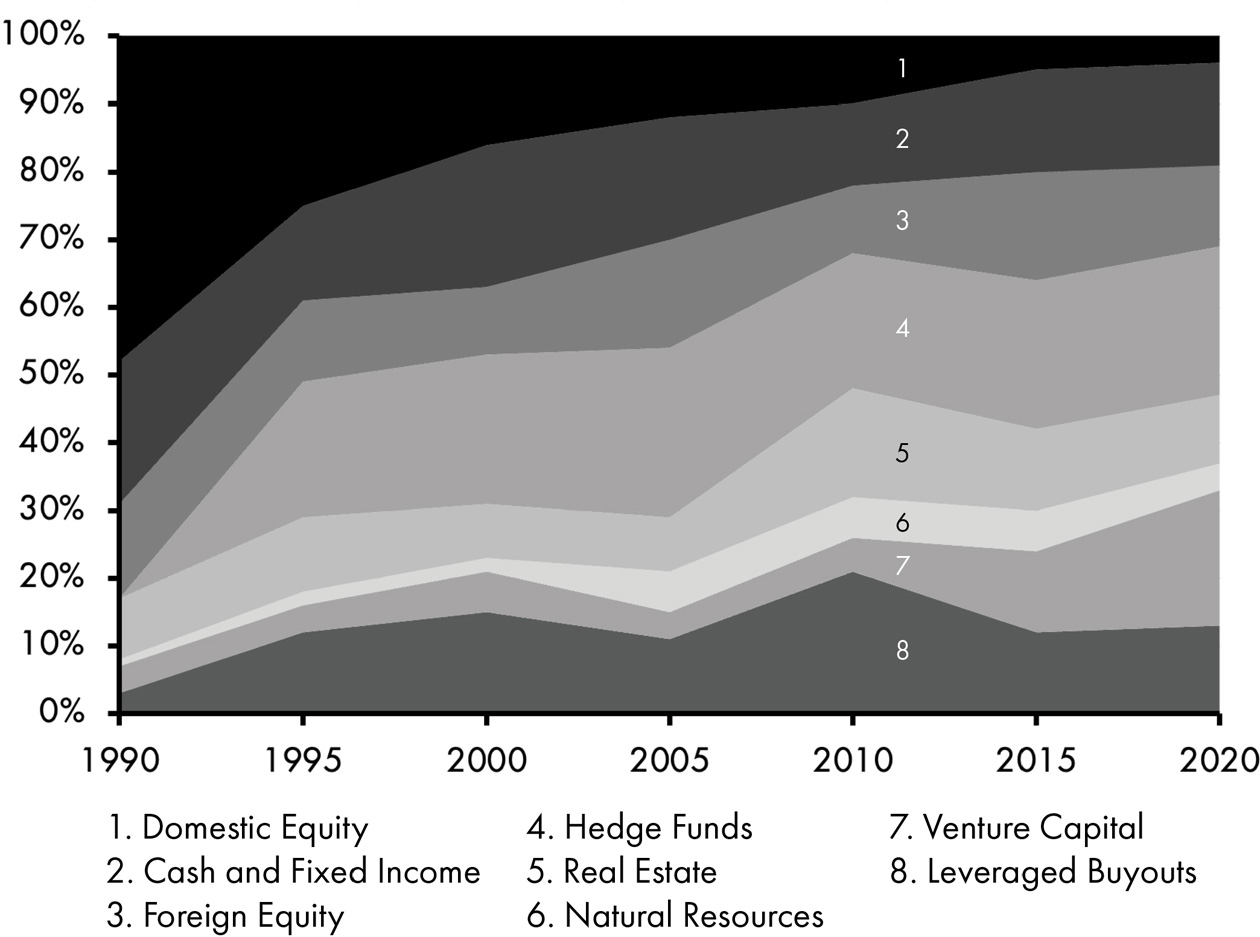
Swensen saw this unloved sector as an opportunity, much like Keynes saw public equities as an opportunity in the early 1900s. Over the course of the next 30 years, Yale’s endowment transformed from a largely bond and public equity fund to a much broader mix of public/private equities and alternatives. Swensen passed away in 2021, but his enormous impact on finance is far from forgotten.
Figure 17.1 shows the evolution of Yale’s endowment allocations.
FUN SIDE NOTE
Keynes is often thought of as the creator of big government economic policy, but Keynes was an avid capitalist who was vocally critical of the socialist movement in the early 1900s. While he was an advocate of countercyclical budget deficits during economic recessions, Keynes was also an advocate of budget surpluses during booms. Some people say “we’re all Keynesians now,” but his actual economic approach hasn’t been followed in developed economies in a very long time.
Figure 17.1: Evolution of endowment allocations
HOW THE ENDOWMENT PORTFOLIO WORKS
The Endowment Portfolio takes the basic building blocks of something like the GFAP and adds numerous diversifiers, with an emphasis on private markets including private equity, hedge funds, real estate, commodities, and others.
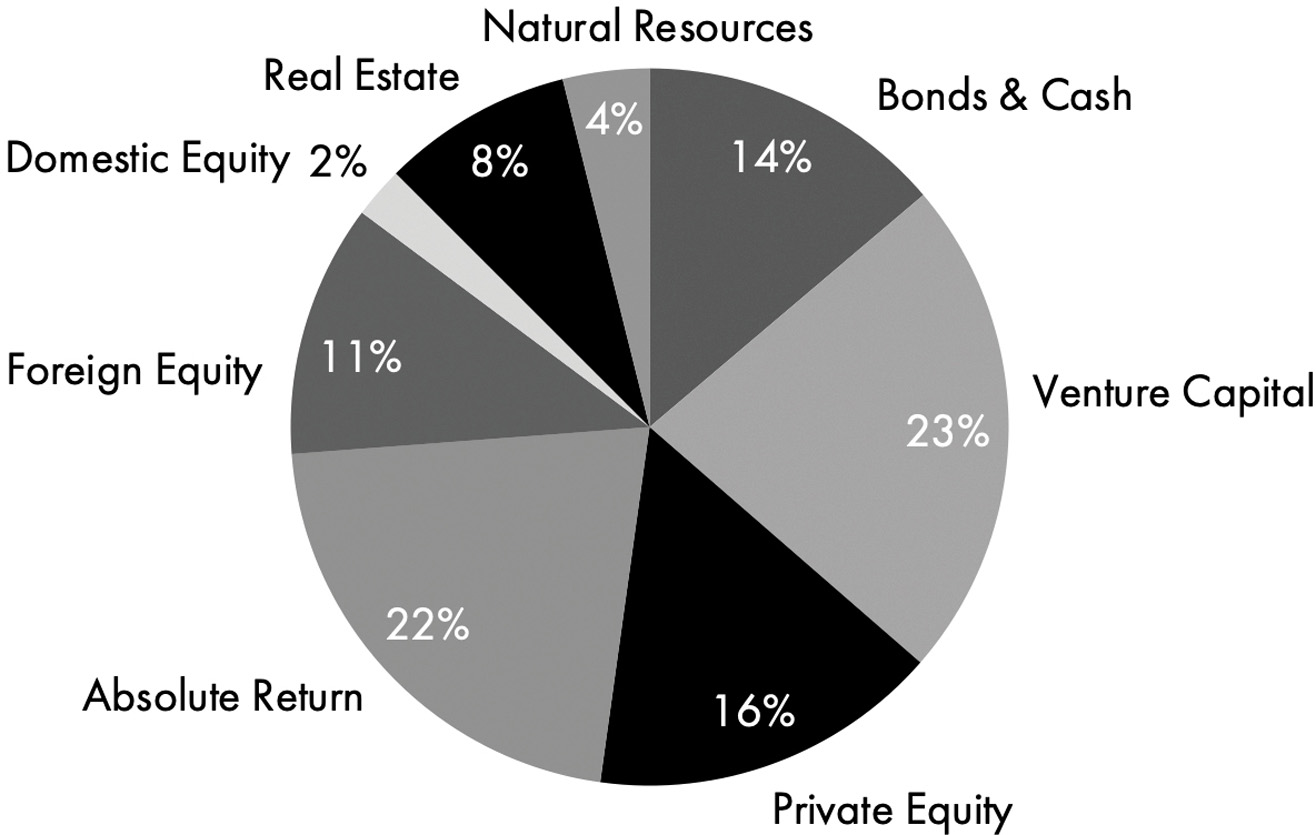
Figure 17.2 shows how the Yale Endowment Portfolio was allocated at the time of David’s passing.
The items that really jump out are a small allocation to bonds and cash, and a 60% allocation to venture capital, private equity, and absolute return (hedge funds). This was part of Swensen’s belief in an illiquidity premium. He said:
Intelligent acceptance of illiquidity and a value orientation constitutes a sensible, conservative approach to portfolio management.
Figure 17.2: Yale endowment asset allocation (2021)
The basic theory of an illiquidity premium is that you can lock up capital to allow it to be targeted to higher-return, long-term allocations, which will reduce the trading costs created by short-term-oriented investors. By giving the strategy more time to achieve its goals you sacrifice short-term liquidity for long-term returns.
Further, because these strategies can be more complex, they have higher embedded costs that can only be offset by aligning them with the right long-term investor.41 It makes sense, assuming of course that you allocate to the right projects.
The key takeaway from this is that Swensen really leaned into the long-term nature of a specific asset allocation, adopted the Keynesian value approach, and then took the focus on corporations one step further by adding private equities to a public equity portfolio. And that makes sense for an endowment because they are inherently long-term entities so they should have a heavy emphasis on more long-term and more illiquid assets.
The key reason why this strategy works is because it leans very heavily into the productive capacity of public and private equities. At the same time, the strategy maintains a high degree of diversification across other uncorrelated assets. This is probably the most diverse portfolio we’ll study in this book.
BUILDING YOUR OWN ENDOWMENT PORTFOLIO
The Endowment Portfolio is difficult to replicate because the majority of the portfolio is allocated in privately held assets like venture capital, private equity, and hedge funds. Swensen had almost 40% of the portfolio allocated in venture capital and private equity at the time of his death. That’s a big figure and replicating that would be very difficult given that Swensen had resources most of us do not.
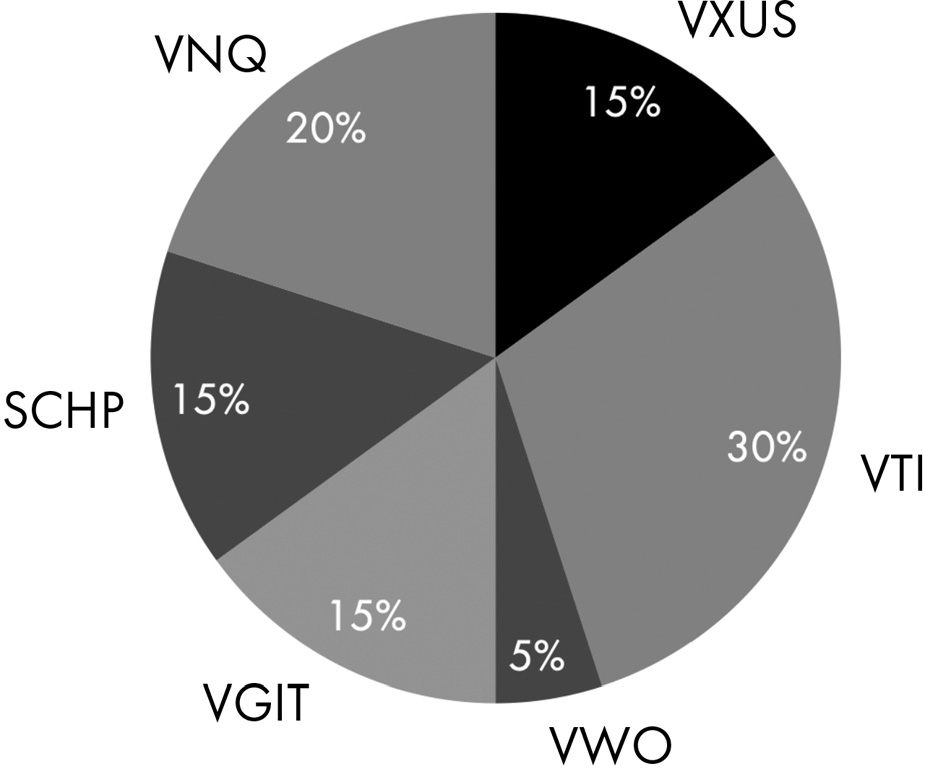
In his 2005 book, Unconventional Success, Swensen outlined a straightforward way to implement an alternative portfolio. The allocation was outlined as follows:
- 30% Domestic stocks
- 15% Foreign stocks
- 5% Emerging market stocks
- 20% REITs
- 15% Government bonds
- 15% TIPS
This is a very rough approximation of what Swensen actually did with the endowment approach, but it’s an easily replicated Swensen portfolio that could be implemented using the following funds, as shown in Figure 17.3.
Figure 17.3: Building the Unconventional Success Portfolio with funds
The actual Endowment Portfolio is much more complex and revolves largely around assets that are hard to access in public markets. The private equity and venture slices are especially hard to replicate. If you wanted to explore some ways to get private equity exposure you might consider some of the following options:
- AngelList (www.angellist.com)
- We Funder (wefunder.com)
- Equity Zen (equityzen.com)
Combined with a larger allocation of private equity access you could add in the Unconventional Success allocation for something that more closely replicates the Swensen portfolio.
Perhaps the private assets are too daunting for you and you’d like to build an Endowment Portfolio using publicly available funds. If you held a gun to my head and asked me to do that I’d probably come up with something like the allocation shown in Figure 17.4, which I’d call the Poor Man’s Endowment Portfolio (which, ironically, requires you to be a rich accredited investor).
Figure 17.4: The Poor Man’s Endowment Portfolio
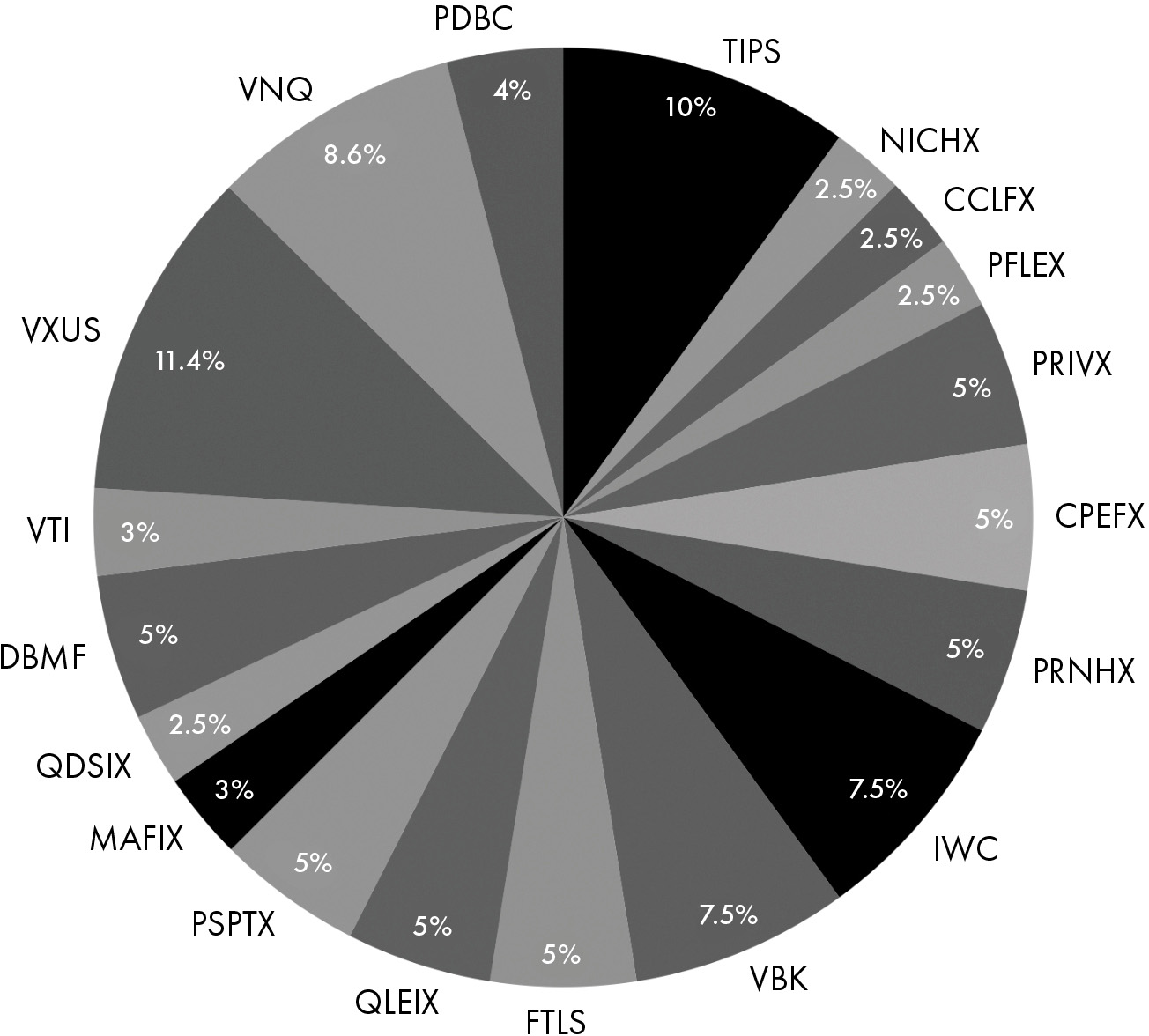
The goal here is to better replicate investments in private equity, private credit, and hedge funds using publicly available funds (some of which require accreditation and therefore might need to be removed depending on the investor’s access to such funds).
A few of these funds are a relatively new fund style called interval funds, which can access private markets by locking up the redemption schedule. This creates more transparency than some private funds, but also adheres to Swensen’s illiquidity premium by locking up funds for longer periods than you’d see with an open-end mutual fund which has daily redemptions.
Here are the allocations and specific funds as outlined:
Bonds and alternative income
- TIPS ETF or TIPS ladder 10%
- Variant Alternative Income Fund (ticker: NICHX) 2.5%
- Cliffwater Corporate Lending (ticker: CCLFX) 2.5%
- PIMCO Flexible Credit Fund (ticker: PFLEX) 2.5%
Venture capital and private equity alternatives
- The Private Shares Fund (ticker: PRIVX) 5%
- Cascade Private Capital Fund (ticker: CPEFX) 5%
- T.Rowe New Horizons Fund (ticker: PRNHX) 5%
- iShares Micro-Cap ETF (ticker: IWC) 7.5%
- Vanguard Small Cap Growth ETF (ticker: VBK) 7.5%
Absolute return alternatives
- First Trust Long/Short Equity ETF (ticker: FTLS) 5%
- AQR Long-Short Equity (ticker: QLEIX) 5%
- PIMCO StockPLUS Absolute Return (ticker: PSPTX) 5%
- Abbey Capital Multi-Asset (ticker: MAFIX) 3%
- AQR Diversifying Strategies (ticker: QDSIX) 2.5%
- iMGP DBi Managed Futures Strategy (ticker: DBMF) 5%
US and foreign public equities
- Vanguard Total Stocks (ticker: VTI) 3%
- Vanguard Total Stock Ex-US (ticker: VXUS) 11.4%
- Vanguard REIT ETF (ticker: VNQ) 8.6%
Natural resources
- Invesco Diversified Commodities (ticker: PDBC) 4%
That. Is. A. Lot. Even though this is my replication of an approximate Endowment Portfolio, I would be remiss if I didn’t say that I am skeptical of this construction. Not only does it not reflect the actual way Swensen accessed private markets, but it is arguably way too diverse and at risk of diworsification, high fees, and tax inefficiencies. The biggest problem with something like this is that even though it’s extremely diverse, you’re not getting the moonshot potential that Swensen would get with venture capital. That’s a huge difference-maker.
But if you’re finding that many of the portfolios in this book are too simple for you then perhaps something overly complex will get you on a path you prefer? In that case maybe there are some interesting ideas in here.
If you’re looking for something a little leaner and cleaner in one package then you might consider Cambria’s Endowment Style ETF (ticker: ENDW). This fund replicates the endowment strategy by taking a target allocation of 50% equities, 20% fixed income, 15% real assets (REITs, TIPS, Commodities and commodity equities), and then alternatives (Trend Following strategies mostly). The equities are globally diversified and tilted to various factors including value, momentum, and Trend Following and levered to a target allocation of 70%. The use of leverage in this fund is interesting because it helps to better replicate the higher expected returns we might expect in venture capital and private equity. It’s a very new fund, but Cambria is one of the thought leaders in the endowment model space so they’re worth paying attention to.
THE ENDOWMENT PORTFOLIO ANALYSIS
It’s virtually impossible to analyze this portfolio in an objective manner because we’re not cleanly replicating the Swensen Portfolio or the large endowments. The vast allocation to private equity makes it virtually impossible for us to copy and analyze objectively. Further, the short track record of many of the funds included in my Poor Man’s Endowment Portfolio limits our ability to assess its historical performance.
So we’ll have to make do with what we have. Swensen’s Unconventional Success allocation is easy to replicate and implement, even if it doesn’t truly reflect the complex methodology he used to allocate assets.
The portfolio Swensen outlines ends up having a very high correlation with a global 70/30 stock/bond portfolio. It is interesting, however, that Swensen starts with a much heavier equity emphasis.
Figure 17.5: Unconventional Success Portfolio performance
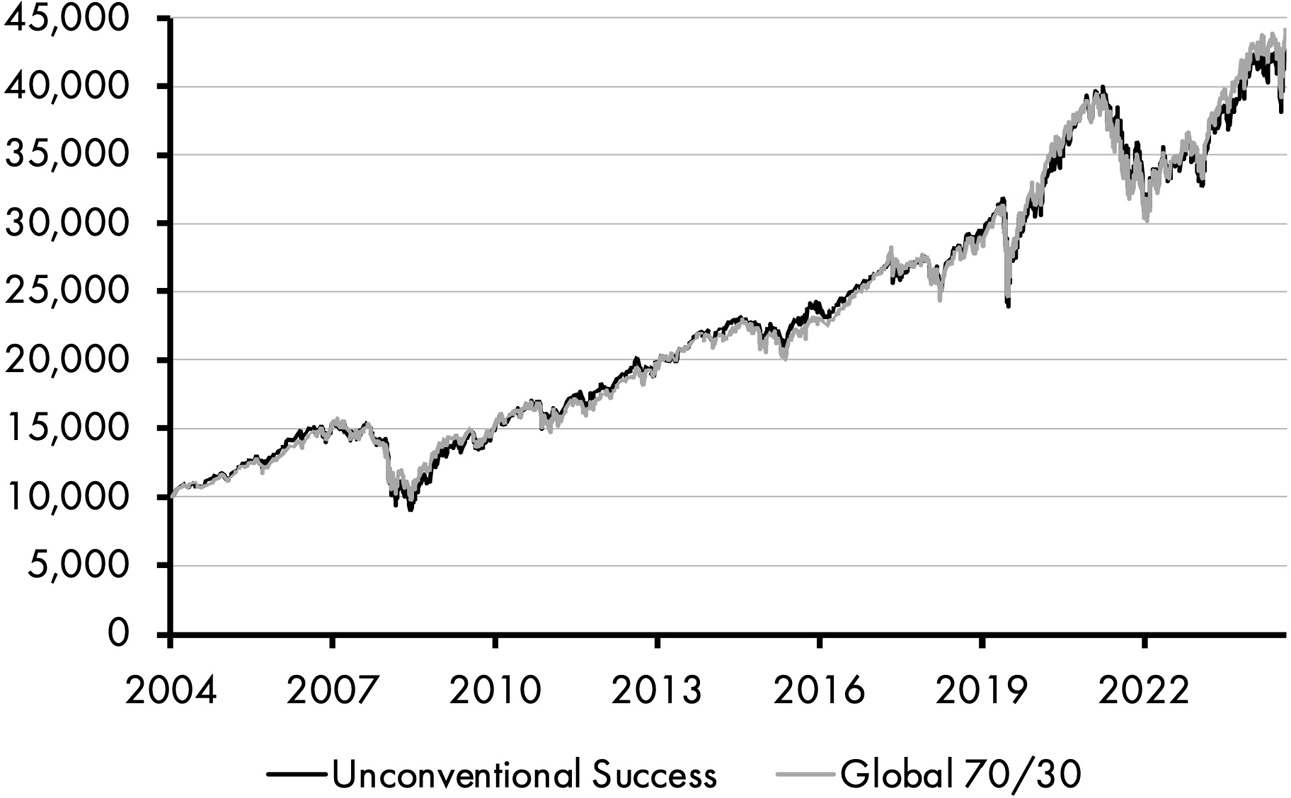
Table 17.1: Portfolio analysis
|
Unconventional Success |
70/30 Stocks/Bonds | |
|---|---|---|
|
Real Returns |
7.50% |
7.25% |
|
Volatility |
13.55% |
12.65% |
|
Sharpe Ratio |
0.49 |
0.49 |
|
Sortino Ratio |
0.68 |
0.68 |
|
Max Drawdown |
−43.51% |
−39.58% |
|
Ulcer Index |
9.02 |
8.30 |
|
Market Correlation |
0.67 |
0.62 |
In terms of its drawdowns we also get very similar results when compared to a global 70/30 (see Figure 17.6).
Figure 17.6: Unconventional Success Portfolio drawdowns (%)
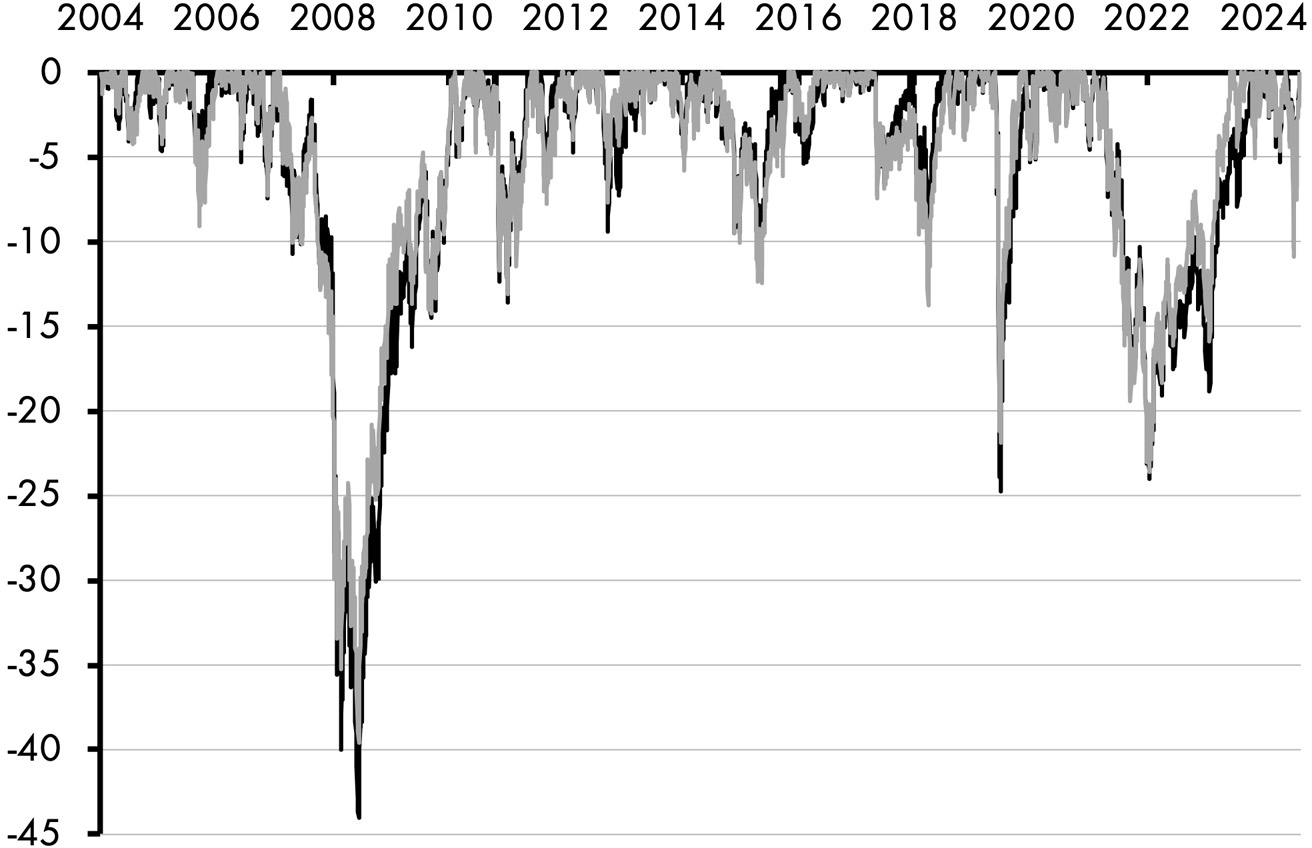
In short, the Unconventional Success Portfolio doesn’t display highly differentiated characteristics when compared to relatively basic indexing strategies. All of this reinforces the point that this strategy works best when it’s maximizing its access to the same kind of private market assets that Swensen focused on.
In my view the Unconventional Success Portfolio is overly simplistic and doesn’t really reflect the more sophisticated ways the endowment model is designed to work. Because of this you should explore more customized ways to access this style of asset allocation. That means personalized private equity approaches meshed with something like the Unconventional Success Portfolio, using a packaged ETF or exploring the Poor Man’s Endowment Portfolio in more detail.
THE ENDOWMENT PORTFOLIO PROS AND CONS
I’ve got good news and bad news. Let’s get the bad news out of the way:
- As stated above, this portfolio is hard to replicate. We don’t have access to the investments that Swensen did given the scale and network that was available to him. If you want to replicate this portfolio you need to do it indirectly.
- There’s a strong argument that most of us cannot afford to invest like an endowment because we don’t have the time horizon of an endowment. These funds will likely outlive every single person who reads this book. While you have short-term liabilities and expenses, an endowment has the luxury of thinking very long term.
- There’s increasing evidence that private market investments don’t consistently outperform their public market counterparts, especially when we consider taxes and fees. Endowments have come under significant criticism in the last decade over their poor performance, which is largely attributable to the high-fee allocations they often have in things like hedge funds, private equity, and venture capital.
And now the good news:
- These strategies are ultra diverse.
- Private placements can give you unique potential for uncorrelated returns and the moonshot potential is far greater in private markets than in public markets.
- The Unconventional Success Portfolio can be implemented in a very simple, diverse, and tax/fee efficient manner.
- In my opinion the big lesson from this portfolio is that we should all learn more about the private equity slice of the allocation. That is, after all, the defining feature of Swensen’s approach.
SUITORS FOR THE ENDOWMENT PORTFOLIO
I really like the core elements of this portfolio and the broader philosophy of thinking long term and staying diversified. But this approach is only appropriate for a specific segment of your portfolio, or a very specific type of investor who is incredibly patient, doesn’t mind illiquidity, and can access these types of investments.
To replicate the Endowment Portfolio cleanly, you need to implement the private equity components of the portfolio. Otherwise, you’re not really capturing the essence of the illiquidity and long-term premiums that Swensen advocated. But that requires a uniquely sophisticated type of investor.
That might not be the most practical portfolio for you to implement. And if you’re looking for something highly practical then you’re going to like our next one.
Retirement Bond Tent Strategies are up next – they are extremely pertinent for anyone nearing retirement or anyone seeking some shelter for a specific piece of their portfolio.