The Portfolios
Chapter 16
The Vice and Virtue Portfolio
THE behavioral portfolios we’ve discussed so far are mostly about helping you stay comfortable with a portfolio because the markets are volatile and unpredictable.
But what if you’re someone who wants to invest in strategies where you can make money and feel good about how you make that money? It’s time to look at virtuous portfolios which help you stay the course by feeling better about what you’re invested in.
Can you have your cake, eat it, and feel good about yourself too?
Let’s see.
***
As I’ll explain later, I am generally inclined to default towards picking the simplest and most diverse portfolio that aligns with your personal goals. I don’t recommend deviating too much from that portfolio because excess activity can create unnecessary taxes, fees, and performance frictions.
But there’s a lot to be said for managing a portfolio so that you’re personally comfortable with it rather than just adhering to a set of textbook mantras. After all, as Bernstein taught us earlier, the suboptimal portfolio you can stay loyal to will likely perform better than the theoretical optimal portfolio that you are constantly chasing (and changing).
As low-cost indexing has become more readily available, we are able to customize portfolios to meet our personal needs and wants. Vice And Virtue investing can be thought of as customizing a strategy to take advantage of the things we have personal preferences for. This approach has become popular as political narratives influence where dollars are allocated. Themes like climate change, social responsibility, and corporate governance are increasingly important to many investors, and entirely new asset classes have been created to meet the increasing demand for this movement. So-called ESG (environment, social, and governance) strategies have attracted hundreds of billions of dollars in recent years with the intent to help investors build a more virtuous portfolio for themselves.
I write this chapter with some hesitancy because I generally feel that we should not allow our vices, virtues, and politics to heavily influence our portfolios. That said, I am not here to tell you how to allocate your portfolio. I am here to remind you to never miss leg day and to help you find a portfolio you can stay loyal to. The point is, if you feel strongly that your allocation is more viable because it aligns with your personal views then this sort of strategy could be an essential piece in helping you stay the course.
But before we get into the specifics, I am going to outline my general view on these strategies so you can assess whether this makes sense for you or not.
The basic goal of ESG investing is to construct index funds and portfolios that are more socially acceptable. For instance, you might think that Exxon Mobil (XOM) is hurting the environment, so you construct a portfolio that doesn’t own that stock. Makes sense.
Or does it? Let’s take a moment to review some of the big themes from ESG investing and assess their validity.
ESG investing is more active investing that will increase the probability of lower future returns
We know that the more active average investor must, by definition, earn a lower average return than the less active average investor.
Let’s say you don’t like XOM and similar energy components in the S&P 500. What you’re doing if you decide to exclude these firms from your portfolio is saying, “I think the other 90% of firms in the index will perform better than the index as a whole.” This is active investing by another name. And the odds are you’re incurring higher taxes and fees along the way when compared to a comparable alternative.
More fundamentally, as Cliff Asness once wrote:
What happens when one group of investors, call them the virtuous, simply won’t own a segment of the market (the sin stocks)? Well, in economist terms the market still has to “clear.” In English, everything still gets owned by someone. So, clearly the group without such qualms, call them the sinners, have to own more than they otherwise would of the sin stocks. How does a market get anyone, perhaps particularly a sinner, to own more of something? Well it pays them! In this case through a higher expected return on the segment in question. This may be unpleasant but it is just math (like math could ever be unpleasant). In the absence of extra expected return the sinners would own X of the market segment in question. The only way to get them to own X+Y is to pay them something more. Now, assuming nothing else changed, how does the market assign this sinful segment a higher expected return? Well by according it a lower price. That is, if the virtuous decide they won’t own something, the sinners then have to, and they have to be induced to through getting a higher expected return than otherwise. This in turn is achieved through a lower than otherwise price.36
Perfectly stated. And this leads me right into a second (and fundamental) point.
The secondary market is a bad place to enact change
The intelligent defense of ESG is “by reducing the demand for a stock we can increase its cost of capital and impact the company’s operating performance.” This is true to some degree, but I think the impact is overstated. For instance, the firms in the S&P 500 are all large, established companies that have more than enough capital to finance their operations. They typically aren’t using the secondary equity markets to fund their operations. In fact, most firms have so much capital that they’ve been net buyers of stock in the last 50 years. So, this thinking is a bit backwards.
A good analogy for this is to think of public secondary markets like horse betting. We can bet on the horses, but secondary market purchases are just private exchanges between third-party ticket owners, not cash issuance to firms. As a result, betting on the horses doesn’t change the outcome of the race. The cash from our betting isn’t buying the horse’s hay, paying for training, or providing the stable. Similarly, our secondary market purchases and sales are mostly shuffling ownership among investors and not directly financing or even impacting the firm’s daily operations. The company, like the horse running in a race, does not care who owns the shares or bets and it doesn’t meaningfully impact the outcome of the race.
ESG investing can put more money in the hands of bad actors
A smart indexer decides to own all the firms in the market because we don’t know which firms will perform better or worse. When you reduce exposure to certain firms because they aren’t aligned with your moral views then you increase the odds that you’ll earn a lower return.
This means that someone else is earning a higher return and potentially investing more of that money into the causes you don’t believe in. You are, in essence, choosing to earn a lower return, thereby funding the very types of people you might disagree with.
No one knows what a “sin stock” really is
The reason I called this chapter “The Vice And Virtue Portfolio” is because we do not actually know what vices and virtues are, in the context of firms. The only reasonable definition of a company that is “immoral” is something that is illegal. Aside from that, a company that operates a legal business is simply providing a service for someone who doesn’t view that business as morally contemptible.
For instance, I own an old Ford F-100 that uses gasoline. I don’t drive it much, but when I do I either get looks of contempt or a million thumbs-up (almost exclusively from other men, which always makes my wife laugh). Sometimes I fill that truck up using XOM gasoline. Some people might find this morally contemptible. There’s nothing wrong with that opinion, but there are also millions of people in this world who don’t find gas-powered engines to be immoral. One person’s vice can be another person’s virtue.
This concept gets even more interesting when we consider the way that companies provide their services across time. For instance, XOM is now one of the leading firms in exploring alternative energies. What if, in 100 years, they are the market leader in renewables and no longer engage in fossil fuel production? By selling XOM you would have reduced your exposure to a firm that is innovating and producing beneficial changes in the world because your behavioral biases led you to believe that XOM is currently an immoral company. This is part of what makes active stock picking so hard. We can’t predict how firms will change and how society will view their businesses across time. What’s a sin stock to you today might not be a sin stock to someone else today or even to you tomorrow.
I am all for investing morally, but I think it should be done in a way that we can maximize the impact and, the fact is, the best place to enact change is in the real economy and not secondary markets. In fact, trying to boycott a stock in the secondary market could be counterproductive to your financial goals which could hurt your ability to do good. So, if you disagree with a firm like XOM then don’t buy their gasoline. But refusing to buy their stock will have little to no impact on their actual business and that’s what will drive their stock price ultimately.
I say you can have your cake and eat it too here. You can own a firm like XOM inside of an index fund, earn the returns, use those returns to fund the moral operations you prefer, and you can boycott XOM’s operations in the real economy if you want to. It’s the best of all worlds.
Okay, I’ll get off my soapbox, but hopefully we all understand the logic behind why ESG investing might not be as great as it seems.
WHY VICE AND VIRTUE STRATEGIES WORK
As Cliff already discussed, these strategies don’t work to generate superior returns. Or at least it’s very unlikely that they’ll do that over any extended period.
At the same time, the textbooks aren’t always right because the economy is driven by people – people with big emotions. And as I will keep drilling into your head, the suboptimal portfolio you stick with is likely to be better than the optimal portfolio you constantly chase. So, if your moral justification for owning the S&P 499 (ex-XOM) results in you being more comfortable and disciplined then that’s wonderful. I think it’s great to have conviction and then follow that conviction. But you need to be aware of all the biases you’re probably succumbing to in the process of implementing this strategy.
Let’s get on with the portfolio construction, okay?
BUILDING YOUR OWN VICE AND VIRTUE PORTFOLIO
Building your own ESG portfolio requires a decent bit of customization to meet your personal needs. The surest way to align a portfolio to your personal needs is to use a custom indexing solution or work with a financial advisor who uses a custom indexing platform. Good options (which might require an advisor) include:
- Canvas Custom Indexing (canvas.osam.com)
- Schwab Direct Indexing (www.schwab.com/direct-indexing)
The alternative is to go direct to the ETF options and choose one that aligns with your personal views. This might require a decent amount of research. Some of these are very generally aligned with the broader ESG movement. Here are some of the larger choices:
- iShares USA ESG Select (ticker: SUSA)
- iShares ESG Aware MSCI EAFE (ticker: ESGD)
VICE AND VIRTUE PORTFOLIO ANALYSIS
I won’t belabor the aforementioned point. Even though this strategy is relatively new, we can see that these strategies do not typically generate higher returns than the overall market. In fact, they tend to underperform and based on the assessment of the SUSA ESG Select ETF they correlate very highly with any corresponding benchmark (see Figure 16.1).
Figure 16.1: ESG performance
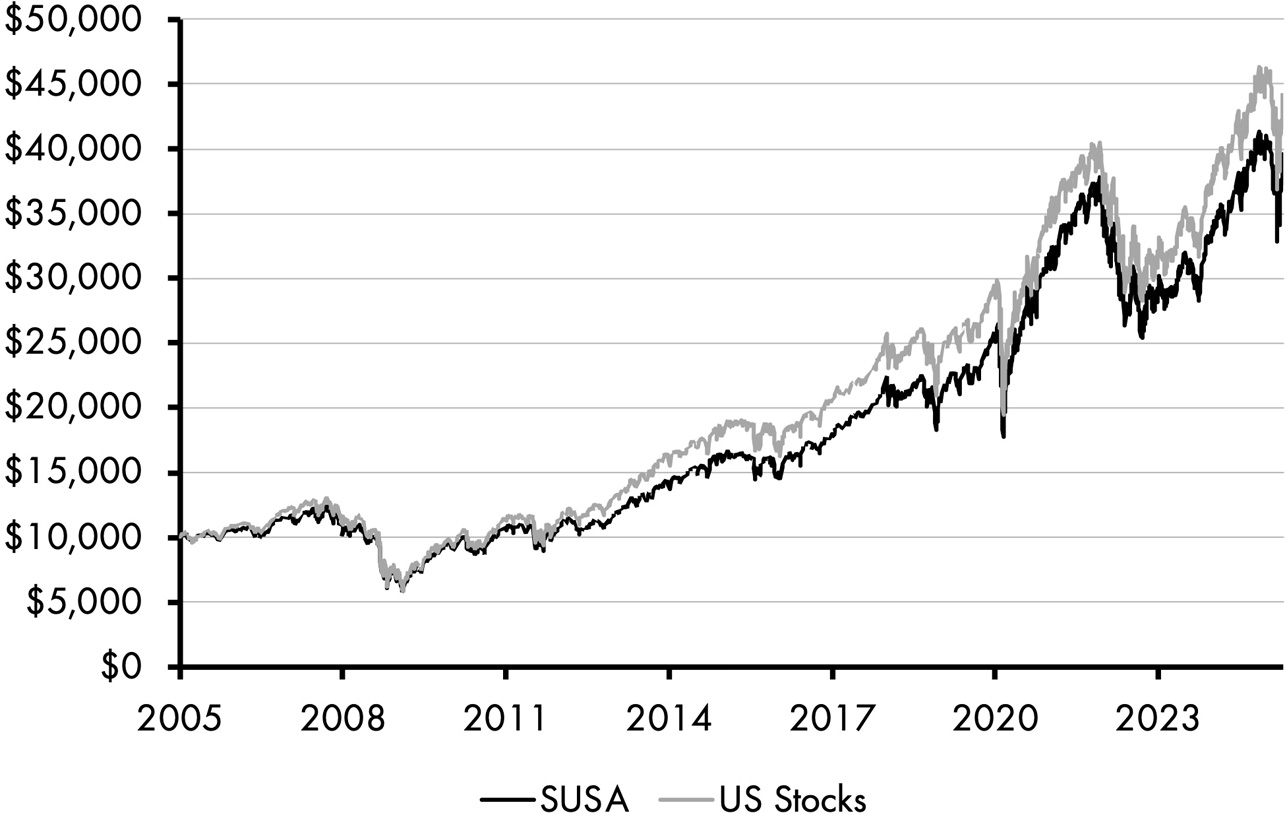
Table 16.1: Portfolio analysis
|
ESG |
US Stocks | |
|---|---|---|
|
Real Returns |
7.04% |
7.65% |
|
Volatility |
18.57% |
19.24% |
|
Sharpe Ratio |
0.51 |
0.55 |
|
Sortino Ratio |
0.71 |
0.75 |
|
Max Drawdown |
-54.70% |
-55.93% |
|
Ulcer Index |
14.50 |
14.30 |
|
Market Correlation |
0.95 |
1.00 |
The drawdowns (see Figure 16.2) and Ulcer Index are also very similar across the biggest ESG fund and the total US market.
Figure 16.2: ESG max drawdowns (%)
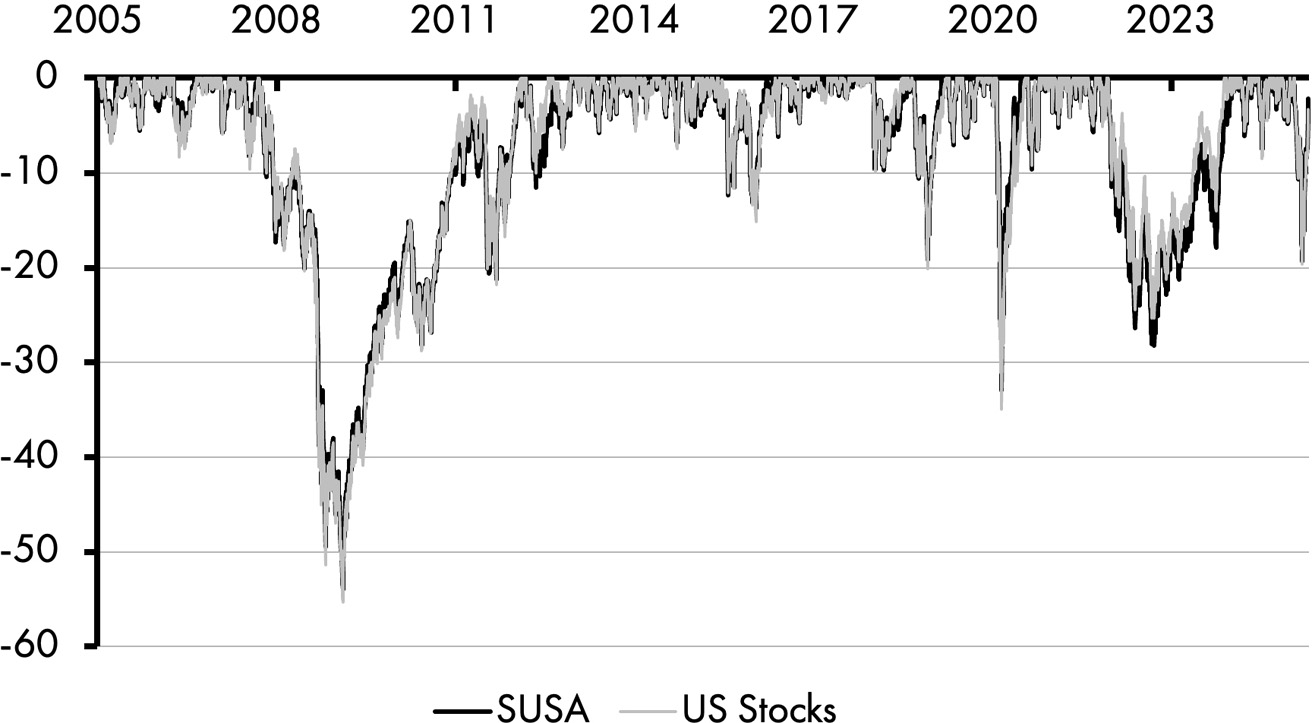
These look a lot like what I’d refer to as closet index funds. That is, they’re not implementing some sort of unique alpha tilt or anything like that and mostly reflect a correlated index fund, typically with higher fees.
Okay, so you’re not necessarily going to get superior performance here or even decrease correlation, but you will get something very similar to the broad market that might align with your personal views.
VICE AND VIRTUE PORTFOLIO PROS AND CONS
As always, we’ve got good news and bad news. First the bad:
- I would describe the Vice And Virtue Portfolios as behavioral portfolios. They aren’t likely to outperform the market and they shouldn’t be sold under that false pretense, but if they help you stay behaviorally disciplined then they’re certainly better than the alternative reality where you’re stuck sitting in cash or some other inferior option.
- The virtuous portfolio is subjective. You have to embrace the bias that’s inherent in this particular strategy.
- Many ESG portfolios are very broad by design and might not fully align with your personal views.
- The custom indexing solutions give me anxiety and can be a tax nuisance because you end up holding 499 (or however many) positions and a more complex tax situation as a result. It’s complexity cloaked as a simple solution.
Now the good news:
- These portfolios can be implemented in a very diverse, tax- and fee-efficient manner. Something like SUSA costs just 0.25%, which is very reasonable.
- You can get exposure to this strategy using a custom indexing service. This would allow you to remove specific items you disagree with as opposed to adhering to a broader ESG implementation.
- These are strictly behavioral portfolios designed to help you allocate capital in a manner that keeps you fully invested by being more morally comfortable with what you are investing in.
SUITORS FOR VICE AND VIRTUE PORTFOLIOS
These portfolios are best for people who are interested in a politically and morally palatable portfolio. This portfolio isn’t for the investor seeking to beat the market and in fact you have to understand that this type of portfolio will likely underperform broader indices.
FINAL THOUGHTS
I don’t generally like to mix politics and investing, but the two worlds inevitably overlap more than we’d like. So ESG investing can be a good way for someone to try to blend their politics with their investing in a way that’s more personally comfortable. There’s nothing wrong with that assuming you understand exactly what you’re doing.
Speaking of politics – let’s talk about one of the most politicized figures in macroeconomics. John Maynard Keynes is best known for his political influence via economics, but did you know that he was highly influential in forming one of the most famous investment strategies currently in use? That’s right, the Endowment Portfolio is up next. So buckle up.