The Portfolios
Chapter 1
The Warren Buffett Portfolio
OUR search for the perfect portfolio begins where my perfect portfolio journey started – with Warren Buffett. When I was 19 years old, I started reading Warren Buffett’s annual shareholder letters. I was so enthralled that I went back further in time to read the Buffett Partnership letters, his original hedge fund notes from before the Berkshire Hathaway days. This was the most educational investment reading I ever encountered, and I highly recommend it for anyone who hasn’t read the letters.*
While it was educational it also filled my head with delusions of grandeur as I was convinced that I would soon become the next Warren Buffett. My marriage to the Warren Buffett portfolio (the “Buffett Portfolio”) did not last long, in large part because I did not understand just how intricate the strategy really was. While it’s probably impossible to replicate his results, there are some very valuable lessons from analyzing this brilliant approach and structure.
I became so obsessed with Buffett that I would write him letters on occasion. He didn’t always respond, but when he did it was in typewritten form from his secretary. How can you not love that?! On that note – here’s a life tip: never be afraid to reach out to total strangers (even famous ones) and ask them for help. You’ll be shocked at how often they respond.
***
As a novice investor I had the right mix of youthful arrogance and inexperience to perfectly misunderstand the scope and complexity of Warren Buffett’s approach to investing. And after reading the annual shareholder letters I was convinced that the approach was simple – you find good companies selling at reasonable prices and then buy and hold them until your net worth explodes.
I soon found out that companies selling at “reasonable prices” are often selling at reasonable prices for the exact reasons that Gene Fama, the father of the Efficient Market Hypothesis claimed – because they’re often bad companies that deserve to be selling at those prices. I had fallen into a classic value trap, where you think value is underpriced market inefficiency when it’s actually market efficiency pricing securities below intrinsic value because the firm is performing poorly and is expected to continue performing poorly.
I had the unfortunate misunderstanding that low prices were similar to value. I can’t even tell you how much time I spent dabbling in penny stocks and low-priced stocks in those early investing years. The price of a stock, of course, has very little to do with its value (in fact, stocks trading below $5 are generally terrible firms that have failed to even meet the basic listing requirements of most exchanges). But these were all things that a much younger Cullen didn’t understand.
To compound all of this I also had the unfortunate timing of building up my first savings portfolio into the teeth of the dot-com bubble. Let’s just say that my first bear market tested my patience and made it difficult to remain disciplined. But with time I learned that the genius of the Warren Buffett strategy wasn’t just good stock picking. It was a brilliant institutional structure and phenomenally disciplined process.
Let’s take a closer look.
HOW BUFFETT’S MONEY-MAKING MACHINE WORKS
In 1956, a 26-year-old hedge fund manager named Warren Buffett began buying up shares of a dying windmill company named Dempster Mill. The manager of Buffett Partners, Ltd slowly gobbled up 70% of the business, which was a sizable 20% of the Partnership’s total assets. Mr. Buffett believed the business was substantially undervalued and he agreed with the advice of a new partner named Charlie Munger that they should replace the CEO. Munger introduced Buffett to Harry Bottle, who would go on to become CEO of Dempster and play an essential role in its turnaround.
Buffett had turned into what we currently call an “activist” investor by buying a large stake in a firm and then actively altering the management and operations of the firm in the pursuit of profits. The Partnership would ultimately make a 3× gain in Dempster before divesting and rolling much of the profit into a textile firm named Berkshire Hathaway.
The early days of the Buffett Partnership are interesting in large part because they catapulted him into the position to purchase Berkshire through actions that Buffett isn’t well known for – concentrated risks and an activist approach wrapped in a high-fee hedge fund structure. Young Warren Buffett sometimes sounds more like Gordon Gekko than Benjamin Graham, his mentor whom he is most often compared to now. But the Berkshire days are when the real magic begins to happen.
In 1955 two companies named Berkshire Fine Spinning and Hathaway Manufacturing joined forces to become a company named Berkshire Hathaway. This made it the largest textile firm in New England, but the merger was a death pact. Berkshire would see its net worth shrink by almost 40% in the ensuing years, but Buffett noticed a curious operation by management – they were buying their own shares. Buffett Partners began accumulating shares at a steep discount of $7.50 versus book value of $20.20. Buffett says this felt like picking up discarded cigarette butts with one puff left. The puff seemed pretty good though and Berkshire’s CEO, Seabury Stanton, agreed to repurchase Buffett’s shares for $11.50. But when Buffett received a tender offer of just $11.375 he was enraged. Instead of selling, he purchased more, took a controlling interest, and fired Stanton. The problem was that Buffett was now sitting on his own value trap as the textile firm was failing fast.
It was around this time that Buffett decided he needed to stop dating cigarette butts and start looking for companies he could marry. In 1967 he purchased his first insurance company, a firm called National Indemnity Company. Although the old textile firm was failing, Buffett had begun accruing what he famously refers to as “insurance float” – the cash flows from insurance premiums, not yet paid out as claims, that operated like interest-free loans to the operating company.
Buffett would lean into this structure over the coming decades and utilize this leverage in a brilliant manner to scoop up undervalued firms and amass the equivalent of a low-cost, leveraged private equity entity. Combine this with the transition to more long-term and disciplined thinking and Berkshire Hathaway was well on its way to becoming what we all know today.
The secret sauce to the Buffett Portfolio isn’t just good stock picking and an extraordinarily patient temperament. The Buffett money-making machine is all about utilizing cash flows from various entities to fuel a broader investment process. Buffett’s strategy is a specific infrastructure around a portfolio, not just a portfolio strategy on its own.
Warren Buffett has what I would describe as the two ultimate asset allocation superpowers:
- The ability to build an investment infrastructure that optimizes for cash flows and margin of safety.
- The ability to be extremely patient, waiting to insert pieces into this infrastructure in a way that allows them to operate within the efficient confines of that infrastructure.
Let’s talk a little bit about both.
In many ways Buffett was a true innovator in the US capital markets. First, the original Buffett Partners hedge fund was unique in its structure as a performance-driven hedge fund. Buffett famously charged performance fees that were aligned only with positive returns. Second, Buffett was an early adopter of the private equity approach to capital allocation. In Chapter 17 we’ll discuss the importance of private equity allocations and how the Endowment Portfolios were early movers there, but Buffett was light years ahead of the game in the 1950s.
While Buffett is famous for his public stock market allocations, it was his private market investments that were some of the best return-generators across his lifetime. And perhaps most importantly, it was these private equity investments that ultimately resulted in the specific structure that allowed Buffett to create a cash-flow machine that could be reallocated to the other investments he made.
But what about patience?
You will notice that time is a recurring theme in this book because it’s the ultimate form of wealth. Time is the only thing you can’t buy more of and when it’s gone it’s gone forever. Buffett has utilized his time in an extraordinary manner.
First, he started investing when he was incredibly young.
Second, he allowed his investments to compound over time without tinkering too much. In his wonderful book, The Psychology of Money, Morgan Housel tells a story about the importance of time and compounding. Warren Buffett started investing when he was 10 years old and had accrued an inflation-adjusted net worth of $9.3 million by the age of 30. He went on to compound his wealth at 22% per year and by the age of 90 he had a net worth of $84.5 billion. $84.2 billion of this was accumulated after the age of 50. Had he started investing with a sum of $25,000 at the age of 30 he would have $11.9 million at the age of 90.9 (You’ll notice discipline, patience, and time will be recurring themes in this book, you can think of them as the main characters in our exploration.)
Julius Caesar once said: “It is easier to find men who will volunteer to die, than to find those who are willing to endure pain with patience.”
Consider how many hugely painful downturns, recessions, and bear markets Warren Buffett endured while exercising extraordinary patience.
That patience didn’t just compound his wealth over time – it did so efficiently, as he structured his assets within a cash-flow-generating engine that optimized both tax and income efficiency across decades.
BUILDING YOUR OWN BUFFETT PORTFOLIO
As I’ve noted, the current day Berkshire Hathaway is nothing like the cigarette-butt-seeking Buffett Partners. While Buffett Partners was a sleeker, sexier asset management approach, the Berkshire we’ve come to know and love is more of a diversified income monster.
Replicating Buffett Partners is probably impossible in today’s efficient markets. But replicating the current Warren Buffett strategy is relatively straightforward. I do need to caution readers that, given Buffett’s age of 96 and the corresponding age of Berkshire, it might not be the most forward-looking strategy to copy.
I am starting to think that he’s Methuselah, the mythical man who lived to be 969 years old, because Buffett appears to be genetically invulnerable to Cherry Coke and cheeseburgers, but I also know that Father Time is undefeated.
There are four general ways in which we might go about building the Buffett Portfolio:
- Start a hedge fund, buy insurance companies or other entities that allow for embedded leverage, become a master private and public equity investor.
- Buy Berkshire Hathaway stock.
- Try to replicate Buffett’s stock-picking methods.
- Buy a 90/10 Stock/T-bill portfolio.
Let’s explore each option.
You can certainly try #1, but the likelihood of this working is about the same as me looking like Brad Pitt when I wake up tomorrow morning. So, on to option #2.
Berkshire Hathaway stock (ticker: BRK-A) is the easiest and lowest-cost way to follow the Warren Buffett strategy. Berkshire is now a trillion-dollar company by market cap, its total market weighted value. As of 2025 it’s the eighth largest company in the world. Despite being an ultra-diverse, tax efficient, cash-flow machine, Berkshire doesn’t pay a dividend or charge you a management fee to own it. Said differently, Berkshire Hathaway is a lot like a zero-fee and tax-efficient index fund.
It’s worth noting that Berkshire has gradually evolved to resemble the S&P 500 more closely over time. Most of its huge outperformance came when Berkshire was a very different animal in the 80s and 90s. From the period of 1980 to 2000 Berkshire Hathaway beat the S&P 500 by an astounding 11% per year. That margin shrank to just 1.4% over the last 20 years and is down to just 1% per year in the last 10 years. Its recent correlation can be seen in Figure 1.1 below.
Figure 1.1: Berkshire Hathaway versus the S&P 500
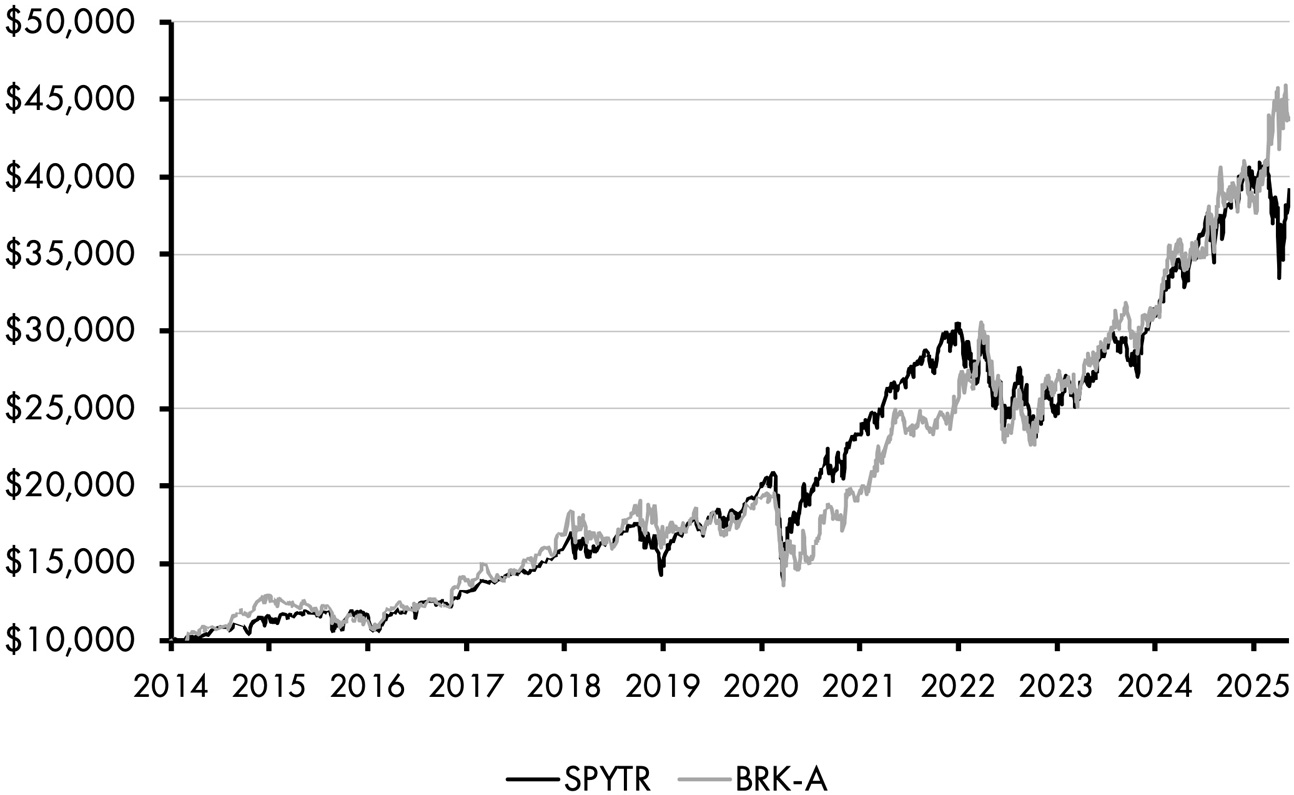
Of course, the Berkshire of tomorrow might not look like the Berkshire of yesterday. While I have no doubt the company is well equipped to navigate Buffett’s succession, you also have to consider the risk that the firm is simply too big to generate the returns Buffett is so famous for. In other words, it might be capped by sheer size, but have the downside of deteriorating after Buffett is gone. That’s why we’re going to jump right into the allocation Buffett himself recommends – buying index funds and owning a slug of cash in the form of T-bills.
And yes, we’re skipping right over option #3. Sorry to disappoint, but I hope that one of the big takeaways from this book is that you should not spend an excess amount of time picking individual stocks. The pros are bad at it and I don’t think most retail investors should spend a lot of time bothering with it when there are so many diversified fund options.
Buffett himself famously recommended option #4. He says:
Among the various propositions offered to you, if you invested in a very low-cost index fund where you don’t put the money in at one time, but on average over 10 years, you’ll do better than 90% of the people who start investing at the same time. . .. In my view. . . the best thing to do is to own the S&P 500 index fund. . . the trick is not to pick the right company. The trick is to essentially buy all the big companies through the S&P 500 and do it consistently and to do it in a very, very low-cost way.
FUN SIDE NOTE
I wasn’t always so militantly against stock picking. In fact, from 2005–2010 I ran a small partnership that took advantage of what is now known as the overnight effect – the tendency for stocks to outperform overnight. I spent years buying stocks every day at the close and selling them at the open, or preferably in the pre-market when I could take advantage of illiquidity. Sometimes with an event-driven bet in mind, but oftentimes just due to illiquidity and inefficiencies. I generated 20.75% per year while the S&P 500 generated 0.5% per year, which, for someone in his 20s, was enough to pay for $2 beers back when I was a poor guy living at the beach in San Diego. The GFC exposed the flaws in such a strategy and after six months of not making one dime in the middle of 2009 I had to pivot out of the stock-picking world, which was too much work and too unscalable given the illiquid markets I relied on. To this day I still can’t decide if my performance was sheer luck, fortunate timing, a little bit of smarts, or all of the above.
One of my favorite stories from this period is when I nailed someone on a fat finger trade only to get nailed myself. I had purchased a position in what was then Sears Holdings into earnings and when their earnings report hit the news wires at 3 a.m. Pacific Time a bid came on the board at a 20% premium. I’d been doing this for years at this point and I could pinpoint the good and bad in an earnings report in minutes and I knew this one was a stinker. I had a $100,000 position in the stock and I hit someone’s fat fingered bid and went to bed around 4 a.m. thinking I’d just made the easiest $20,000 of my life. But I woke up at 8 a.m. to see an alert that a trade had been “busted,” the term for a reversed trade. I now owned $80,000 of Sears Holdings and I’d seen a $40,000 reversal in four hours. I wrote to Nasdaq to inquire about the reversal and never did get an answer, but let’s just say that I had to stick to $2 beers for a while after that one. Stock picking was a tough way to make a living....
If an indexing component is one important element of how Buffett recommends we invest then the other essential element of the Buffett strategy is the way he generates cash flows and exercises its optionality.
Buffett holds this optionality position in the form of Treasury bills, super-safe, high interest-bearing bills issued by the US government. Holding a portfolio of T-bills is like holding a money market fund that you build yourself.
Historically, Buffett has held about 10% of his assets in T-bills. In his 2023 letter, Buffett explained the rationale of holding that 10% T-bill position:
[Berkshire] also holds a cash and US Treasury bill position far in excess of what conventional wisdom deems necessary. During the 2008 panic, Berkshire generated cash from operations and did not rely in any manner on commercial paper, bank lines or debt markets. We did not predict the time of an economic paralysis, but we were always prepared for one.
Extreme fiscal conservatism is a corporate pledge we make to those who have joined us in ownership of Berkshire. In most years – indeed in most decades – our caution will likely prove to be unneeded behavior – akin to an insurance policy on a fortress-like building thought to be fireproof. But Berkshire does not want to inflict permanent financial damage – quotational shrinkage for extended periods can’t be avoided – on Bertie or any of the individuals who have trusted us with their savings.
Buffett thinks of cash like it’s an insurance holding. Insurance will be another recurring theme in this book and so remember this point – cash is sometimes the ultimate form of insurance because it gives us principal stability, certainty, and optionality.
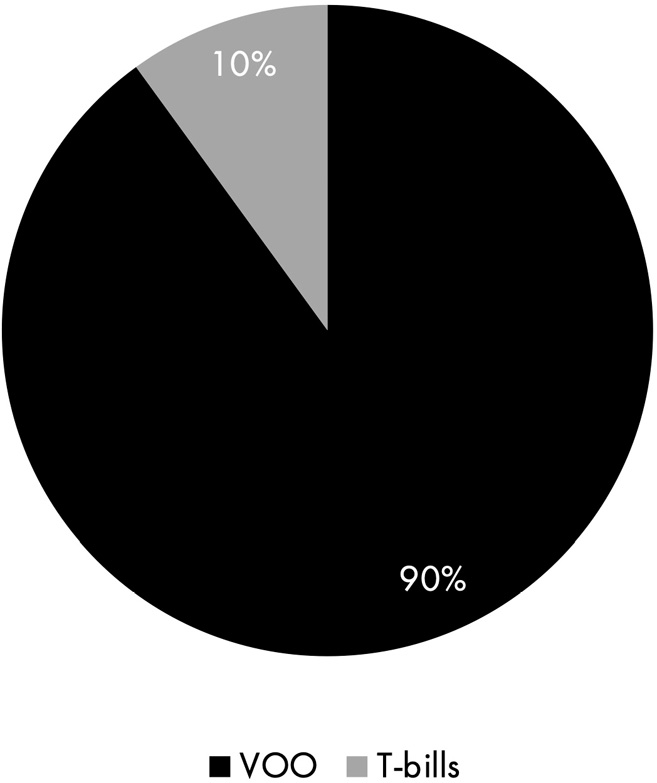
Now, if you wanted to implement this it could be as basic as two positions, as seen in Figure 1.2:
- S&P 500 ETF (ticker: VOO): 90%
- T-bills (individual bills or ETF, ticker: BIL): 10%
That’s as simple as we’re going to get in this book so buckle up from here on out.
Figure 1.2: The Buffett Portfolio
BUFFETT PORTFOLIO ANALYSIS
Let’s take a closer look at how the Buffett Portfolio works and see if this is a potential suitor.
In 2013, Frazzini, Kabiller, and Pedersen published a paper titled “Buffett’s Alpha.”10 The paper did a deep dive into the drivers of Buffett’s returns. They concluded that the Buffett structure was built around:
- The use of structured leverage of 1.6:1
- Buying low-beta, high-quality stocks with a low price-to-book ratio and high quality (profitable, stable, growing, and high payout ratios).
How did this structure perform over the last 100 years? According to Frazzini, et al., if you could have hopped into a time machine and picked a single stock in 1926, the very best performing stock in the next 90 years would have been Berkshire. Incredible.
Regarding point #1, the authors found that Buffett’s unique business structure allowed for strategic leverage via cheap financing in the insurance segment of the Buffett Portfolio. He then utilized this leveraged structure to purchase stocks that are high quality and inexpensive. That might not be easily replicated unless you happen to own an insurance company, but we can all think of our existing incomes as the cash-flow machine that fuels our investment portfolios. And then we can structure our entities by feeding specifically efficient structures like 401(k)s, IRAs or LLCs to house the cash flows and investments in a manner similar to Buffett.
Point #2 is more about the specific type of entity Buffett would target. And the S&P 500, while not technically a factor tilt like value or high quality, captures all the factors by definition. No need to overthink what Buffett specifically recommends. Don’t worry, we’ll do a deep dive into Factor Investing in Chapter 6, which could help you apply certain factors to a Buffett Portfolio if you are interested in implementing the strategy similarly to point #2.
You aren’t going to repeat Buffett’s performance buying a 90/10 stock/T-bill portfolio, but you’ll still do very well with time. So, let’s look at the metrics of a 90/10 stock/T-bill portfolio.
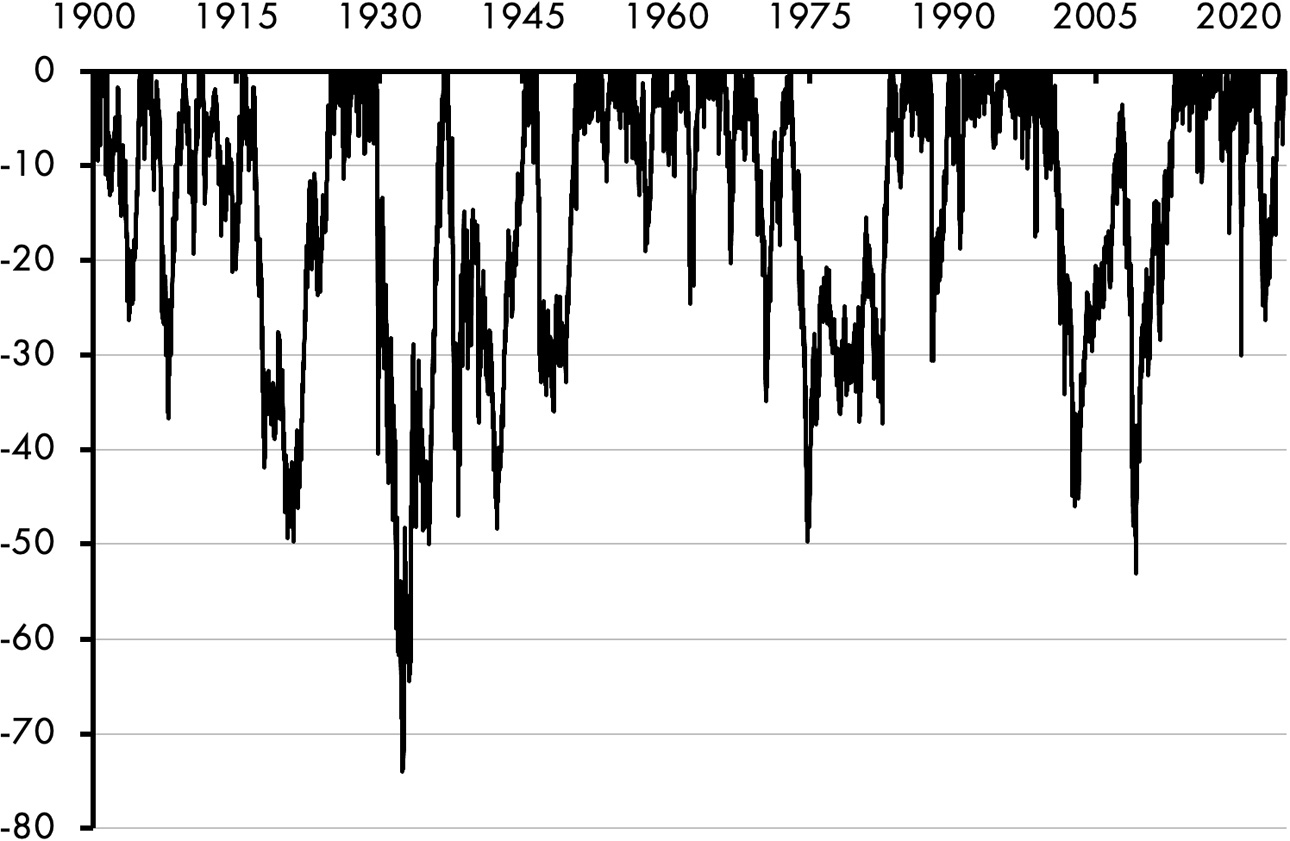
With this portfolio you can expect high real returns with a high level of volatility. A 90/10 portfolio would have generated 6.30% real returns per year with volatility of 15.67%. There is the outside chance of very large drawdowns at times and the Ulcer Index, at 19, is consistent with a portfolio that will cause you higher levels of stress at times.
Figure 1.3: 90/10 stocks/T-bills real returns
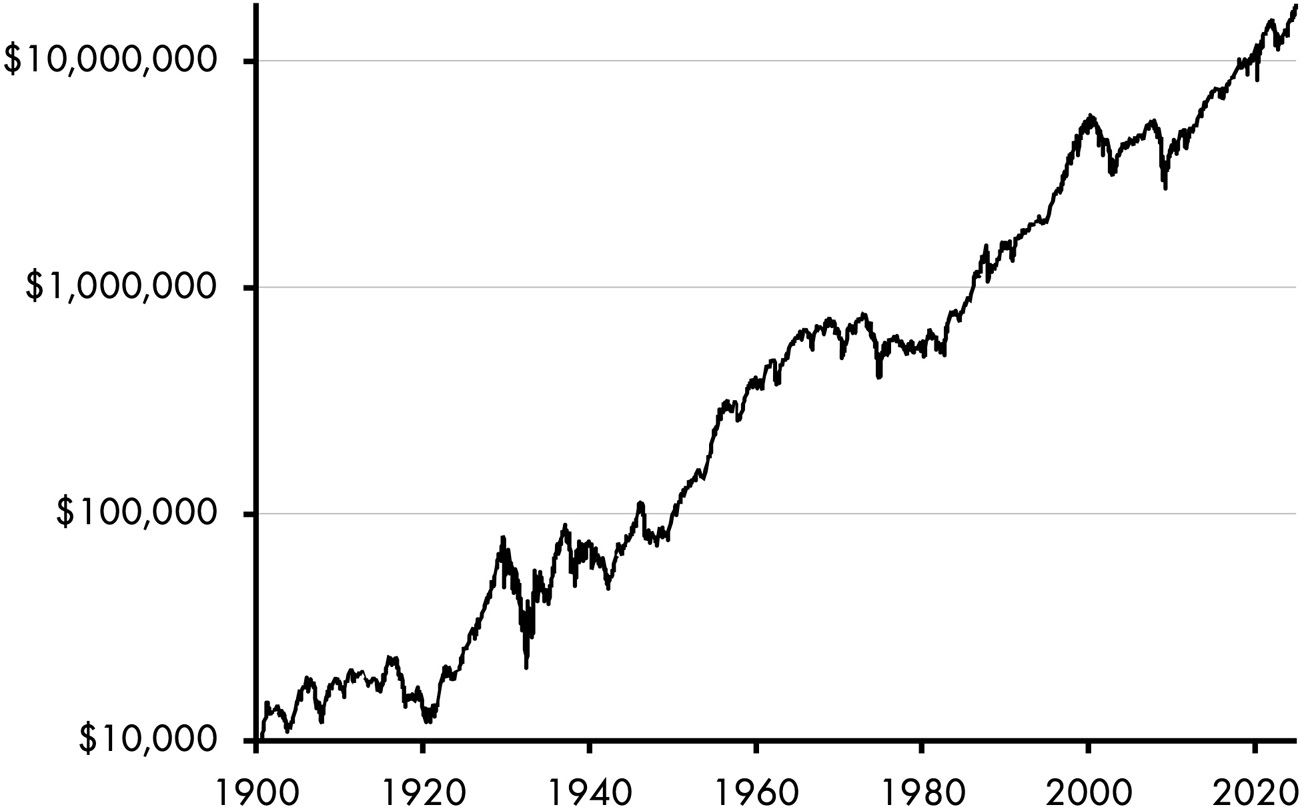
Table 1.1: Portfolio analysis (1900–present)
|
Buffett Portfolio |
US Stocks | |
|---|---|---|
Real Returns | 6.30% | 6.65% |
Volatility | 15.67% | 17.70% |
Sharpe Ratio | 0.44 | 0.44 |
Sortino Ratio | 0.62 | 0.62 |
Max Drawdown | –74.00% | −79.20% |
Max Drawdown (Post-1945) | –53.00 | −58.20% |
Ulcer Index | 19.12 | 21.84 |
Market Correlation | 0.90 | 1.00 |
Figure 1.4 provides perspective on how the drawdowns would have looked. As you can see, this one’s pretty volatile at times. None of this is terribly surprising considering the high allocation to stocks.
Figure 1.4: 90/10 stocks/T-bills drawdowns (%)
In terms of implementing and maintaining such a strategy, you’d want to be hands-on with your cash and dollar cost average regularly into the 90% stock component. You might also benefit from the optionality of investing larger sums during market downturns – for example, trying to be systematically more aggressive whenever the stock market declines 20% from a previous high. Although Buffett is not a big market timer, he is notoriously greedy when others are fearful.
If you are the aggressive and adventurous type you could try adding a bit of leverage to the portfolio through something like a leveraged S&P 500 ETF. This would better replicate the leverage Berkshire has embedded in it, but this also accelerates the fee and risk profile.
If you wanted to replicate something more akin to the Buffett Partners approach, you might consider some private equity allocations. We’ll discuss this in more detail in Chapter 17, the Endowment Portfolio. It might be worth revisiting the Buffett Portfolio after you digest some of the later chapters to see how you can customize your own Buffett Portfolio.
BUFFETT PORTFOLIO PROS, CONS, AND LESSONS
All of this looks great with the benefit of hindsight, but let’s look at both sides of the coin here. After all, are we looking at a suitor who’s a suave 25-year-old or is this portfolio more reflective of the actual 90+-year-old who made it so famous?
First, let’s get the bad news out of the way:
- The Buffett Portfolio is roughly a 90/10 stock/T-bill allocation. This is a volatile portfolio that will test your patience.
- It’s hard to replicate the low-cost insurance leverage within Berkshire. Replicator portfolios are likely to incur higher financing costs. Any leverage utilized will exacerbate the behavioral risks of the already risky 90/10 allocation.
- The Berkshire of tomorrow is unlikely to look like the Berkshire of yesterday. After 50+ years of outstanding returns we have to consider that Berkshire is now so big that it will not grow at the same rate that it could when it was a smaller stock. If you’re choosing to own BRK you have to assess this risk.
- Owning the S&P 500 isn’t going to replicate Buffett’s actual returns and could leave you feeling dissatisfied with the results when compared to Buffett’s historical track record.
- Because this is a stock/bond-only portfolio with a heavy tilt on stocks, it will encounter periods where the portfolio isn’t significantly diversified across relative asset classes, especially considering it holds no alternative assets.
- Portfolio structure can have a big multiplier effect across tax and operational efficiency, especially when combined with an efficient, income-generating machine.
- This portfolio is super lean, tax and fee efficient, and can be replicated and maintained within a very clear process.
- A relatively simple factor-based methodology (such as value investing) is effective when adhered to over the long run and after reading Chapter 6 you might revisit the Buffett strategy to consider how the S&P 500 could be tilted to certain factors more consistent with a Buffett stock-picking approach and Frazzini’s research.
- This is a reliable long-term return generator given the broad diversification.
- The T-bill component not only gives you optionality but could serve as a decent behavioral buffer at times when the 90% stock piece is very volatile.
In short, lots of good and some bad.
But who is this portfolio good for?
SUITORS FOR THE BUFFETT PORTFOLIO
The Buffett Portfolio, no matter how you implement it, looks like a good potential suitor, but we do have to be careful about extrapolating past returns into the future. This is especially pertinent given the key man risk in this specific entity if you choose to use the pure Berkshire option.
Further, it’s worth noting that one of Buffett’s main strengths is that he doesn’t need a lot of money. Buffett lives in the same house he bought in 1958. He doesn’t live extravagantly and so his liabilities are extremely low relative to his income and assets. This is crucial because it allows him to be extremely aggressive without needing consistent cash flow to fund his short-term expenses. This is another Buffett superpower – he doesn’t need much and that gives him an extra amount of behavioral bandwidth in his portfolio.
No matter how you might implement the Buffett Portfolio, you have to be someone who has the same general attributes that made Buffett so successful. You have to be disciplined, patient, and behaviorally robust.
FINAL THOUGHTS
There are numerous useful lessons from understanding Warren Buffett’s approach:
- Cash flow fills your moat. Optimize your cash flows to feed your portfolio. Your portfolio should have what Warren Buffett refers to as a moat – a margin of safety around it that makes it invulnerable. But the way you fill that moat is by constantly replenishing it with new cash contributions to the plan.
- Infrastructure is your foundation. Use your available infrastructures to optimize for taxes and fees. While Buffett leverages a corporate insurance structure, the rest of us can optimize via the use of tax-deferred accounts, corporations, trusts, and other account types to optimize for taxes and cash flows.
- Patience and discipline. Create a plan that adheres to long-term principles while also taking advantage of some short-term volatility.
Wait a minute now. We went all the way to 90% stocks with the Buffett Portfolio. Why not just go all-in and implement a 100% Stock Portfolio? If that’s what you’re thinking, then keep going. That’s our next suitor.