The Portfolios
Chapter 9
The Permanent Portfolio
RAY DALIO wasn’t the only investor whose views were transformed by the Nixon Shock. Around this time, an investment advisor named Harry Browne began advocating for broad diversification beyond equities and fixed income to combat what he believed would be a period of widespread currency devaluation due to reckless government intervention in the economy.
While Dalio concluded that he needed more balance across his portfolios, Browne advocated for a portfolio that was “fail safe.”
Harry Browne was a Libertarian and was one of the party’s most vocal advocates for many decades. During this time, he used his financial expertise and skepticism of government to advocate for “fail-safe investing.” Browne’s theory was that investors needed broad diversification to protect them from all types of potential economic outcomes.
While Risk Parity tries to create balance across the risks inherent in the specific instruments you hold, the fail-safe approach focuses on balancing risk across economic environments. Browne’s general thinking was that the economy cycles through four consistent types of environments, expansion, recession, inflation, and deflation, as seen in Figure 9.1:
Figure 9.1: The four quadrants of the economic cycle
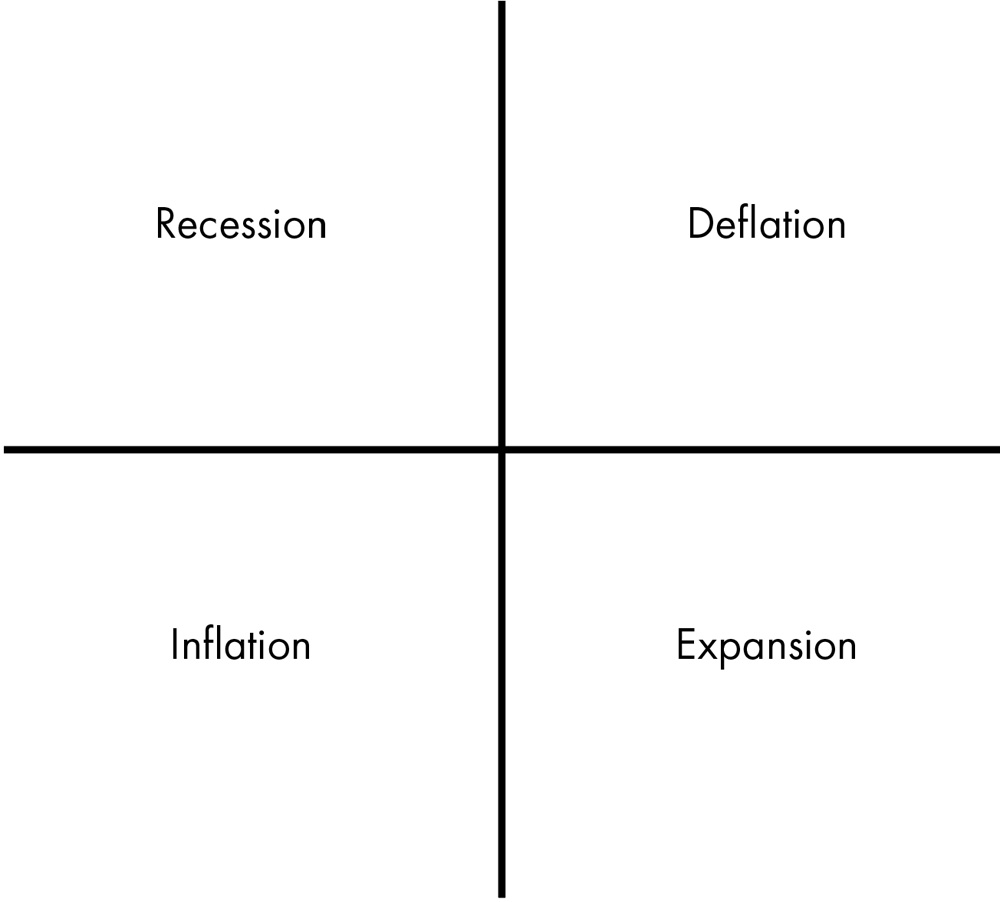
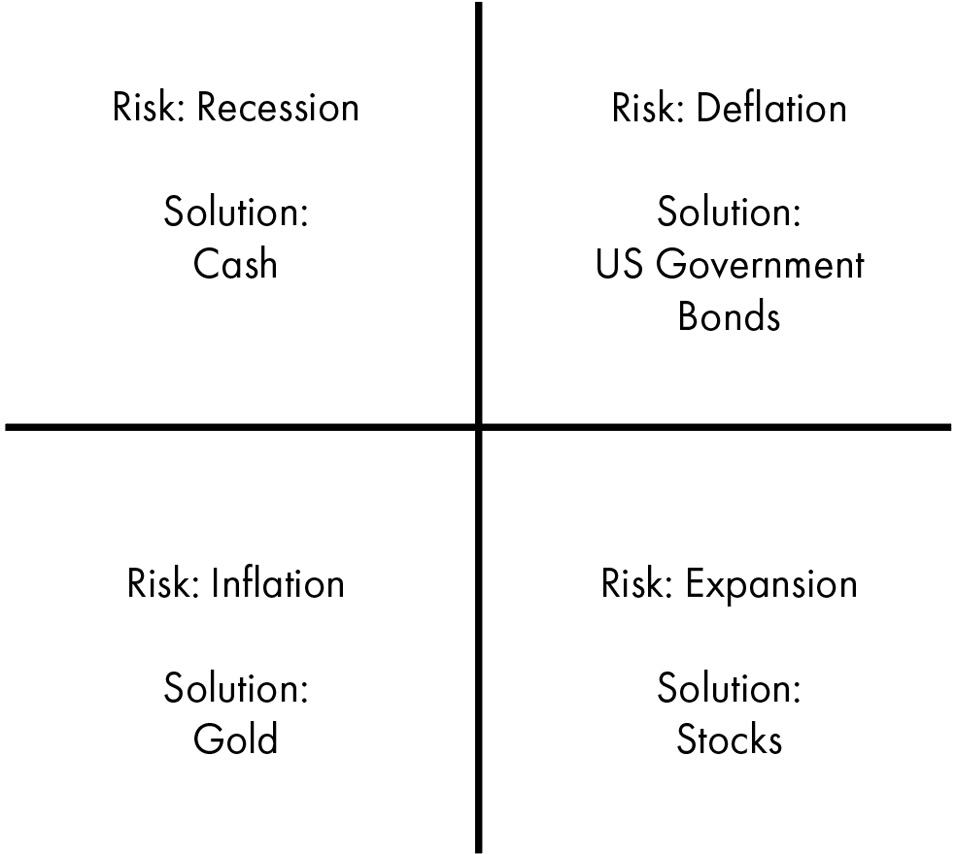
Browne argued that you can protect against these environments using four simple instruments that provide permanent protection if held for the long run:
- Stocks protect you in an expansion.
- Cash protects you in a recession.
- Gold protects you in an inflation.
- US government bonds protect you in a deflation.
This portfolio has some similarities to the Dalio methodology, but it’s far simpler under the hood. You don’t need to measure the expected volatility of assets or rebalance them based on volatility contribution and environment. You just need to hold four equal slices of four assets across all time horizons. But does this work and why?
Let’s dig deeper.
WHY THE PERMANENT PORTFOLIO WORKS
The Permanent Portfolio is a clever concept that allocates assets to specific buckets to help insulate you from specific economic environments. The reason the portfolio works is because the economy is consistently turbulent. Expansion, recession, inflation, and deflation are recurring conditions throughout history.
A more in-depth analysis of economic cycles reveals something interesting though. Expansion and inflation are far more common than recession and deflation, but recession and deflation have significant asymmetric impacts on our financial lives. In other words, while economic expansion and inflation are the norm, recession and deflation have acute and devasting consequences when they do occur.
You might think of recession or deflation protection as being similar to insurance. You don’t buy life insurance because you expect to die tomorrow. You buy life insurance because death, while unlikely at any given time, would have devastating financial consequences for those who depend on you. Similarly, protecting your portfolio from rare but harmful economic shocks is about preparing for the unexpected, not predicting it.
Figure 9.2, which shows the year-over-year percentage change in GDP, illustrates that while the economy tends to grow steadily over the long term (as evidenced by mostly positive figures in the chart) short-term growth rates can be quite volatile.
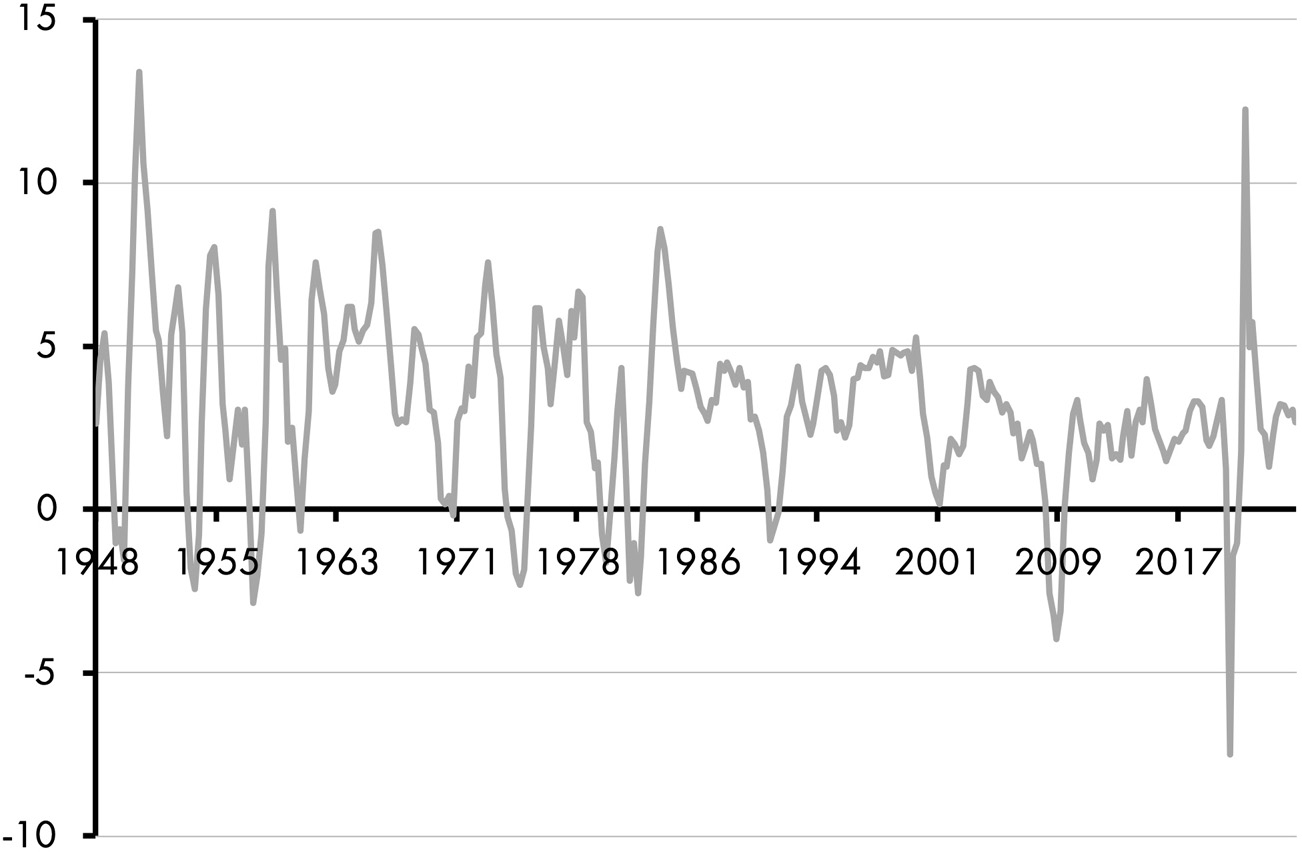
Over the long term, the economy can feel like a smooth upward ride. But in the short term, the economy often feels more turbulent as we cycle through periods of expansion and contraction.
Why do certain assets protect us in these specific environments though? Let’s look at the four holdings of the Permanent Portfolio in turn.
- Stocks tend to rise in the long run because corporate profits and earnings generally grow over time. This is your expansion allocation. As the economy does well, we should expect corporate profits to expand and value to accrue to stocks over time.
- Cash (T-Bill and Chill) helps diversify a portfolio by adding a nominally stable income-generating asset to a portfolio. It protects against recession because it gives you nominal principal certainty when the world becomes uncertain.
- Gold tends to rise in the long run because it is an industrial commodity used in many goods inputs. It is also viewed by many as a form of money and is therefore widely held by central banks and investors who view it as a monetary inflation hedge. This protects us from inflation because it’s both viewed as a monetary alternative to fiat currencies and because it has embedded real economic utility.
- US government bonds are similar to cash in that they add a safe income-generating diversifier with minimal credit risk. Long-term Treasury bonds are useful at times as they have a high degree of interest rate sensitivity and during a deflation, when interest rates are most likely to decline, they can appreciate significantly in value.
FUN SIDE NOTE
US government bonds are the ultimate safe haven because they’re the instrument issued by the largest income-generating entity in human history, the US government. These bonds are ultimately supported by the income stream of US corporations and individual taxpayers. As long as the US government doesn’t print so much money that it causes runaway inflation, the underlying productive capacity of the US private sector will continue to drive sufficient income to the US government, which makes its liabilities extremely safe, especially during deflationary shocks.
Importantly, as we touched on in Chapter 7, the US is likely to lose some of its relative reserve currency status in the coming 50 years, but for now this position is unmatched. If you want to say that all fiat currencies are dirty shirts then the US dollar is the cleanest dirty shirt by a large margin.
So, the Permanent Portfolio isn’t just based on sound economic reasoning, but there are sound fundamental reasons why the actual asset classes make sense as well.
BUILDING YOUR OWN PERMANENT PORTFOLIO
There’s a well-known mutual fund that adheres to the principles of the Permanent Portfolio and adds a bit of extra diversification. You’ll be shocked to learn that the fund is called the Permanent Portfolio Fund (ticker: PRPFX).
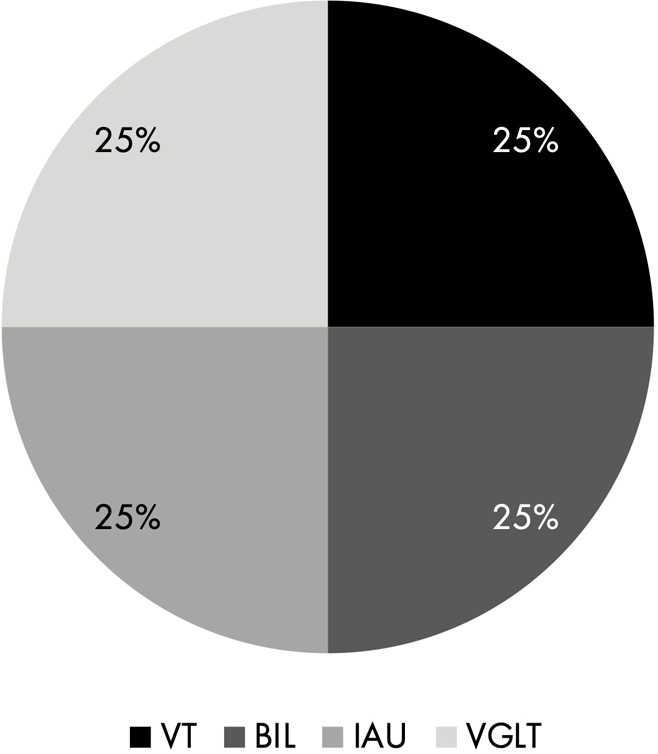
If you wanted to own a lower-fee version of this portfolio you could also construct it using low-cost ETFs. For example, you could adopt the pure Harry Browne allocation, as shown in Figure 9.3:
- 25% VT (Vanguard Total World) or VTI (Vanguard Total US Stocks)
- 25% BIL (SPDR T-Bill ETF)
- 25% IAU (iShares Gold ETF)
- 25% VGLT (Vanguard Long-Term T-Bond ETF)
Figure 9.3: The simple four-fund Permanent Portfolio
As it pertains to the four quadrants of risk, here’s how that looks in Figure 9.4:
Figure 9.4: The four quadrants of the economic cycle with their corresponding assets
There it is. Nice and clean.
Now let’s look under the hood and at the quant analysis.
PERMANENT PORTFOLIO ANALYSIS
The Permanent Portfolio analysis can only go back to 1970 because the price of gold was pegged in dollar terms before then. But even that historical view gives us a pretty good understanding of the portfolio because it includes the high inflation of the 1970s, the growth boom of the 1980s and 1990s, the tech and financial booms and busts, and the low inflation of the 2010s.
Overall, this portfolio performs well with real annual returns of 4.65% and volatility of 8.58%. Global equities returned 5.60% per year with 16.42% volatility over the same period. On a risk-adjusted basis, the Harry Browne Permanent Portfolio generates a 0.48 Sharpe and 0.93 Sortino ratio, good for a significant outperformance versus the broader global stock market, which had a Sharpe ratio of 0.37 and Sortino ratio of 0.52 over the same period.
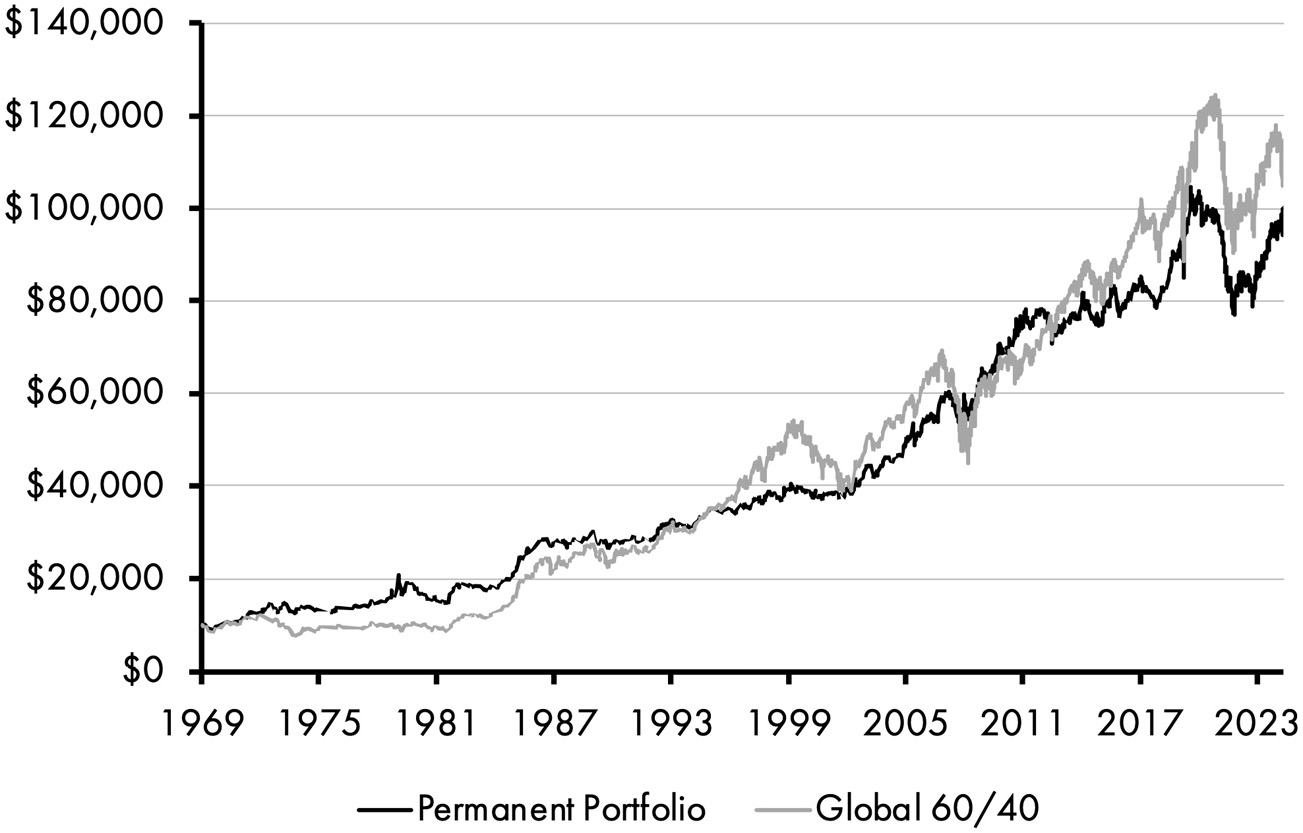
It’s worth noting that stocks aren’t necessarily a fair benchmark here, but I am using them to reiterate just how strong the diversification is in the Permanent Portfolio. When compared to a global 60/40 Portfolio over the same period, the Permanent Portfolio looks even stronger with returns of 4.23% versus 4.51% for the 60/40 Portfolio, a Sharpe ratio of 0.52 versus 0.45, and Sortino ratio of 0.76 versus 0.63. So, this one beats global equities as well as a 60/40 mix on a risk-adjusted basis by a healthy margin.
Figure 9.5 shows a lower return, but much smoother ride across time for the Permanent Portfolio.
Figure 9.5: Permanent Portfolio performance
|
PP |
Global 60/40 | |
|---|---|---|
Real Returns | 4.23% | 4.51% |
Volatility | 7.32% | 9.64% |
Sharpe Ratio | 0.52 | 0.45 |
Sortino Ratio | 0.76 | 0.63 |
Max Drawdown | −31.81% | −38.51% |
Ulcer Index | 8.26 | 12.33 |
Market Correlation | 0.18 | 0.46 |
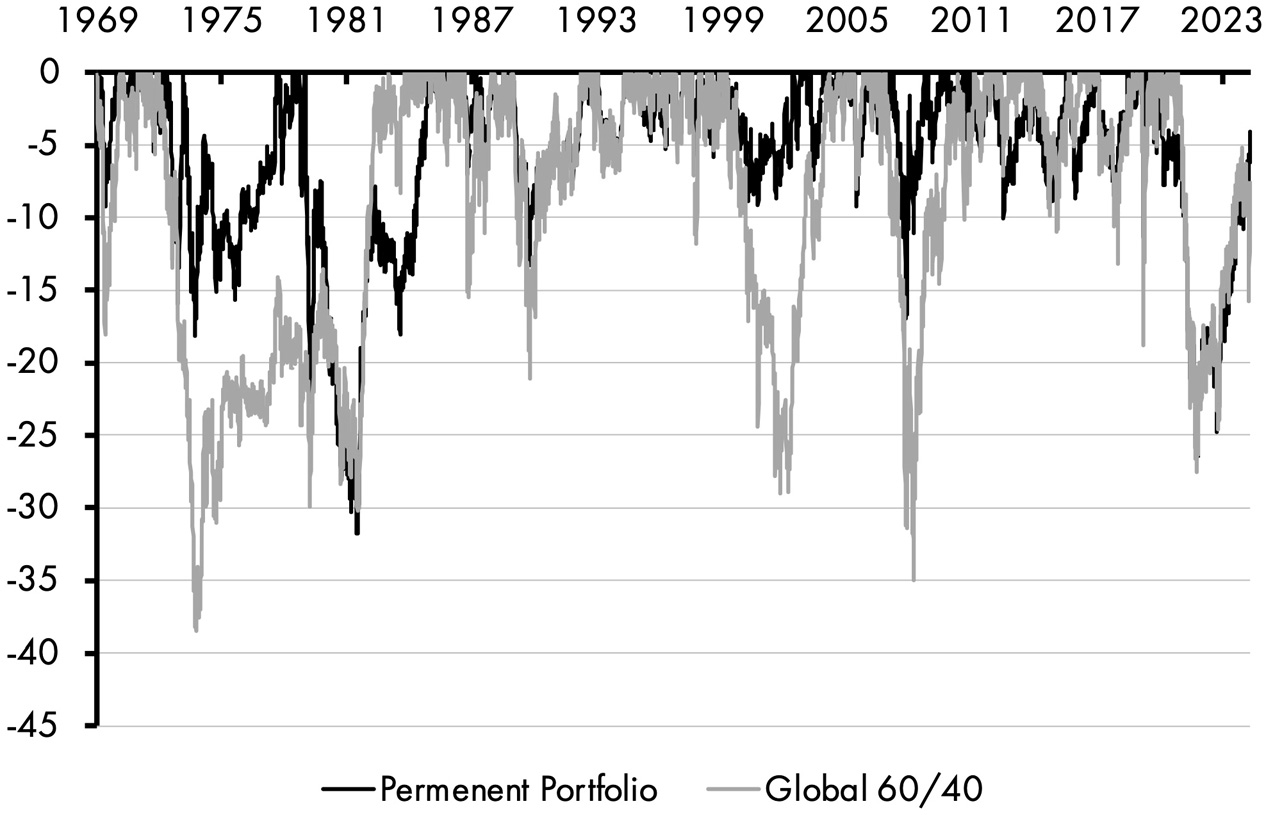
The portfolio’s drawdowns are driven by extreme moves in stocks, gold, and T-bonds, but the inclusion of cash and its general diversification makes its drawdowns less severe on average than that of the global 60/40 Portfolio, as seen in Figure 9.6. The Ulcer Index of 8.26 is moderately high, but not as high as 60/40 on average. And with a correlation of just 0.18 you’ve got an asset allocation that will consistently look different from your traditional 60/40 or pure stock portfolio.
Figure 9.6: Permanent Portfolio drawdowns (%)
PERMANENT PORTFOLIO PROS AND CONS
This one’s interesting, huh? There’s a logic to the underlying portfolio theory that is intriguing, and you don’t get bogged down in some of the complexities of other all-weather approaches. The risk-adjusted outperformance is especially interesting given the simplicity of the allocation and the uncorrelated returns.
But what about the pros and the cons? Let’s take a closer look. First, the bad news:
- There’s something elegant about the simplicity of the four-quadrant approach and its straightforward 25% allocations. But its basic approach might strike some investors as being too simplistic.
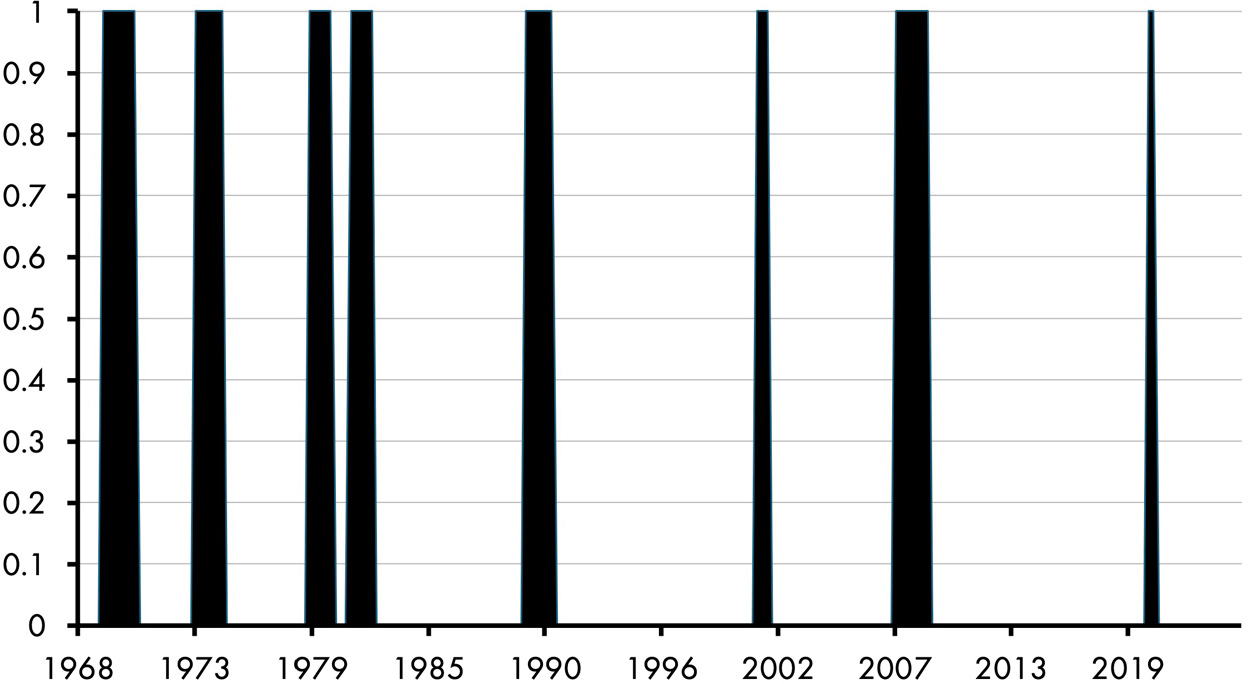
- The insurance components in this portfolio could be overkill. For example, while recessions can be devastating, they are also somewhat rare as evidenced by the fact that the US economy has been expanding 82% of the time over the last 50 years (see Figure 9.7 below). Recessions are not the norm. Deflationary recessions are even more unusual, and we’ve only experienced one meaningful deflationary recession (the GFC) in the last 50 years.
Figure 9.7: US economic recessions
- The most glaring weakness of the Permanent Portfolio is the small equity allocation of just 25%. You can argue that most investors should have a larger stock allocation since equities are likely to be among the highest expected return instruments we can own.
- While gold has industrial uses that make it a relatively good inflation hedge, much of its value rests on the belief that it will continue to serve as a monetary hedge. I often note that gold has an embedded “faith put” in its price. That is, people buy it because they believe it’s the ultimate form of sound money. But what if that perception changed? What if, for instance, Bitcoin completely replaced gold as the go-to store of value? In that scenario, gold might behave more like a typical commodity and lose much of its demand as a hedge against fiat currency. Is that likely? I don’t know. But it’s difficult to argue that this perception will persist forever based on hard evidence alone. As often noted, much of gold’s monetary role depends on the assumption that because it’s been seen as money in the past, it always will be.*
- The portfolio’s cash allocation is large and subject to persistent 0% or negative real return over time. Don’t get me wrong – I like having a T-Bill and Chill component in a portfolio. But how much chilling does a person really need? A 25% cash allocation might be a bit too much relaxation.
- The T-bond position is the highest duration bond instrument most investors will own. It will not beat cash by a large margin across most market cycles, but it will be significantly more volatile. Further, deflations are exceptionally unusual although generally devastating. T-bonds are an excellent hedge against deflation, but if deflation only occurs 1–5% of the time, does it really make sense to maintain a permanent 25% allocation as insurance for that scenario? Color me skeptical.
Alright, let’s not be so critical. What about the pros?
- The portfolio is diversified and can be implemented in a simple, low-cost and tax-efficient manner.
- The portfolio is likely to be a good behavioral hedge as the allocation rationale is logical and intuitive.
- This is a true one-stop-shop portfolio. It has bits of insurance, growth and liquidity. You can argue with the specific allocations and weightings, but it does meet almost all the needs an asset allocator might have over time. In theory, these four allocations could be enough to comprise an entire portfolio.
SUITORS FOR THE PERMANENT PORTFOLIO
This portfolio is best suited for investors who want the benefits of broad, multi-asset diversification in a simple, easy-to-follow structure.
To stick with it, you need to have an unwavering faith in gold as an asset class. And you also need to understand that the small equity component could leave you underexposed to cash-flow-generating, inflation-hedged instruments. Oh, and you need to be really comfortable with long-term US Treasury bonds, which have historically performed as a low return and very high volatility instrument.
As Harry Browne envisioned, this portfolio embraces a fail-safe approach – one that likely prioritizes downside protection more than most investors typically need. This is, in some ways, a doomsday bunker portfolio that has such a large insurance component that you are happy forgoing significant growth because you have a more resilient portfolio during downturns.
Perhaps most importantly, you need to really buy into the permanency of the allocation. These are volatile assets that won’t always be exposed to the environments you’re using them to protect you against. You cannot expect them all to be operating well at the same time. And that’s the point. This portfolio works precisely because its four parts behave differently. To benefit, you need to be exceptionally patient and committed to its long-term strategy.
FINAL THOUGHTS
A Permanent Portfolio for all seasons sounds nice.
But what if you wanted something a little more customized for a situation that requires a high level of liquidity with the potential for high growth? You might want a portfolio that is not quite so permanent, but specifically structured across two distinctly different time horizons.
Well, let me introduce you to the Flying Ladder Portfolio. It has an awesome name which is derived from an even better story and we all know that your portfolio needs to have a cool name, so keep reading.